BARCELONA, SPAIN · RESTAURANT · 8 MIN READ
Alkimia: One Star, One Bell, and the Best Rice in Barcelona
Upstairs in an old brewery, behind a door you have to ring for, Jordi Vilà has spent twenty years not chasing a second star. The rice alone justifies the stairs.
By J.C. Mercer
- Covers Two, 8.30pm
- Dined April 2026
- Menu La Taula de Cuina Catalana, the dining room’s tasting menu
- Drinks By the glass, poured against the courses
- How it was booked Direct with the restaurant
Every meal on this site is booked the way any other guest would book it.
Alkimia is on the first floor of a brewery, and there is a bell. You press it from the landing of the Fàbrica Moritz, the old Moritz beer works on Ronda Sant Antoni, and someone comes. Michelin’s own entry calls the location “somewhat surprising,” which is the guide being polite about the fact that nothing at street level tells you a one-star restaurant is upstairs. Jordi Vilà and Sònia Profitós opened Alkimia in 2002 in the Eixample and ran it there for fourteen years. They moved it here in 2016, into what had been the Moritz family’s own apartment.
Behind the bell there are two restaurants, and this is the thing to get right before you book. One is Alkostat, the bistro. The other is Alkimia proper, the dining room with the star. They share an address, a floor and a kitchen, and they are not the same evening. I ate in the dining room.
| Alkimia | Alkostat | |
|---|---|---|
| What it is | The dining room, and the one with the star | The bistro, same floor, same kitchen |
| What you order | La Taula de Cuina Catalana, the tasting menu, six sections | À la carte, shorter, less formal |
| Book it as | “Alkimia, the dining room, tasting menu” | “Alkostat” |
| The mistake | Booking one and expecting the other. They share an address, a landing and a bell, and the confirmation email does not always make the difference obvious | |
The distinction matters more than it sounds. I watched a couple arrive just behind me, give the name at the top of the stairs, and be walked to the other room, perfectly happy as far as I could tell, but not eating the menu they had read about. Whatever brought you up the stairs, name it when you write.
The room, and what it used to be
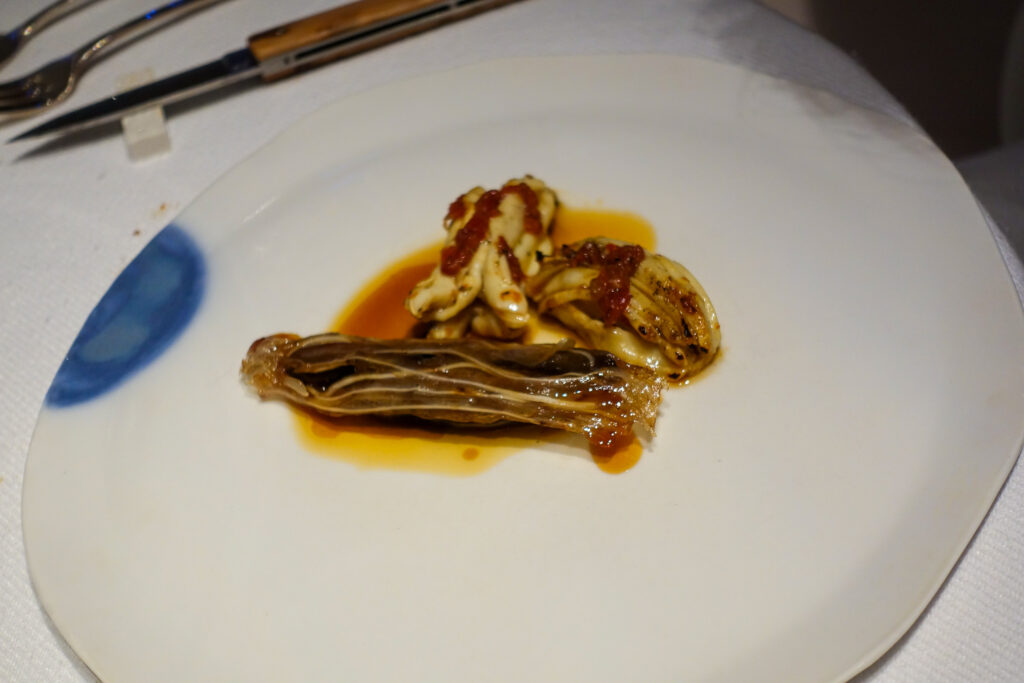
You can still read the apartment in it. High ceilings, tall windows onto the ronda, the proportions of a family that could afford the good floor of their own factory. Principal, in the Barcelona way of numbering, is the grand one just above the street. The tables are round and dressed in heavy white cloth. The cutlery is horn-handled. There is a blue brushstroke glazed onto the rim of several of the plates, the same mark on the fish course and on the squid, so it reads as the house pattern rather than decoration for one dish.
The lighting is low and, at the far end, faintly blue. There is a lit panel somewhere behind the last table that turns up in the corner of photographs. It is the only thing in the room that feels like 2016 rather than 1902.
One menu, six movements
The dining room runs a single tasting menu, La Taula de Cuina Catalana, the Catalan cuisine table, and the kitchen sets it out in six sections rather than as a numbered run of courses. There is an à la carte list, La Carta de Jordi Vilà, and a shorter midday menu, La Taula del Migdia. Ordering the tasting menu is the point of coming, and it is the version the room is built around.
The food is Catalan and it is mostly from the sea. Vilà has a reputation among cooks as a chef’s chef. He does not do television and he does not do the circuit, and what that means in practice is a menu with very little decoration on it. Things are cooked hard, seasoned assertively, and sent out.
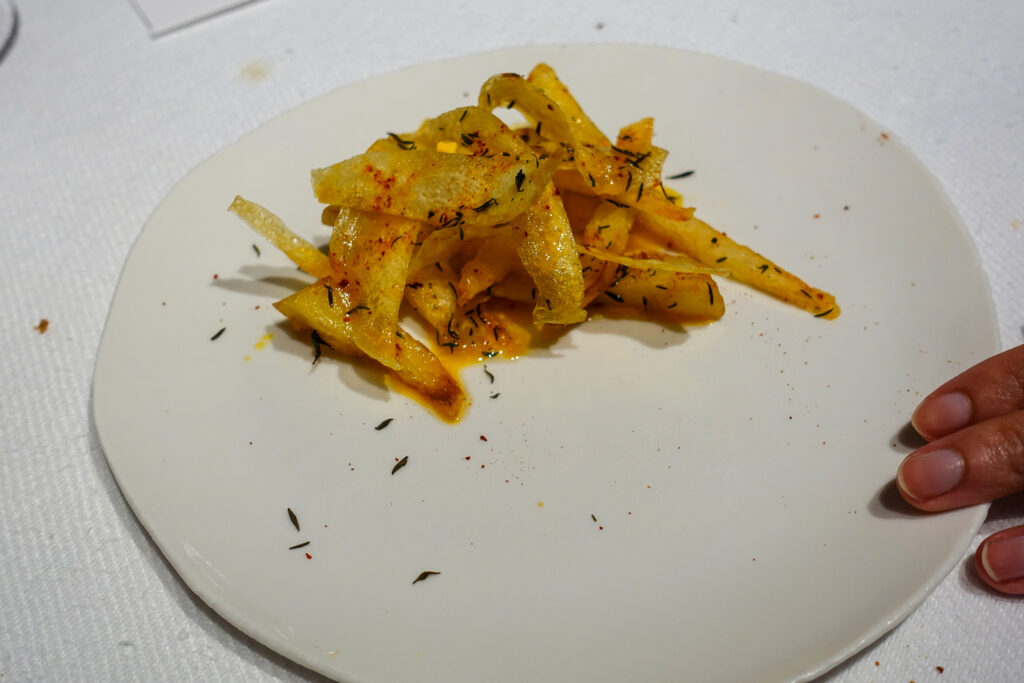
It opens light and salty. Ribbons of potato fried until they buckle, thyme, enough paprika to leave dust on the plate. You eat them with your hands. It is the least serious thing served all night and it sets the level for everything after: this is a kitchen that is not going to be precious with you.
The rice, which is the reason to come
Vilà’s rice is the dish people travel for. The house signature is the arròs de colom, rice with squab and truffle; what arrived on my menu was the sea version, and I would not trade it. Rice cooked loose and wet rather than dry, the grains still holding, a slick of dark shellfish stock around the edge of the plate, and a piece of red mullet laid over the top with the skin left crisp and the stripe still showing. Beside it, a lace of something fried into a crisp golden net: brittle, faintly sweet, there to be broken into the rice.
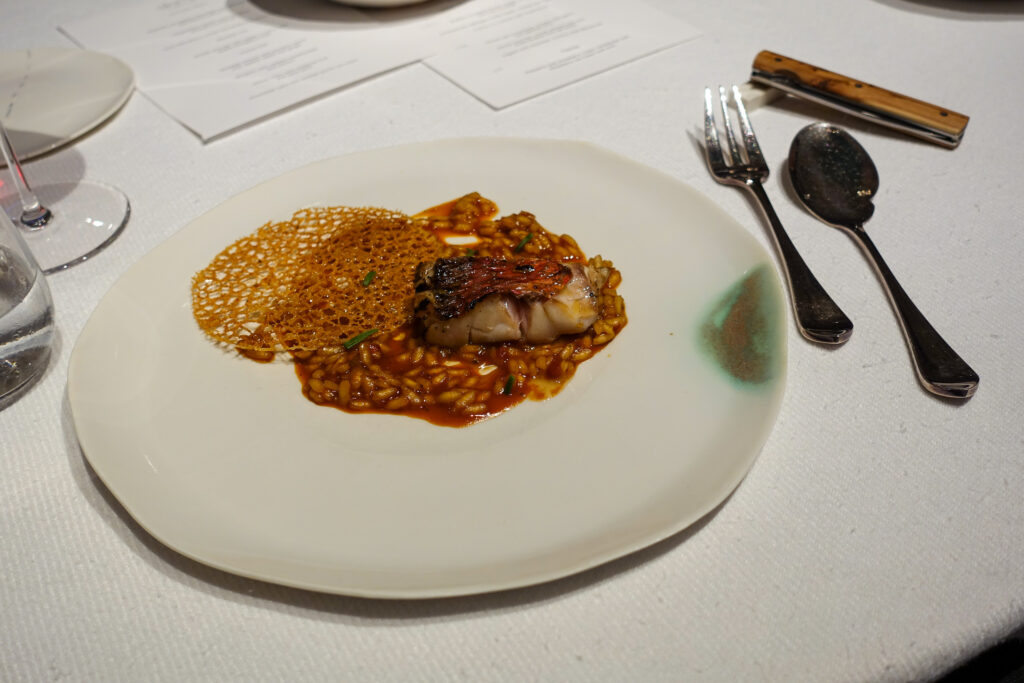
I have eaten a lot of rice in this city and most of it is drier than this, cooked down until the grains separate and the pan leaves a crust. Vilà goes the other way. The rice arrives still moving on the plate, and by the time you have worked from the edge to the middle it has tightened into something else entirely. The same dish twice, in one sitting. This is the course that explains the star. It is not clever, and it is not trying to be. It is a rice dish cooked by someone who has cooked several thousand of them, and the seasoning is a full step louder than a cautious kitchen would dare.
You are given a printed menu on the table and it stays there through the meal. It is a small thing and I liked it. You can look down and see where you are, rather than reconstructing the evening afterwards from memory.
The fish course
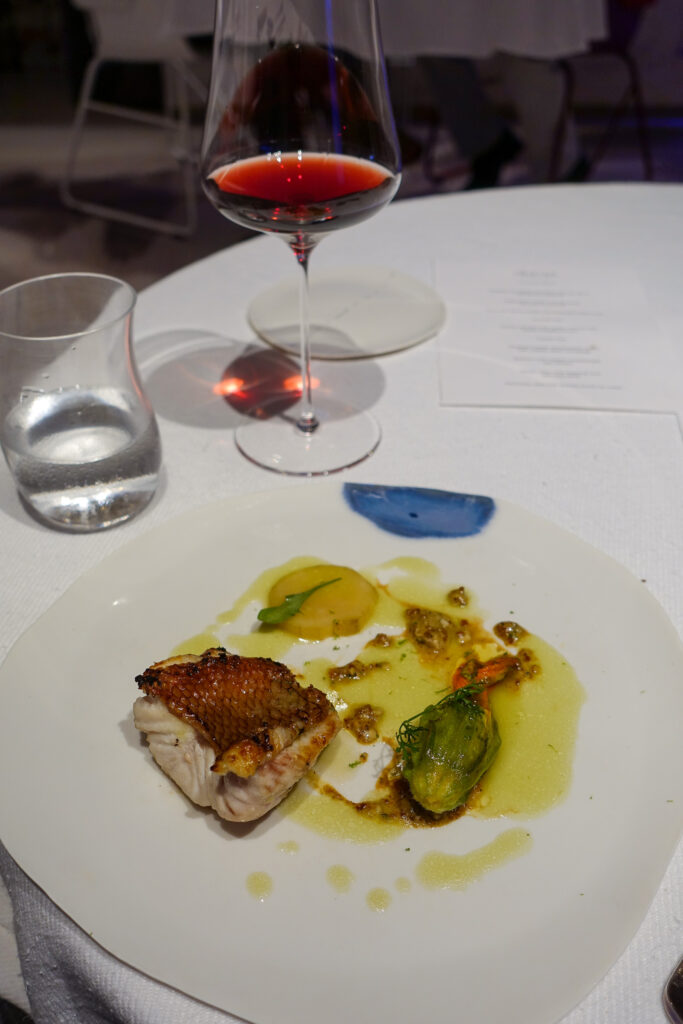
Mullet a second time, deliberately: crisp skin, an egg yolk broken into a green oil sharp with herbs, an artichoke heart, a scatter of something crushed and savoury. The yolk and the oil make a sauce on the plate as you eat, which is the whole idea, and the artichoke is there to stop it becoming rich.
They poured a red against it. I would not have chosen red with mullet and I was wrong; it is a light one, cold enough to be surprising, and it holds up against the herb oil in a way a white would have surrendered to.
The seasoning here is a full step louder than a cautious kitchen would dare. That is the argument for the place.
Dessert, and the neon
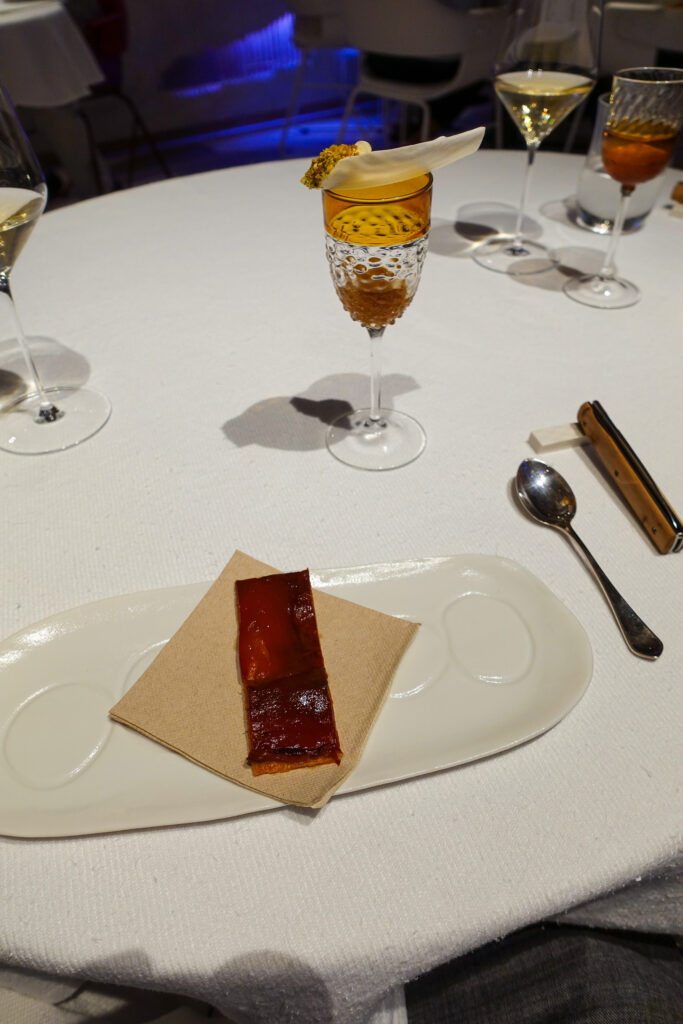
Dessert arrives in a cut-crystal glass that looks inherited, filled with a sharp orange fruit mousse and capped with a crisp. Alongside, on a folded paper napkin, a rectangular tile of dark red fruit set firm enough to pick up. The napkin is not an affectation; the tile is sticky and you need it.
The chocolate-and-olive-oil dessert the restaurant is known for did not appear on my menu. If you want it, ask when you book rather than on the night.
The counter-argument
Two things, and neither is the food.
The first is the room. It is handsome and it is quiet and it is also, on a full night, quite hard to hear across. The ceilings that make it beautiful send everything upward, and by the middle of the meal I was leaning in. If you are coming to talk, take a table away from the centre.
The second is the bell. Not the bell itself, which is charming, but what it stands for. Nothing about arriving here is smooth in the way a hotel dining room is smooth. You find the factory, you find the stairs, you press the bell, you wait. On a wet night with a booking you are late for, it is a lot of friction for a restaurant at this level, and it is worth building ten minutes in for it.
What is not a fair complaint: the star. Alkimia has held one for a very long time, and the restaurant says twenty consecutive years. There is a school of thought that it should have a second by now. Having eaten it, I think one is right, and I do not mean that as a criticism. This is a restaurant that decided what it was and stopped negotiating.
Know before you go
Book direct. The dining room and Alkostat take separate reservations and it is entirely possible to end up in the wrong one, so say Alkimia, and say the tasting menu, when you write.
It is upstairs in the Fàbrica Moritz on Ronda Sant Antoni 41, the principal floor. Ring the bell. There is a private room at the front, Aldavant, if you are a group.
Lunch is a different, shorter menu. If you only have one meal in Barcelona, make it dinner in the dining room.
See the full set: Alkimia, Barcelona — in frames.
A kitchen that decided what it was and stopped negotiating. Order the rice.
The Alkimia gallery
Every photo on this site is my own, shot on the night. Slide through →