ISTANBUL, TÜRKİYE · RESTAURANT · 8 MIN READ
Galeyan: The Menu Tells You What Month It Is
An Anatolian kitchen beside Hagia Sophia that prints the months against its kebabs, opens at nine in the morning, and publishes not so much as a menu.
By J.C. Mercer
- Covers Two, on the terrace
- Menu À la carte: mezes, bread and grills, not the tasting menu
- Drinks No pairing is offered
- How it was booked The way any other guest would
Every meal on this site is booked the way any other guest would book it.
Galeyan stands on Ticarethane Sokak, a narrow lane in Sultanahmet lined end to end with restaurants, inside Sura Design Hotels & Suites and a short walk from Hagia Sophia. That address usually tells you what to expect: laminated photographs of the food, a man outside with a clipboard, a kitchen built for people who are never coming back. Galeyan is on that street and is not that restaurant, and the evidence is its own menu, which runs to forty pages and prints the months beside several of its dishes.
The cooking is southeastern. Gaziantep and Antakya above all, with dishes from Kilis, Birecik, Siverek and Urfa scattered through the list, served in a hotel dining room in the most visited quarter of the city. This is not a reinterpretation of Anatolian food into something new; it is a regional recipe book, cooked straight. It holds one toque and 11.5 out of 20 from Gault&Millau Türkiye, entered in 2023. It is not in the MICHELIN Guide, which did not reach Istanbul at all until October 2022.
What it does not do is publish a menu. Not on its website, which is a single page; not on the menu it puts online, where the numerals are set in a font that will not read; not anywhere else, in any language. At the top end of a tourist quarter, that is worth knowing before you sit down.
A menu with the months printed on it
The printed menu was last revised in April 2026 and reprinted in July. Most of it is the standing list any good southeastern kitchen carries: mezes, kebabs, pilafs, a long breakfast, a short seafood section. Then, under headings for spring–summer and autumn–winter, individual dishes carry a service window. Not a vague note about seasonality. Months, against dishes.
The truffle kebab runs March to May, and the truffle in question is keme, the pale desert truffle that comes up out of the southeastern steppe after the spring rain and has nothing to do with the ones sold by the gram in Piedmont. The loquat kebab runs April to June, roughly as long as loquats are worth eating. Then tomato takes high summer, Birecik aubergine takes the autumn, and the onion kebab appears in November and again in February and at no point in between.
| Dish | On the menu | What it is |
|---|---|---|
| Keme kebabı | March to May | Kebab with keme, the southeastern desert truffle |
| Taze enginar | April to June | Fresh artichoke in olive oil |
| Yeni dünya kebabı | April to June | Loquat kebab |
| Taze fasulye | April to June | Green beans in olive oil |
| Domates kebabı | June to August | Tomato kebab |
| Şiveydiz çorbası | June and September | Meat, chickpea and fresh-garlic soup |
| Patlıcan kebabı | July to November | Aubergine kebab, made with Birecik aubergine |
| Soğan kebabı | November and February | Onion kebab, two months, not consecutive |
| Taze kereviz | November to February | Fresh celery in olive oil |
Read down that middle column and the year has a shape: truffle and artichoke in spring, loquat in early summer, tomato in the heat, aubergine through the autumn, onion and celery in the months when the southeast has always fallen back on onion and celery. A restaurant that only wanted to look seasonal would print the word and leave itself room. This one has committed to dates in ink, which means a good part of its own list is deliberately unavailable at any given time.
One caution, and it is the reason to telephone rather than assume: a printed window is a promise, not a service record. If you have picked your month for the keme kebab, ask when you book whether it is actually on.
What arrives first
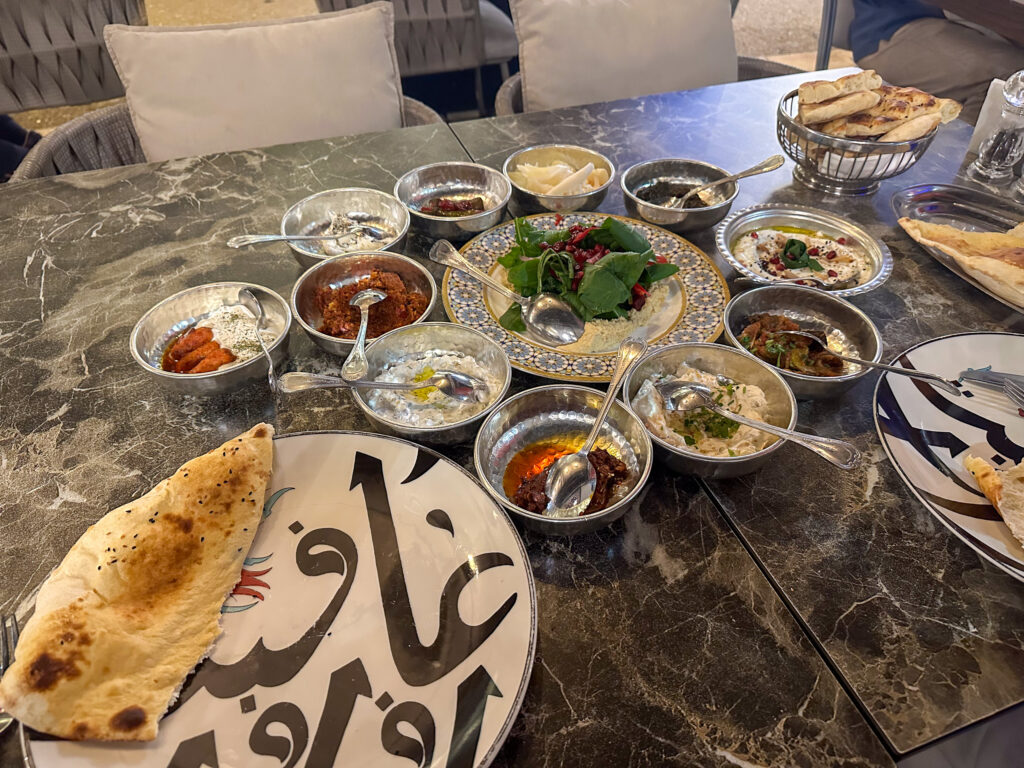
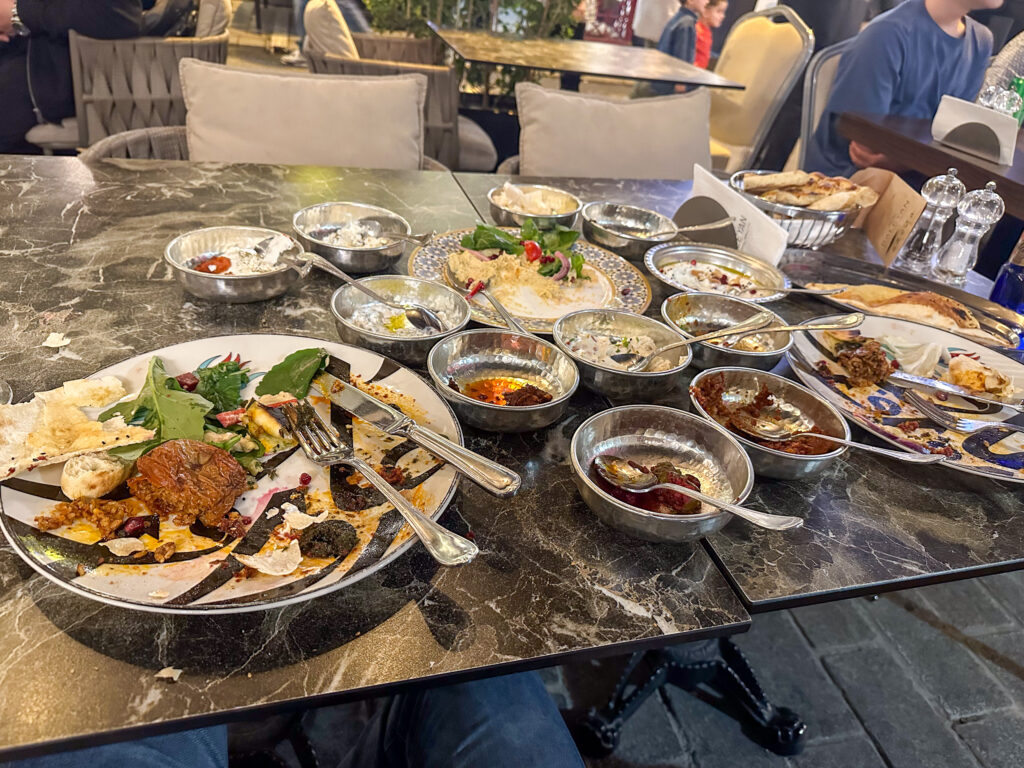
The meze arrive in hammered steel and copper bowls, ten or eleven at once, covering the table before anything else is decided: chilli paste slicked with oil, red pepper paste, cacık, a whitened aubergine purée, braised aubergine in tomato, thick yoghurt under dill. The bread is a long flatbread flecked with black sesame, folded once across a hand-painted plate, warm, and it keeps coming.
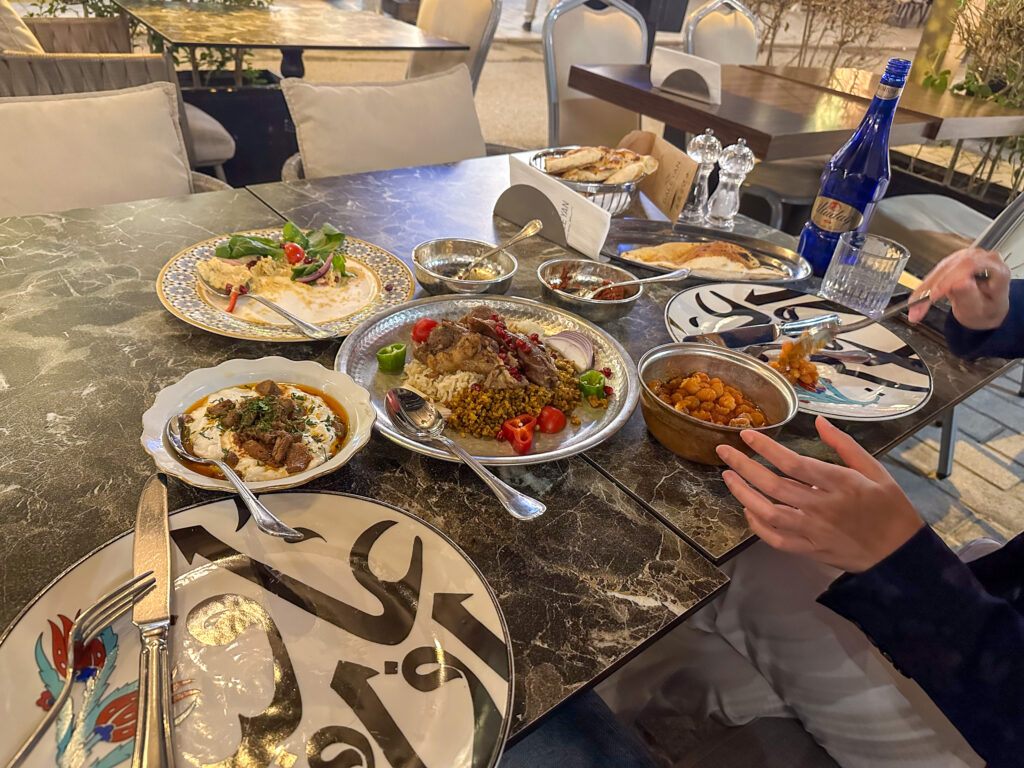
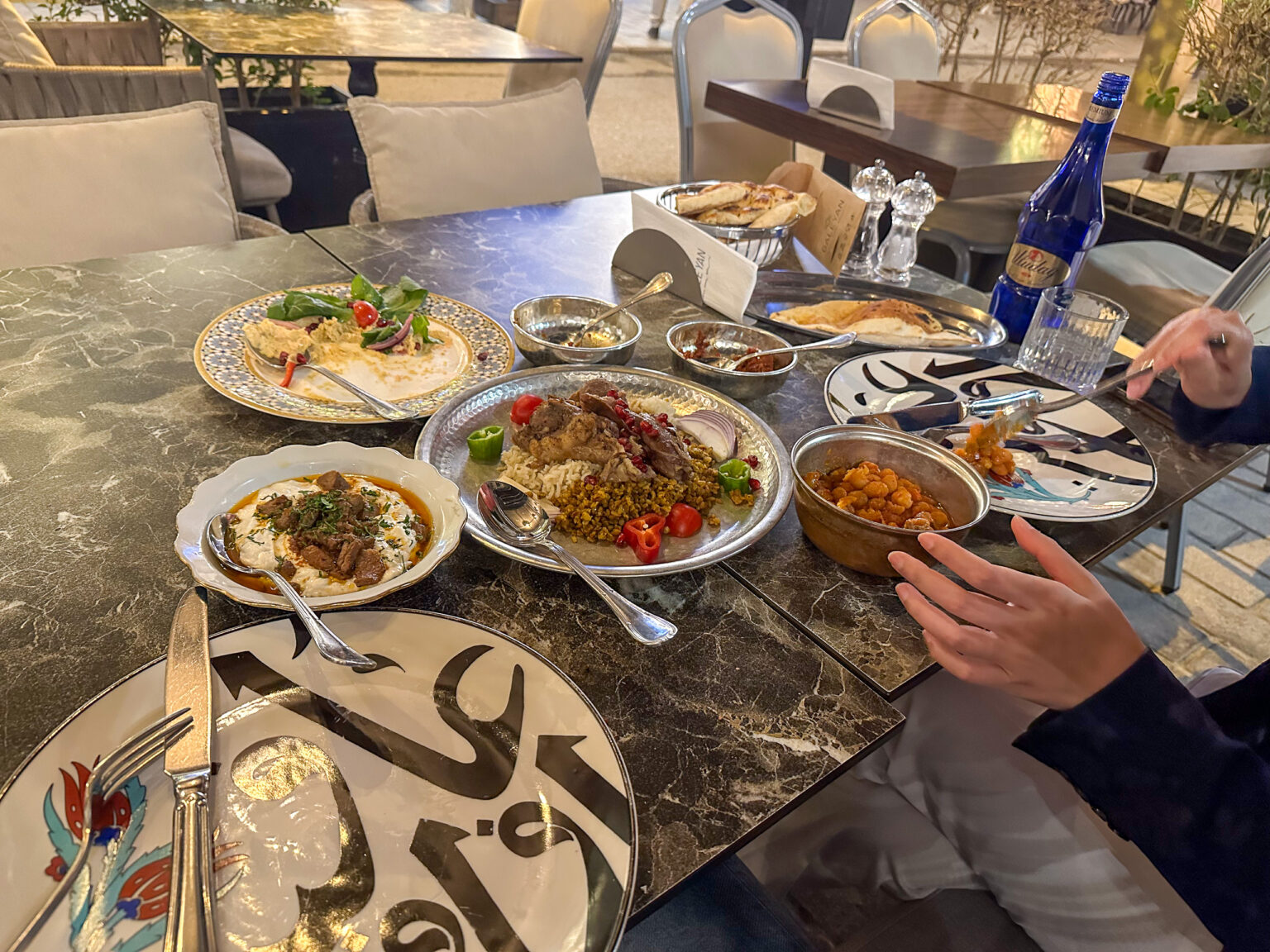
The dish at the centre is the one to order. The hummus here is not a dip: it is spread wide and flat across a blue-and-white tiled plate, dressed with oil, then heaped with leaves and pomegranate seeds so that you eat it in forkfuls rather than scoop at it. There is a version with pastırma over the top. It is the single dish this kitchen is most often named for, and the photograph explains why in a way the menu line does not.
Past the mezes the set pieces are the southeastern ones: içli köfte, semsek, testi kebabı sealed in clay and broken open at the table, ali nazik, hünkâr beğendi, firik pilavı made with green freekeh. The grills arrive on a wide steel platter over rice and freekeh with a charred green pepper, a tomato, sumac onion and pomegranate, a format anyone who has eaten in Antep will recognise on sight.
A terrace on a restaurant street
Every photograph I came away with is of the terrace, so that is what I can describe. It runs along the front of the hotel under a fixed canopy, heaters slung from the frame and lights strung through it, which makes it usable in a cold Istanbul spring. The tables are dark green-black marble, square and slightly too small once eleven bowls are down; the chairs are woven rattan with heavy white cushions, closer to a hotel lounge than a lokanta.
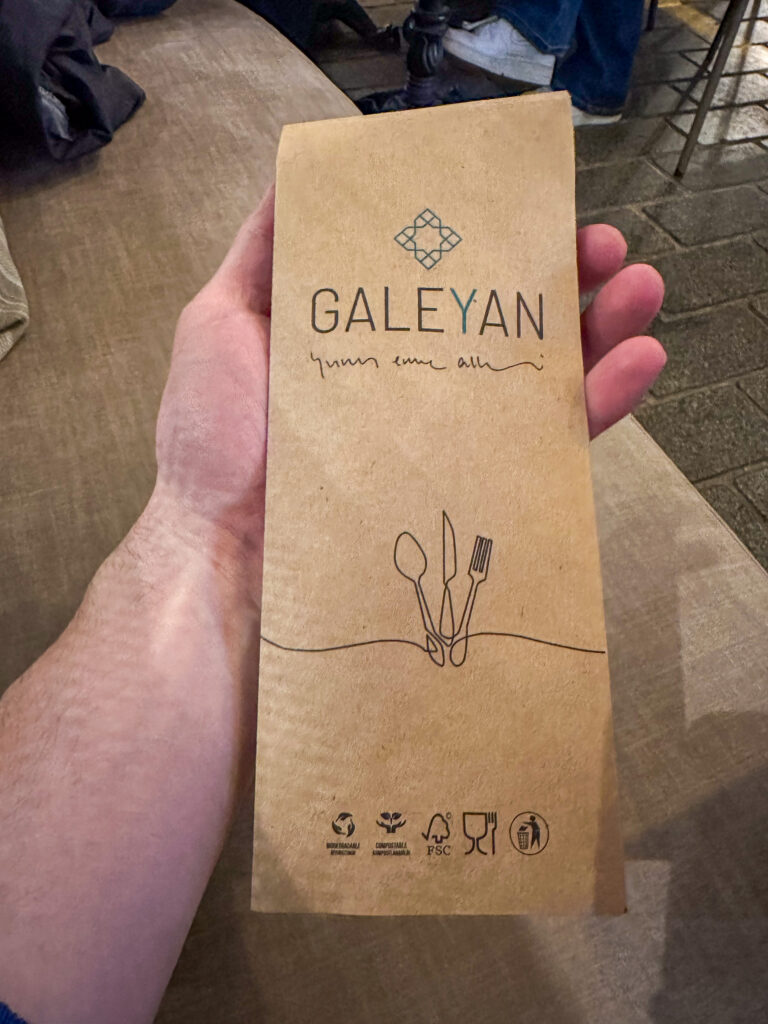
The tableware is where the ambition has gone. The plates are hand-painted, black Ottoman calligraphy sweeping across white with a carnation or tulip in one corner, and no two settings are quite the same. Water comes in cobalt glass bottles, salt and pepper in cut-glass mills, and the cutlery arrives folded into a printed kraft sleeve stamped compostable, a level of attention most of this street does not bother with.
The terrace also gives you the street, and Ticarethane Sokak is not quiet: you look across a few metres of lane at another dining room and a lit façade. In warm weather that is the pleasure of the place. In February it is the argument for sitting inside, a room I cannot show you because I did not photograph it.
Open at nine, and it will feed anyone
The doors open at nine in the morning and do not shut until midnight, seven days a week, and that single fact explains the restaurant better than any description of the cooking. Breakfast is a proper draw: plates loaded with cheeses, pistachio halva, honey and cream, curd, olives and pepper paste; hot plates of spiced potatoes, fried Antep cheese and pan eggs; poached eggs with pastırma on sourdough. In Ramadan the kitchen runs iftar menus, as it has for years.
It is also, unusually for an ambitious Turkish kitchen, easy to eat in. Vegetarian, vegan and gluten-free options are on the list, and the printed menu asks you to declare an allergy before you have to raise it yourself. Highchairs are available and there is no minimum age. Cards are taken, Amex included.
A tasting menu exists alongside the à la carte and has done since at least 2022, as do set menus for groups. Neither is described anywhere: no course count, no sample list, nothing at all. If that is what you want, it is a telephone call, not a click. The house reckons about thirty minutes from order to table, worth knowing if you hold a ticket for something afterwards.
The counter-argument
The case against Galeyan is narrow and consistent: not that the food disappoints, but that people walk out feeling the evening promised more than it delivered. Two versions of it circulate, and they contradict each other instructively. One says the cooking was fine, the room pleasant, the service warm — and still the promise outran the plate. The other says the food fell short of the setting. Both are complaints about the promise. Neither is a kitchen complaint.
It is worth naming what nobody complains about, because that silence is louder. Not the service, which is the most consistently praised thing about the place. Not the room, the portions, the pacing, or how allergies and diets were handled. There is no recurring story of a bad table, a slow kitchen or a party turned away.
So weigh it for what it is. A hotel restaurant in the most visited quarter in Istanbul, open nine to midnight, in a quarter that turns over a great many visitors a day. Two things are true at once: the cooking is truly regional and truly careful, and you are paying an Old City address for it. The same recipes exist in Gaziantep, a very long way from Hagia Sophia.
Know before you go
Book by telephone or WhatsApp: the restaurant’s line is +90 212 513 83 90, its reservations number +90 531 372 4489. There is no online booking of any kind. The “Book a Table” button on the website scrolls you down the page rather than taking you anywhere, and the entire English site is that one page. Email reaches them at info@galeyann.com, with the double N the domain uses and the restaurant does not.
Two questions are worth asking on the call. Which of the seasonal dishes are running this week; and terrace or inside; the terrace is the better room in warm weather and the wrong one in a cold March.
It is an easy restaurant to use, rarer in Sultanahmet than it should be. It opens at nine, so a late breakfast or a quiet lunch needs no planning and dinner is the sitting to secure. Order fewer mezes than the table wants and add more. And if you are coming for one dish off that calendar, come in its month, because the kitchen has already told you when that is.
See the full set: Galeyan — in frames. More Istanbul: Türk Fatih Tütak.
The seasonal dishes are the smallest part of this menu. They are the only part that tells you what the kitchen is for.
The Galeyan gallery
Every photo on this site is my own, shot on the night. Slide through →