MACAU · RESTAURANT · 8 MIN READ
Jade Dragon: Eight Straight Years of Three Stars, and It Shows
The only Cantonese restaurant in Greater China holding three Michelin stars and three Black Pearl diamonds, and what an evening there is actually like.
By J.C. Mercer
Jade Dragon, City of Dreams
- Covers Two, 7pm
- Dined June 2026
- Menu The tasting menu
- Drinks Wine by the glass, and a pot of aged pu-erh
Every meal on this site is booked the way any other guest would book it.
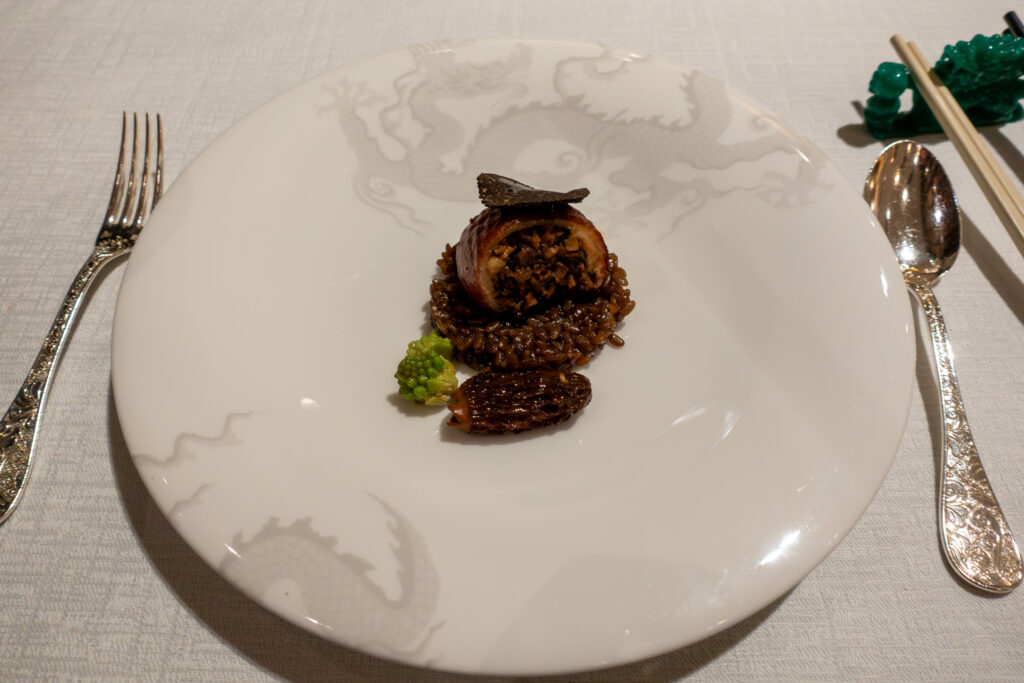
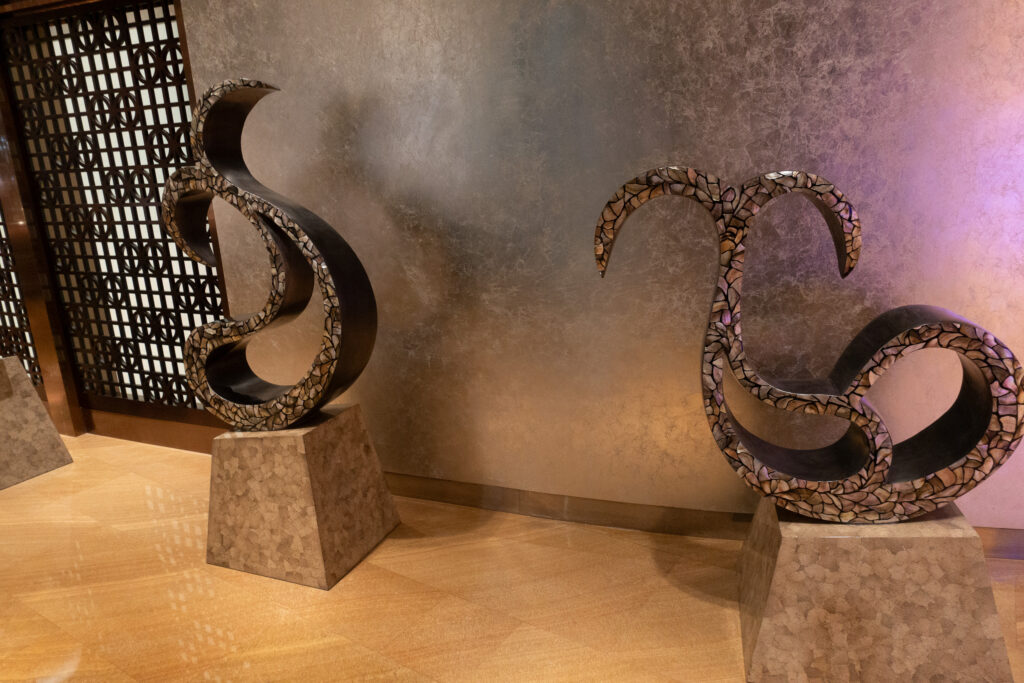
Two bronze dragons stand on stone plinths at the entrance, coiled into shapes that read as calligraphy before they read as animals, and they set the register for everything that follows. This is not a restaurant being playful about its name. It is a restaurant that commissioned sculpture, laid a carpet with a pattern nobody will photograph, and had the plates made with a dragon in relief under the glaze, and it did all of that before deciding what to cook.
Jade Dragon has held three Michelin stars for eight consecutive years, and it is the only Cantonese restaurant in Greater China to hold three stars and three Black Pearl diamonds at the same time. Those are the two guides that matter in this part of the world and they very rarely agree at the top. Here they do.
What the room is doing
The dining room is high, quiet and built out of screens. Dark lattice panels run the length of the walls in a pattern that lets light through in small squares, drum shades hang low over the tables, and the tables themselves are far enough apart that you cannot hear the next conversation. The carpet is a heavy floral in muted golds and greens, which is the single most old-fashioned thing in the room and the reason the acoustics work.
There is no music. In a city built on noise, and inside a resort that pipes sound into every other space it owns, walking into a silent room is a physical relief. Whatever this dinner asks of you, some of it is being spent on the absence of things.
The opening trio, and what it tells you
Dinner started with three things on one plate, which is a Cantonese convention and is also a statement of method. A deep-fried puff, golden and blistered, sitting in its own small dish. A single pleated dumpling in a woven basket spun from caramelised sugar, which you eat as well. And slices of barbecued pork under a dark lacquer glaze, laid over dressed greens.
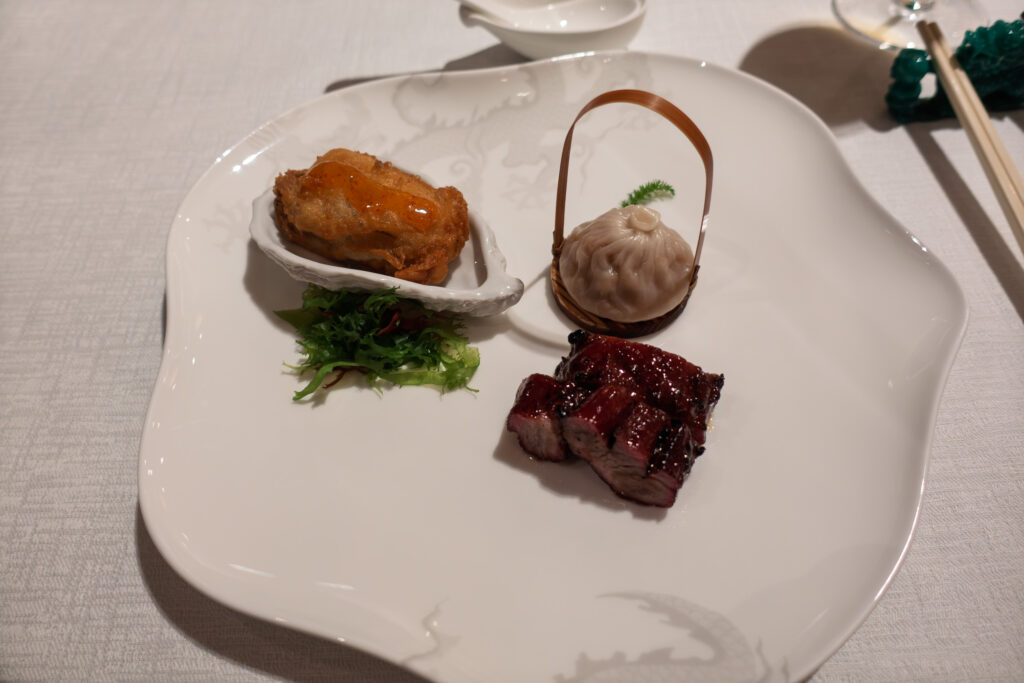
Each of those is a different discipline. The puff is pastry work, the dumpling is skin work, the pork is fire and time. Putting them together first is the kitchen telling you which three things it wants to be judged on, and it is a confident thing to do at the start rather than the end.
The pork was the best of the three and the best single mouthful of the evening. The glaze had gone almost to the edge of burnt in places, which is where it should go and where most kitchens stop short of.
Soup, and the part that cannot be rushed
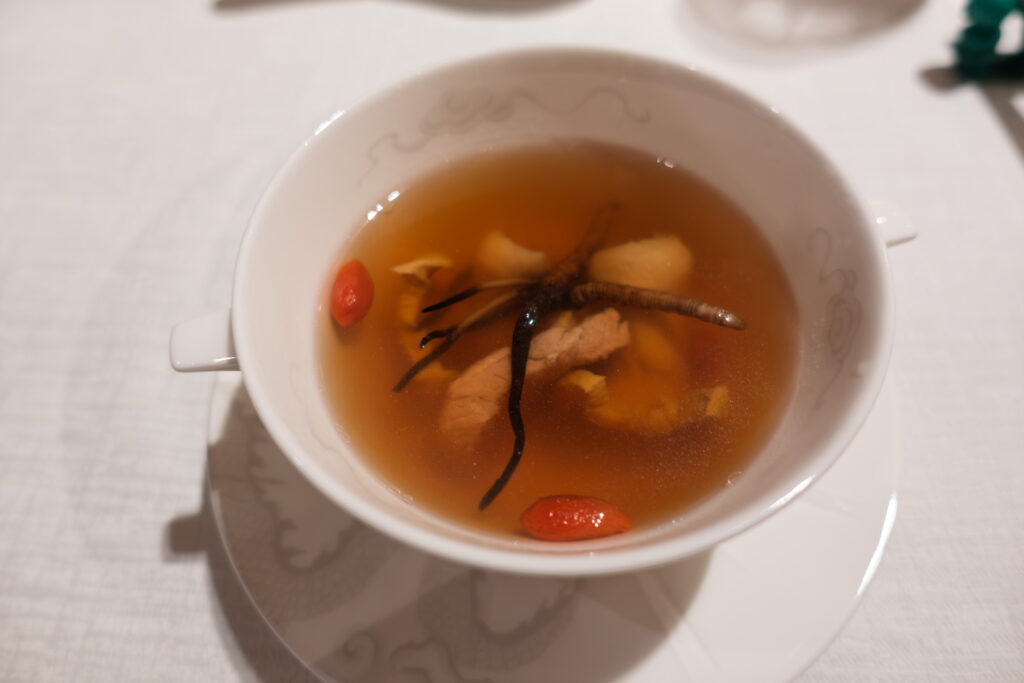
Then a clear double-boiled soup, amber and completely transparent, with a few goji berries sitting in it and seafood beneath. Double-boiling is the technique where the ingredients go into a sealed vessel and the vessel goes into simmering water, so nothing ever boils and nothing clouds. It takes hours and it cannot be shortened.
It also cannot be improved by presentation, which is why it arrives looking like almost nothing at all. This is the course that separates Cantonese restaurants that are expensive from Cantonese restaurants that are serious, and it is the one to pay attention to.
Abalone, and gold leaf used properly
The centre of the meal was a whole braised abalone in a dark reduction, on a long oval plate, with a stem of gai lan alongside, a piece of dark braise finished with gold leaf, a wedge of crisp pumpkin, and a smear of orange purée underneath it.
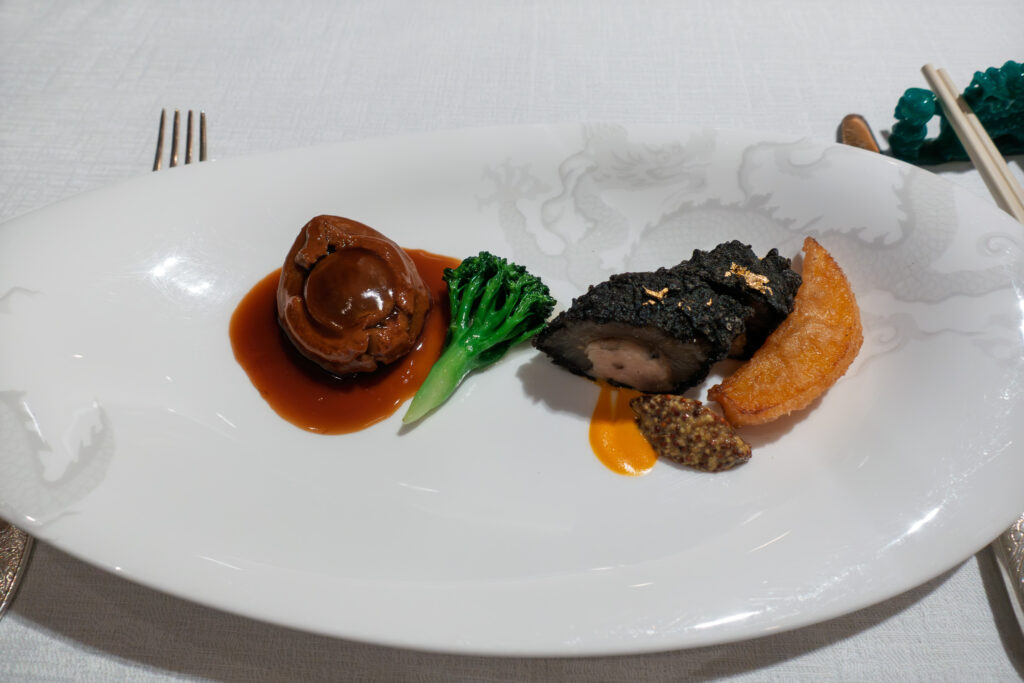
Gold leaf on a plate is almost always a bad sign, and it is worth saying plainly that here it is not doing what it usually does. It sits on one dark element among five, and the plate would be just as good without it. That is the only false note in the meal and it is a small one.
The abalone itself was the thing. Braised long enough to yield without going soft, coated in a sauce with enough reduction behind it to stand up on the plate, and served hot, which sounds trivial and is the failure point in half the versions of this dish anywhere.
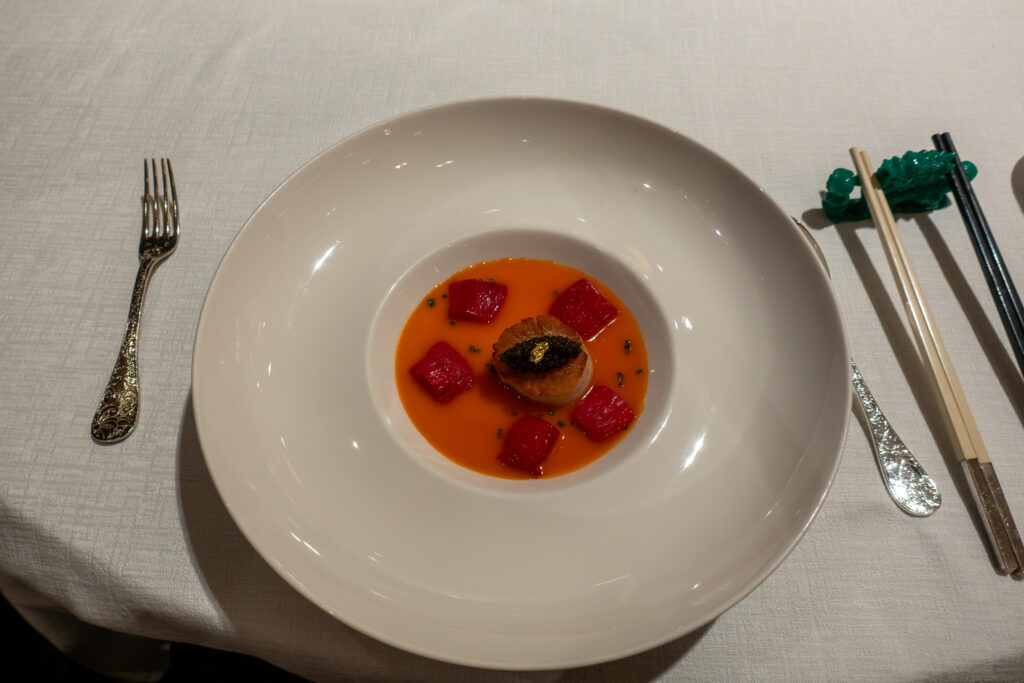
Between the abalone and the dessert came the courses that are easy to forget and are the reason the meal holds together: a small round tart under an orange-red sauce, a dark crisp nest that shattered properly rather than bending, and a plate of greens cooked to the exact point where they stop being raw. None of those is a signature. All of them were correct.
The service, and the trolley
Service here is formal in the old sense: black suits, gueridon trolleys, wine opened and decanted at the table rather than at a station out of sight. Plates are set down together and cleared together. Nobody introduces themselves or explains the concept.
What impressed me most was the pacing. Three hours passed and at no point was there a gap that felt like waiting or a course that arrived while the previous one was still being finished. That is invisible when it goes right and unmistakable when it goes wrong, and it is the hardest thing in a restaurant to get consistently correct.
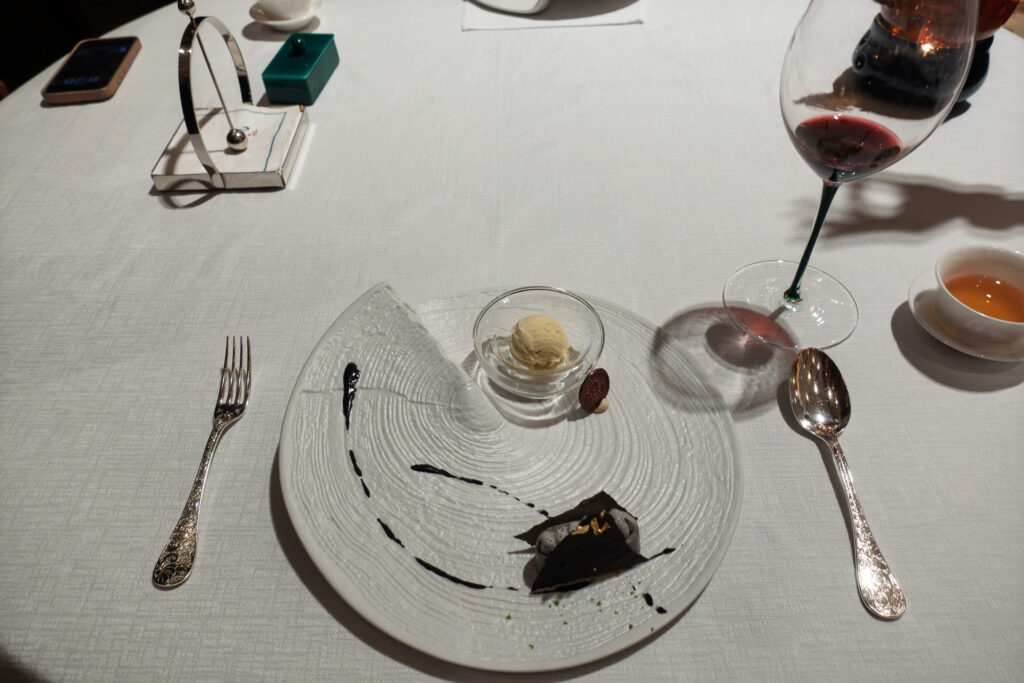
Dessert is deliberately restrained. Cantonese kitchens at this level do not finish with a construction, and the last plate of the evening is a small, cool, precise thing that resets the palate rather than competing for the memory. It is the right decision and it will disappoint anybody expecting a finale.
What to drink
There is a serious wine list and a sommelier who will work with it, and there is also tea, served properly, in glass over a burner so you can watch it open. Tea is the better answer with the first half of the meal and wine is the better answer with the braises, and a table of two can comfortably have both without it becoming a project.
Noted
| What | Checked on the night |
|---|---|
| Michelin | Three stars, eighth consecutive year, 2026 guide |
| Black Pearl | Three diamonds |
| Cuisine | Cantonese |
| Where | City of Dreams, Estrada do Istmo, Cotai |
| Room | Quiet; no music; tables well spaced |
| Length | About three hours for two |
| Booking | Weeks ahead for a prime sitting |
Observed on the stay, not measured.
The counter-argument
The complaint about Jade Dragon is never the cooking. It is the setting. To get here you walk through a casino floor, and you arrive at a three-star dining room having just crossed a carpet designed to disorient you under lighting designed to keep you awake. The restaurant does everything it can to shut that out and it succeeds from the moment the door closes. The approach is still the approach.
Second, this is a formal room and it does not pretend otherwise. If what you want from a great Cantonese kitchen is a loud table of eight and a lazy Susan, that is a real and legitimate thing to want and this is emphatically not it.
Third, dining rooms this precise leave very little room for a bad night, and one indifferent course would be more noticeable here than in a warmer restaurant. Nothing on my evening was indifferent. The margin is narrow by design.
Know before you go
Book weeks ahead for a prime sitting and take an earlier one if that is what is offered. Ask for tea alongside the wine rather than instead of it. Order the barbecued pork whatever else you do. Do not skip the soup because it looks like nothing. And walk in through the sculptures rather than cutting through from the lift lobby, because whoever designed the arrival meant it to be used.
See the full set: Jade Dragon — in frames. More Macau: Morpheus.
Three hours of silence, in a building engineered to prevent exactly that.
Jade Dragon gallery
Every photo on this site is my own, shot on the stay. Slide through →