PARIS · RESTAURANT · 9 MIN READ
L’Oiseau Blanc: Two Stars, a Rooftop, and an Aeroplane That Never Arrived
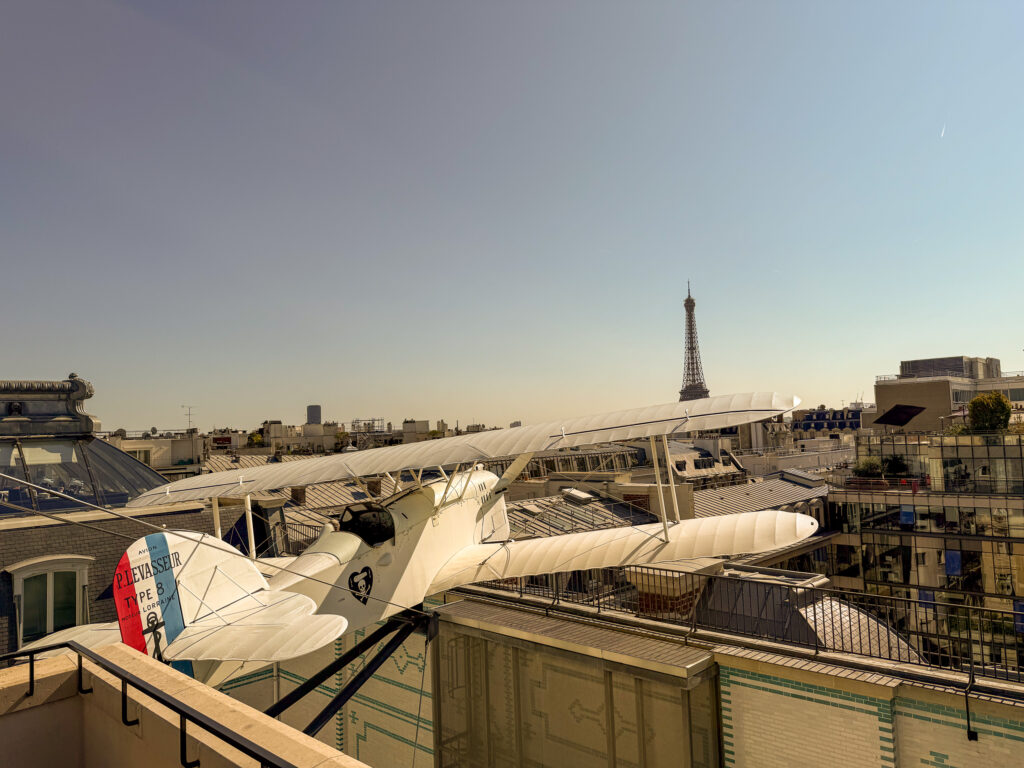
The Peninsula Paris’s rooftop dining room, named for a biplane that vanished over the Atlantic in 1927, with a full-size replica parked outside the glass.
By J.C. Mercer
L’Oiseau Blanc, The Peninsula Paris
- Covers Two, 7.30pm
- Dined April 2026
- Menu The tasting menu
- Drinks The pairing, half wine and half not
Every meal on this site is booked the way any other guest would book it.
There is an aeroplane on the roof. Not a model and not a sculpture of one: a full-size white biplane with a tricolour flash on the tail, parked on the terrace with its nose up and its wings out over avenue Kléber, so that from the dining room you look past a wingtip to the Eiffel Tower. It is the single most literal piece of restaurant branding I have seen anywhere, and it works, because the story behind it is not a marketing story.
In May 1927 Charles Nungesser and François Coli took off from Paris in a white biplane called L’Oiseau Blanc, aiming to be the first to fly the North Atlantic. They were never seen again. Charles Lindbergh made the crossing in the other direction a fortnight later and the world remembered him instead. The restaurant is named after the aircraft that did not arrive, which is an unusual thing for a two-star dining room to build itself around and is the reason the room has more character than its glass walls would suggest.
The room, and the view everybody books for
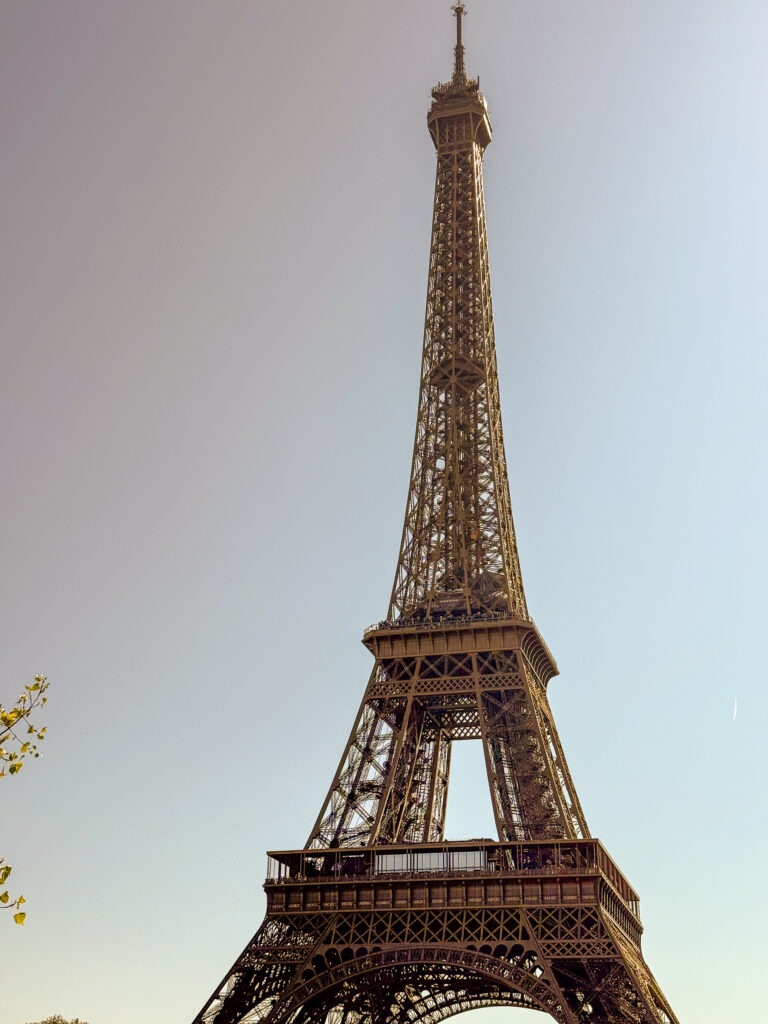
L’Oiseau Blanc sits on top of The Peninsula Paris on avenue Kléber in the sixteenth, glazed on the long side and open onto the terrace at the end. The tables run along the glass. Below you are the zinc roofs and the chimney stacks and the pale stone, and then the Eiffel Tower straight ahead, and Sacré-Cœur off to the right on a clear evening.
Be honest with yourself about what you are booking. There are a limited number of tables with the tower squarely in front of them and a larger number without, and the difference to the evening is considerable. Ask when you reserve, ask again when you arrive, and take the earlier sitting if that is what it takes.
The opening
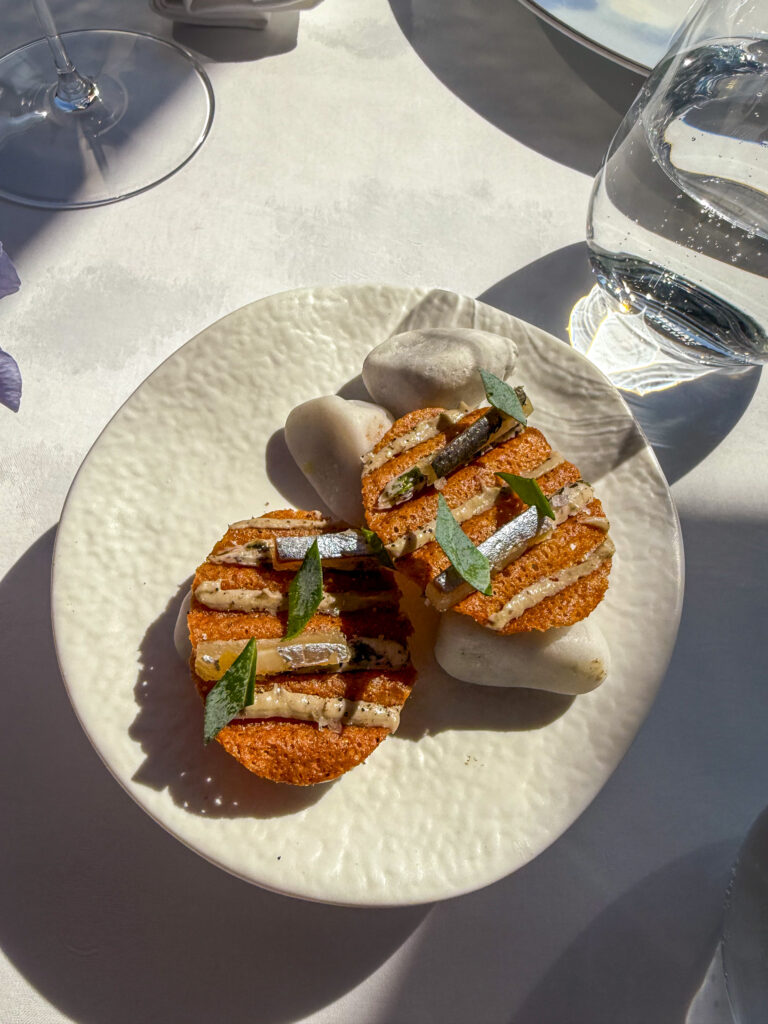
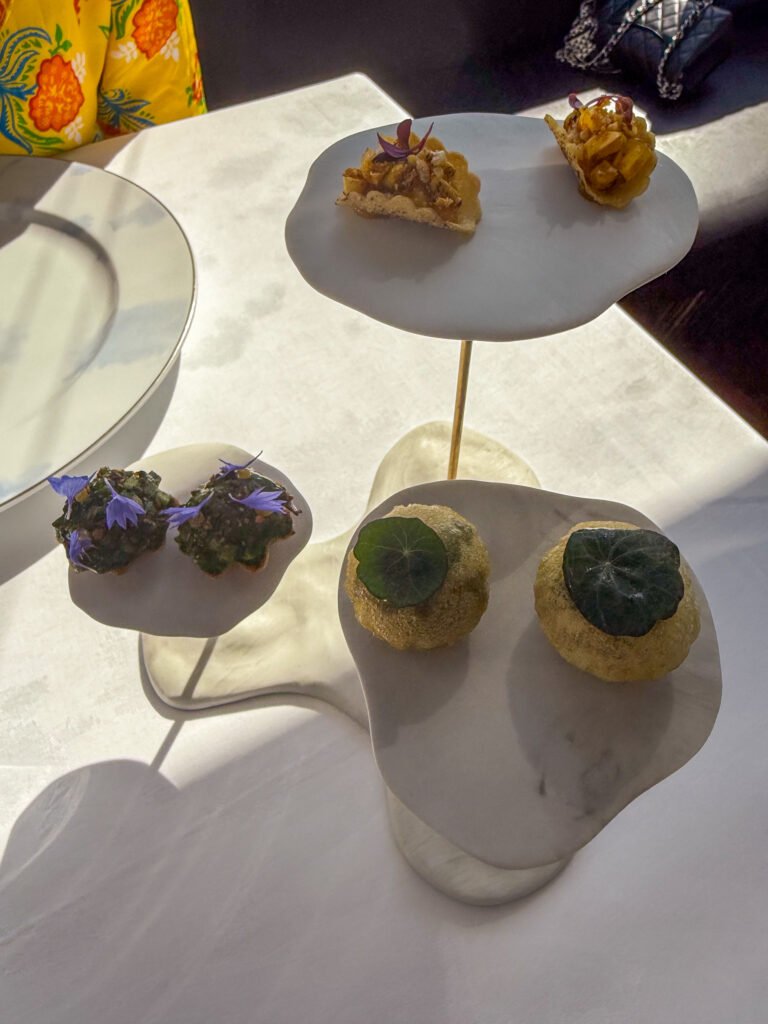
Dinner starts with a small architecture of snacks on a two-tier stand of white pebble-shaped plates: a tart under a purple flower, a filled golden shell, two dark canapés under blue borage, and two pale rounds each capped with a whole nasturtium leaf. It is precise, very pretty, and over in about four minutes, which is the correct length for this part of a meal.
What David Bizet is actually cooking
David Bizet has run this kitchen since the hotel opened and took the second Michelin star in March 2022, which it has held every year since. The cooking is classical French technique used with a very light hand: sauces reduced properly but poured sparingly, a great deal of raw and barely-cooked vegetable work, and a consistent preference for acidity where a heavier kitchen would reach for fat.
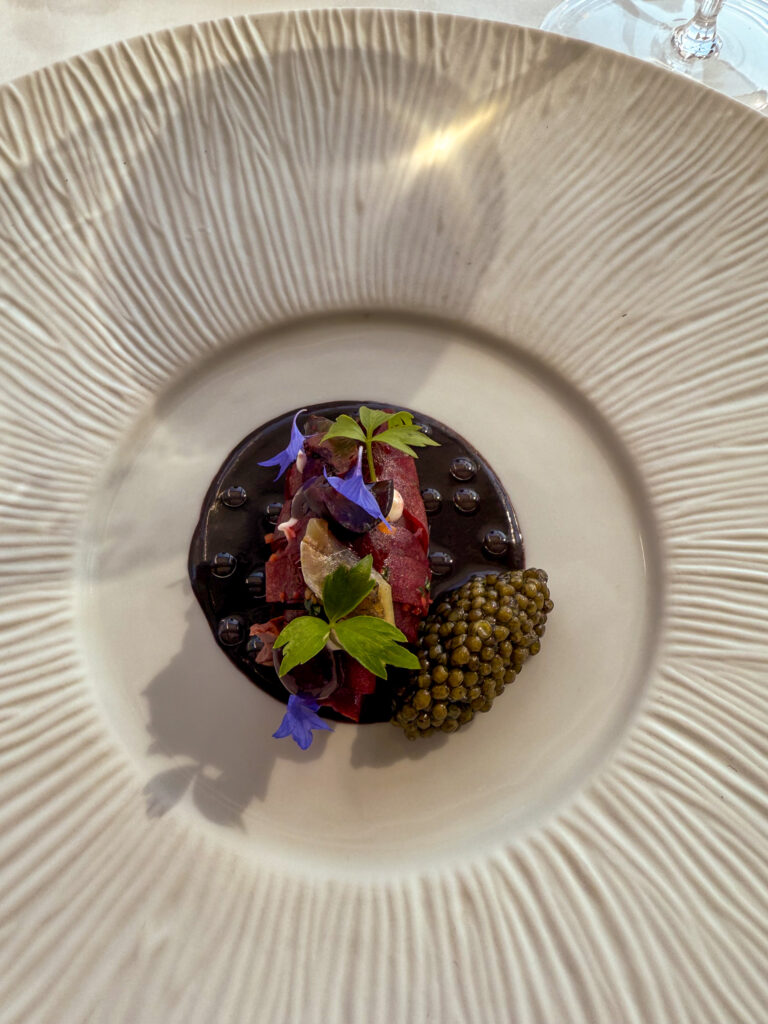
The dish that made the case was a shallow bowl with a dark, glossy, almost black base, sliced pink flesh laid over it, blue flowers and small leaves scattered across, and a crescent of caviar at one edge. It looked like a garden and ate like a much more serious plate of food than it looked, which is the trick this kitchen keeps performing.
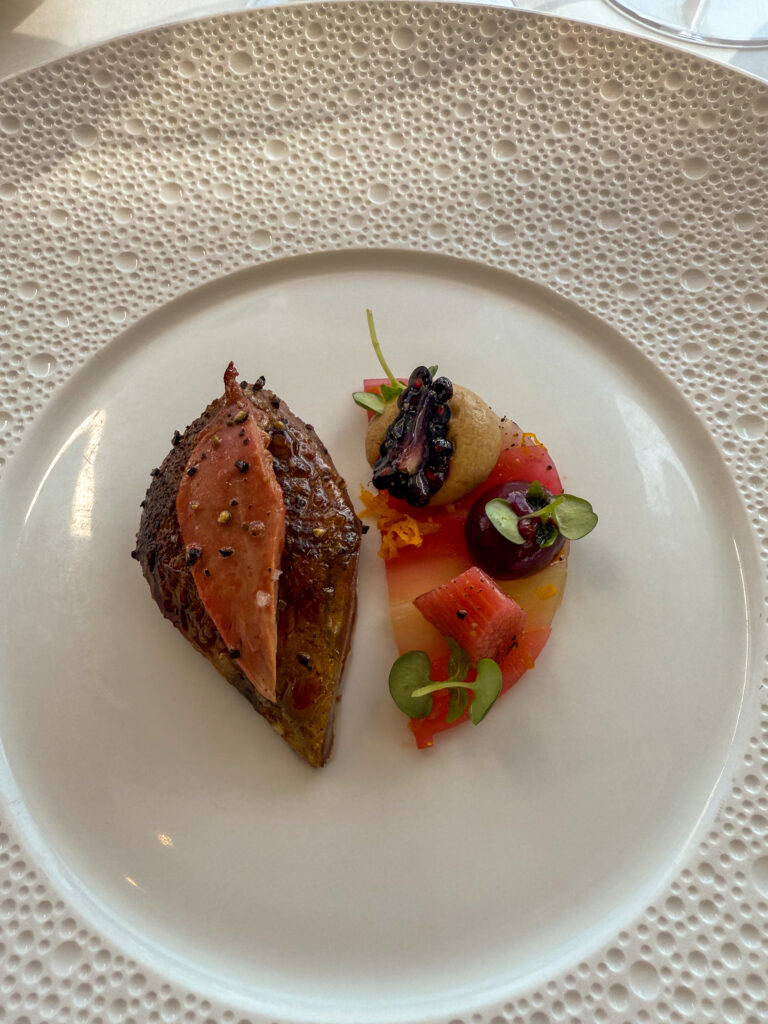
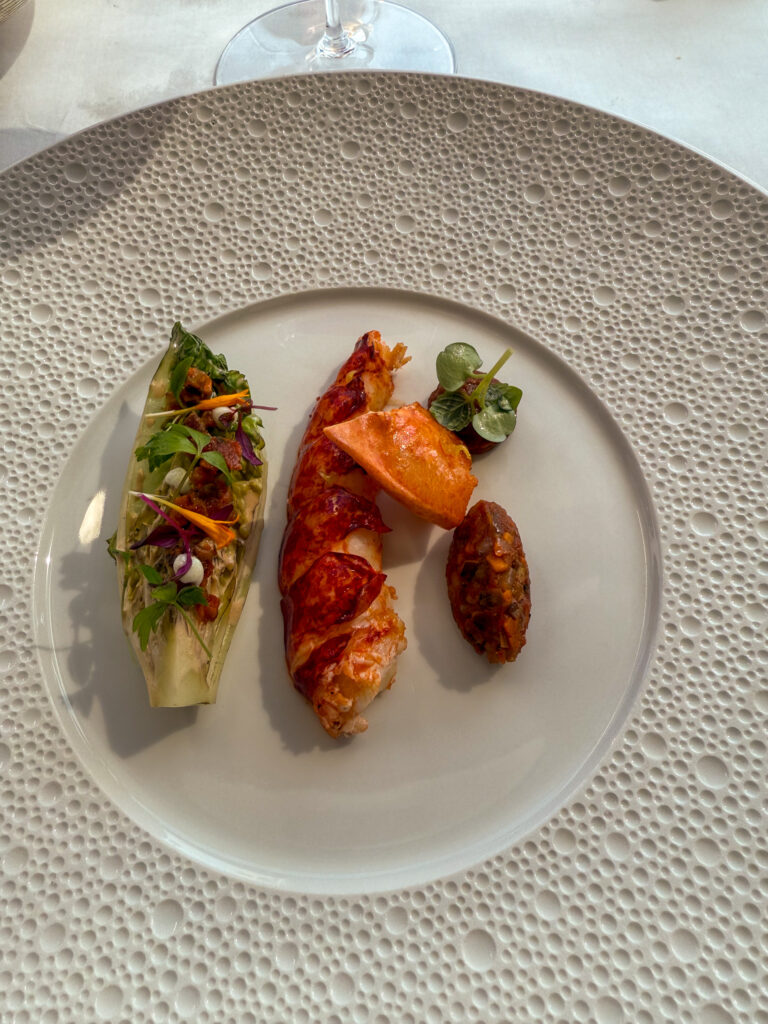
The best course was langoustine: the tail glazed a deep red and laid whole down the middle of a dimpled white plate, a chicory boat of dressed leaves and shredded vegetables to one side, a dark croquette to the other. Three temperatures, three textures, one flavour running through all of them.
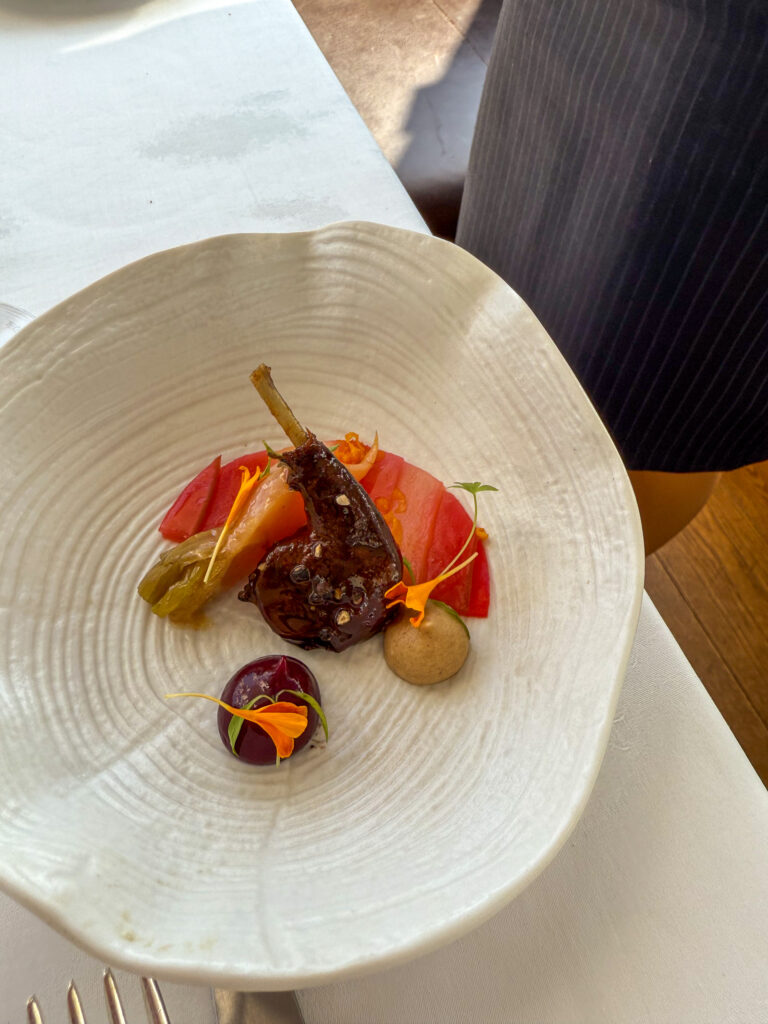
Where the kitchen is least interesting is the middle of the menu, where two or three courses in a row arrive as a single dark element in a pool of sauce on a large pale plate. They were all good. They looked like each other.
Bread deserves its own sentence, because in a French restaurant at this level it is a test and most kitchens quietly fail it. Here it arrives warm, is offered more than once without being pressed, and the butter is worth the trouble it has clearly been given. Nobody at this table left any.
Desserts follow the same restraint as the savoury courses. Fruit rather than chocolate, acidity rather than sugar, and a final plate small enough that it does not undo the two hours before it. That is the house position across the whole menu, and the consistency of it is what makes the meal feel composed rather than assembled.
The pairing, and the bottle that was not wine
The pairing is the part worth taking. The sommelier works the room himself, brings each bottle to the table before pouring it, and explains it in about two sentences rather than four minutes, which is the correct ratio.
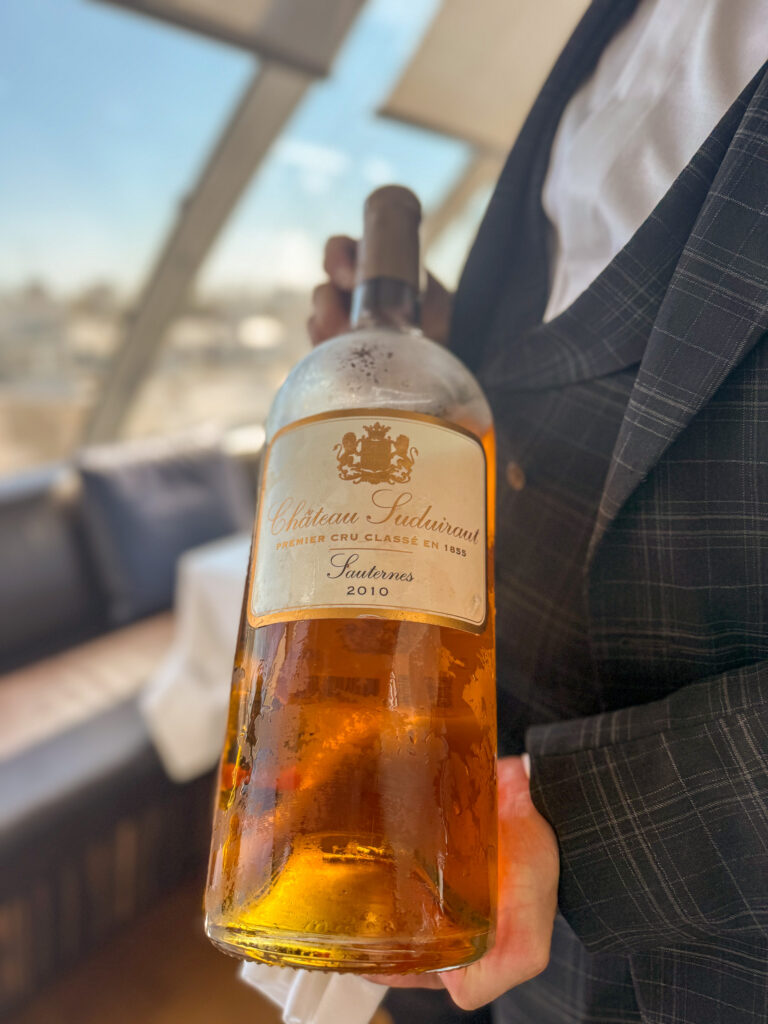
The unexpected thing is that roughly half of the pairing is not wine. A kombucha, brewed in France, arrived alongside an early course in a bottle with a painted mouth on the label, and it did what the pairing needed better than a white wine would have. Later there was a Gevrey-Chambertin from old vines with fifteen years on it, and a Sauternes at the end, and the two halves sat together perfectly comfortably.
If you do not drink, or are only half drinking, this is one of the few kitchens at this level where the non-alcoholic half of the list has clearly been built by someone who cares about it rather than assembled to avoid embarrassment.
Noted
| What | Checked on the night |
|---|---|
| Michelin | Two stars, held since March 2022 |
| Chef | David Bizet |
| Where | On the roof of The Peninsula Paris, avenue Kléber, 16th |
| View | Eiffel Tower ahead; Sacré-Cœur to the right on a clear evening |
| The aeroplane | A full-size replica, on the terrace |
| Length | About three hours for two |
| Pairing | Roughly half non-alcoholic, by design |
Observed on the stay, not measured.
One more thing about the terrace, since it is the reason to choose this restaurant over the several others in Paris holding the same two stars. It is not a viewing platform bolted onto a dining room; it is where the whole conceit resolves. The aeroplane is at eye level, the roofs go on for a mile, and the tower does its hourly business on the hour whether or not anybody is watching. Fifteen minutes out there between courses is the part of the evening I would repeat first.
The counter-argument
The view is doing a lot of the work, and everyone in the room knows it. That is not a criticism of the cooking, which would hold two stars in a basement. It is a warning about expectation management: if you get a table on the inside row on a grey evening, you are eating a very good but not transcendent dinner in a glassy modern room, and the thing you were promised is happening to somebody else eight feet away.
Second, the room reads modern hotel rather than Paris institution. Pale, bright, comfortable, slightly anonymous. There are dining rooms in this city where the room is half the reason to go. This is not one of them; the terrace is.
Third, the sixteenth is a quiet, handsome, expensive and slightly airless part of Paris, and there is very little reason to be up here except this restaurant and the hotel under it. Dinner does not spill into an evening the way it would in the eleventh or the ninth. Plan what happens afterwards, or accept that nothing does.
Know before you go
Book weeks ahead and ask specifically for a table on the window row facing the tower. Take the earlier sitting in summer so that you get the light on the roofs and then the tower lit. Take the pairing and let them give you the non-alcoholic half. Go out onto the terrace between courses, at least once. And read about Nungesser and Coli before you come, because the restaurant will not tell you the story and it is the best thing in the room.
See the full set: L’Oiseau Blanc, Paris — in frames.
Named for the flight that failed, in a city that remembered the other one.
L’Oiseau Blanc gallery
Every photo on this site is my own, shot on the stay. Slide through →