The Suite Report

Tag: Thailand

  • Capella Bangkok: The Best Service of Any Hotel, Anywhere

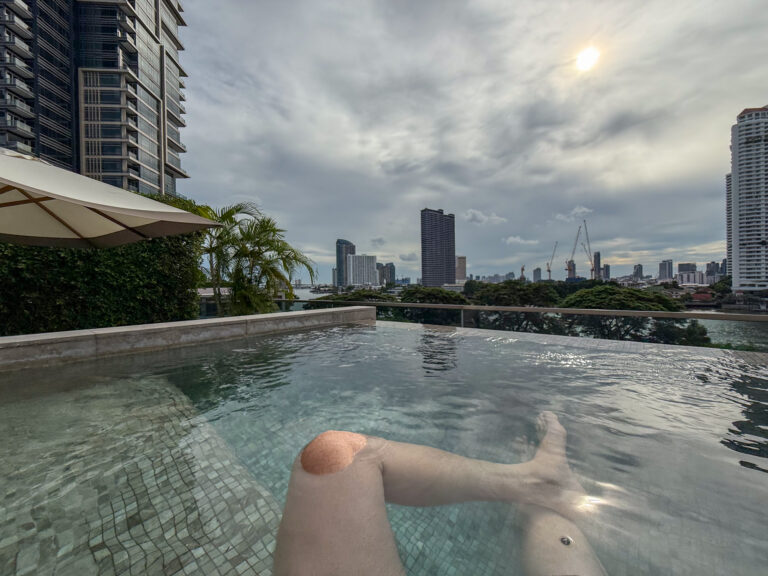
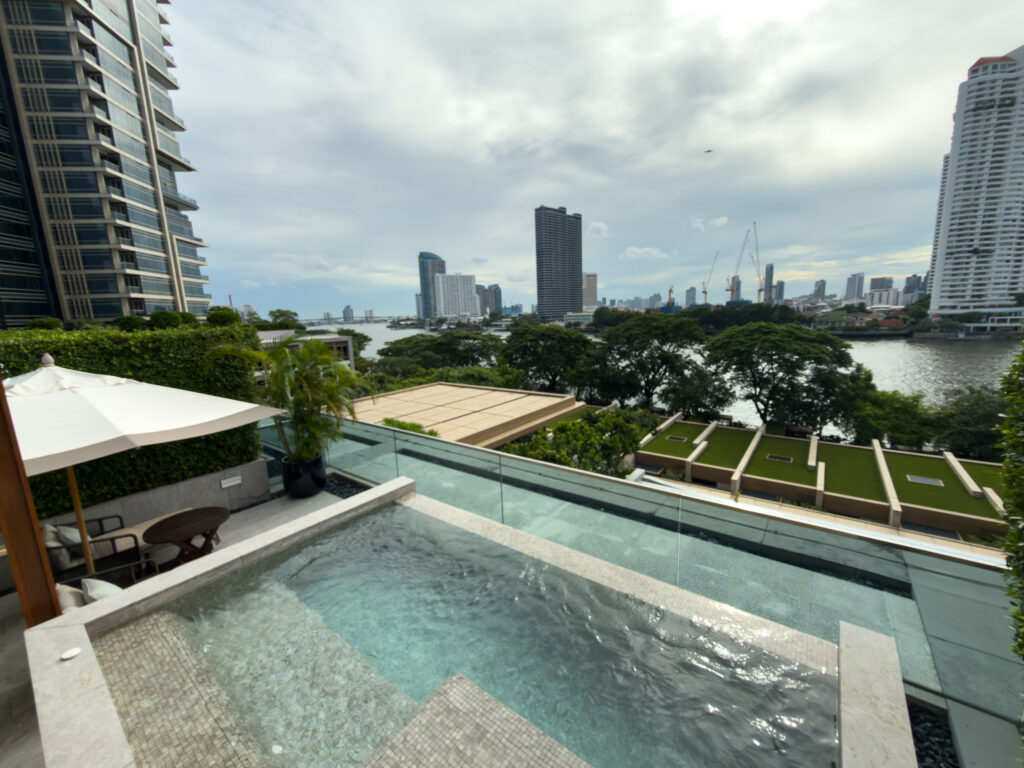
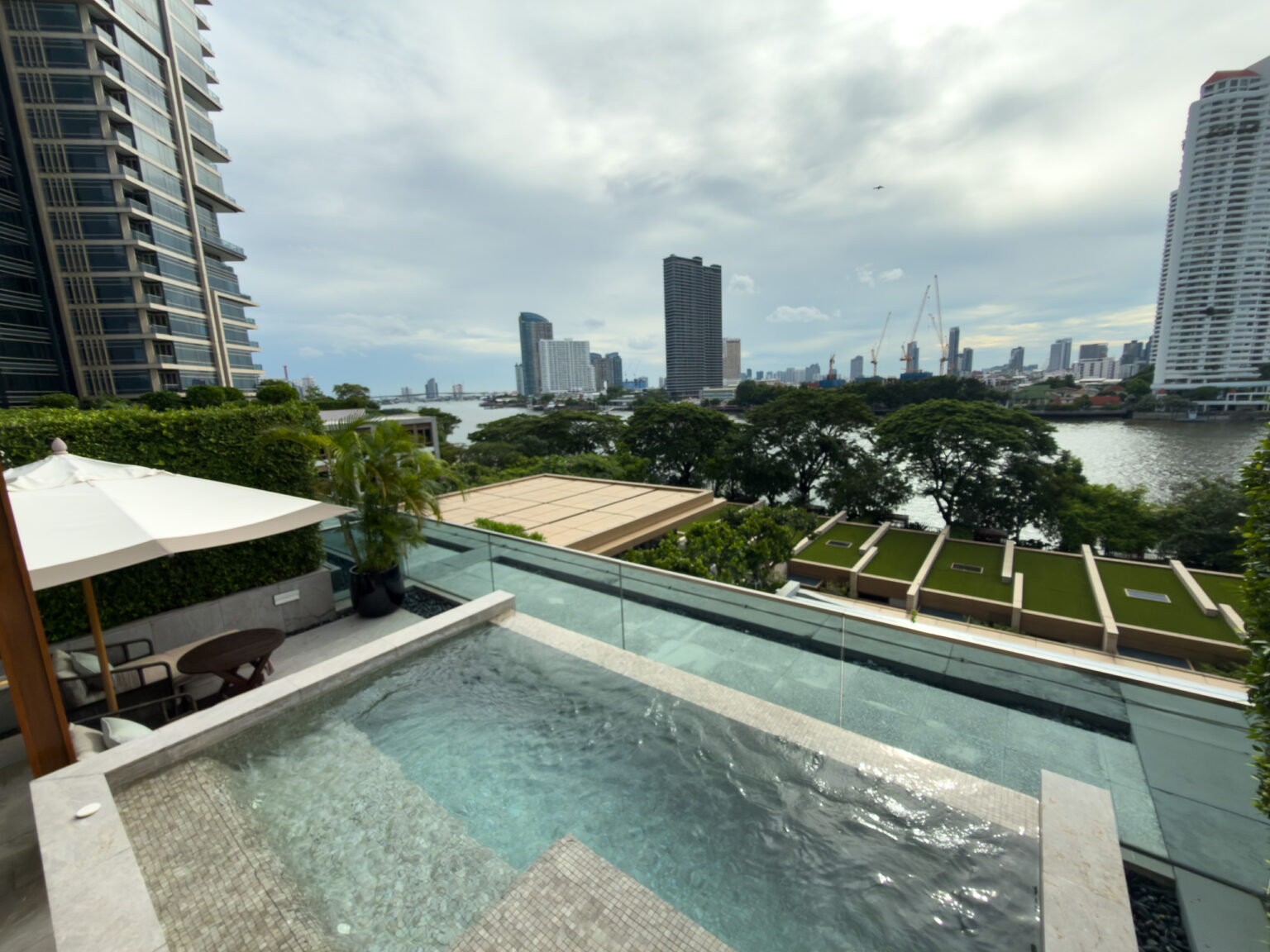
    A private plunge pool on a suite terrace looking over the Chao Phraya to the towers of Bangkok

    BANGKOK, THAILAND · VERIFIED STAY · 7 MIN READ

    Capella Bangkok: The Best Service of Any Hotel, Anywhere

    The best service I have had in any hotel, anywhere, and a kitchen that came close to the best restaurant in Thailand.

    By J.C. Mercer

    Verified stay·paid in full

    • Stayed July 2026
    • Room booked Riverfront Premier, king, third floor.
    • How it was booked Amex Fine Hotels + Resorts, public rate
    • What the channel bought upgrade, breakfast, late checkout, the works.
    • Value verdict Worth it in any season. The service is the product here, and is best in class. This hotel is my Number 1 for service worldwide.
    • When to go Any months. June/July are hot but less busy and we had a wonderful time indoors. Book this stay

    Booked the way any other guest would book it.

    Arrival

    Capella runs low and wide along the east bank of the Chao Phraya, wood-panelled, set back behind tiered lawns and old trees that step down to the water. The whole plan is organised around one idea, which is that you should be able to see the river from wherever you happen to be standing, and on that it does not miss. What I did not expect, and what this review is mostly about, is that the people would be better than the building.

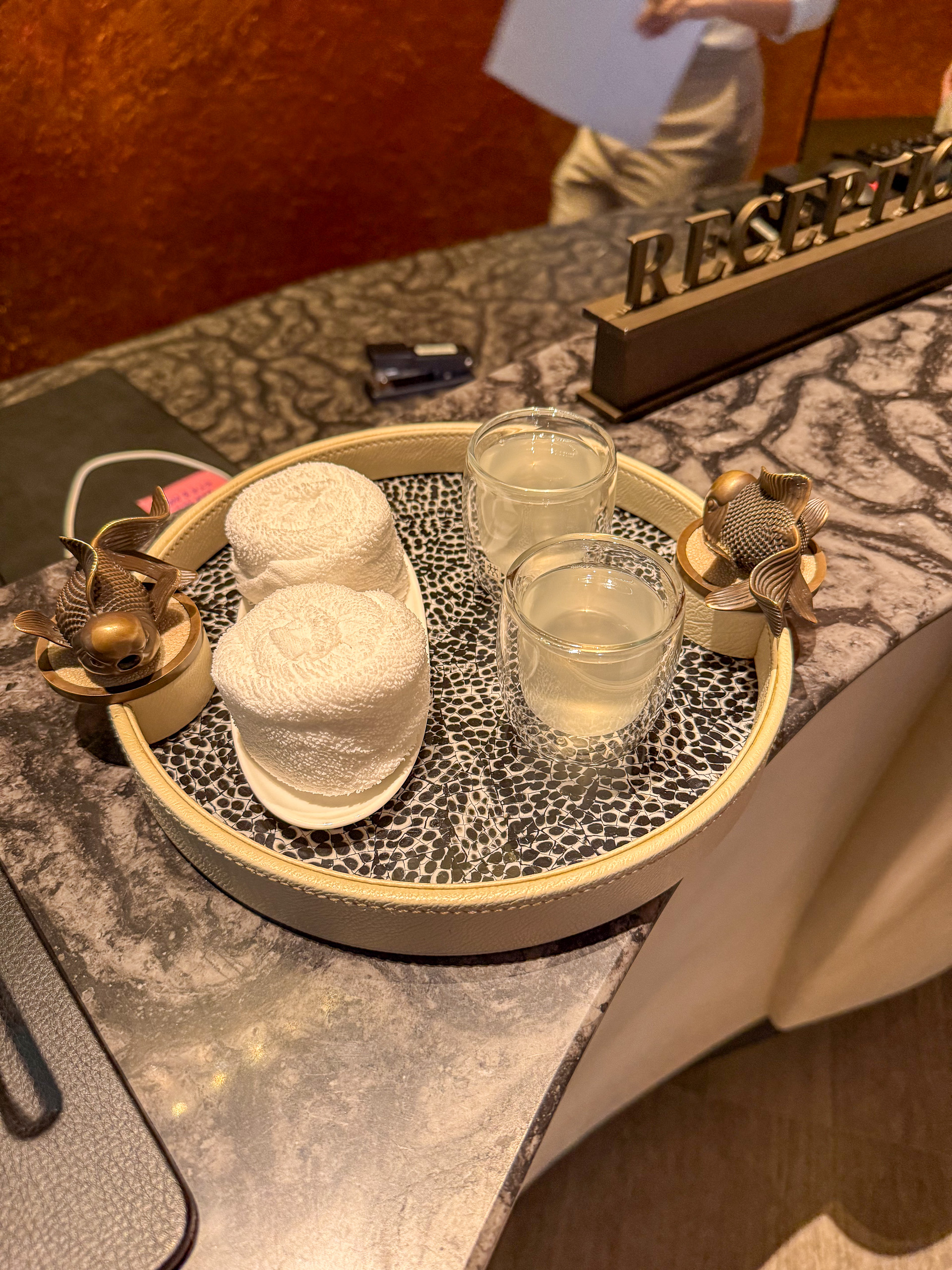
    There are two lobbies and only one of them is yours. The first is enormous, open to anyone who wanders in off Charoen Krung, and looks over a pond towards the pool and the river. Past two reception desks is a frosted, key-carded door, and behind it is the hotel you are paying for. Nobody queues. Check-in happens sitting down, with a cold towel and a drinks menu on the table before anyone mentions a passport.
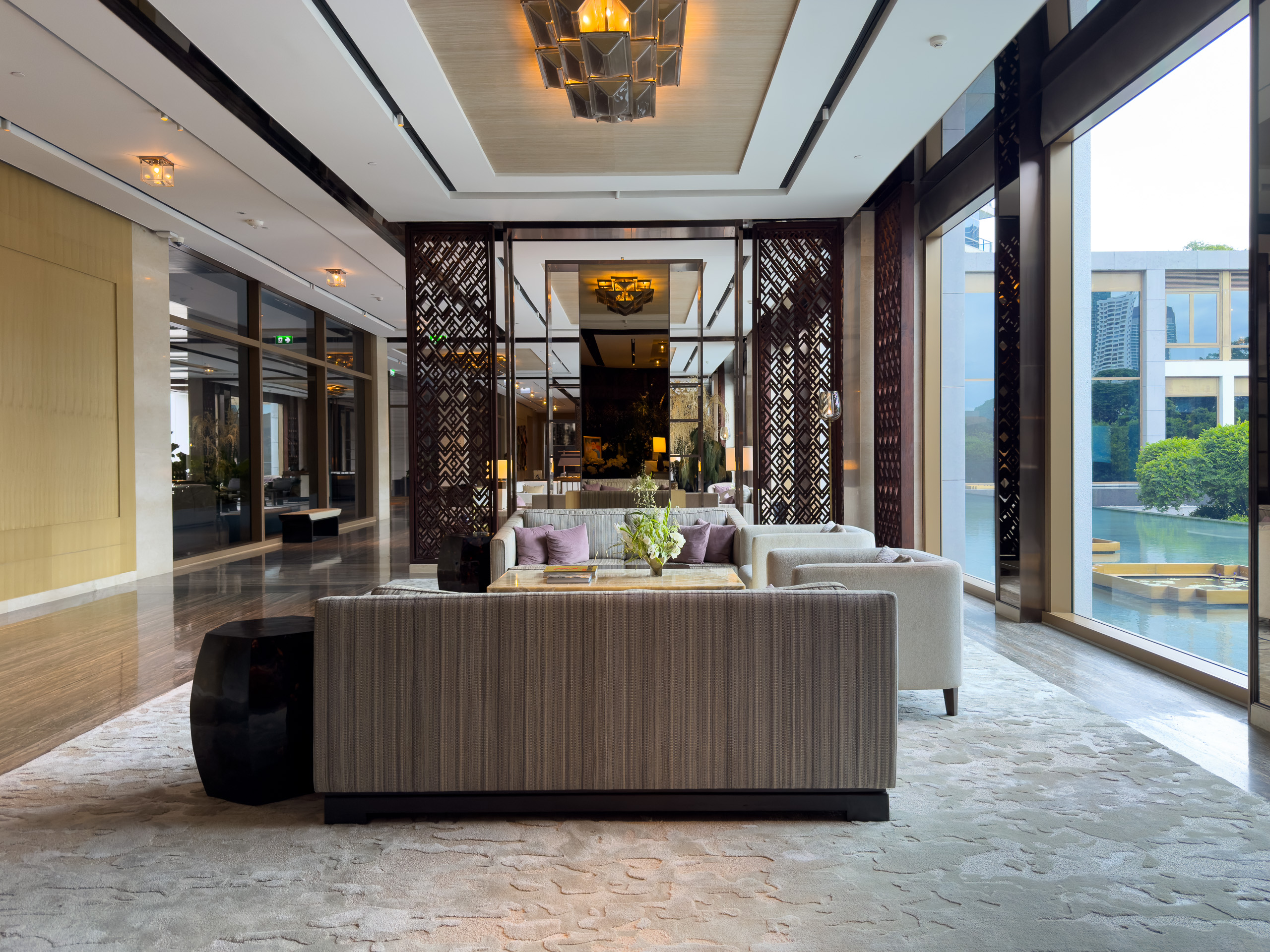
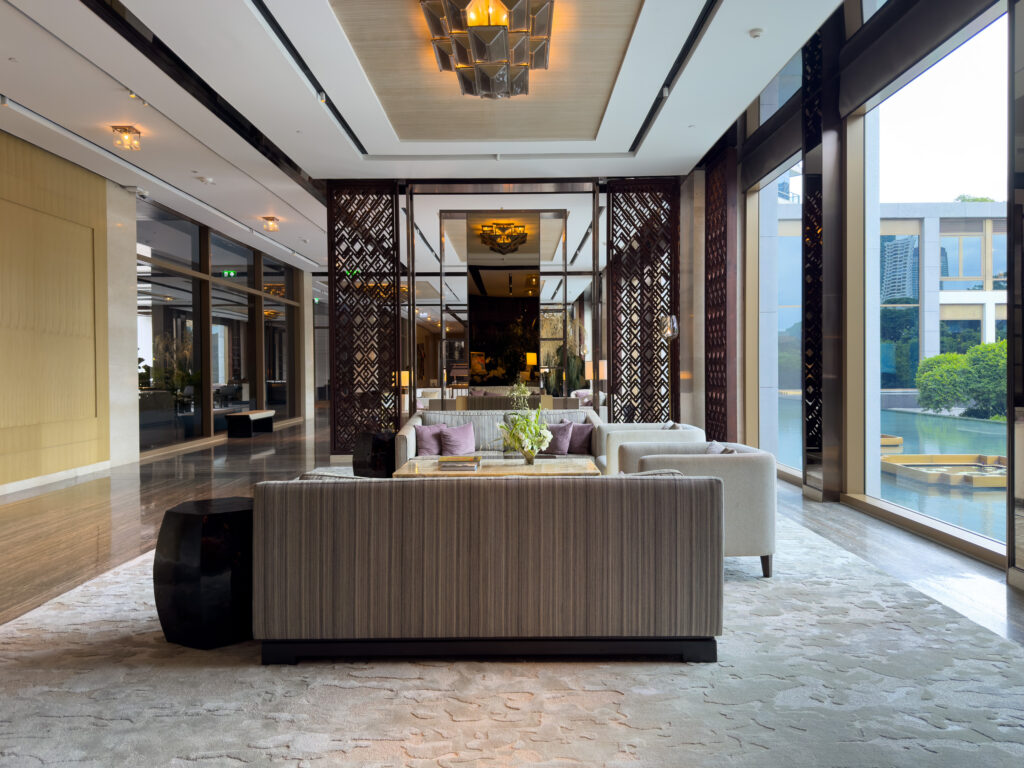
    A pale lounge with a carved screen at the centre and the river through the glass
    The Living Room, behind the key-carded door, and the river the whole building faces.

    The Living Room is where a surprising share of the whole offer lives, and it is open from breakfast until eleven. Sparkling wine, juice, barista coffee, tea and jars of snacks all day; a tea trolley with egg cake at three; and between five and six Cin Cin Hour, with proper drinks and ya dong, the Thai herbal spirit, which is worth its weight in gold and is how I learned that “herbal” is not a promise. Ya dong is a must for every proper drinker. Cin Cin moves around the property. They will let you know.

    Running through all of it are the Culturists, part butler and part concierge, one per room, around the clock. These beautiful people work in the open rather than behind a desk, they remember names, they pick up conversations from the day before. I have been looked after in a great many hotels. I have never been looked after like this. Four Seasons Sultanahmet was a close second where I swear they had someone follow me around the city when I went out alone to protect me.

    The room

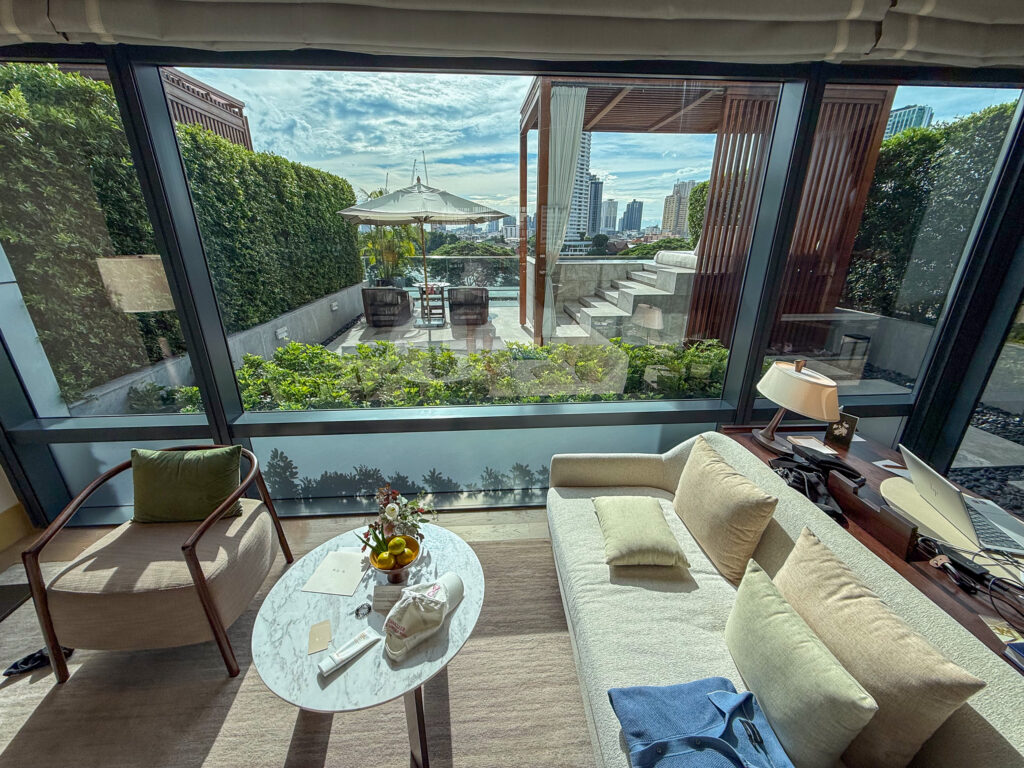
    I had a Riverfront balcony with plunge pool on the third floor, which is an upgraded room on a lower floor: this room has the views you can use. This room was exceptional.
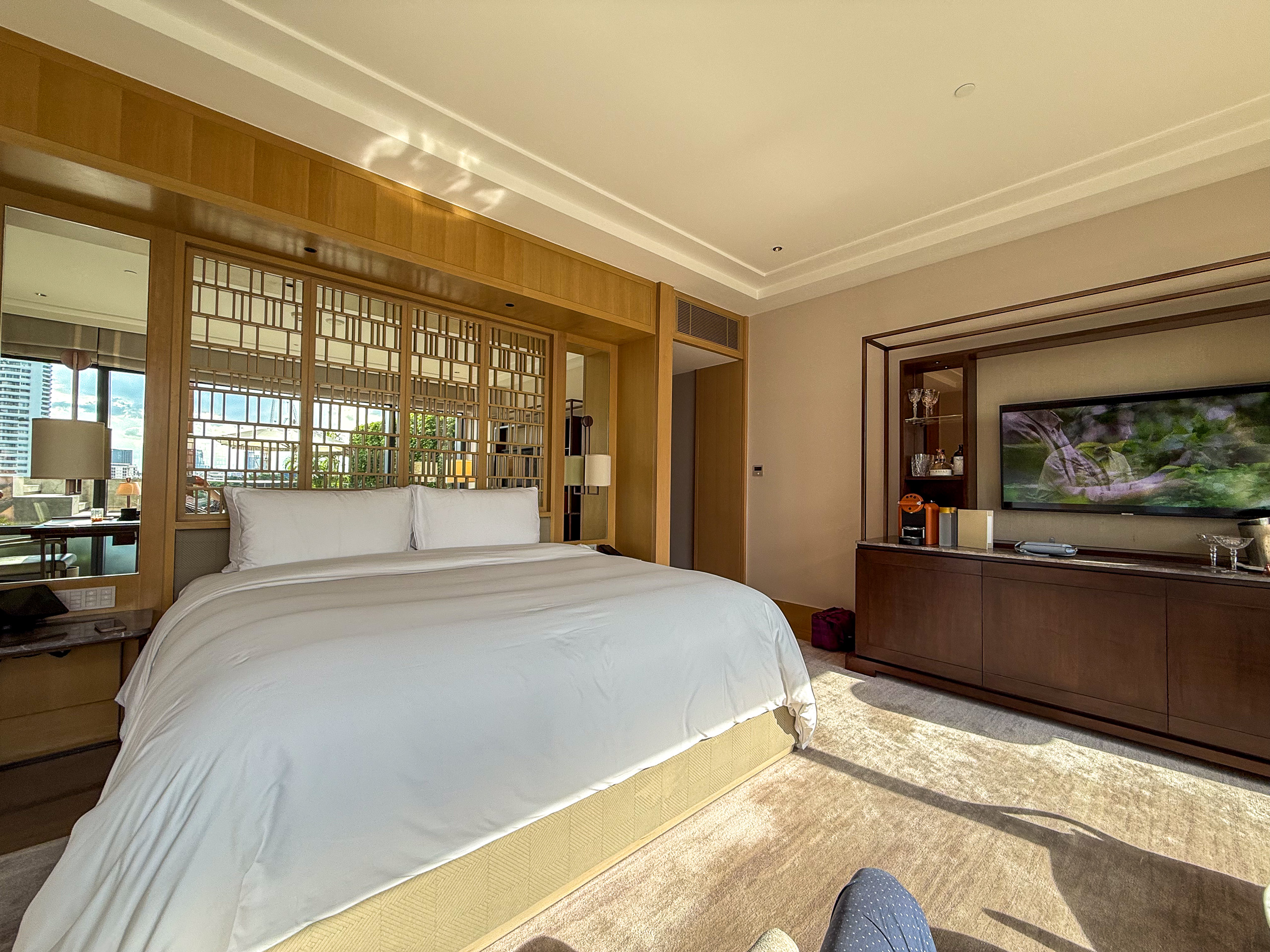
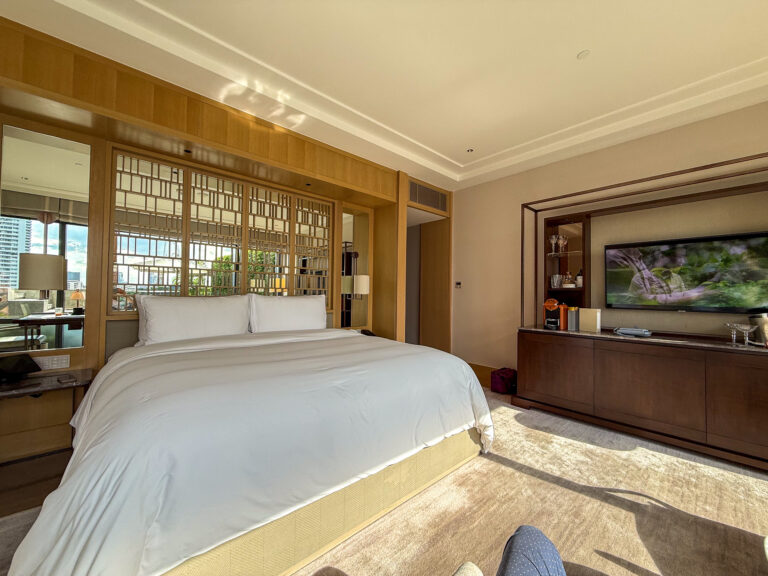
    A white-dressed bed against wood panelling, the river visible through the window beyond
    The bed faces the river. Every room in the house does.

    One caveat, found at about eleven at night. Leave the slider open for more than a minute and the air conditioning switches itself off. It is an energy-saving interlock, it is entirely reasonable, and nobody tells you. I spent a warm quarter of an hour blaming the hotel before I worked out it was blaming me.

    The rest is quietly clever in a way photographs never catch. A service hatch links the closet to the corridor, so laundry and pressing come and go without anyone entering the room — the best piece of design in the building, and it is a cupboard door. Bed panels run the lights and the shades. The amenity boxes, stacked side by side, reassemble an old photograph of fishermen on the river.

    The river is brown. It is a working river carrying silt out of central Thailand, moody rather than postcard-blue, and if the picture in your head is turquoise, adjust it now and you will enjoy the week more. What it gives you instead is traffic: long-tail boats from six in the morning, perfectly audible with the door open and inaudible with it shut, and in the early evening karaoke boats drifting past with the volume up, which is more charming than it sounds and less charming than the singers think.
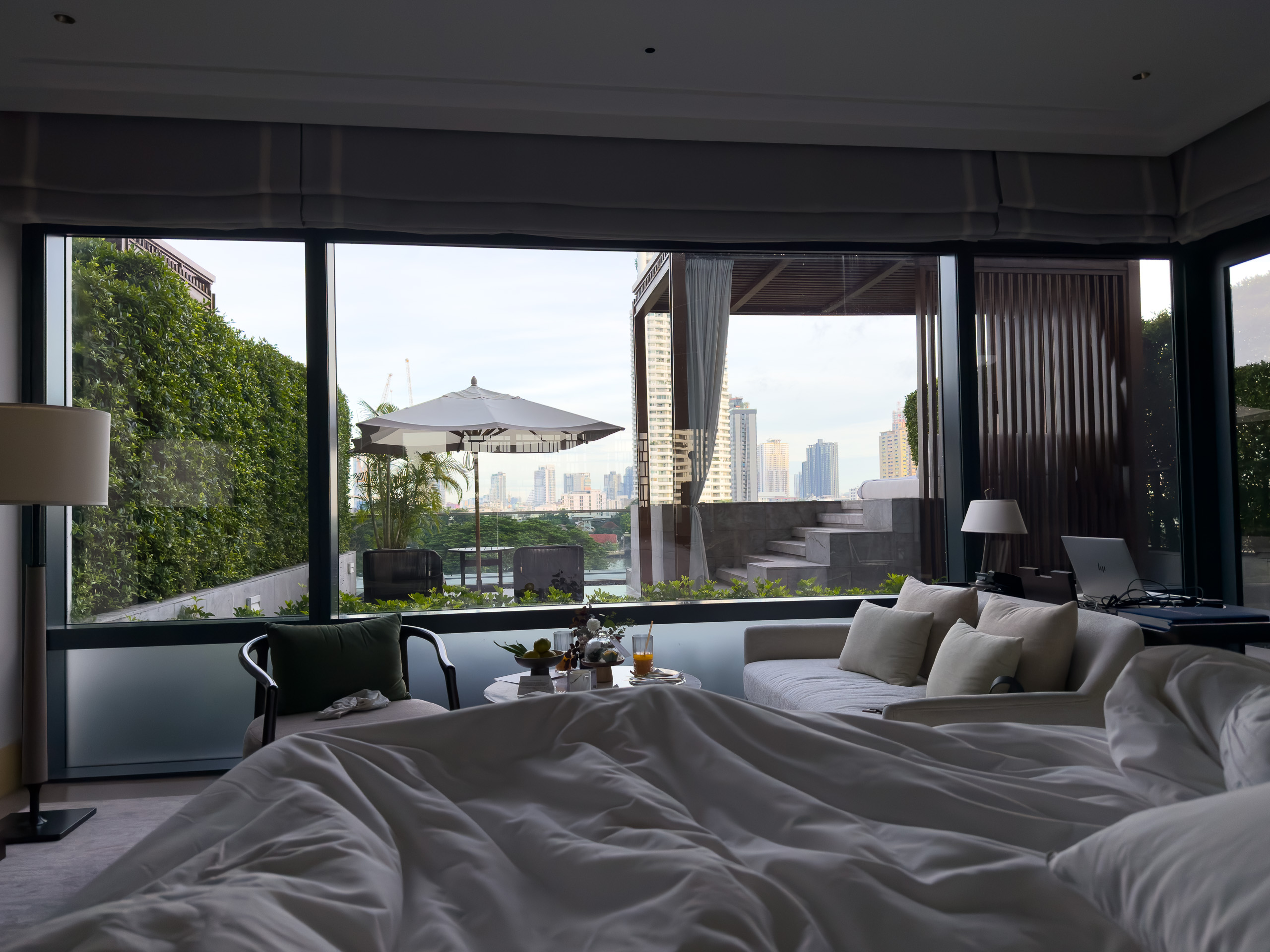
    Looking from the unmade bed through full-height glass to the terrace and the city
    From the unmade bed, mid-stay.
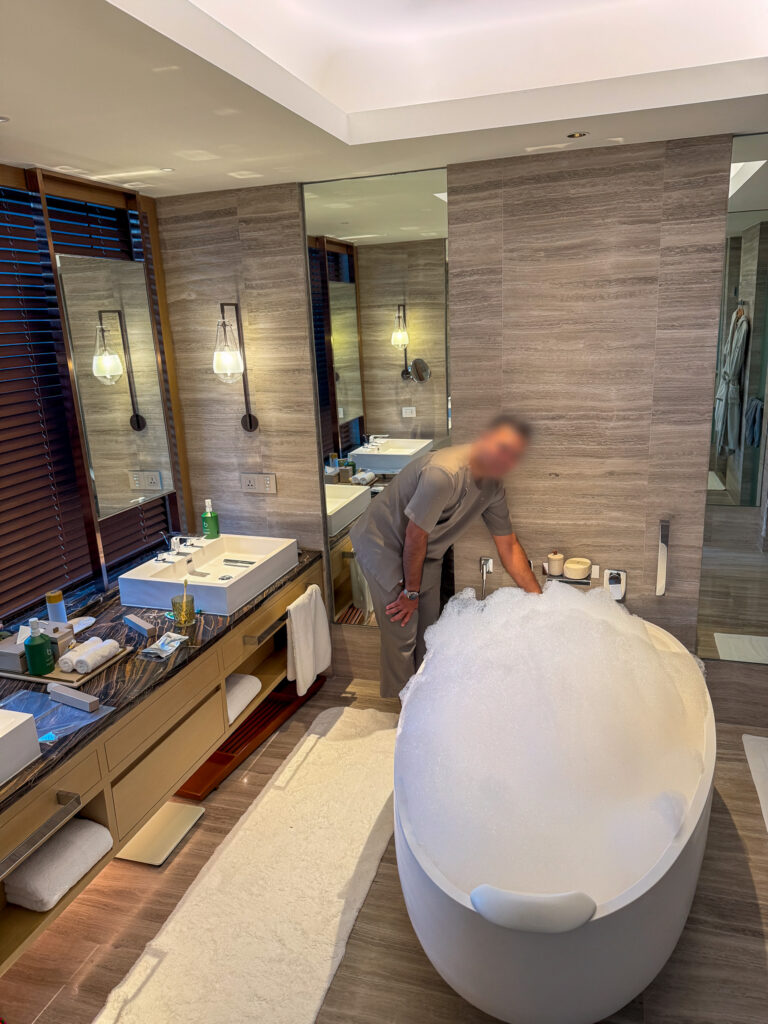
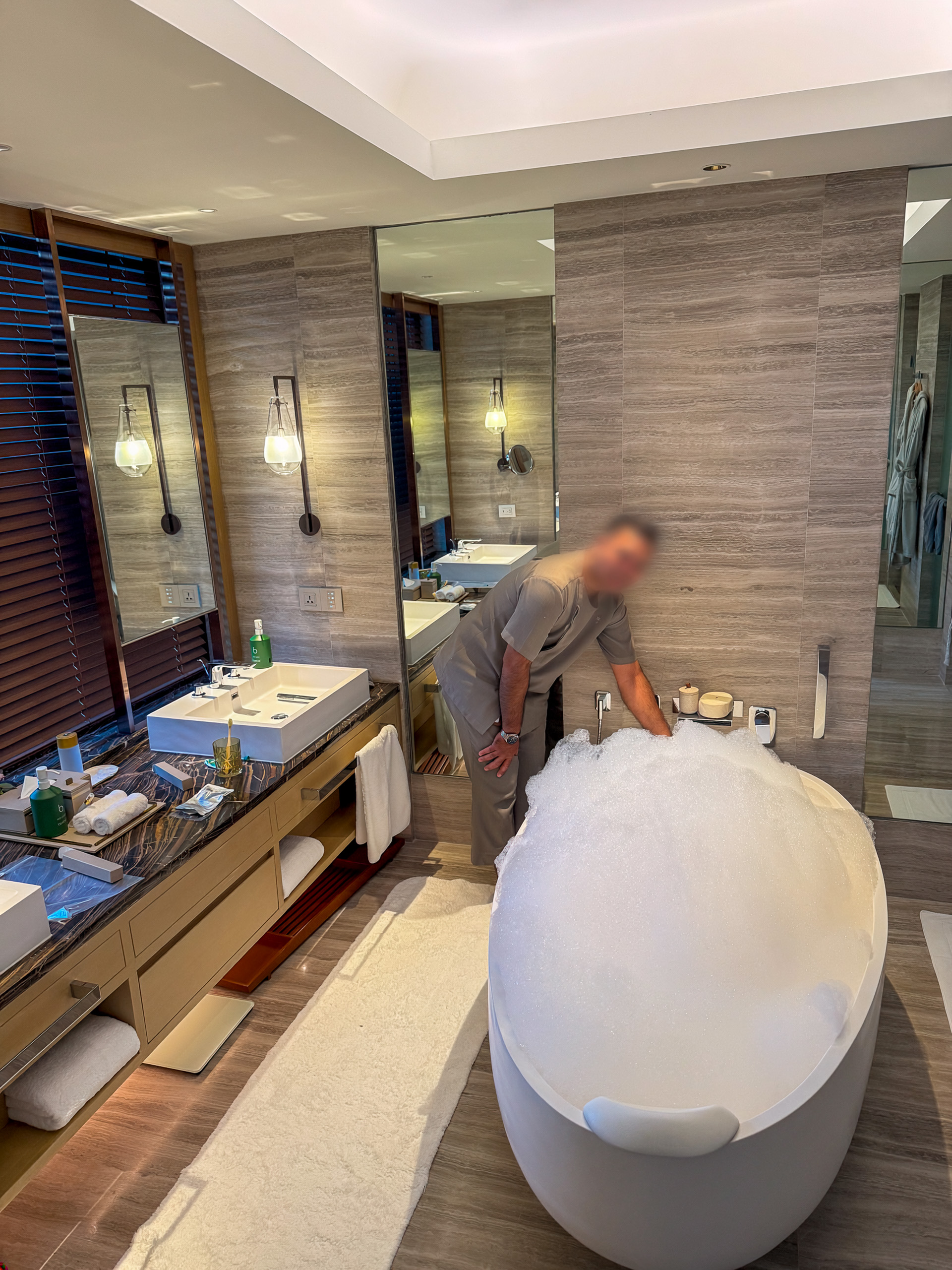
    A member of staff running a deep bath in the stone-lined bathroom
    The tub, stone all round, being run.
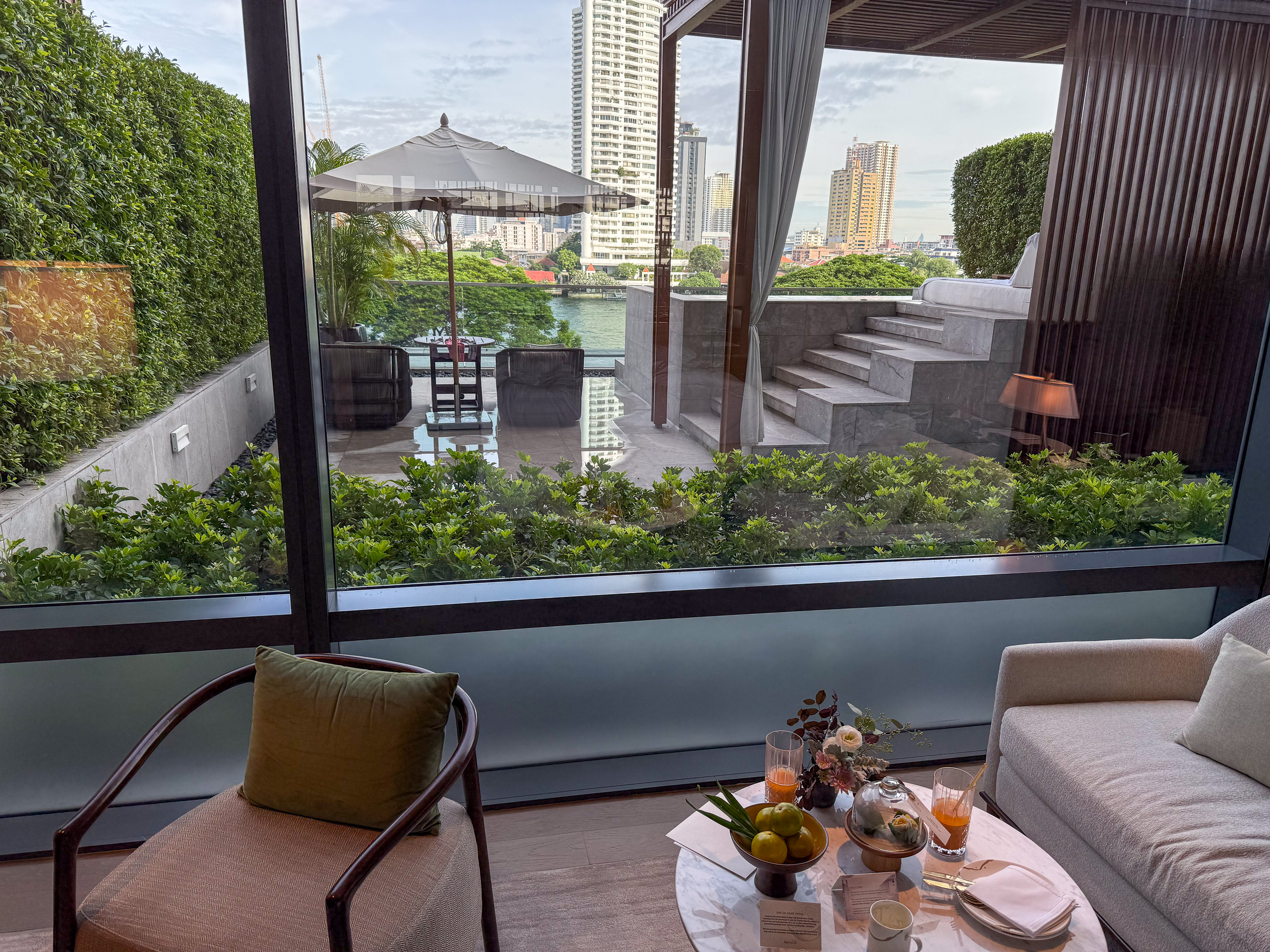
    The planted terrace and river seen from the living room, a drink on the low table
    The terrace, and the low table for the drink.

    Noted

    Observed on the stay, not measured.

    WhatChecked on the stay
    Wi-FiFast and constant
    NoiseSound blocked — perfect quiet, and the air conditioning is quiet too
    BedMedium-hard, and a true delight of a night’s sleep
    Blackout curtainsPerfect dark
    Lift waitUnder thirty seconds, and a concierge rides with you to ask what you need
    The bathAn attendant will draw it

    And from the same notes, the parts no table holds: water, juices, drinks, fruit and cake arrive at the room daily; flowers are everywhere; every member of staff knows your name; the happy hour is the best a hotel has ever offered us; and the sushi buffet at breakfast is a hidden gem.

    Eating

    I will say this carefully, because I do not say it often: the food at Capella came nearly equal to Sorn, which is the best restaurant in Thailand and which I have written up separately. That is not a sentence I expected to write about a hotel dining room.
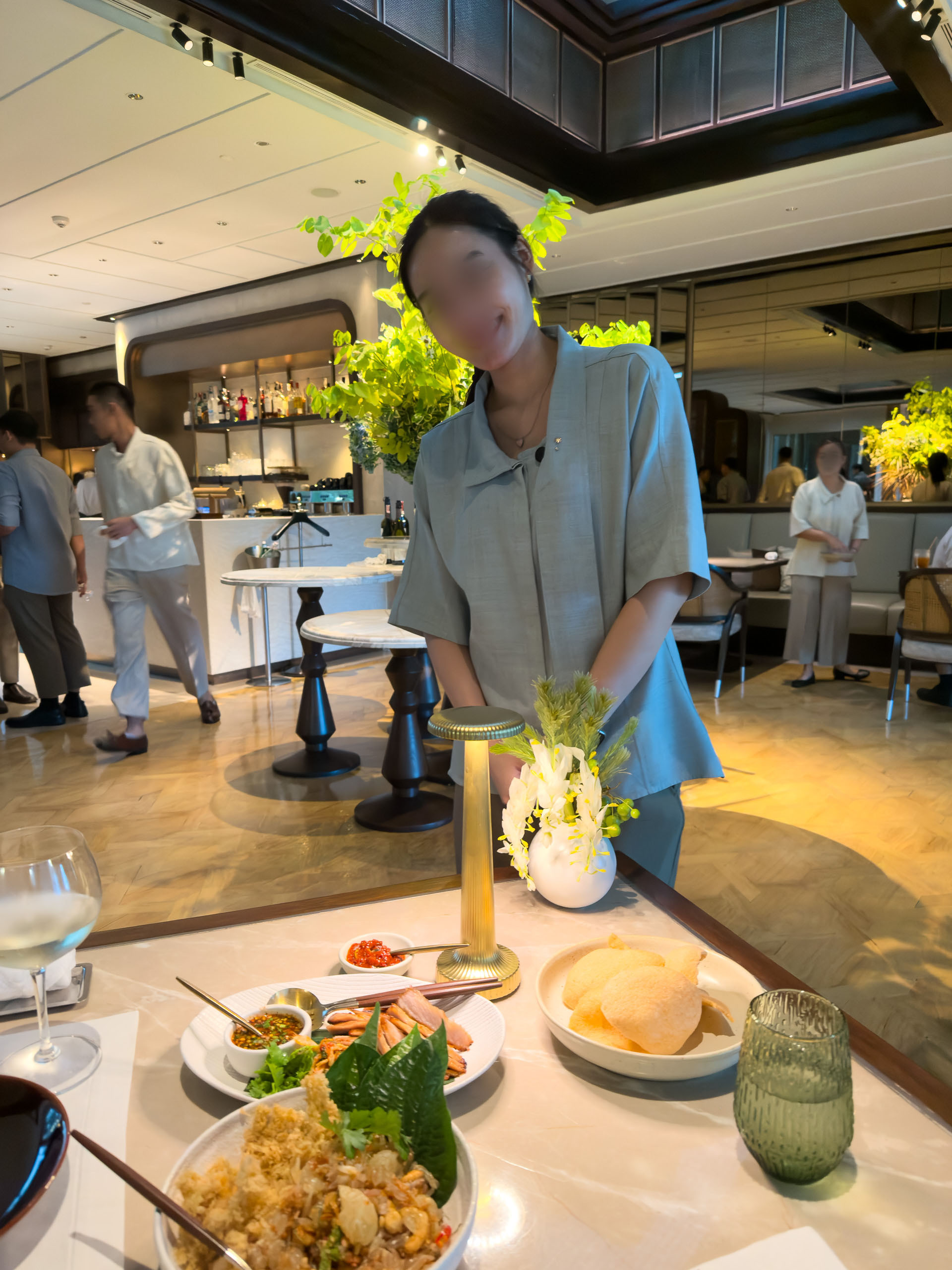
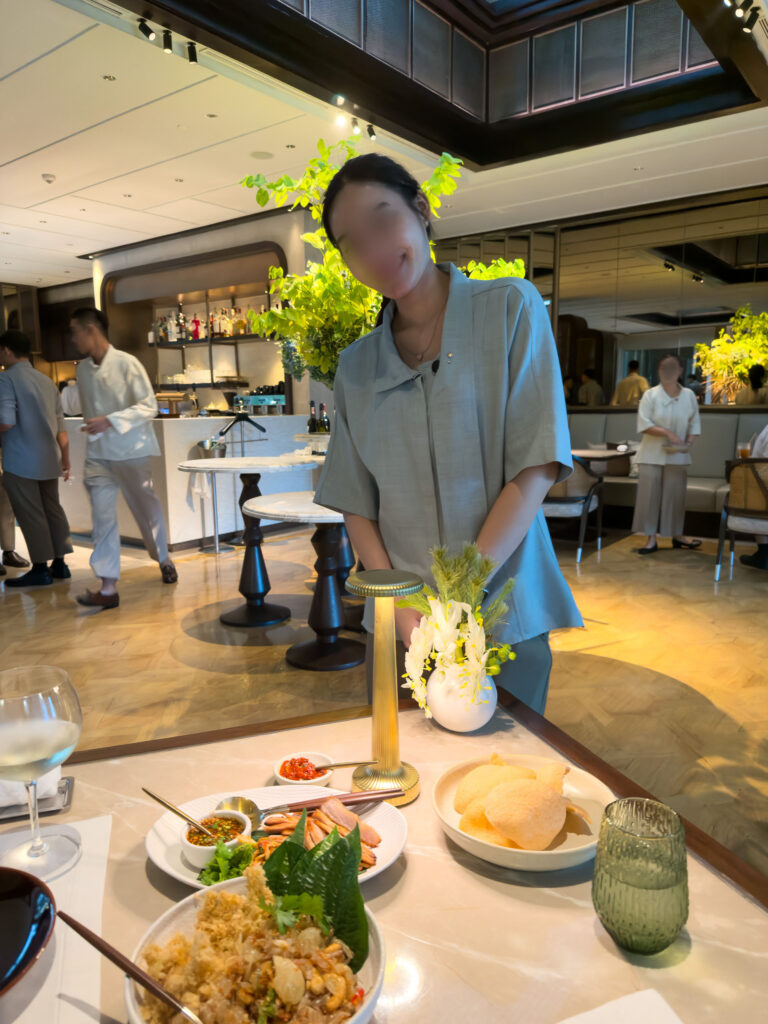
    A table of Thai dishes at the open counter, the kitchen team working behind
    Phra Nakhon’s open counter. Chef Kannika cooks to order here, and by the second night it was perfection.

    The reason is Chef Kannika, who runs Phra Nakhon, the hotel’s Thai restaurant, and who cooks to order if you ask her. On the first night we asked her to decide for us. On the second night we asked again, and it was perfection — I am not reaching for the word, it is the one I wrote down at the table. The crab curry you see below was equal to anything at Sorn.

    We asked if she would come out, and she spent twenty minutes with us explaining how she had done it, which involves sourcing spices from the far reaches of the country that I had never heard of and could not now spell. I have had chefs visit the table before. This was next level and equal to Chef Caroline at Kokomo. June, the most beautiful culturist, volunteered that the spices Kannika uses are special and impossible to source even for other Thai.
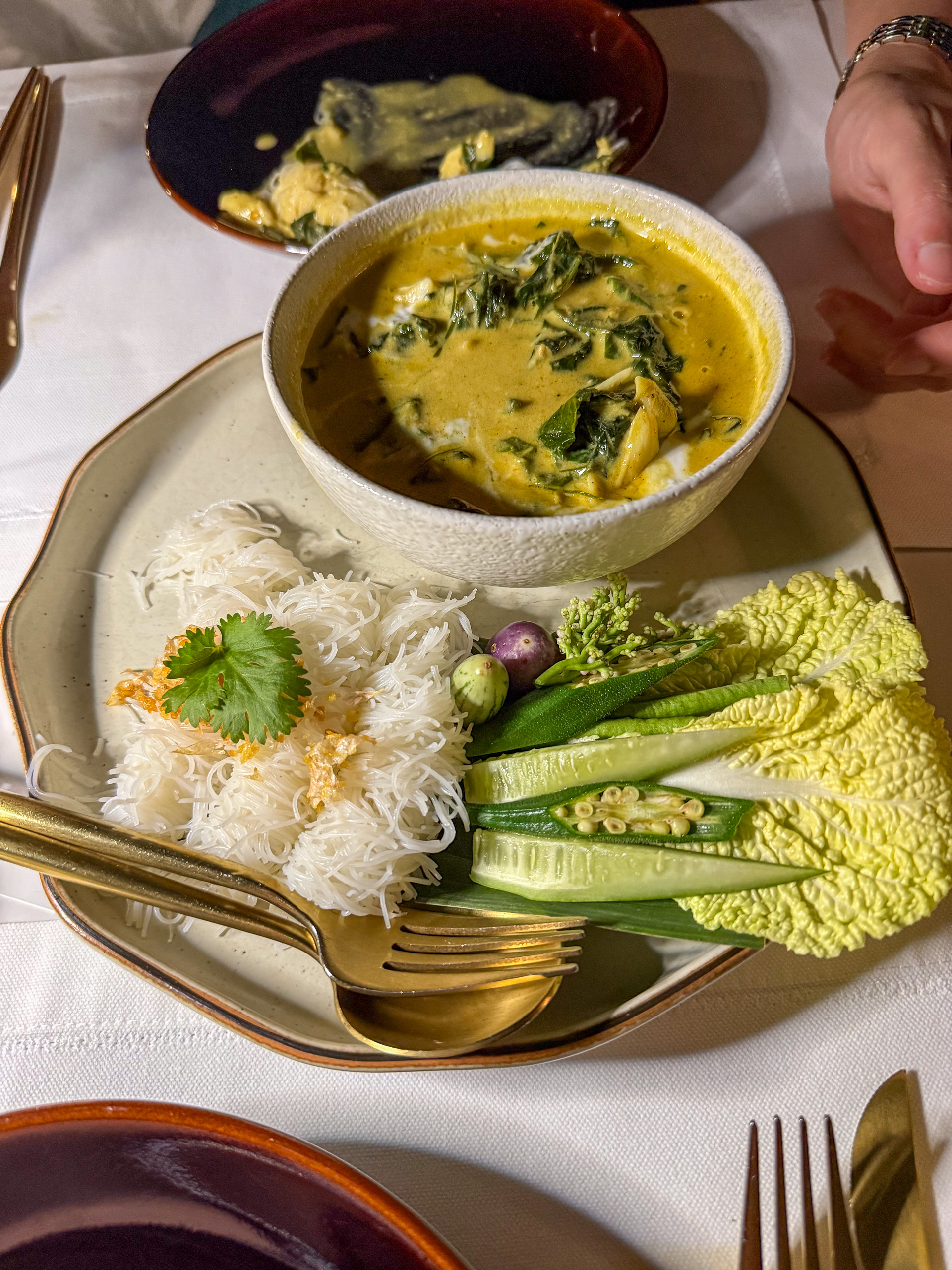
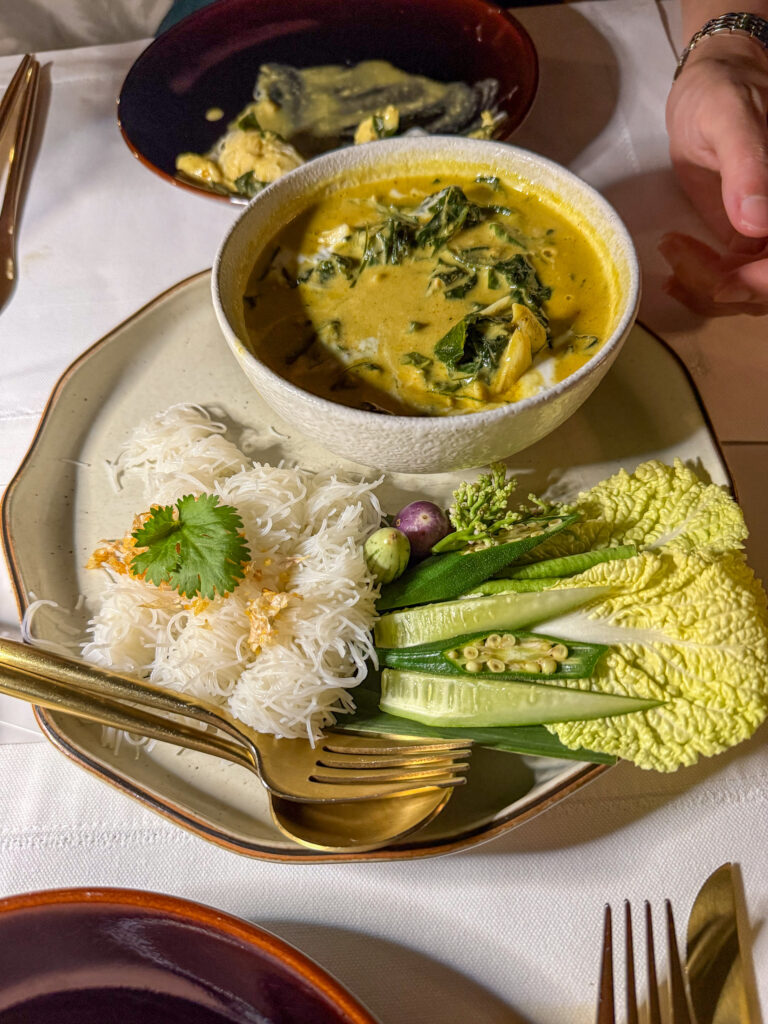
    A bowl of green curry with rice noodles, herbs and raw vegetables on a gold-rimmed plate
    Green curry with rice noodles and the raw vegetables.
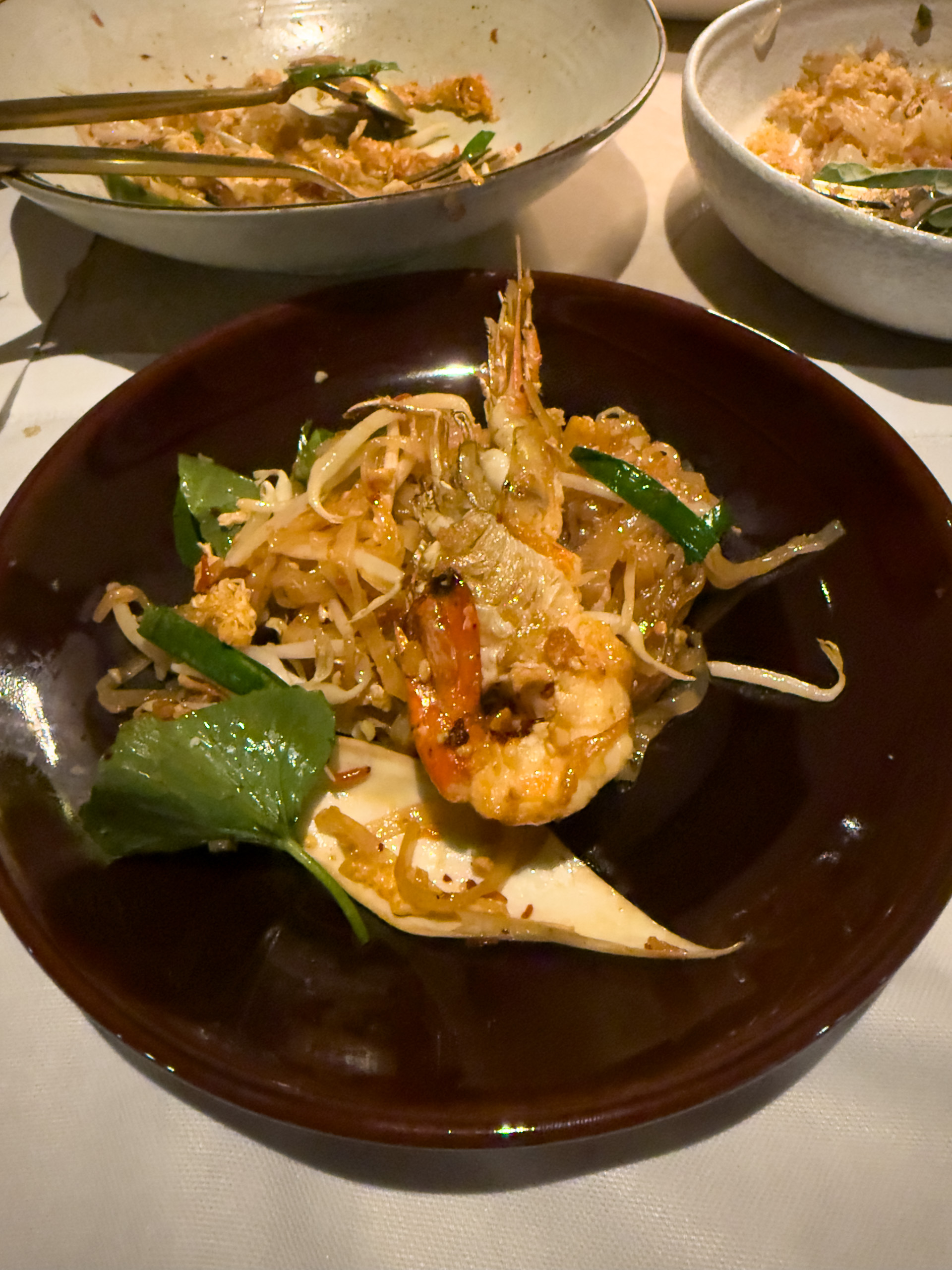
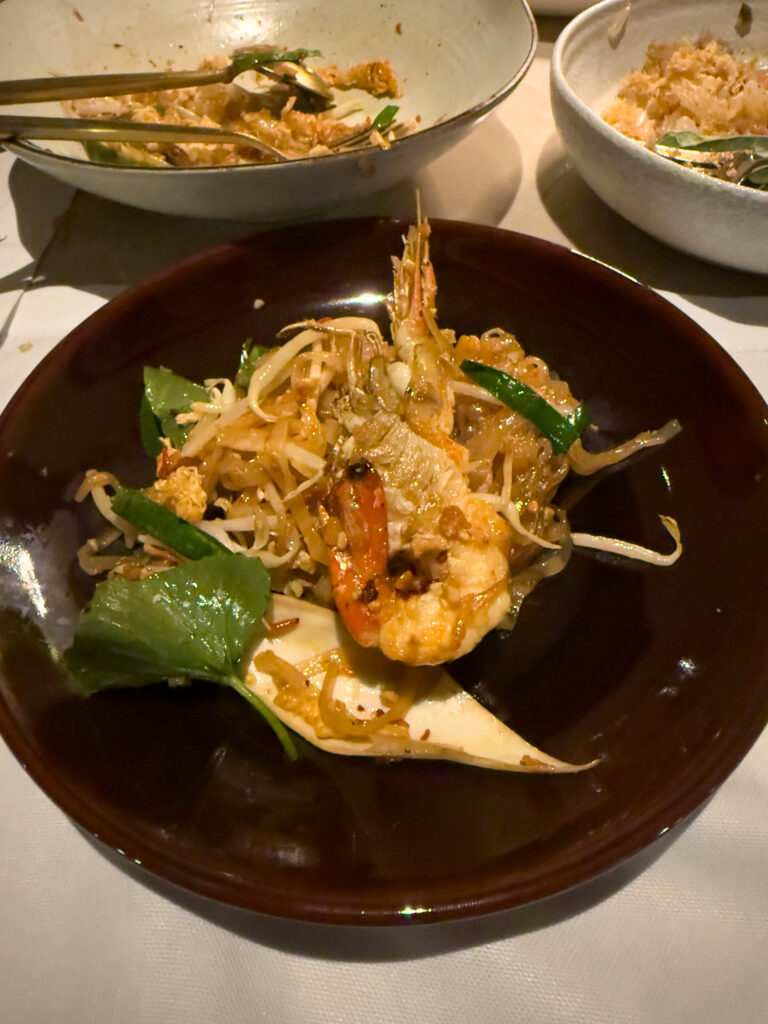
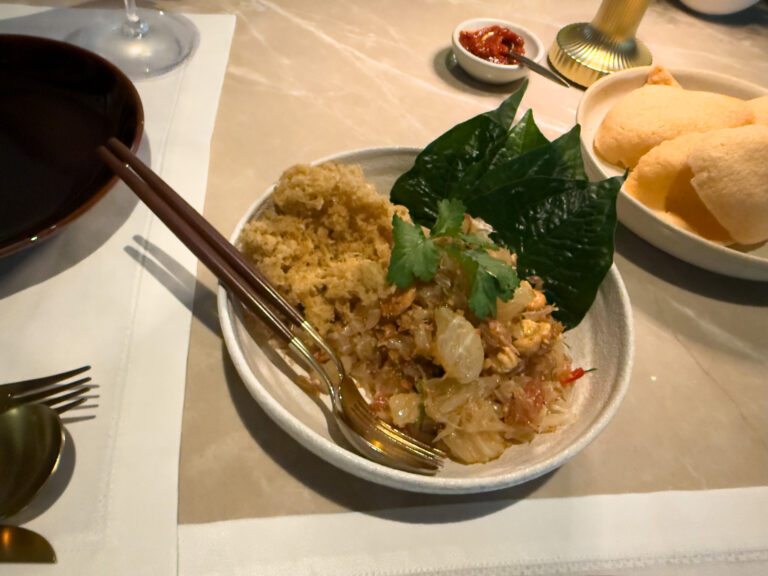
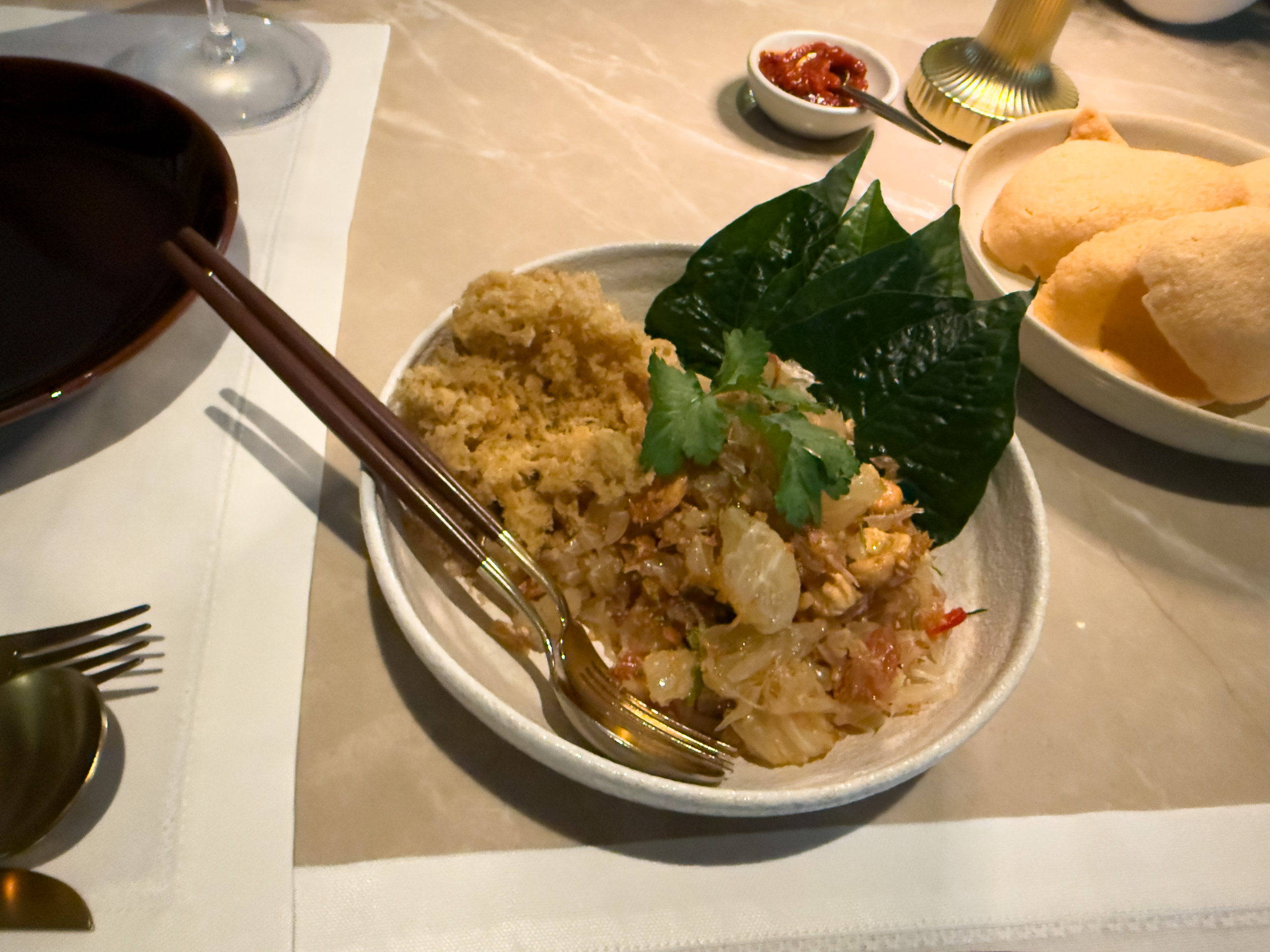
    Fried rice with crab served on a betel leaf, prawn crackers and a dish of chilli alongside
    Fried rice with crab, the chilli alongside.
    Bowls of noodles and rice set out together on a dark table
    Noodles and rice set out to share.

    The rest is very good and, next to that, beside the point: the Living Room will feed and water you all day without a bill appearing, breakfast on the river is the meal to have included, and the sommelier’s wine tasting, which comes with the stay, pours a Thai red that is better than the phrase “Thai red” suggests. There is a separate piece on the restaurants here.

    The garden, the art and the pool

    The site could have carried a tower and deliberately does not. The building spreads sideways so that every room faces the water rather than looking down on it, and from a boat the panel grid plays a trick: each apparent square is three storeys, not one. The gardens step down in tiers — lawns, a lily pond, old trees, the villas at the bottom on the river’s edge — and behind the hotel a greenhouse grows herbs and edible flowers for the kitchens, some of which reached the table that night.
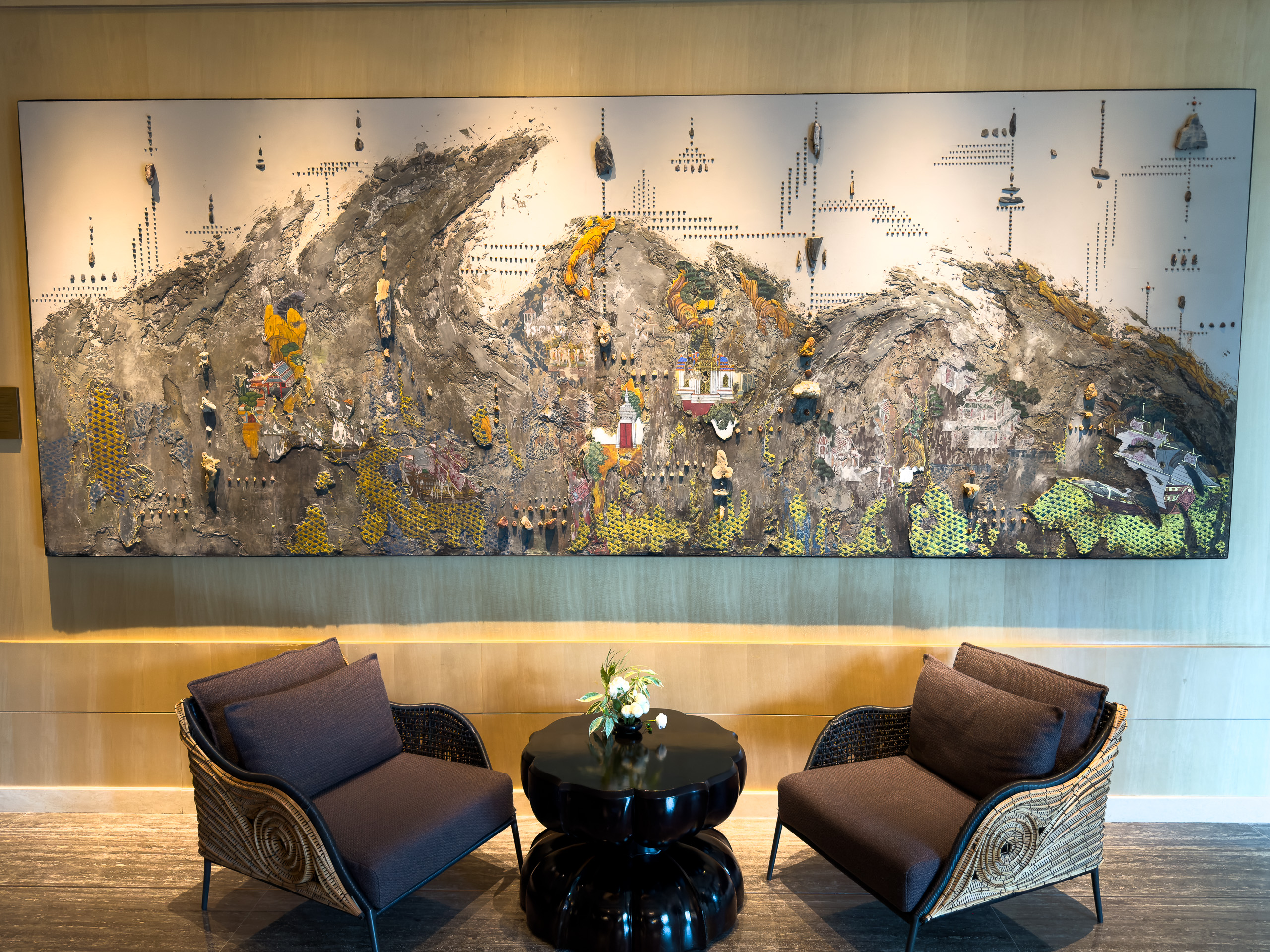
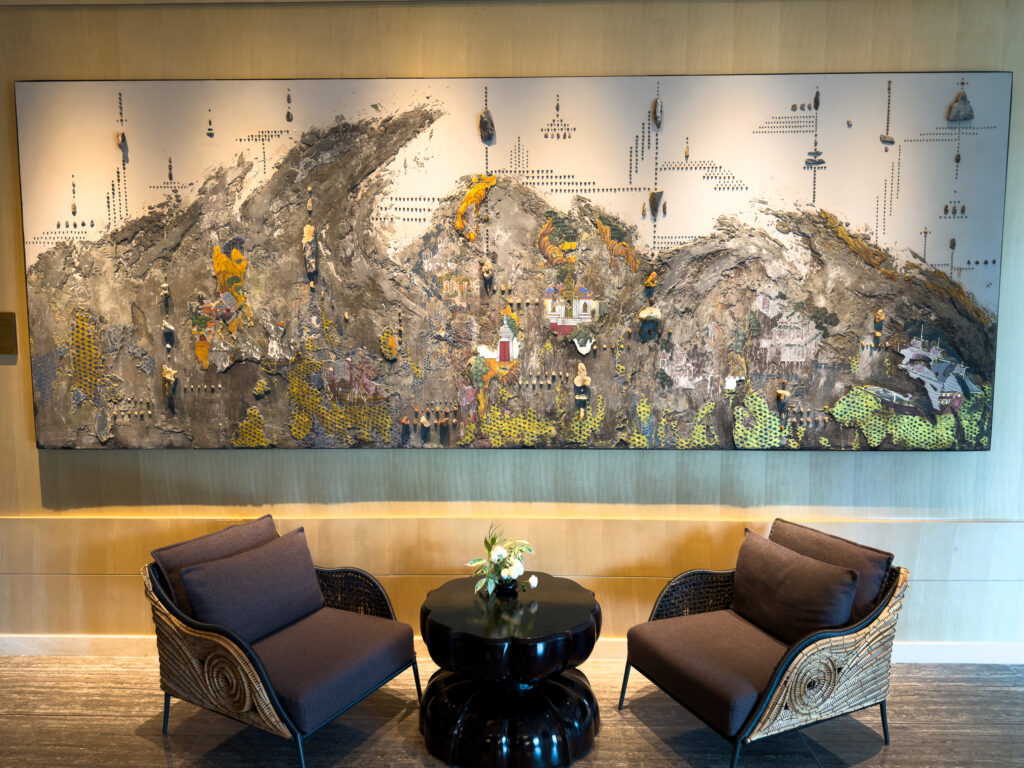
    A long textured landscape panel above two armchairs and a low black table
    One panel of the art programme, in a corridor. The tour takes an hour and is worth it.

    The art runs the length of the corridors and through the public rooms, much of it made in response to the river and to Charoen Krung, and there is a guided, unadvertised tour of it. Ask on the first morning rather than the last; you will walk those corridors twenty times either way, and it changes what you are looking at.

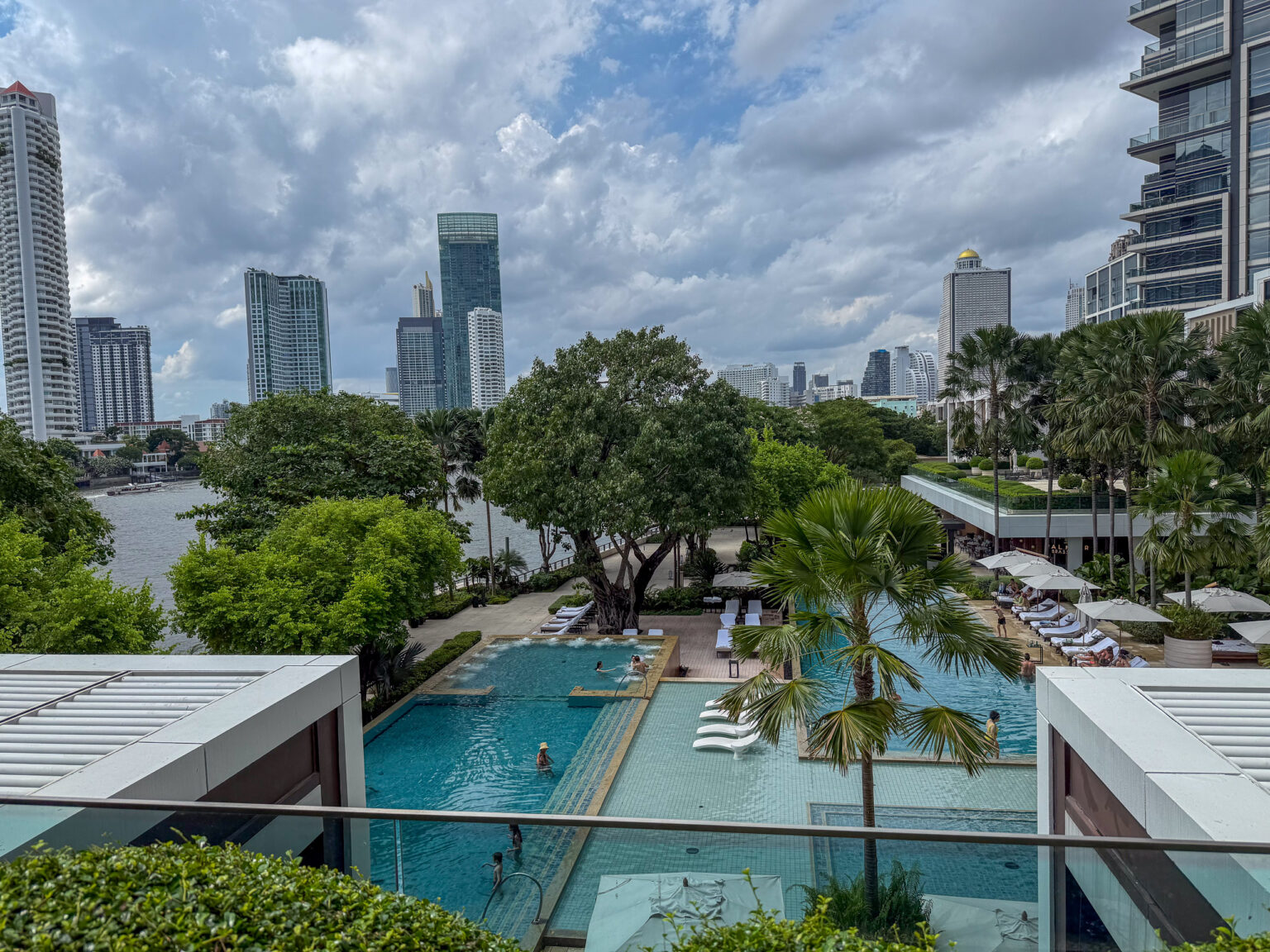
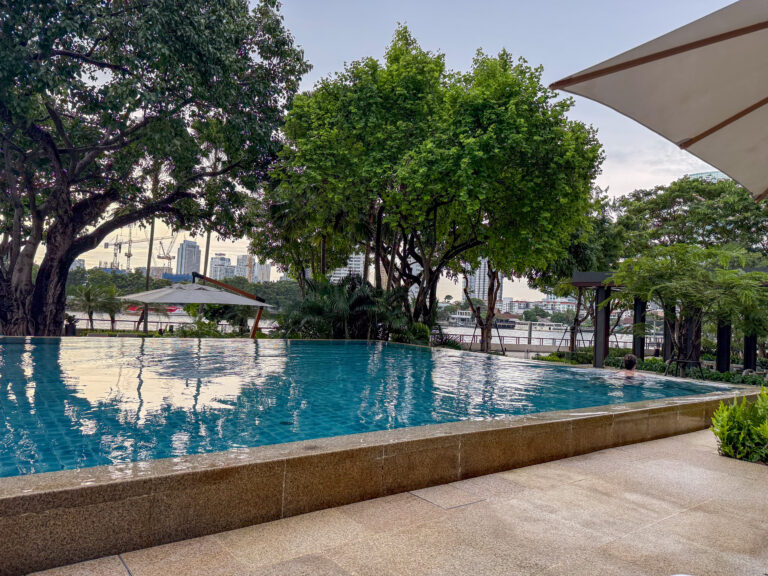
    The pool is a single infinity edge over the river, open around the clock, and it stays quiet. The spa is Auriga and it is very good. The gym is a genuine walk: lift, lobby, second lift, out past the villas and through a gate. By the time you arrive you have done the warm-up. The low riverside terraces draw mosquitoes at dusk; the Culturist will have already put the repellent in your room.

    Service moments

    This is the section the rest of the review exists to set up, so here is the list, and it is not complete.

    Two hours before dinner on a night we had nothing booked, I mentioned Gaggan. The Culturist did not say it was impossible, which it is. He said he would try. We had a table for two that evening.

    Walking past one of the restaurants on the way to the boat, I was greeted by name by staff I had never met. It happened again the next day. It took me until the third time to work out that the Culturist was calling down as I passed, so that nobody in the building would ever have to ask who I was.
    A member of staff carrying plates through the suite, the garden through the glass
    Plates carried through the glass to the suite. Nobody asked for this; it was volunteered.

    I was late for the boat once. The person who saw it was not my Culturist and did not have a radio in her pocket; she was from the front desk, and she ran — sprinted, in uniform, down the garden — to hold it. I have thought about that more than about anything else on the stay. Nobody had asked her to. I did not know the front desk could sprint. I suspect it is not in the manual.

    They volunteered help for things I did not know could be helped with (get the bubble bath drawn!). They never missed anything: not a preference mentioned once, not a time, not a name. And the chef came out and brought the spice. All done with a genuineness that I do not believe can be faked at this scale. Service at this level is not a series of tasks done well. It is people paying attention to you, continuously, without making you feel watched, and I have not found it better before or since anywhere else on the planet. If I ever find it better I will update this statement.

    I have been looked after in a great many hotels. I have never been looked after like this.

    Who it is for, and who it is not

    Come if you want to find out what service can actually be, and give it three or four nights, which is the length the place is built for. Come in the rains if the calm is what you want; come in the cool season if the view is the point, and book well ahead. Ask for height; the upper floors get the sightline. Ask Chef Kannika to cook for you on the first night rather than the last, so there is a second night. Take the boat to Sathorn at least once, and be on time for it, or do not, and see what happens.

    Look elsewhere only if you would rather be left alone. If you are a grump. If you have something against the world. Or still come. And this place will help. Some people want a hotel that treats them as furniture, and there are excellent ones a few minutes up the same river. This is not that. Oh and if the picture in your head is a blue river (beautiful but deceptive art from Four Seasons), the Chao Phraya is going to disappoint you at any hotel, so you may as well be disappointed here. Go here instead.
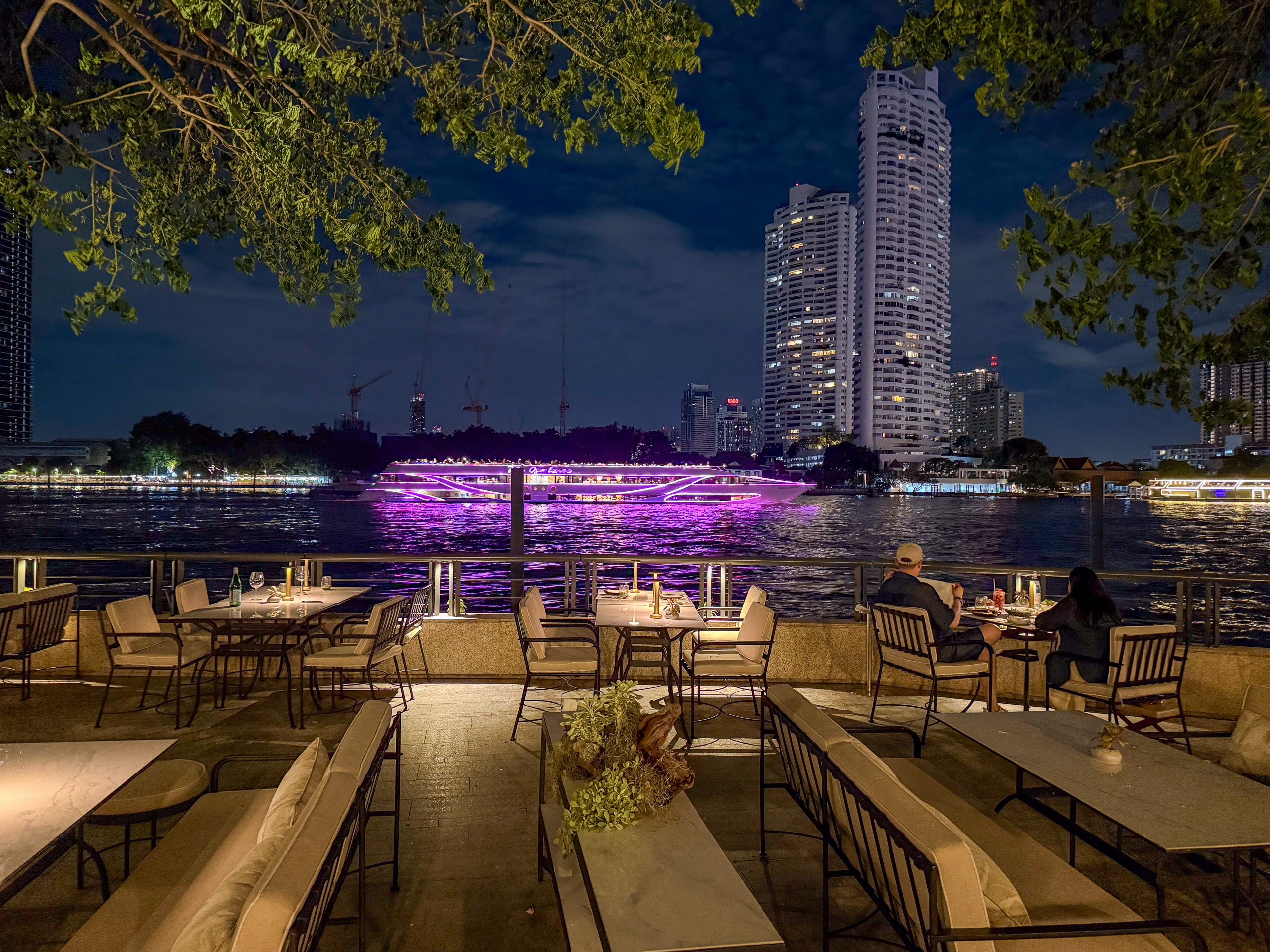
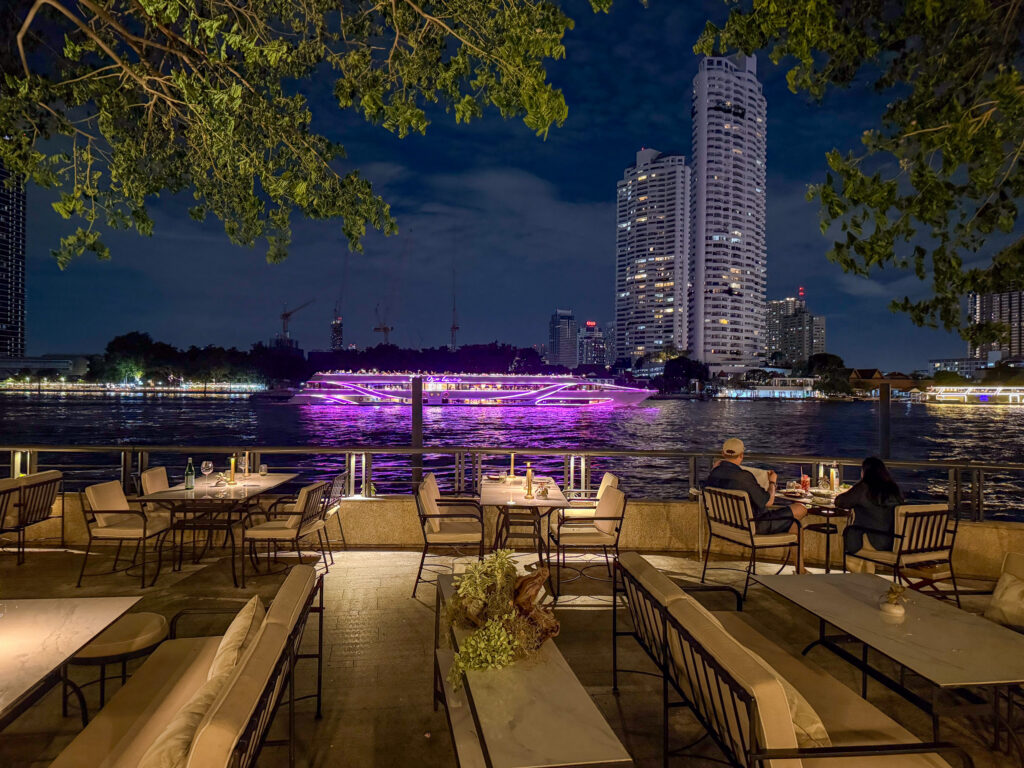
    The riverside terrace after dark, the bridge lit purple across the water
    The terrace after dark, the bridge lit purple. The karaoke boats are out of frame and audible.

    Bottom line

    Capella is the best-run hotel I have stayed in anywhere, and the kitchen is close behind. Book a third-floor Riverfront room for three or four nights and let them look after you.

    See the full set: Capella, Bangkok — in frames. More Bangkok: the Bangkok set.

    The Capella Bangkok gallery

    Every photo on this site is my own, shot on the stay. Slide through →
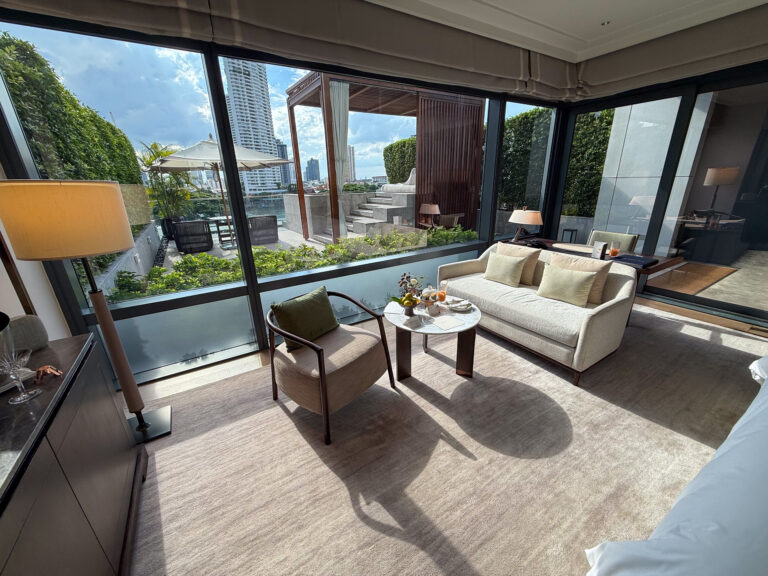
    A corner living room glazed on two sides, sofa and armchair facing the terrace plantingTables under canvas parasols along the river, boats passing beyond the railA long stone table laid with pastries and breads, a chef working at the range behindSofa and armchairs by the window, sun hats left on the seat backCut glass tumblers of whisky beside dumplings and a bowl of crisps on a mirrored tableA marble doorway with a figure beyond, patterned floor running throughThe edge of the plunge pool with the city skyline under heavy cloudTwo canapes on a stone stand with a menu card and a glass of whiskyThe open kitchen at breakfast, baskets of fruit along the pass and cooks at the rangeTiered stands of condiments and preserves on a marble table, greenery above
  • Dining at Capella Bangkok: Two Michelin Stars Upstairs, and the Better Meal Downstairs

    A private plunge pool on a suite terrace looking over the Chao Phraya to the towers of Bangkok

    BANGKOK, THAILAND · RESTAURANT · 9 MIN READ

    Dining at Capella Bangkok: Two Michelin Stars Upstairs, and the Better Meal Downstairs

    Five places to eat, one of them with two stars, and the meal that stays with you is the Thai room on the water two floors below it.

    By J.C. Mercer

    Verified meal·paid in full

    • Covers Two, dinner on the riverside terrace
    • Dined July 2026, during a two-night stay at the hotel
    • Menu À la carte at dinner, and breakfast at the same tables in the morning
    • Drinks By the glass from the list. No pairing is sold with the food here
    • How it was booked The way any other guest would

    Every meal on this site is booked the way any other guest would book it.

    Capella Bangkok has five places to eat and one of them holds two MICHELIN stars. That is the sentence the hotel gets written up on, and it is the wrong way round. The two-star room is upstairs, and plenty of people who sleep here never get inside it. The meal they leave describing is downstairs, at a marble table under a white umbrella with the Chao Phraya at eye level.

    Everything here takes non-residents, so you do not need a room key to eat in it.

    The room on the water

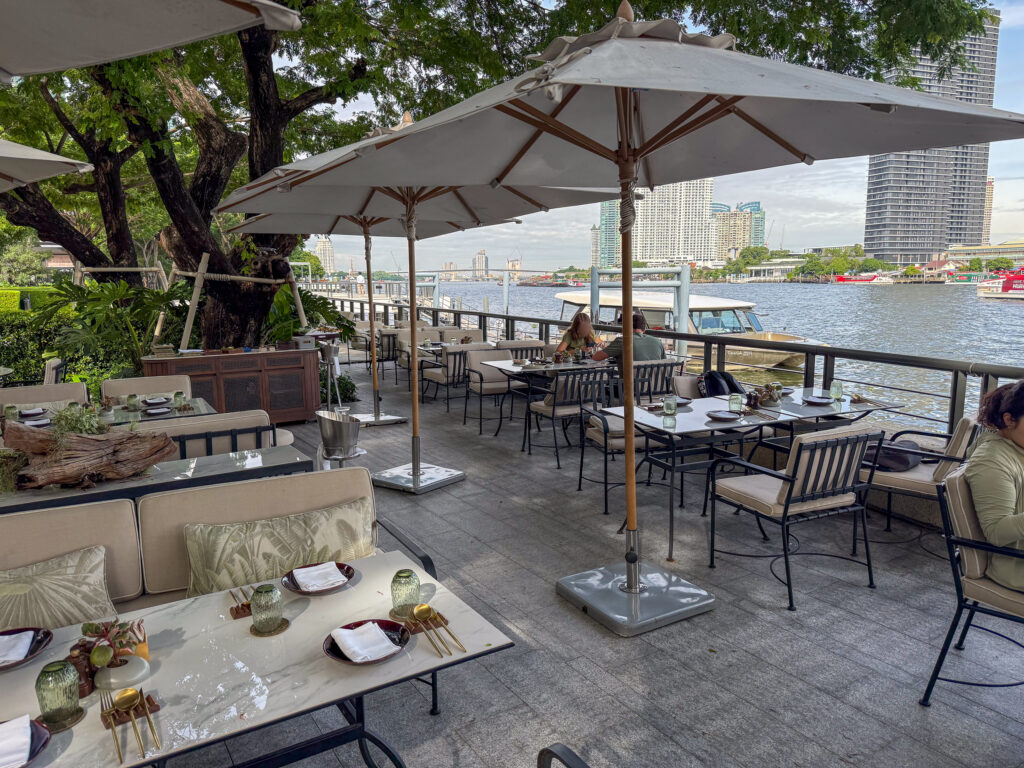
    White canvas umbrellas over marble tables set for lunch on a riverside terrace, boats moored on the Chao Phraya and towers across the water
    Lunch laid on the terrace. The tables sit at the water’s edge rather than above it, which is the whole difference.

    Phra Nakhon is the Thai restaurant and the room that does the most work. It sits on the lower lobby, a glass conservatory opening onto a tree-shaded terrace at the river’s edge, where almost nobody chooses to sit indoors. Breakfast starts at half past six and the kitchen runs through to eleven at night.

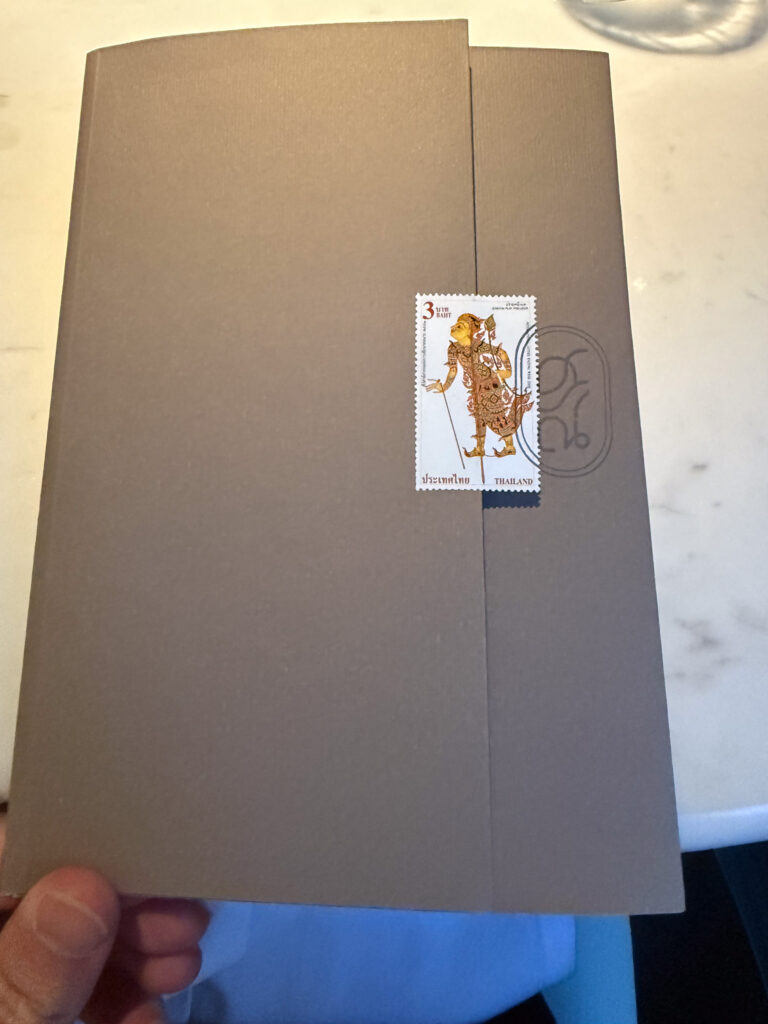
    Kannika Jitsangworn runs it, cooks south, and buys her own seafood. Much of the leaf and herb comes from a greenhouse behind the hotel that also supplies the two-star kitchen upstairs. The menu states its case on the cover: rustic family recipes, standing relationships with farmers and fishing families, and a strapline reading Evoking Memories of Old Siam. Heavy positioning for a hotel Thai restaurant. The food carries it.

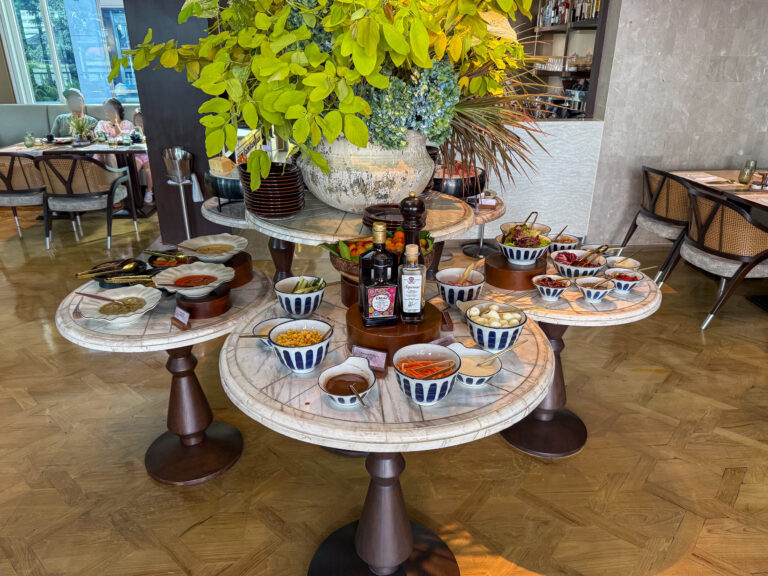
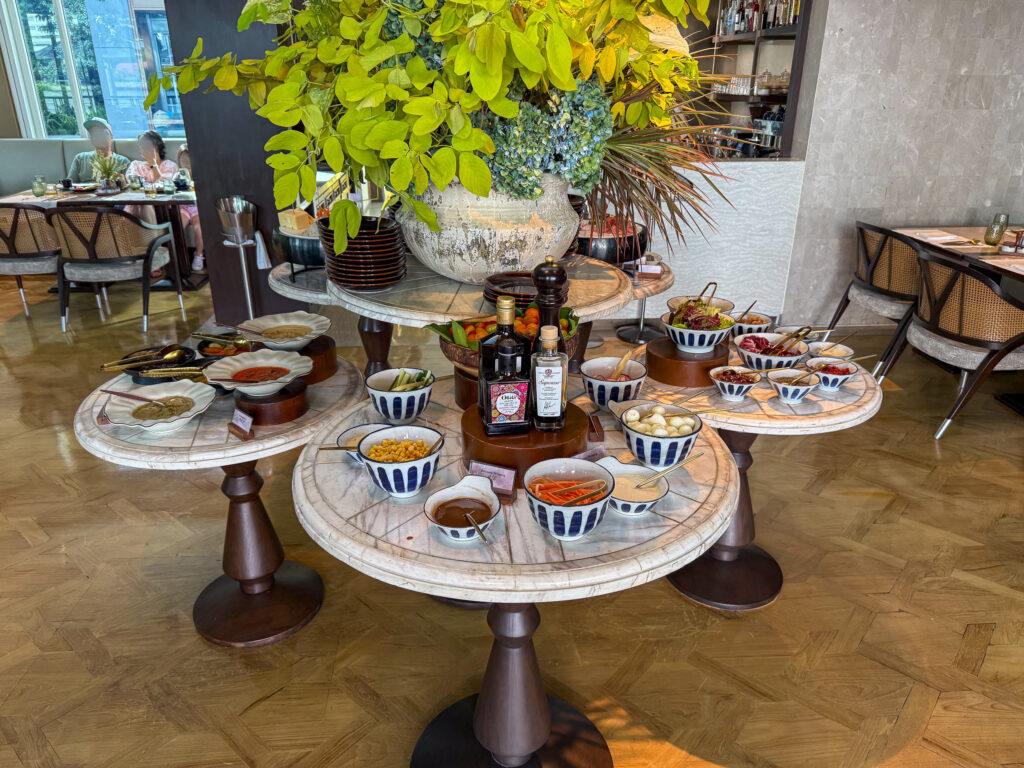
    Tiered marble tables laid with Thai curries, relishes and condiments in blue-and-white bowls beneath a tall arrangement of foliage
    The relish and curry stands. Blue-and-white bowls, tiered marble, and a foliage arrangement doing the work a buffet sign usually does.

    Karaoke boats work this stretch of the river after dark and carry across to the terrace, cheerfully rather than intrusively, until the noise rules bring the water quiet at about half past ten. Book at eight and you get the boats; book at ten and you get the hush.

    Long Chim, and a menu organised by region

    The set menus are the reason to come, and they are built by region rather than by course. Two Long Chim lunch sets, seven courses each, sold for two people. One I-san, from the north-east; one Pak Tai, from the south. You do not mix them.

    The I-san set runs grilled beef on betel leaves, green papaya salad, house-fermented pork with crispy rice, a whole fish char-grilled in banana leaf, and sticky rice with longan. Take the southern one if you take only one: turmeric-battered baby shrimp, grilled squid in kaffir lime, a hot-and-sour curry with heart of palm and Phuket pineapple, Phuket-style braised kurobuta pork belly, and banana prawns with stink beans and shrimp paste. Lunch as it lands.

    A bowl of yellow curry with rice noodles, raw vegetables and gold cutlery on a white linen table
    Yellow curry with rice noodles, and the plate of raw vegetables that is supposed to come with it and usually does not.

    Off the sets, order the wok-fried roasted pork belly with crispy chilli and garlic, and the crab and betel-leaf curry with vermicelli. Children’s menus exist across the restaurants, which is not always true at this level.

    Breakfast is the same room and a different proposition: a small, very good cold table and an à la carte list on a tablet that runs to pages. Order the pad kra pao with an egg, and the coconut water, served in a shell shaved so precisely the staff will tell you, deadpan, that they send it out to be done. It is also the one meal here with a reliability problem: a broken hollandaise returning re-plated rather than remade is what this room does on a bad morning. High ceiling; uneven floor.

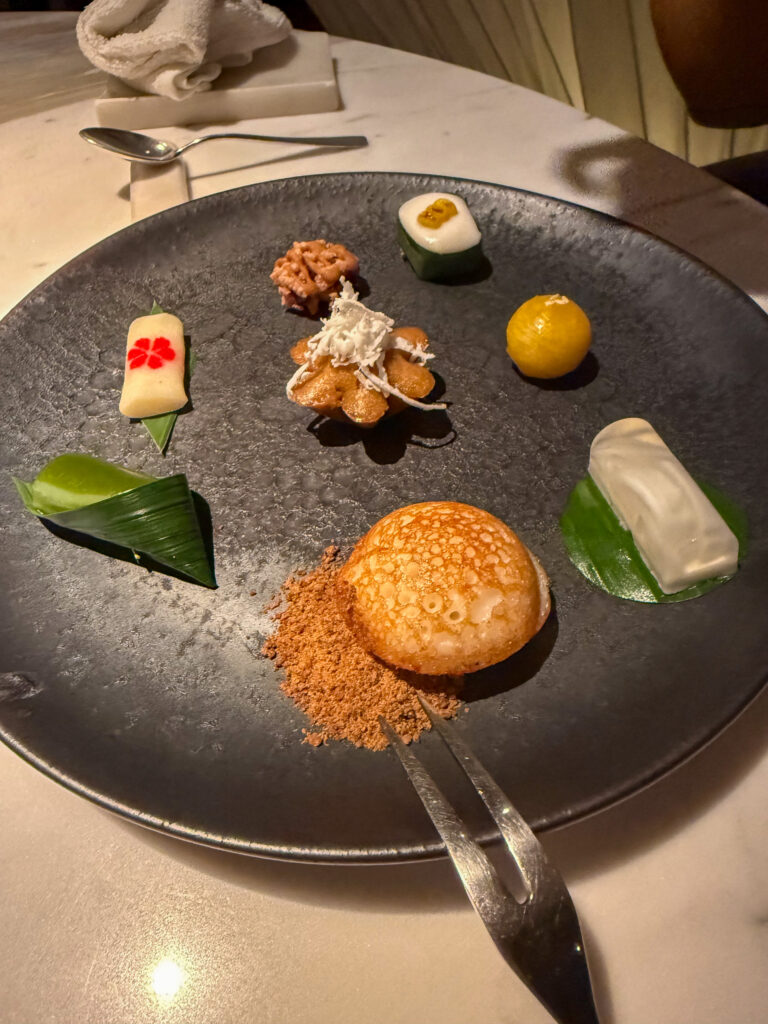
    Six Thai petits fours arranged on a dark stone plate on a marble table, one folded into a banana leaf and one dusted with palm sugar
    Thai sweets, six to a stone plate. One folded into banana leaf, one under palm sugar; the pastry side of this hotel is a serious operation.

    Two floors up, and no menu at all

    Côte by Mauro Colagreco cooks the Riviera, Nice to Genoa, and has held two MICHELIN stars since the 2025 Thailand selection, having gone in with one. Colagreco is the name on the door; he does not cook in Bangkok. This kitchen belongs to Davide Garavaglia, on the Mirazur team from 2015, chosen to open the room in 2020, and holder of the Thailand Young Chef award of 2023.

    There is no printed menu and nothing to choose from. Every service is a carte blanche: the kitchen decides, it changes with what arrived that morning, and the only question is what you cannot eat. Lunch is four courses, the long menu nine. Around them comes a commentary of things that are not courses – bread with a poem attached, olive oil infused with Menton lemons and made for these two restaurants alone, and a raw cut brought to the table before it is cooked.

    Almost nothing is permanent. One thing is: a beetroot macaron filled with goat’s cheese cream from Hua Hin, held over menu after menu because guests will not let it go. The other fixture is volume – seven courses eat like twelve. Pace yourself, and do not eat lunch before you eat lunch.

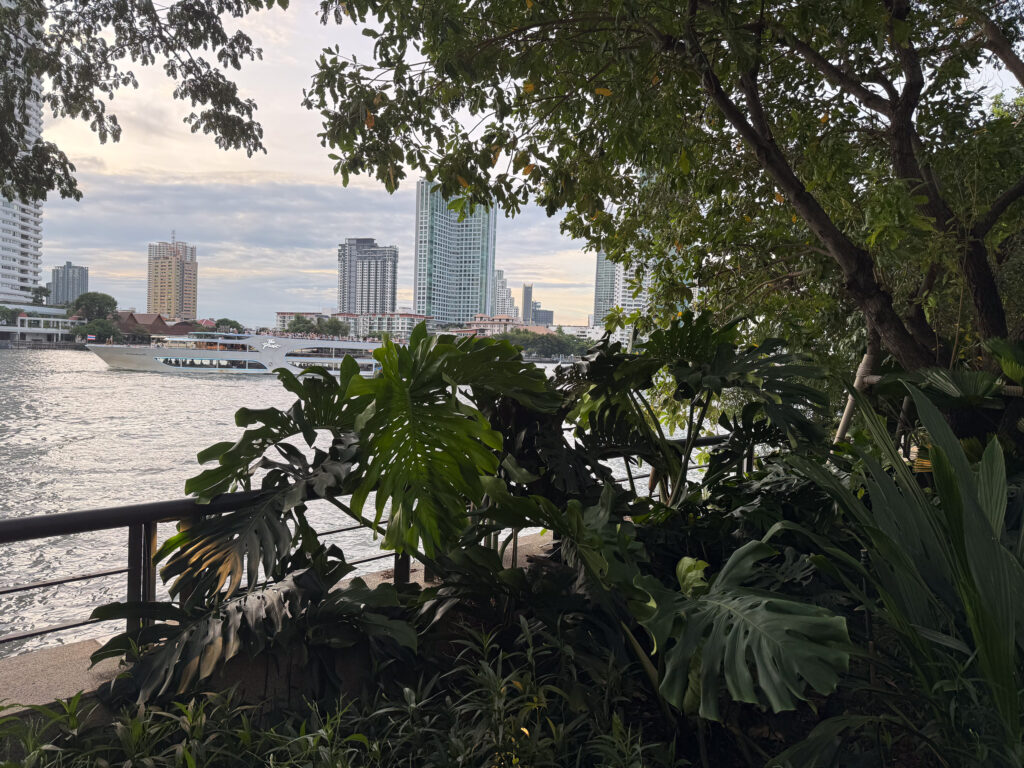
    Monstera and palms along a railing above the Chao Phraya at dusk, a river boat passing and the city skyline beyond
    Six o’clock on the river. The dusk here lasts about twenty minutes and it is the reason to take the first dinner seating rather than the last.

    The cellar is the other argument: over 550 labels, most organic or biodynamic, and the deepest run of grower Champagne in the city. A sommelier-led tasting at Côte comes with the stay, and the pour people remember is a Thai red. Ask for it.

    The four-course lunch is the quiet coup: the same kitchen and team as dinner, at midday, with the terrace light thrown in.

    The bar, the tea, and the golden hour

    Marble tables and cushioned chairs on a riverside terrace at night, a violet-lit cruise boat crossing the Chao Phraya and the Bangkok skyline behind
    The same tables after dark, with a dinner cruise going by lit violet. This is the hour the terrace is worth booking for.

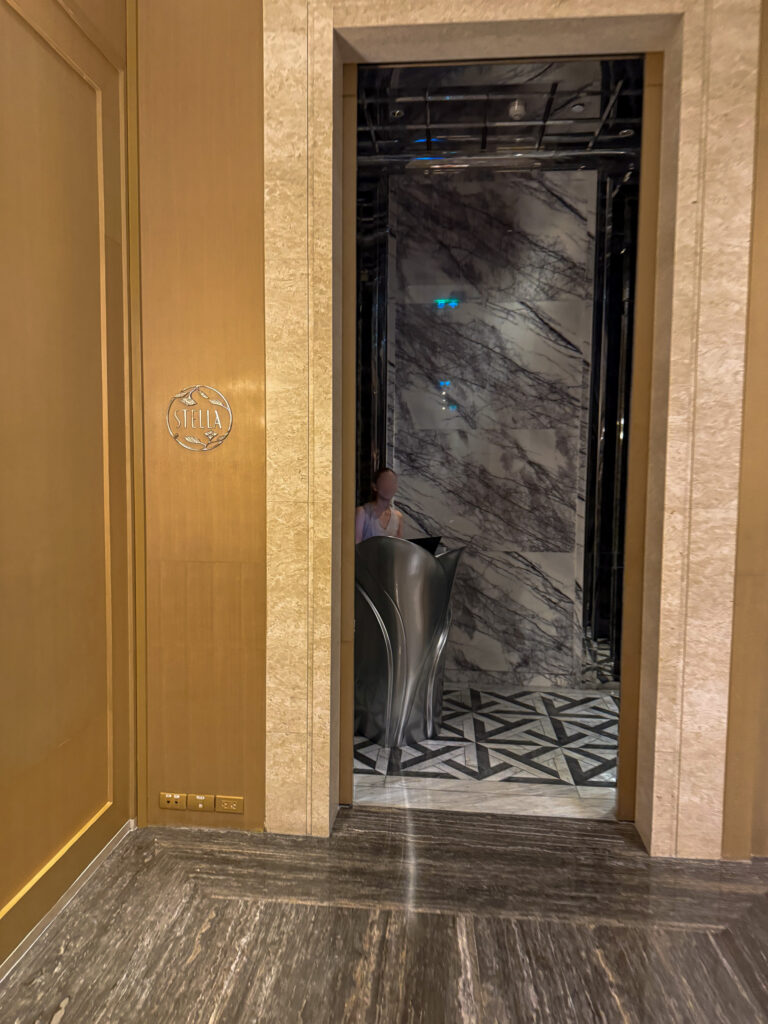
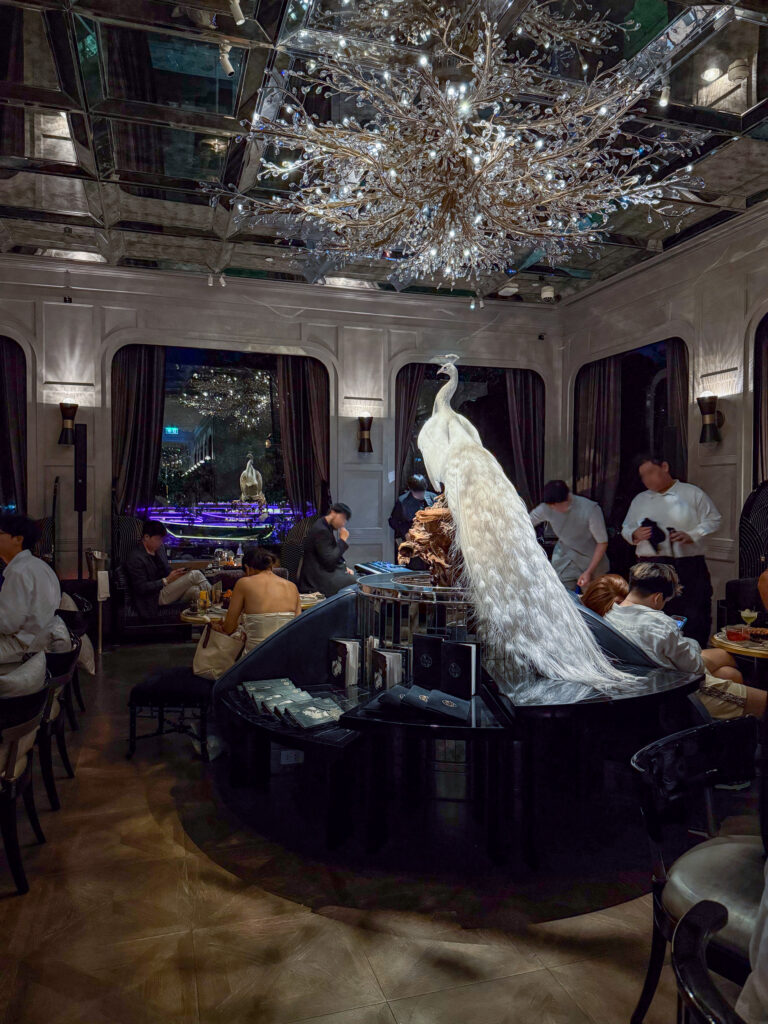
    Stella opens at six: small, deliberately theatrical, marble and frescoes, wicker peacock chairs, a chandelier built to look like the Milky Way, and a taxidermy white peacock holding the floor. The list is Journey into the New Siam, each drink pinned to a Bangkok neighbourhood; order the Bangkok Noir, bourbon and black orchid with Campari and two vermouths. Two hard facts: music starts about a quarter past nine, and alcohol service stops at eleven though the room is open to midnight.

    A lobby lounge with a striped sofa and carved timber screens, tall windows looking out to a reflecting pool and gardens
    The lobby lounge, which is where afternoon tea is served. Carved timber screens, and windows onto the water garden.

    Afternoon tea is in the lobby lounge over the lily pond, from noon. The current one is a limited chocolate collaboration running to October 2026, sold by the head or as a set for two. Two things catch people out: it is sold by the set, minimum two, and tables cannot be reserved individually – first come, first served, so arrive at noon.

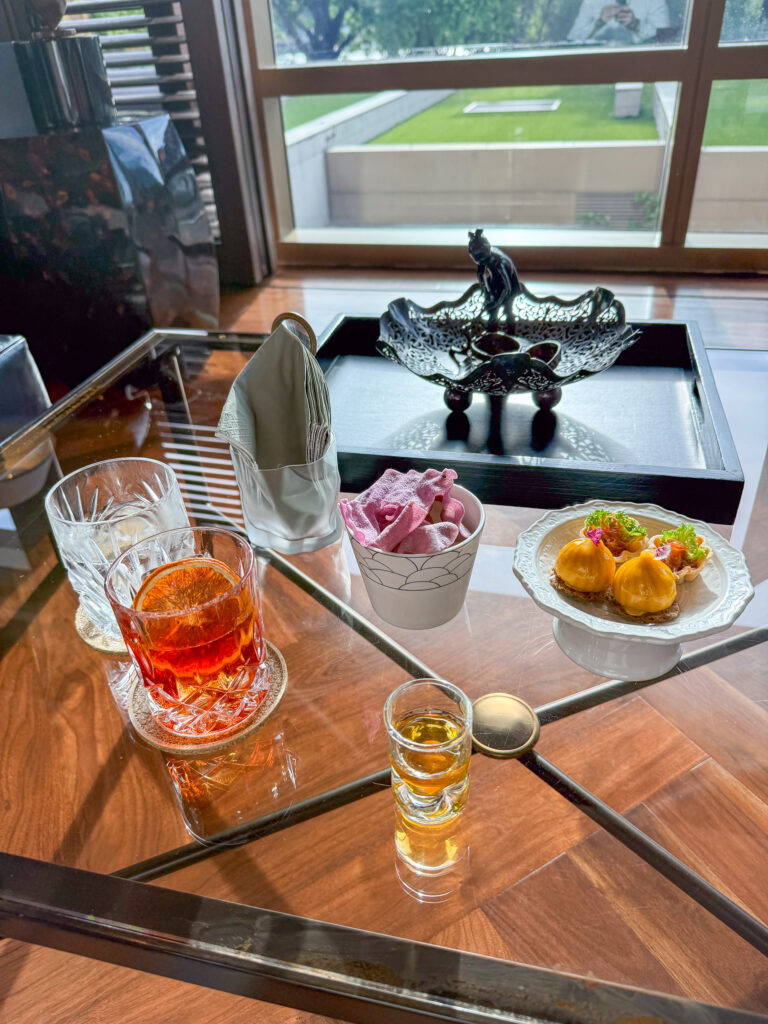
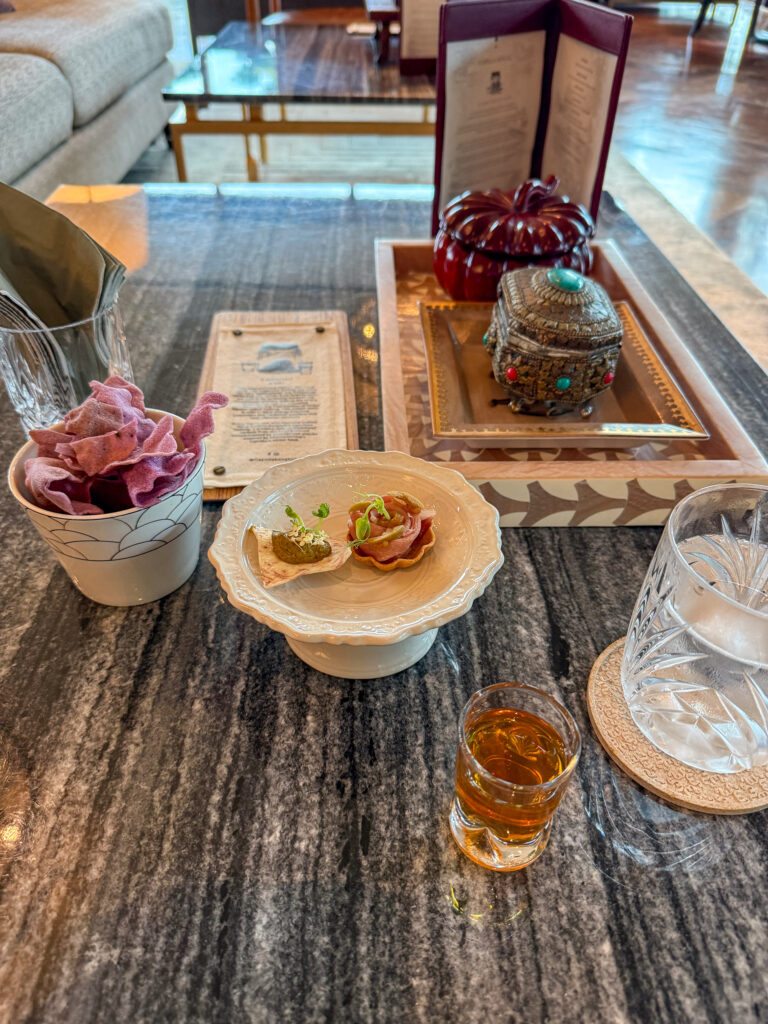
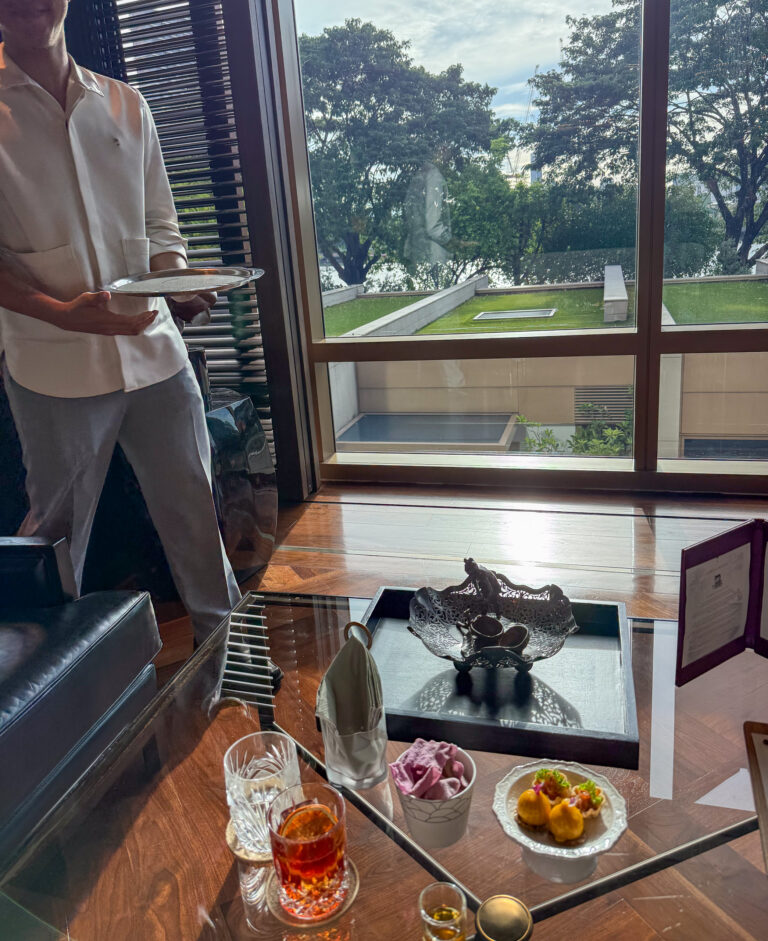
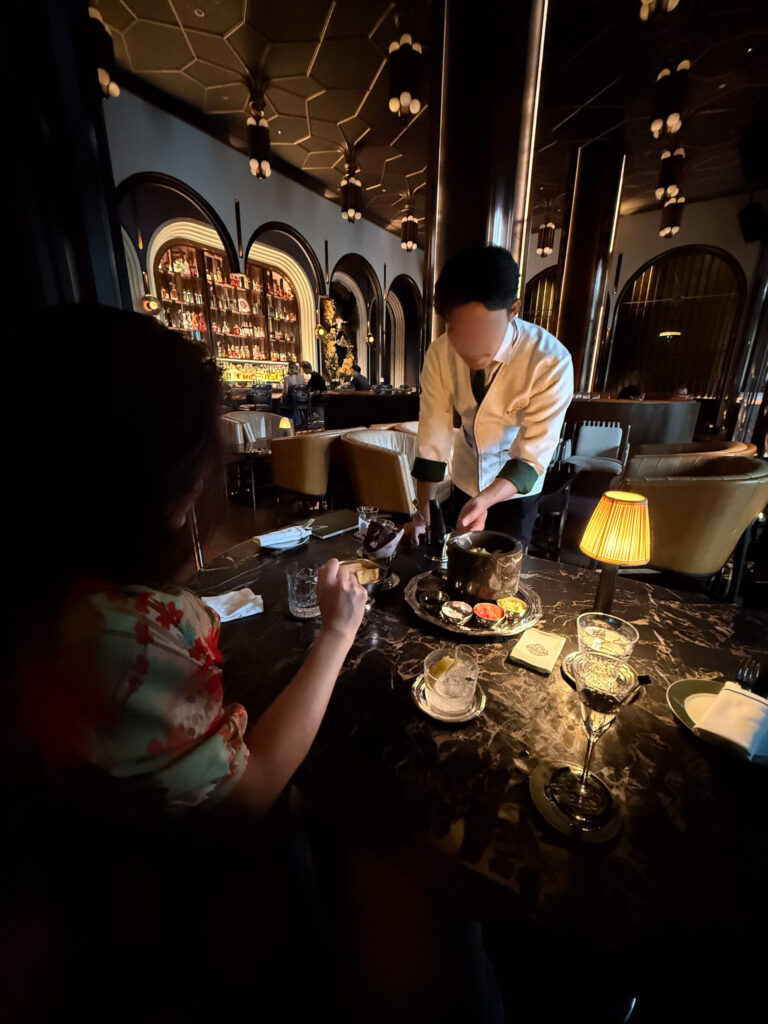
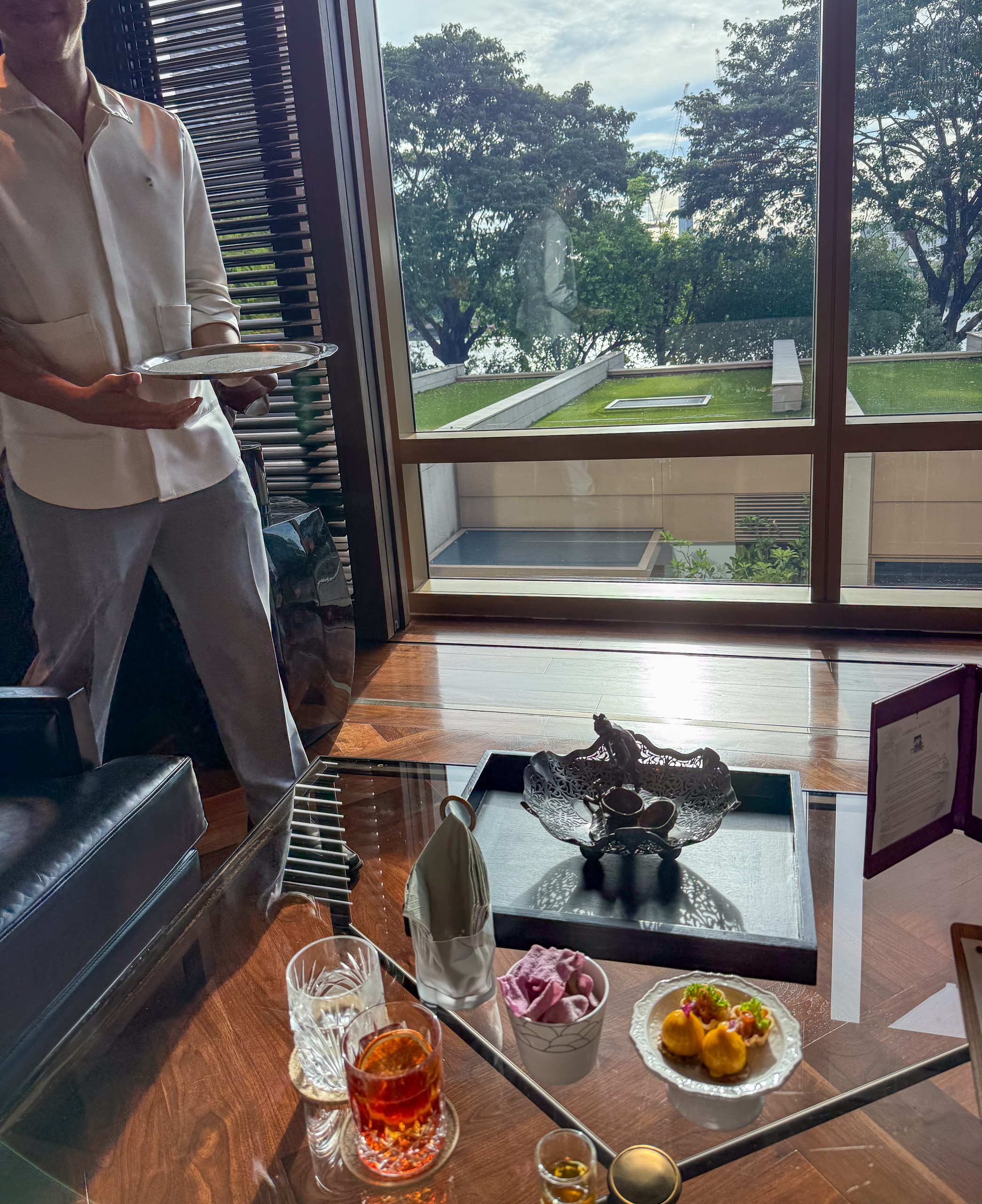
    Two canapes on a footed plate with prawn crackers, a whisky and a jewelled box on a stone table in a suite
    Canapés, prawn crackers and a whisky, sent up without being asked for. A fair amount of what you eat here never reaches a bill.

    KIN is the patisserie and coffee counter beside Phra Nakhon, open eleven to eight. And then the Living Room, the part of the offer nobody writes about because it has no menu and nothing to sign. Behind the key-carded door on the guest side of the lobby, open seven to eleven, it pours sparkling wine, juice, barista coffee and tea free for the length of your stay. A tea trolley comes round between three and four, and at five there is an hour of drinks and canapés called Cin Cin Hour, which moves between the Living Room, Stella and the courtyard – ask where it is that evening, and ask for the ya dong.

    The counter-argument

    The complaints about eating at Capella are almost never about the food. Nobody has a bad word for what comes out of Côte, Phra Nakhon or Stella. What goes wrong is everything arranged around the food, and it goes wrong the same way every time: nobody is quite sure what was agreed.

    A river-boat trip quoted three different ways in three conversations. A late check-out offered at noon, then one, then half past one, then three. A turndown skipped and blamed on a do-not-disturb light that was not switched on. None of that is a dinner, but it is the same muscle that books your table and keeps the window seat you asked for.

    Then the upkeep, which should not exist at this level: a frayed robe with two more worn ones behind it, a stained lounger left on the terrace, empty water bottles not replaced. Trivial one at a time. Together, a hotel that is not checking.

    And the compound. Mention that you ate Thai food somewhere else in Bangkok and you may be scoffed at for it – that has happened here twice in one stay, at two separate meals, in the city with the best street food on earth. It reads less like rudeness than like a building sealed off from its neighbourhood, which has taught its staff to treat the road outside as competition. It is also the reason not to eat every meal in: five outlets is exhausted by the third night.

    Two smaller things, both outdoors. The sliding door onto a riverside room is heavy and loud, and the glass fogs when wet air meets the air conditioning – a problem in a hotel selling nothing but a view. And the low tables at the water’s edge draw mosquitoes at dusk, exactly when you want to sit at them.

    Last, the awards are running ahead of the building. Michelin’s Thailand selection gives Capella two Keys. The Mandarin Oriental and The Siam, both older and both a few minutes further up the same river, hold three. A hotel called the best in the world in 2024 sits a rung below two of its neighbours.

    Know before you go

    Côte opens Wednesday to Sunday and is dark Monday and Tuesday. Lunch from noon, last order half past one; dinner six to ten. Book online and book ahead: Friday or Saturday dinner wants a week or two, weekday lunch is flexible, and arriving mid-stay expecting a table is how people leave this hotel without eating in its best restaurant. Dress is smart casual and enforced. Ask for a window table at lunch, or the six o’clock seating.

    Phra Nakhon serves breakfast from half past six to eleven and runs through to eleven at night. It publishes no dress code, which in practice means the terrace is relaxed. The set menus are lunch menus; dinner is à la carte. Ask for a table on the terrace, at the rail.

    All of it is open to people who are not staying. Charoen Krung slows badly in rain and worse when there is an event on the river, so give a fixed booking more time than the map says. Thai public holidays can suspend alcohol service at short notice and the dates move; if a bottle matters, check when you book.

    Finally the season. November to February is dry, clear and dearest; March to May is punishing; June to October brings short downpours and higher water. The terrace is the point of eating here, and it is a wet-season gamble.

    See the full set: Capella, Bangkok — in frames. More Bangkok: the Bangkok set.

    The two MICHELIN stars are upstairs. The meal you will still be describing a year later is on the terrace two floors below them.

    Don’t miss

    • The four-course weekday lunch at Côte.
    • The Long Chim Pak Tai set, for the pork belly.
    • The sommelier tasting at Côte, on the house.
    • Cin Cin Hour at five. Ask for the ya dong.
    • Book Côte before you fly.

    The Capella Bangkok gallery

    Every photo on this site is my own, shot on the stay. Slide through →
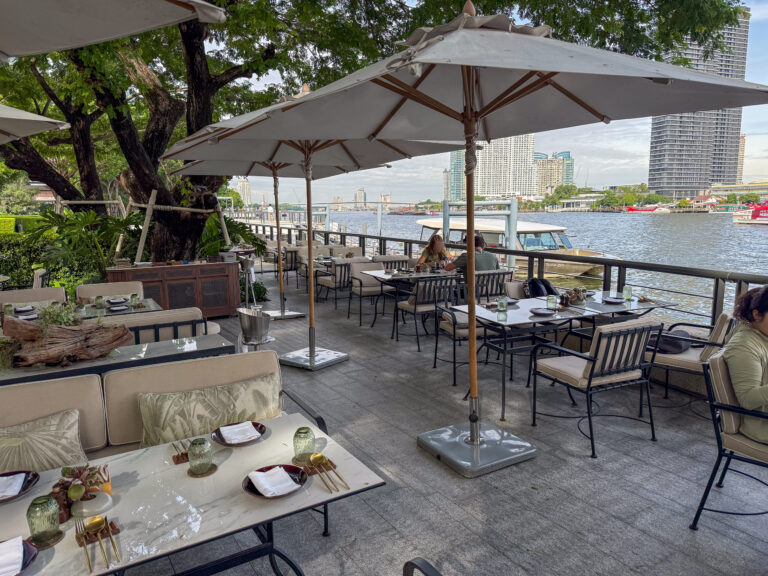
    White canvas umbrellas over marble tables set for lunch on a riverside terrace, boats moored on the Chao Phraya and towers across the waterMarble tables and cushioned chairs on a riverside terrace at night, a violet-lit cruise boat crossing the Chao Phraya and the Bangkok skyline behindTiered marble tables laid with Thai curries, relishes and condiments in blue-and-white bowls beneath a tall arrangement of foliageA bowl of yellow curry with rice noodles, raw vegetables and gold cutlery on a white linen tableSix Thai petits fours arranged on a dark stone plate on a marble table, one folded into a banana leaf and one dusted with palm sugarTwo canapes on a footed plate with prawn crackers, a whisky and a jewelled box on a stone table in a suiteA lobby lounge with a striped sofa and carved timber screens, tall windows looking out to a reflecting pool and gardensA long textured mural of a Thai landscape above two woven armchairs and a black lacquer table holding white orchidsMonstera and palms along a railing above the Chao Phraya at dusk, a river boat passing and the city skyline beyondA private plunge pool on a suite terrace looking over the Chao Phraya to the towers of BangkokA suite sitting room with a long pale sofa and green cushions, floor-to-ceiling glass opening to a terrace with an umbrella and the city beyond
  • Sorn vs. the hotel dining rooms

    Tiered turquoise pools, loungers under white umbrellas and palms above the Chao Phraya, the Bangkok skyline across the water

    BANGKOK, THAILAND · SORN vs. THE HOTEL DINING ROOMS · 5 MIN READ

    Sorn vs. the hotel dining rooms

    Sorn is the hardest table in the country and the best meal of my life. The shock of this piece is how close a hotel dining room with no stars came.

    By J.C. Mercer

    Verified meals·paid in full

    Sorn, Sukhumvit 26The Chao Phraya Estate, Charoen Krung
    DinedJuly 2026July 2026
    CoversTwo, at six, the only sitting there isTwo, across a four-night stay split between the two hotels
    MenuThe set tasting menu; there is no otherÀ la carte across the restaurants, bars and lounges of both hotels
    DrinksThe wine pairingBy the glass and from the bar lists
    Value verdictThe best meal I have ever eaten, in any country. Go once before you die.Worth it every other night — and some of Phra Nakhon’s plates matched Sorn’s.

    Booked the way any other guest would book it.

    The question

    Sorn is the most difficult table to get in the country. I have talked to more than a dozen people, inside and outside Thailand, who tried numerous times and failed. It is also the best meal I have ever eaten in my life, in any country, and anyone who can possibly afford it should go once before they die. So the heading above looks like a joke at Sorn’s expense. It is not. Everyone knows about Sorn. What nobody would guess is that a hotel dining room with no stars could put some plates beside it. That is the point of this piece.

    Sorn is a destination and behaves like one. One southern Thai tasting menu, dinner only, one sitting a night from six, built from the produce of the southern provinces and cooked over charcoal and in clay pots, with three stars on the door. You cannot order anything else, you cannot come at eight, and the booking is final a month or two before you sit down. It is the best restaurant in Thailand and I have written it up on its own.

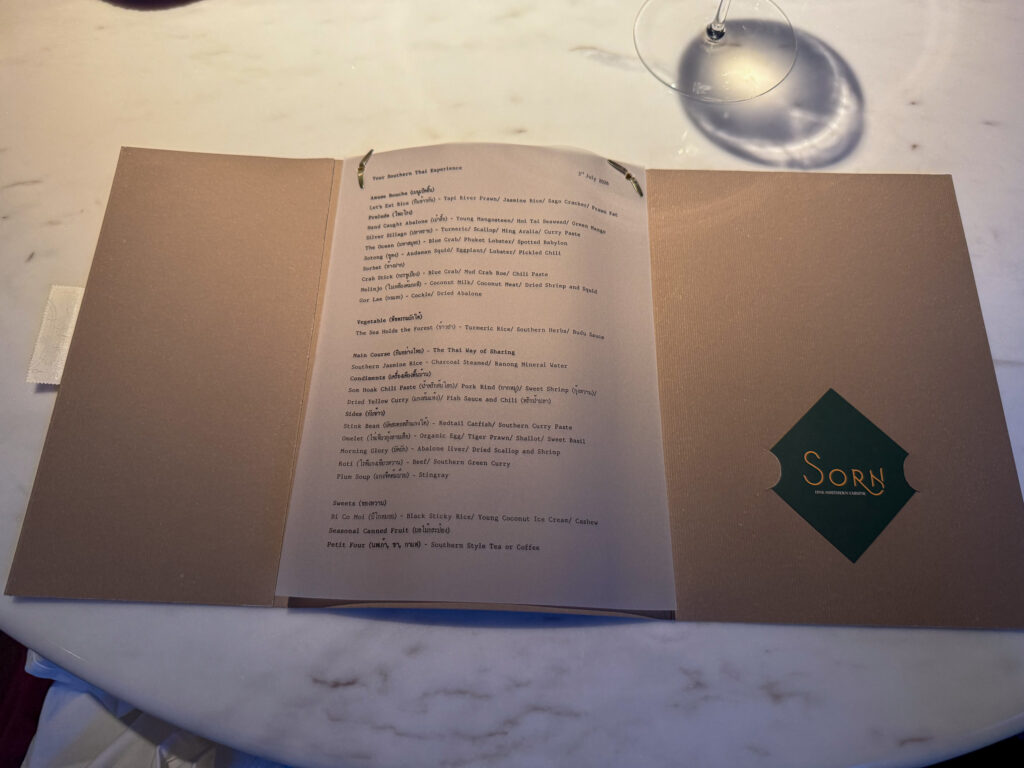
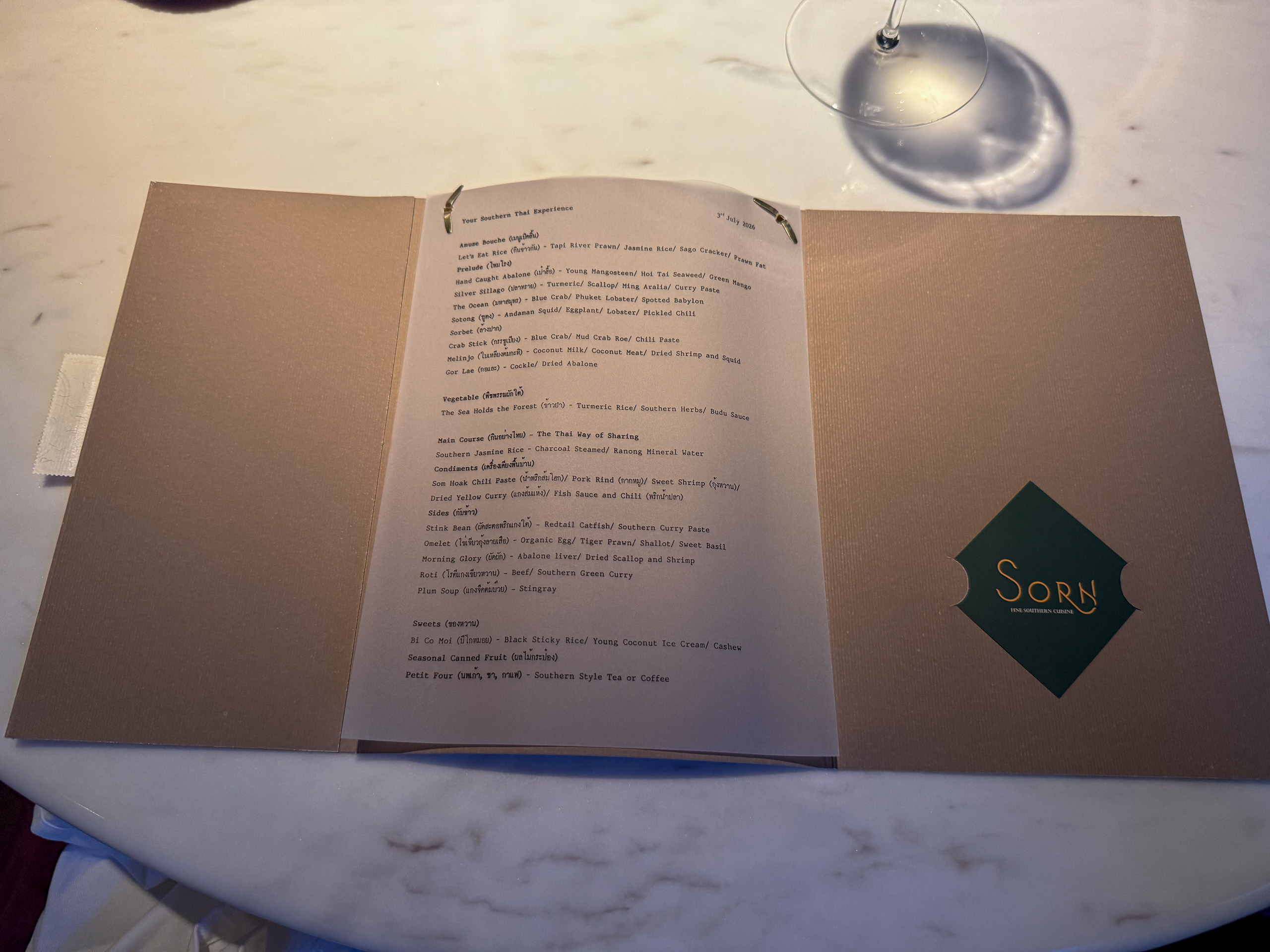
    The tasting menu open inside its grey folder, courses listed in Thai and English beside the green Sorn diamond
    The whole of Sorn’s offer, printed on one card. There is nothing on the other side of it.

    The Chao Phraya Estate is the opposite proposition, and the extreme version of it: two hotels, one driveway, more than a dozen places to eat and drink between them. Cantonese, French, Italian, Riviera, Thai, a patisserie coffee at seven in the morning, a bar the city crosses the river for. Both hotels take outside bookings at every room, so none of it requires a key. Nothing needs deciding a month out. And one of those rooms, Phra Nakhon at Capella, came nearer to Sorn than any hotel kitchen has a right to.

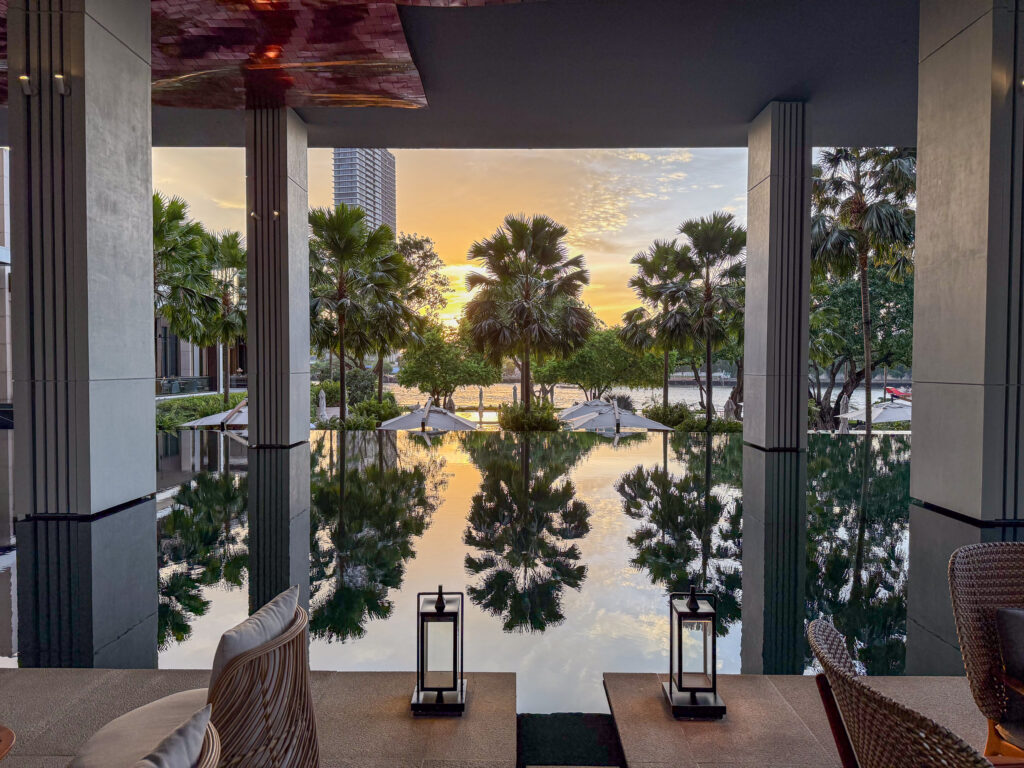
    Sugar palms and a sunset sky mirrored in a still reflecting pool, seen between grey stone columns from a lounge set with lanterns
    The Four Seasons at dusk. Water and lanterns, and eight kitchens within four minutes of each other, which is most of what a hotel dining room actually sells.

    Side by side

    WhatSornThe hotel dining rooms
    The menuOne set tasting menu; nothing elseEverything, across a dozen rooms; a Thai omelette in the lounge to a nine-course carte blanche upstairs
    How far aheadA monthly release for the month ahead; plan one to two months out and set two alarmsA date, a party size and a time; same day is normal
    The commitmentFinal on confirmation — no changes, no transfersNone
    If you are lateMore than thirty minutes and the booking is voidNothing happens
    Who it cannot feedNo vegetarian or vegan menu; no shellfish allergy of any degree; eight core ingredients it will not substituteSeparate vegan and vegetarian menus at the Cantonese room; Côte has no printed menu and simply asks
    The starsThreeTwo at Côte, Capella; none at Yu Ting Yuan, whatever the internet says
    The table lotteryBook for four rather than two — there are more tables that sizeThe same lottery at the top of the house: two suites with one name, one on the river and one not
    Best forThe trip built around a mealThe meal that has to fit around a trip
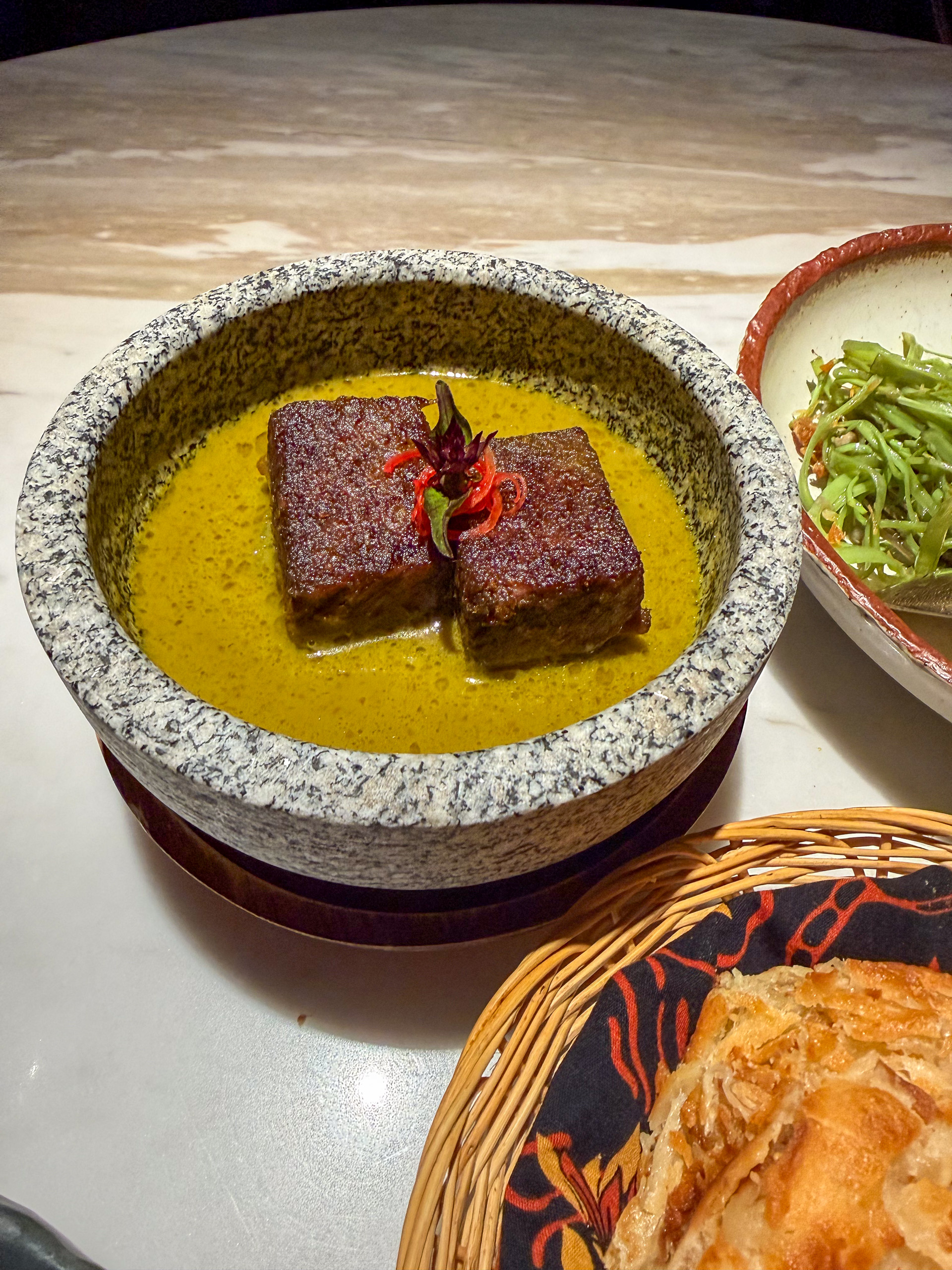
    A curry served in a stone bowl beside the basket
    Sorn: the curry in the stone bowl.
    A table of Thai dishes at the open counter, the kitchen team working behind
    Capella: Chef Kannika’s open counter at Phra Nakhon.
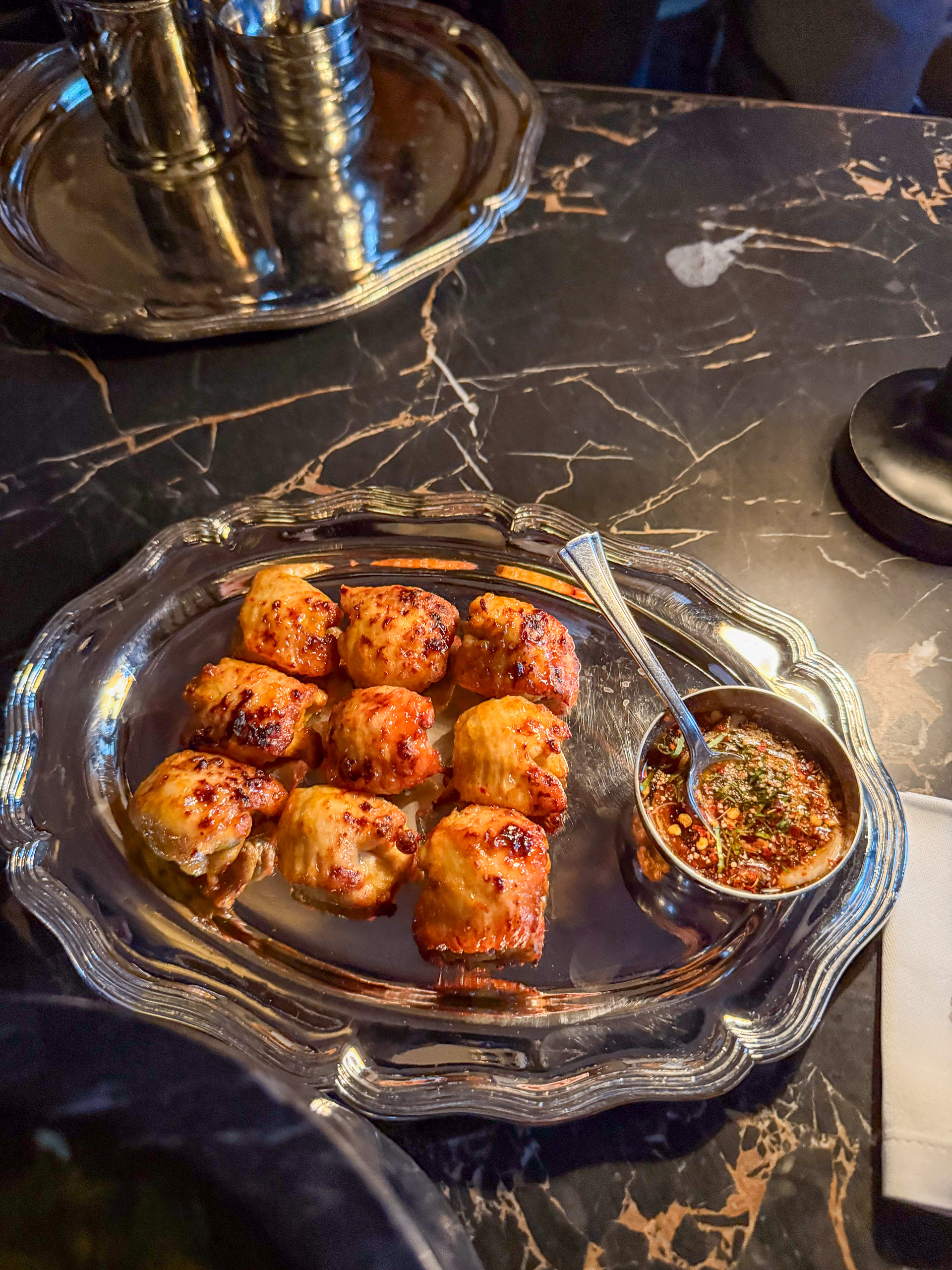
    Grilled morsels on a silver platter with a dish of dressing alongside, on dark marble
    Four Seasons: grilled morsels at the terrace bar.

    Where Sorn wins

    The argument. One kitchen making one case for three hours about the food of a region most visitors never eat: a clay pot broken open at the table, roe and a charred prawn tail in a stone mortar, a card with the whole of the evening printed on one side and nothing on the other. Nobody on the river is trying to do this, and nobody should.

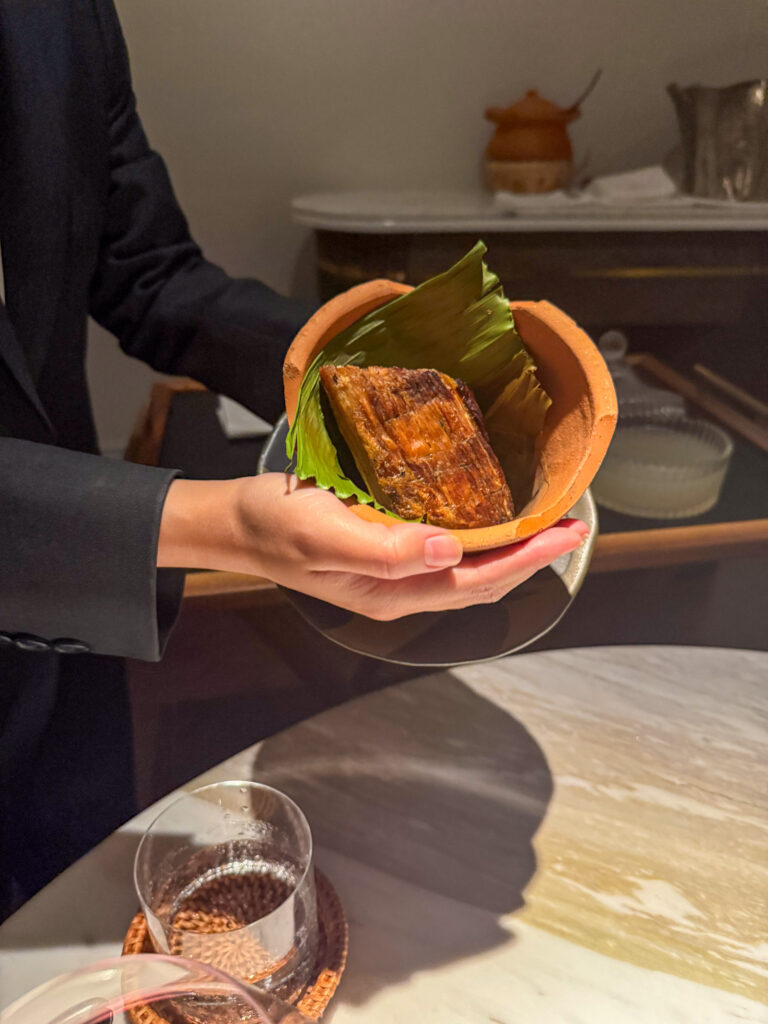
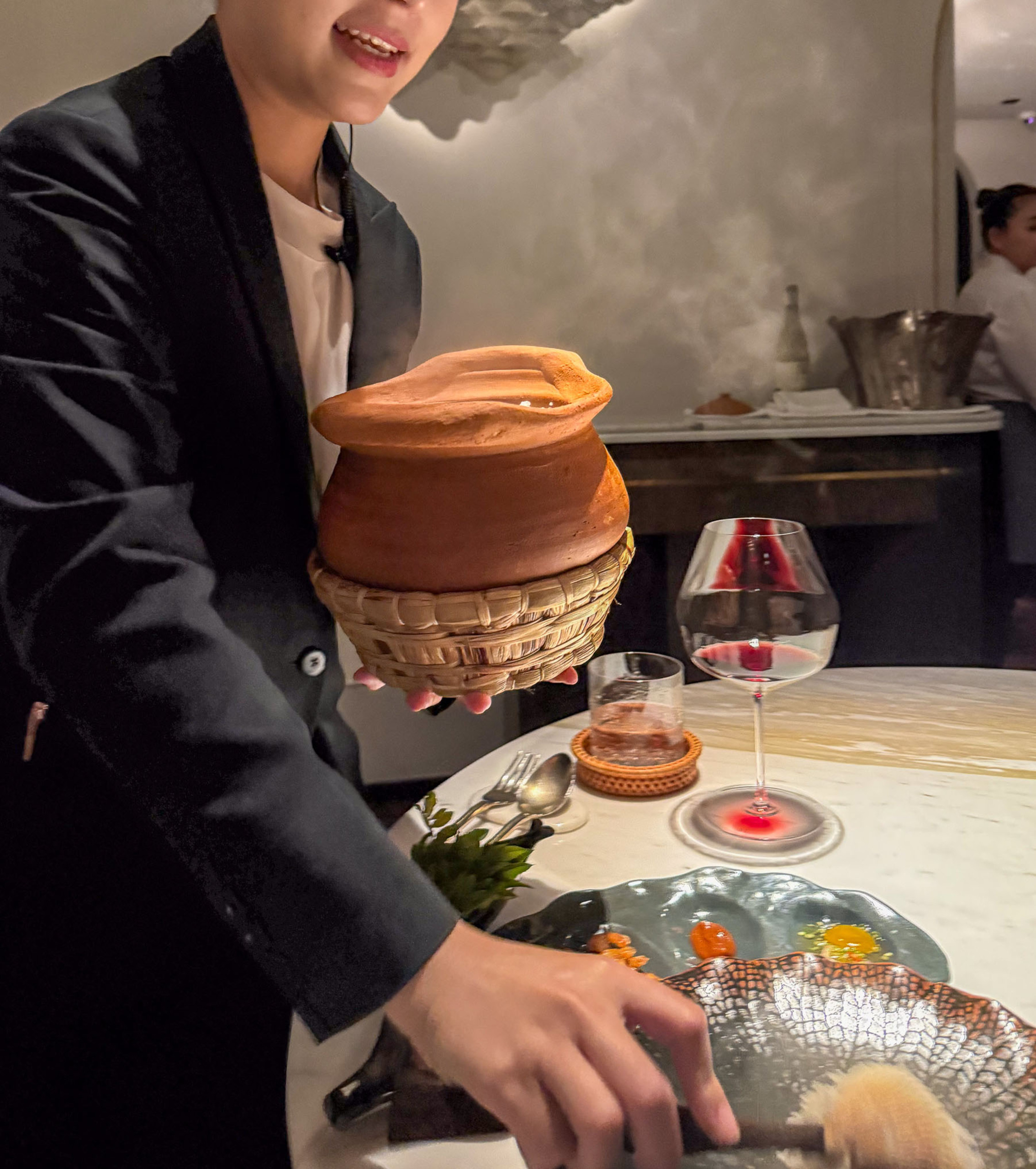
    A hand holding a broken clay pot lined with banana leaf, a piece of charred grilled fish inside
    A clay pot broken open at the table. This is the sort of thing the second option is not trying to do.
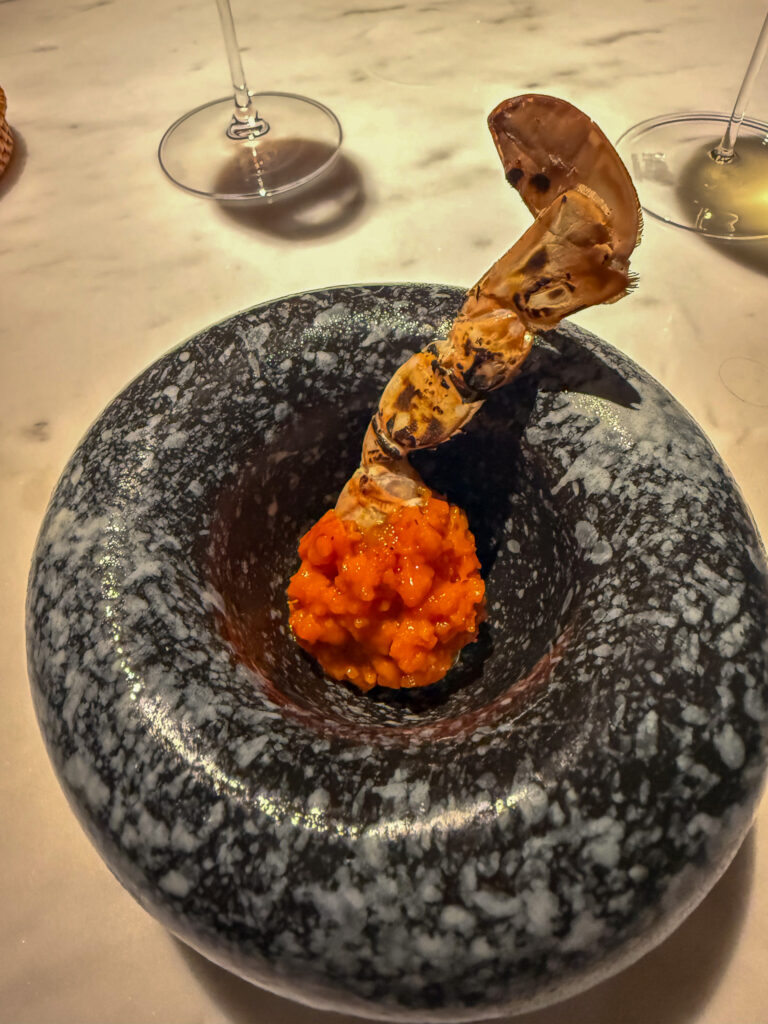
    A mound of bright orange roe with a charred prawn tail arching out of it, served in a heavy speckled black stone bowl between two wine glasses
    Roe and a charred prawn tail in a stone mortar.

    Arrive more than thirty minutes late and the reservation is void, which in this city’s traffic is not a theoretical risk. I left the hotel at half past four for a six o’clock table and arrived, as planned, embarrassingly early. Against that, the estate asks for a date, a party size and a time. So the honest framing is committed against uncommitted — the two-star room at Capella asks the same commitment for the evening.

    Where the hotel dining rooms win

    Phra Nakhon, and this is the sentence the piece exists for: some of what Chef Kannika Jitsangworn cooked for us at Capella’s Thai room was just as good as some of what Sorn served. It lacked the same feeling of excitement and it was far from the same experience, because that is not what it was trying to be. But taste? She has the goods. Her yellow crab curry stands with the best foods I have ever eaten, and it arrived by walking downstairs.

    There are moments in these starred food hunts when you come across an essence. The essence of tomato at Moss in Iceland. The essence of shrimp at Masa in New York. The essence of taro at Fufu Kawaguchiko. This was the essence of crab: she used the powers of the accompanying spices in the liquid to present your mouth with what you knew a crab should be.

    She came out afterwards and spent twenty minutes on the spices, sourced from the far reaches of the country. The room runs from late morning to late evening, takes a booking for tonight, and is three minutes’ walk from either bed on the estate. She is a gem, and they must not let her go.

    Marble tables and cushioned chairs on a riverside terrace at night, a violet-lit cruise boat crossing the Chao Phraya and the Bangkok skyline behind
    The argument for eating where you sleep, in one frame: marble tables, a working river, and no taxi at the end of it.

    The starred table is not where you think. Côte by Mauro Colagreco, on the second floor at Capella, holds two stars and cooks the coast between Nice and Genoa; its long menu asks the same commitment as Sorn’s. It closes two days a week, which no hotel restaurant is supposed to do, has no printed menu, and asks about allergies at the table.

    Yu Ting Yuan, the Cantonese room at Four Seasons, is the one most people think has a star and does not; it is still a very good Cantonese restaurant with the most approachable of the three long menus, an open kitchen and a lit reflecting pool in the window, and it will seat you tonight.

    A bowl of green curry with rice noodles, herbs and raw vegetables on a gold-rimmed plate
    Green curry and rice noodles, downstairs at Capella.
    Fried rice with crab served on a betel leaf, prawn crackers and a dish of chilli alongside
    Fried rice with crab, cooked to order.
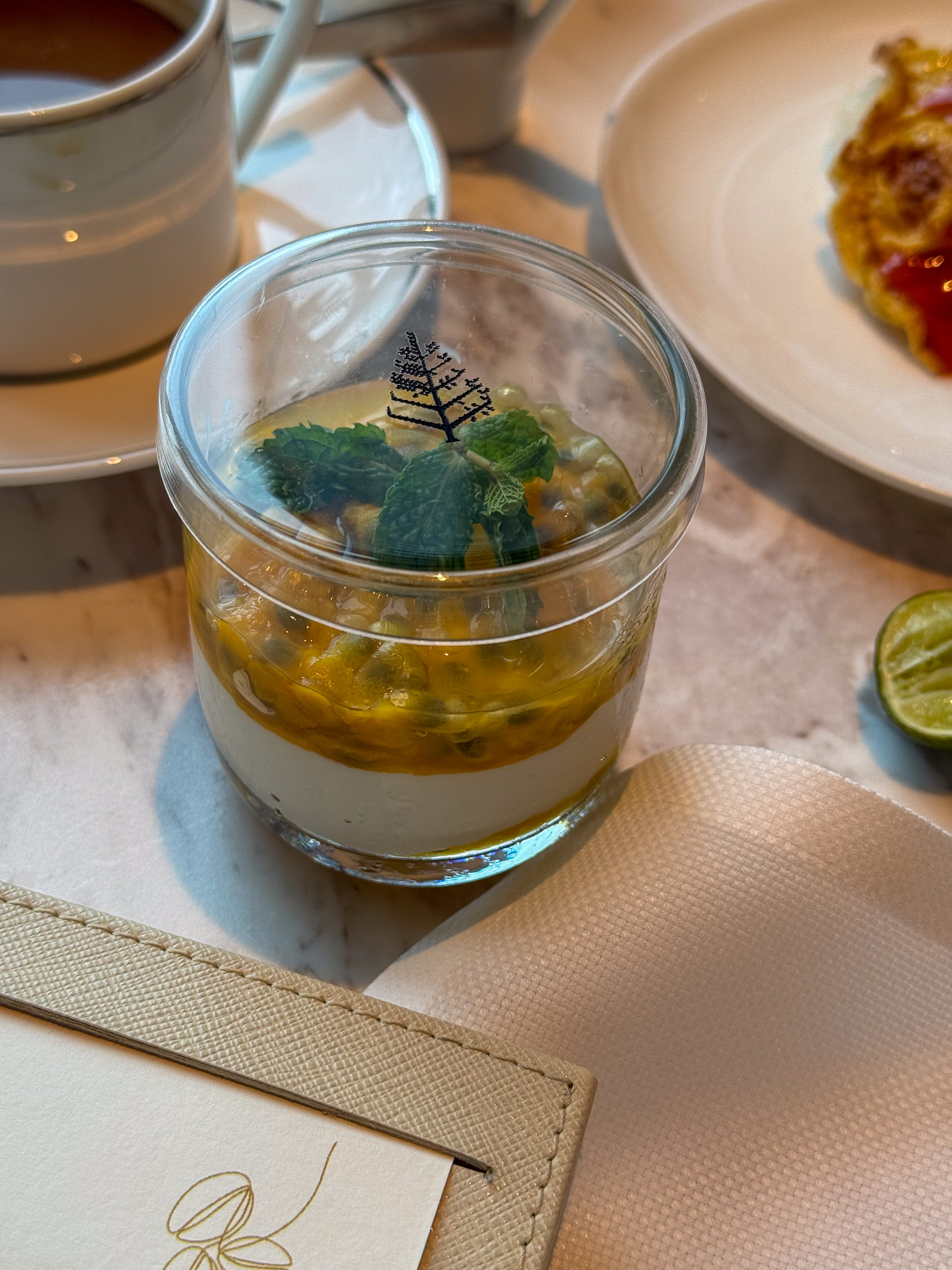
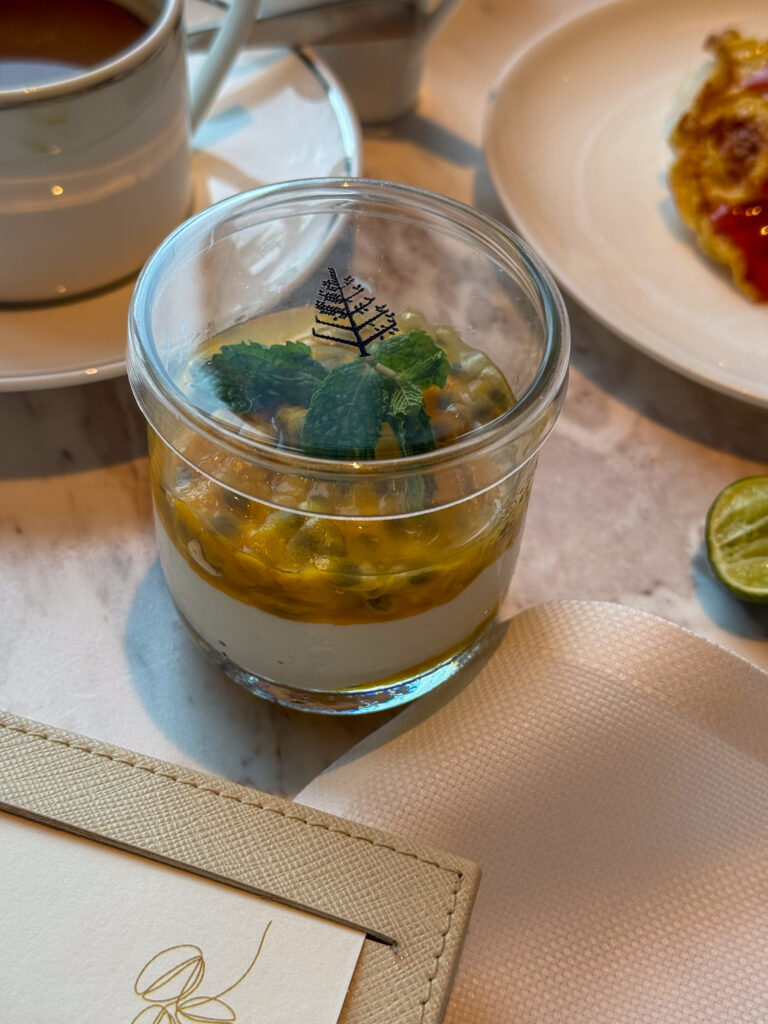
    A layered dessert in a glass jar, coffee and a plate behind it
    Dessert in a jar at the Four Seasons.

    Anyone with a restriction. Sorn’s terms are unusually blunt and you find them on the page that takes your card: no vegetarian or vegan menu, no shellfish allergy of any degree, eight core ingredients it will not substitute. The hotel side has the opposite problem, which is to say none. If anyone in your party has a hard restriction, the comparison is over before it starts.

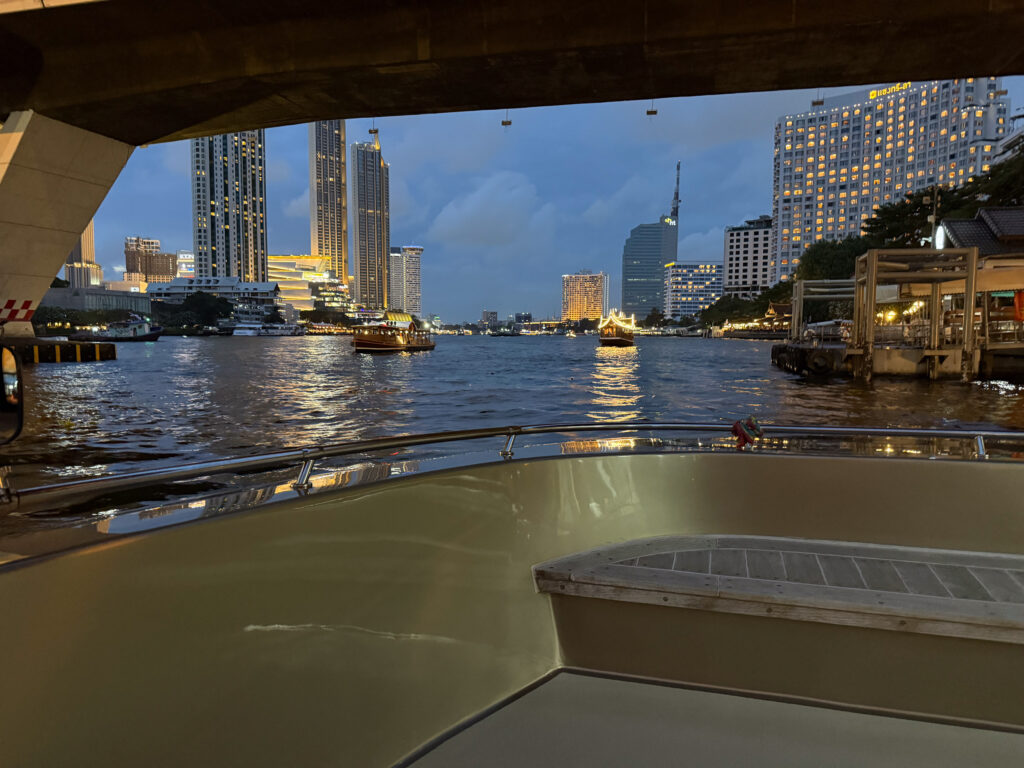
    The Chao Phraya at dusk from under the canopy of a hotel boat, a wooden rice barge and the lit city skyline ahead
    The estate from the water at dusk. Both hotels run shuttle boats, and either will take you to a table at the other.

    One caution for high summer: the Four Seasons’ own Thai restaurant is an outdoor charcoal grill and closes for the season, so in August the Four Seasons cannot put a proper Thai dinner in front of you. Capella can.

    Verdict by traveller type

    Book Sorn if this dinner is the point of the trip; if you will plan two months out, set two alarms and accept that the commitment is final whatever happens; if nobody in the party is vegetarian, allergic to shellfish or unable to eat any of eight ingredients; and if you can be in Sukhumvit 26 by half past six with certainty. Book for four rather than two if you can.

    Book the hotel dining rooms if the trip is bigger than the meal; if you would rather eat well on four consecutive nights than brilliantly on a fixed Tuesday in six weeks’ time; if you want to eat at nine because the flight was late; if there is a dietary restriction anywhere in the party; or if you want a starred table without the scramble, in which case walk to Capella. And book Phra Nakhon on the first night, ask Chef Kannika to decide, and book it again.

    Do not book Sorn for a party with mixed dietary needs, for anyone who might not make the date, or on the theory that three stars means the grandest room in town. Do not book the Four Seasons expecting a starred kitchen or, in summer, a Thai dinner; it has neither.

    Book Sorn if the dinner is the reason for the trip. Book the hotel dining room if the trip has other reasons.

    The sweets under a glass dome on the tiered stand
    Sorn’s sweets under glass. Two alarms, two months, and this at the end.

    Bottom line

    Everyone knows about Sorn — the hardest table in the country and the best meal of my life. Nobody would guess the no-star hotel dining room could compare, and some plates did. Sorn if the dinner is the reason for the trip; the estate if the trip has other reasons — Phra Nakhon first, the yellow crab curry on the table. Book Sorn for four, two months out; book Chef Kannika for tonight.

    See the full set: Sorn — in frames. More Bangkok: the Bangkok set.

    The Bangkok galleries

    Every photo on this site is my own, shot on the trip. Slide through →

    A glass of white wine poured at the table, the bottle behindA suite sitting room with sofas and a wall of glass onto the riverTables set along the riverside terrace after dark, a lit boat passing on the waterA white-dressed bed against wood panelling, the river visible through the window beyondA member of the team presenting an ingredient at the tableA hotel bar built around a tall white sculptural centrepieceThe entrance under a mature tree, gold panels either side of the doorsA corner living room glazed on two sides, sofa and armchair facing the terrace plantingThe printed card standing on the table before serviceA long swimming pool with cabanas, the river and city beyond
  • Four Seasons Bangkok: A Resort Address in the Middle of the City

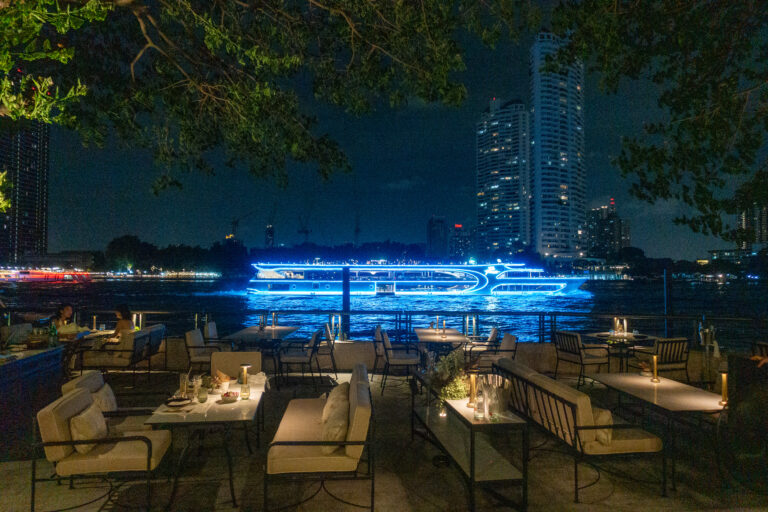
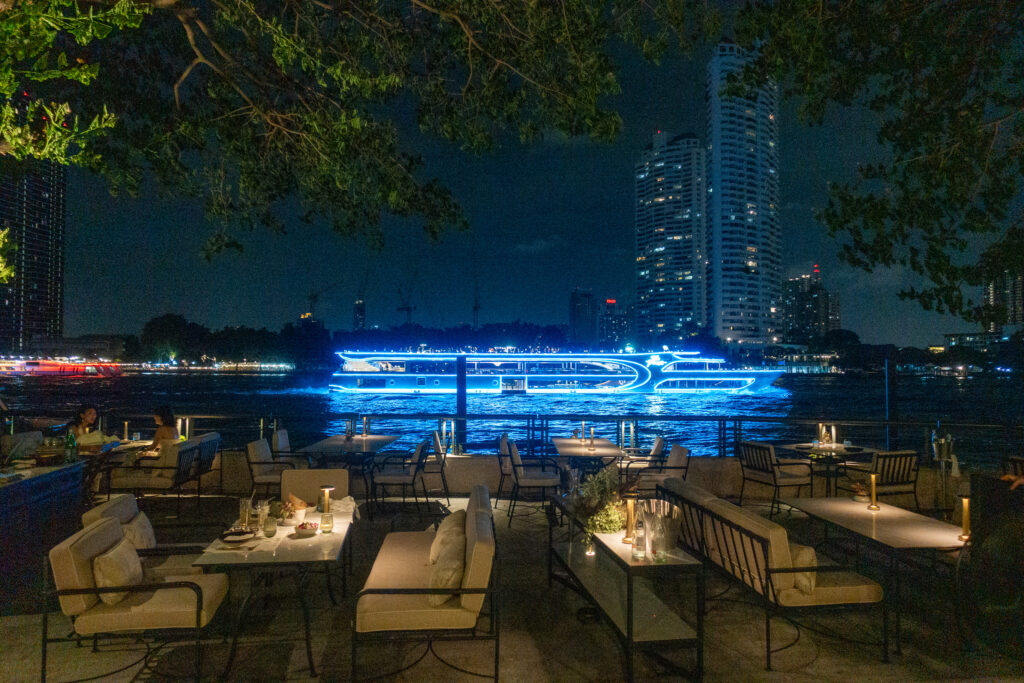
    The hotel's riverside terrace at night, low sofas and lit tables under trees, with a dinner boat outlined in blue lights passing on the Chao Phraya

    BANGKOK · STAYED MAY 2026 · 6 MIN READ

    Four Seasons Bangkok: A Resort Address in the Middle of the City

    A river resort in the middle of the city, and the argument for barely leaving it.

    By J.C. Mercer

    Verified stay·paid in full

    Four Seasons Bangkok

    • Stayed July 2026
    • Room booked Deluxe River-View Room, king
    • How it was booked Amex Fine Hotels + Resorts, public rate
    • What the channel bought upgrade to annex w/ balcony, breakfast, credit, late checkout at 9 pm with full use of pools and spa
    • Value verdict Worth it for the facilities; lovers go to Capella to get more for less.
    • When to go June was great. Book this stay

    Booked the way any other guest would book it.

    Arrival

    The hotel keeps a boat at Sathorn pier, and it is the right way to arrive. Bangkok turns two miles into forty minutes without warning and without apology. The river turns the same two miles into about eight, and you spend them on the water watching the city drop from towers to warehouses to the low green wall of the hotel’s own trees. By the time the boat noses into the landing, the argument the building is going to spend three days making has already been made once, for free, from the deck.

    The address is on Charoen Krung, a warehouse street with a creative district growing through it — galleries, a design centre, shophouses, the old customs house down the road. It is worth an afternoon. It is not worth pretending it is walkable to anything else: the Skytrain is a long hot walk, and every departure from here is a boat you have to catch or a car you have to allow far too much time for.

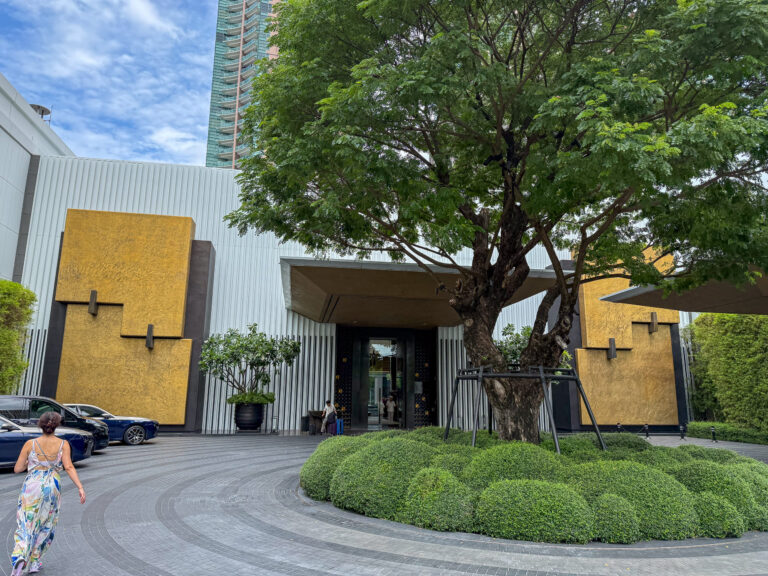
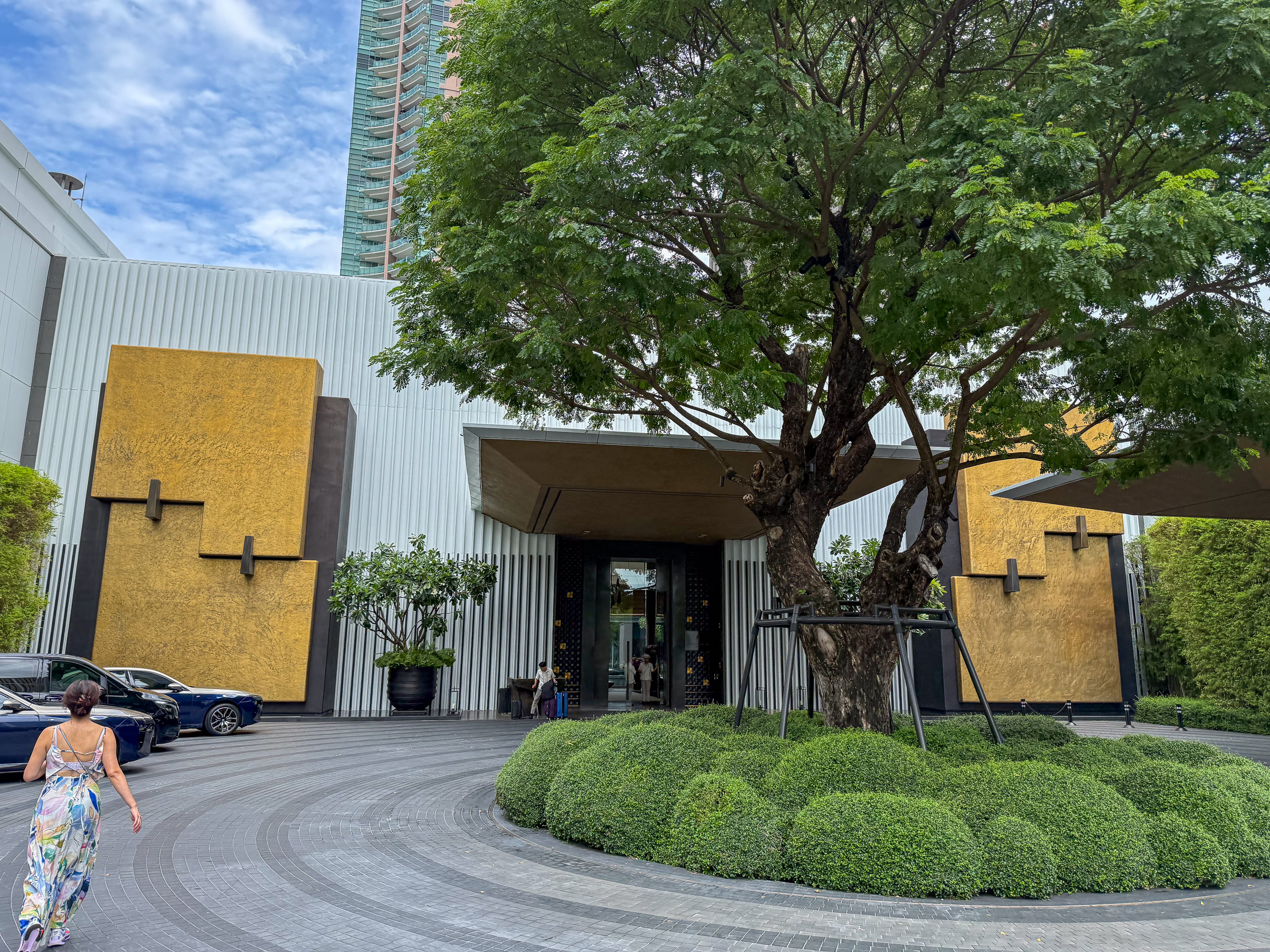
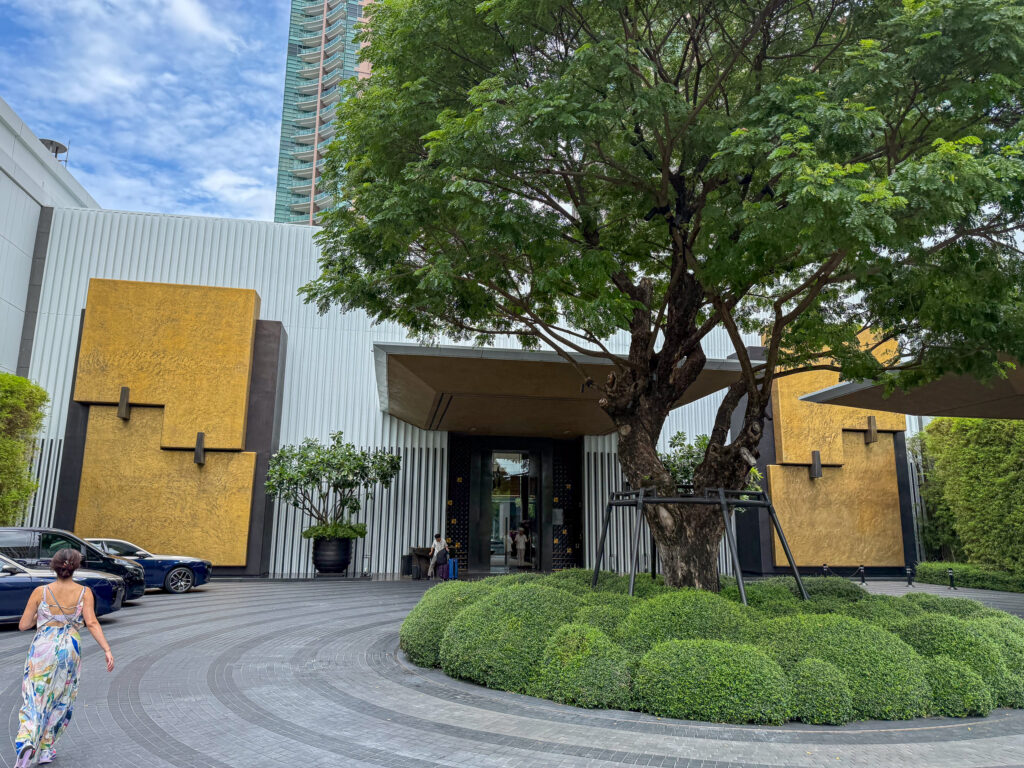
    The entrance under a mature tree, gold panels either side of the doors
    The entrance under the old tree. The resort hides behind it.

    Nothing about the approach from the road prepares you for what is behind the gate. The hotel is a sequence of low buildings stepping down to the water rather than a tower standing on it: courtyard, colonnade, reflecting pool, lawn, river. You are never told you have arrived. You just keep going down and the noise keeps dropping.

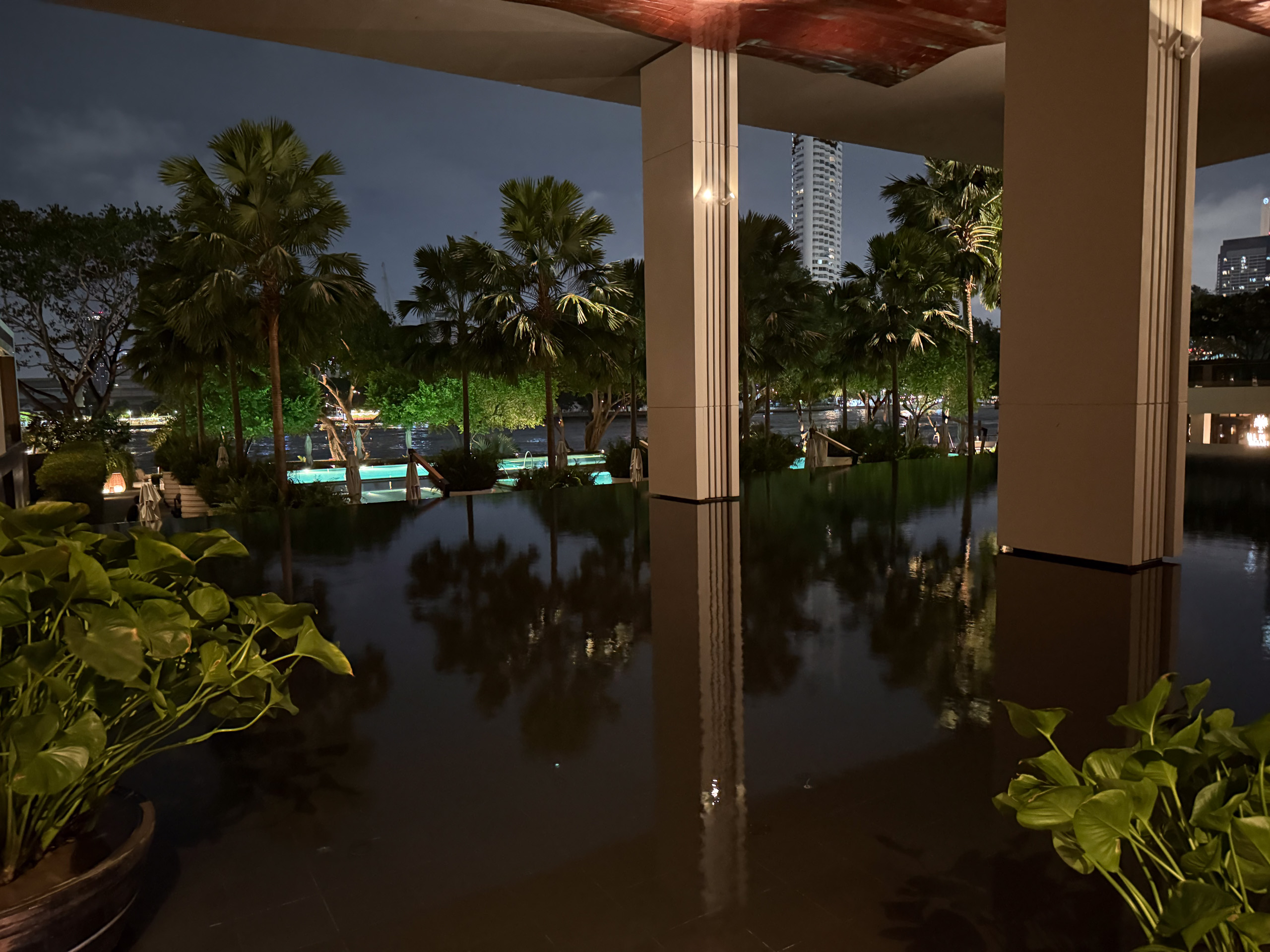
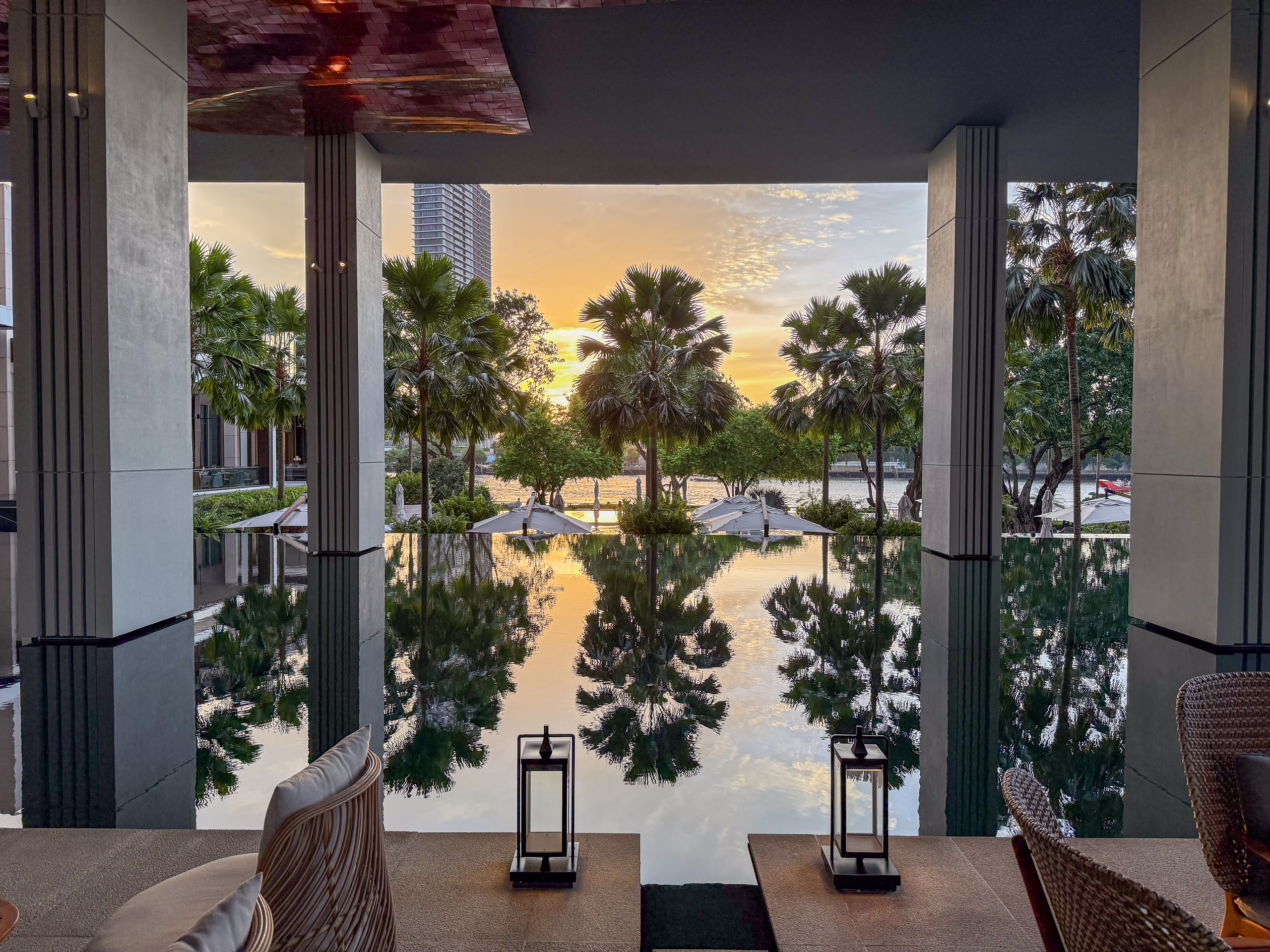
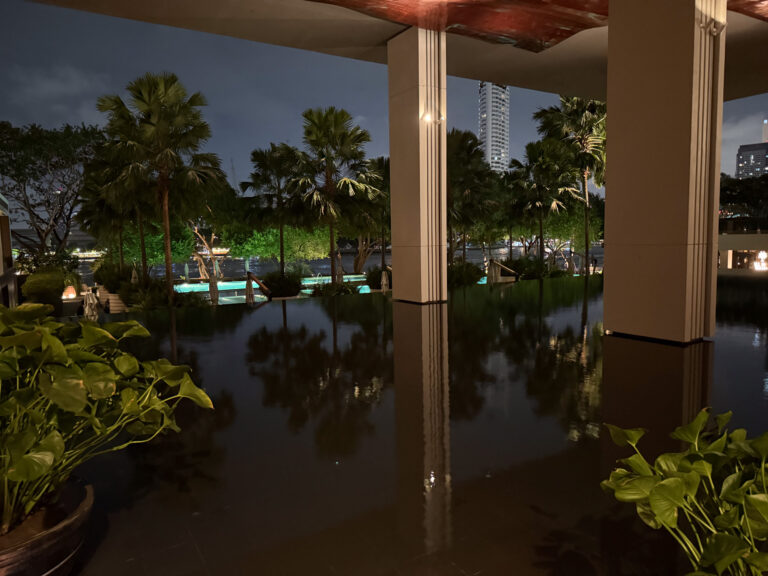
    Water does most of the work. There is standing water almost everywhere on the ground floor, black and shallow and dead flat, set between pale columns so that the palms and the towers on the far bank arrive twice. It is a device, it is obvious, and it works anyway. On the second evening I walked the length of it before dinner for no reason except that it was quiet, which in Bangkok is a reason.

    The reflecting pool between the colonnades at night, palms mirrored in the still water
    The courtyard at dusk. Everything arrives twice.

    The room

    I booked a Deluxe River-View Room, the entry river category, and was upgraded to an Annex room with a balcony and a river view: a long window wall, the bed placed to face it, a writing desk that is a desk rather than a shelf with a lamp on it. The proportions are wonderful and the view of the river and pools forces to leave the curtains open.

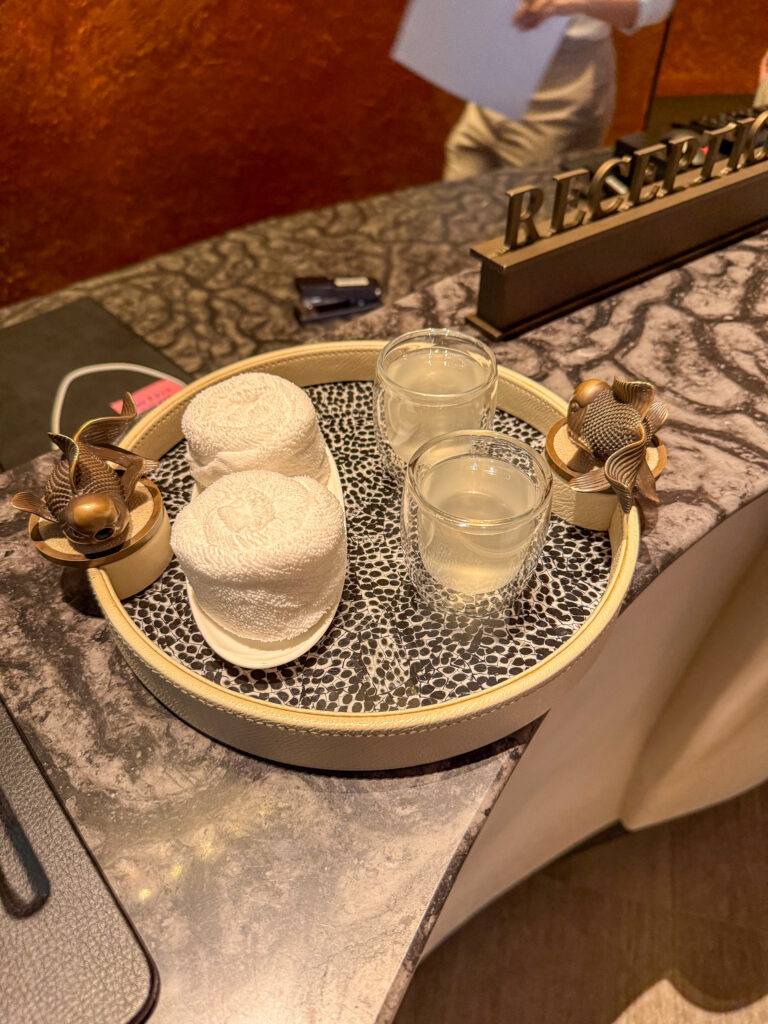
    Two rolled towels and glasses of water on a tray set on a marble table
    The tray that follows you around the property: towels, water, nothing to sign.

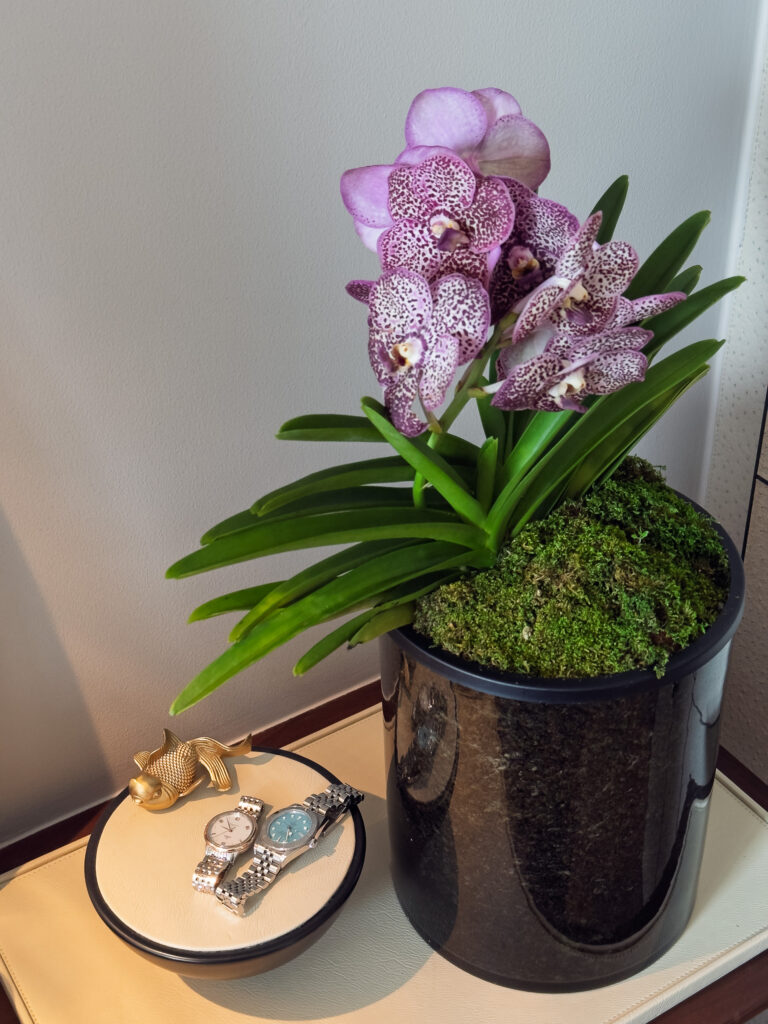
    The detailing is quietly expensive. An orchid on the desk in a heavy black pot, large enough to count as a shrub and replaced rather than watered. Housekeeping moved a watch I had left out onto a small lacquer tray without being asked and without saying anything about it, which is the kind of thing that is either invisible or the entire point.

    Noted

    Observed on the stay, not measured.

    WhatChecked on the stay
    Wi-FiFast and stable in the room, no drop-outs across three days
    NoiseSilent inside; river traffic audible on the terrace, never in the room
    BedKing, medium-firm, pillow menu – Four Seasons Bed Nuff Said
    Water pressureStrong, hot immediately
    Blackout curtainsFull, motorised, no light gap
    Boat shuttleEvery half hour, morning to late evening, to Sathorn pier and ICONSIAM, by the timetable
    Lap pool35 metres per the hotel; never too crowded

    Eating

    Yu Ting Yuan is the reason to stay in for one dinner. Cantonese, a Michelin star on the door, a tall glassy room over the water, and dim sum that is worth ordering at dinner even though nobody will suggest it. The service is formal without being stiff, and the wine list runs deep. Good but no Jade Dragon.

    Riva del Fiume is the Italian on the river, handmade pasta and a wood-fired oven, and the easiest room in the hotel to eat in twice. Brasserie Palmier is the fish room, with an oyster bar and a chequered floor doing an unembarrassed impression of Paris in the tropics; lunch, not dinner.

    Grilled morsels on a silver platter with a dish of dressing alongside, on dark marble
    Grilled morsels at the terrace bar.
    A layered dessert in a glass jar, coffee and a plate behind it
    Dessert in a jar, coffee behind.
    A pale dessert in a dark glass bowl on the window ledge, the pool and palms outside
    Dessert on the ledge, pool beyond.

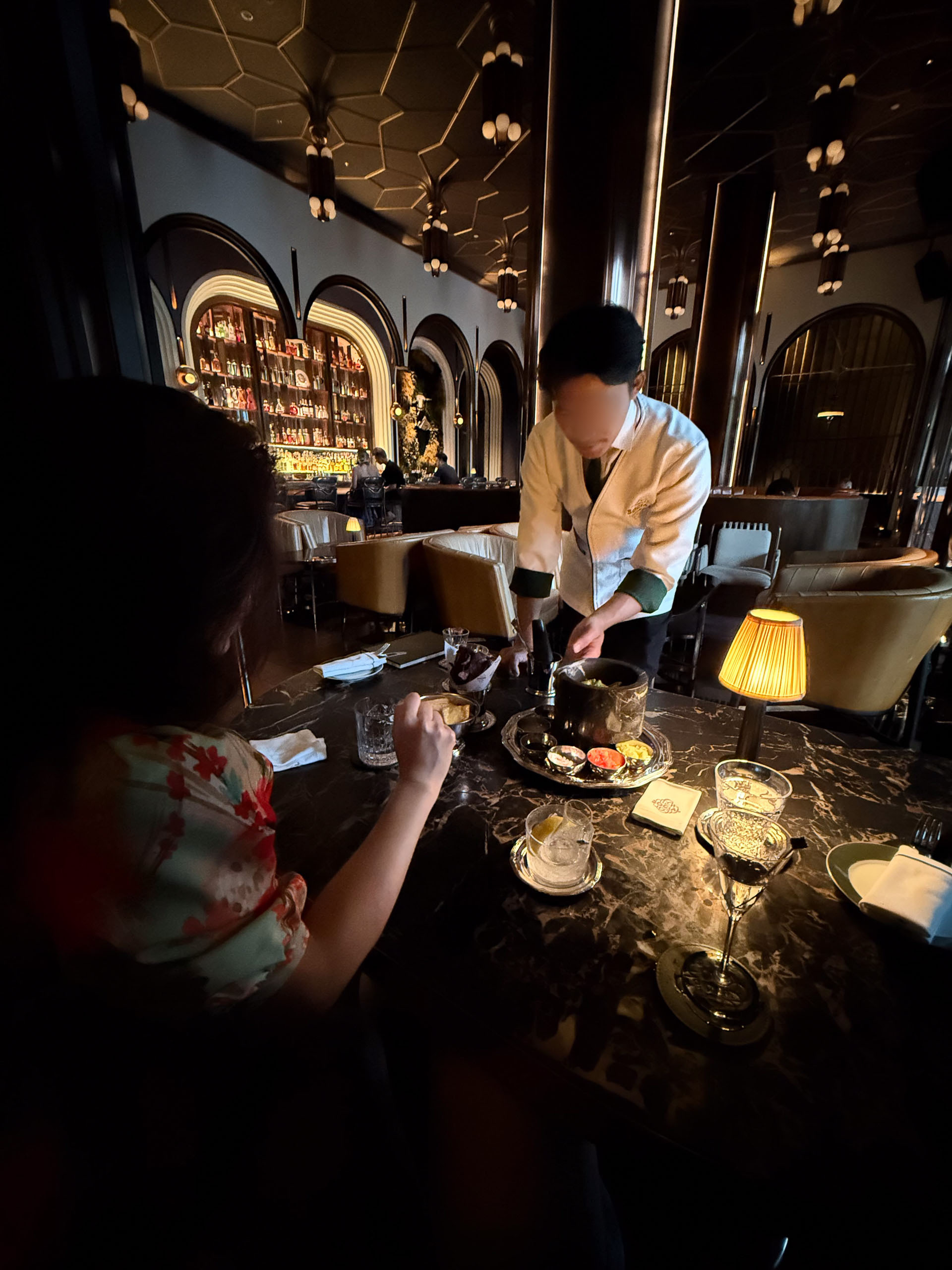
    BKK Social Club is the bar, and it is a destination rather than a lobby with cocktails: enormous, gold-lit, arched, with a mirrored back bar you can see from the door. Go before nine or accept that you are queuing behind the city. Book it for the drinks not the food. The drinks were world class (the bar manager is literally best in the world) the food meh. They need to send their chef to the Yucatan to learn what guacamole can be.

    Have breakfast included. It is served properly, it is large, and it covers the morning until the pool does. It is also the only meal here where the river is not charging admission.

    A bartender working tableside in the low-lit bar, bottles ranked behind
    The low-lit bar, bottles ranked behind. The saved difference gets spent here.

    Three pools, and one of them is for swimming

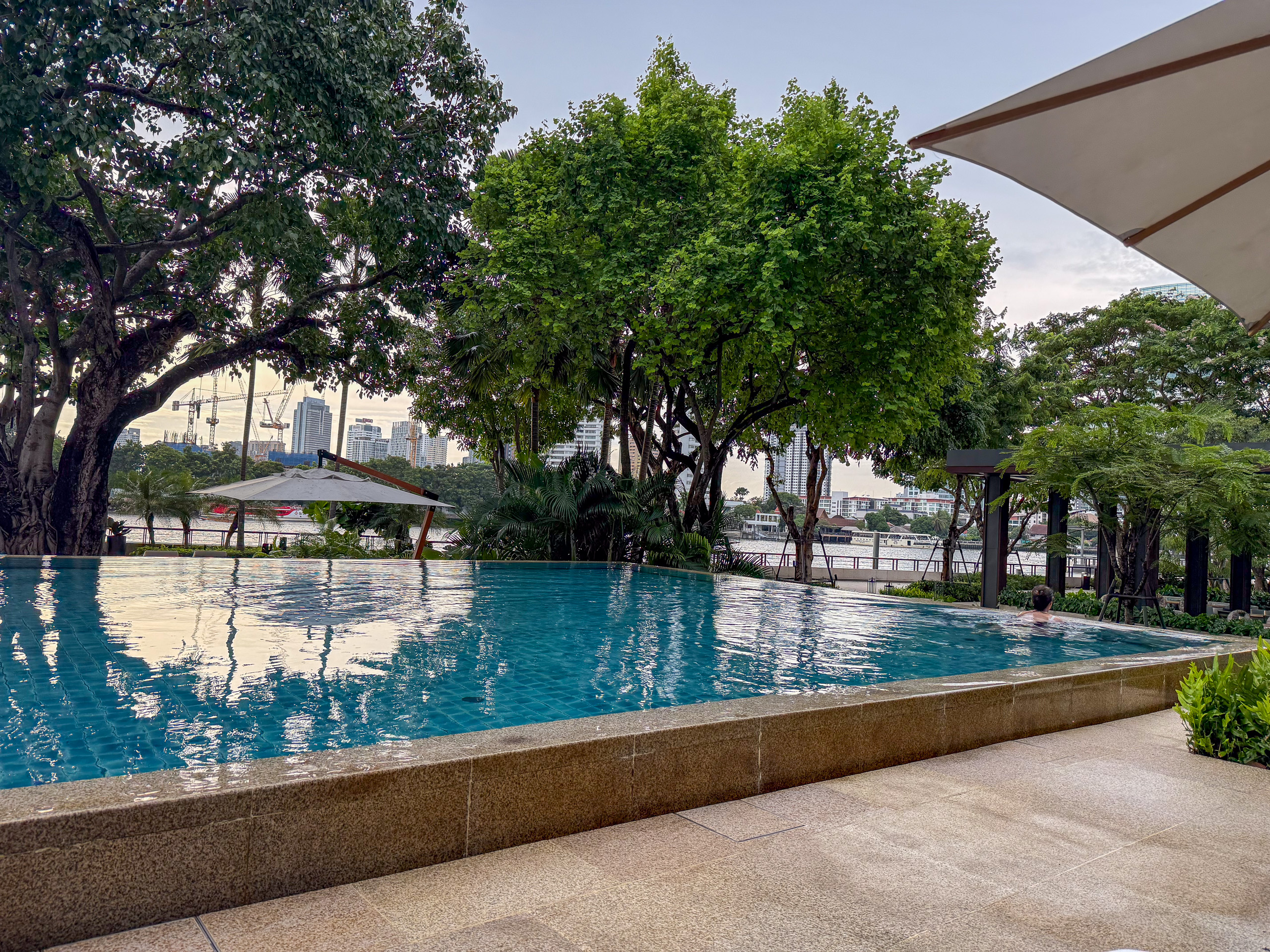
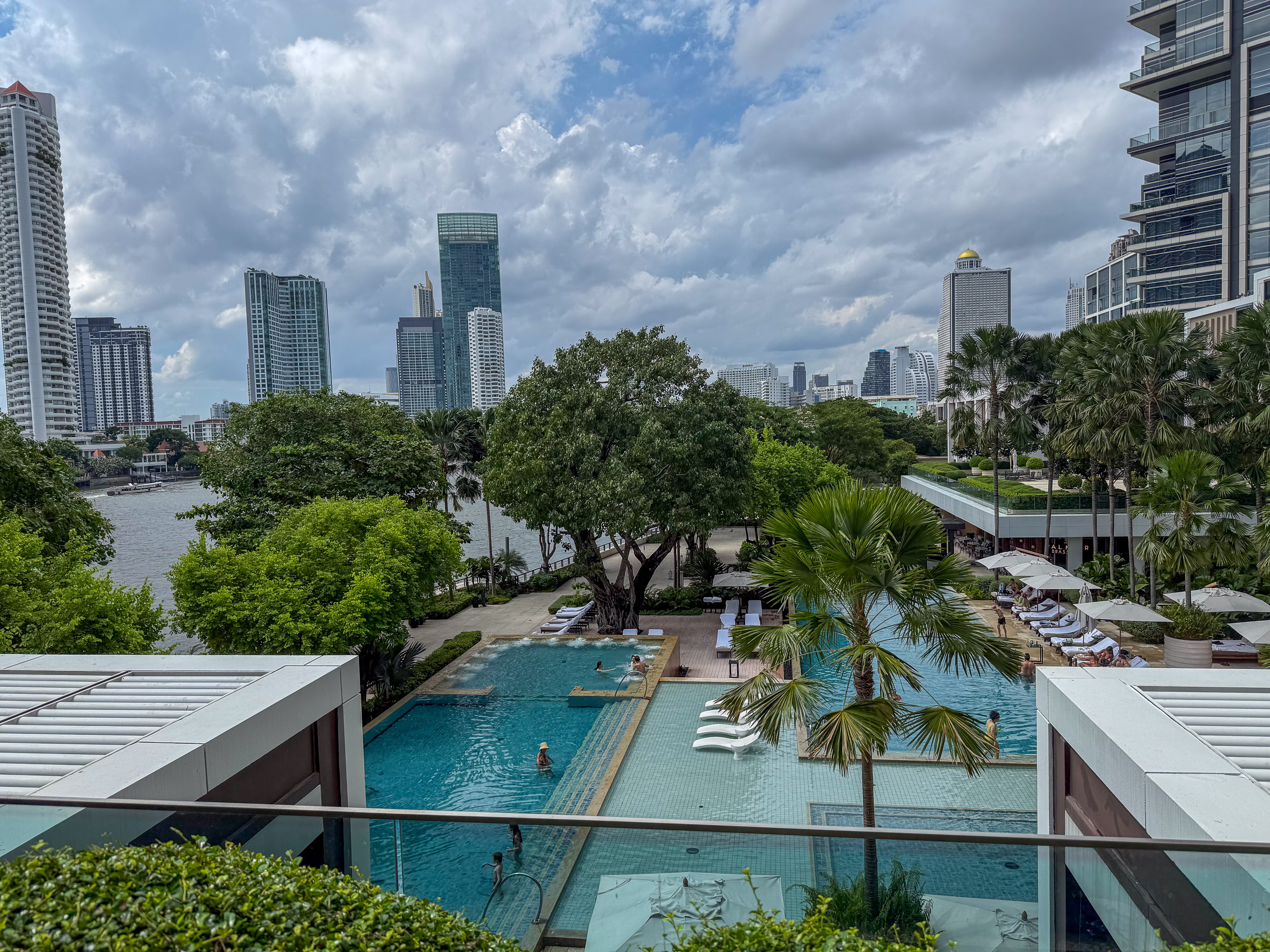
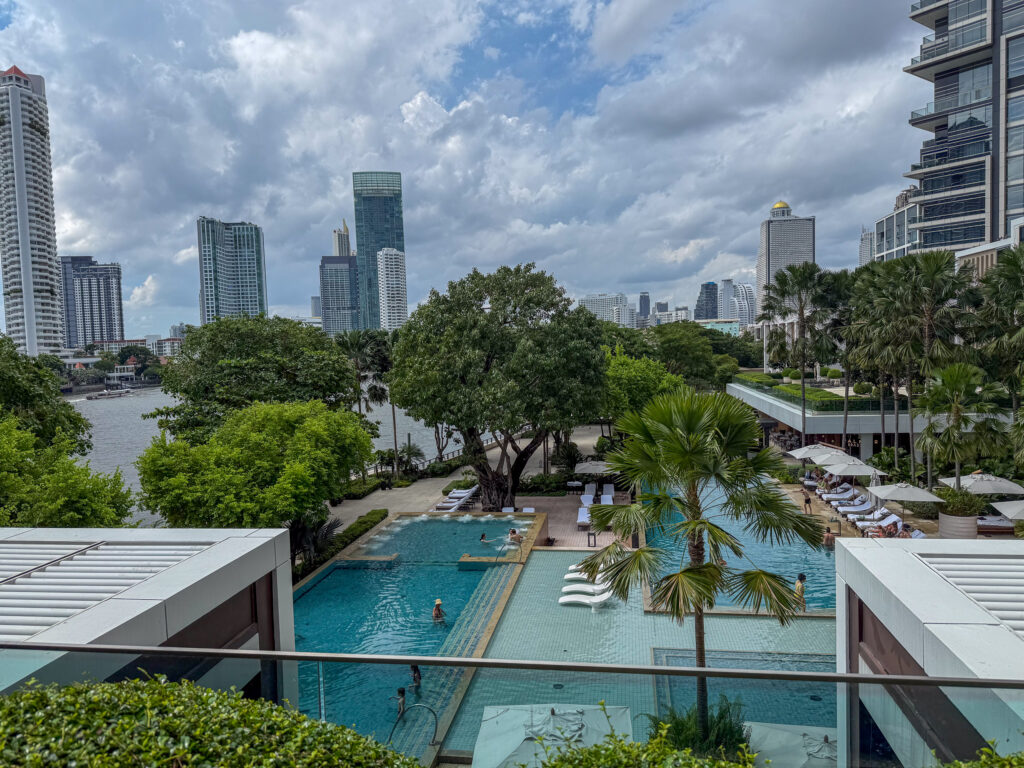
    The one everybody photographs is the long turquoise pool on the terrace above the river, lined with loungers and set into the trees, and it is the sociable one. The one that matters if you actually swim is the lap pool at the wellness centre, long enough to train in rather than to stand in. The spa is in the same building; it books out, and the pools do not.

    The long pool running to the water, old trees standing over the far end
    The terrace pool, the rain tree, and the city that starts again behind it.

    Go early. By ten the terrace has filled and the loungers nearest the water have gone; by two the heat has made the decision for you anyway. Between seven and nine the pool is effectively private and the light on the river is the best of the day.

    Six-thirty in the evening is the hour the property is built around. The heat goes out of the stone, the river turns from brown to pewter, and the far bank comes on. Take a drink out onto the terrace rather than staying in the bar for it.

    The reflecting pool at sunset seen between two columns, palms silhouetted against the sky
    Six-thirty, from the terrace. This is the hour the property was built for.

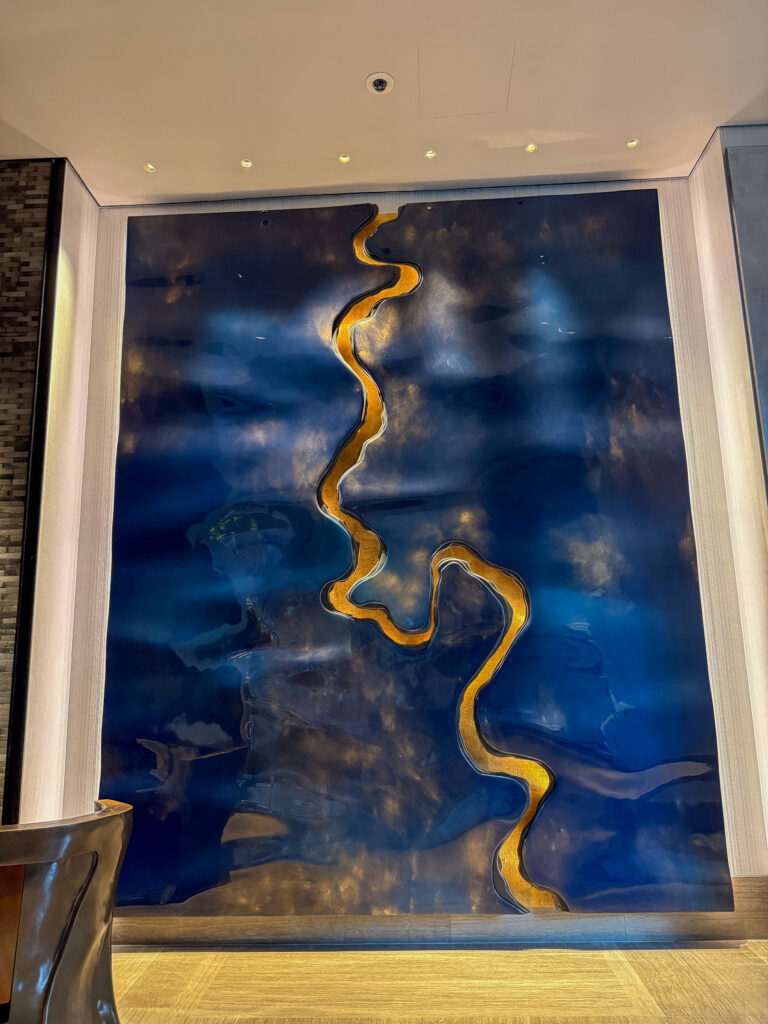
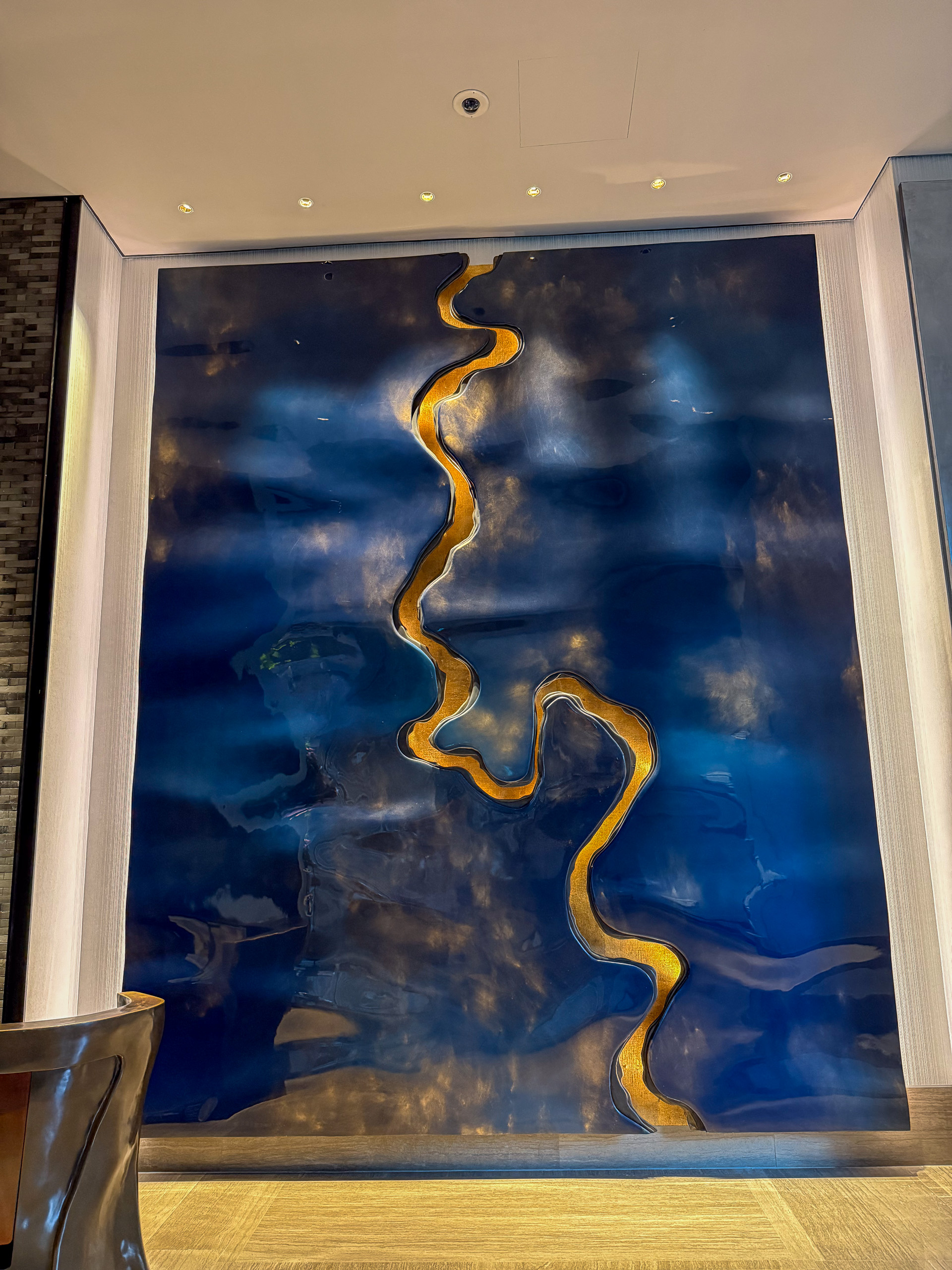
    There is an art space running from the lobby down to the river, showing Thai artists in exhibitions that change, and it is the most unusual thing about the hotel. The piece I kept walking back to was a tall panel of deep blue with a single gold line wandering down it, which is the river, and which is better than that description makes it sound. Give it twenty minutes on the way through rather than walking past it four times, which is what I did before I looked properly.

    The pool terrace from above in the afternoon, the river and skyline behind
    The pool terrace at three.
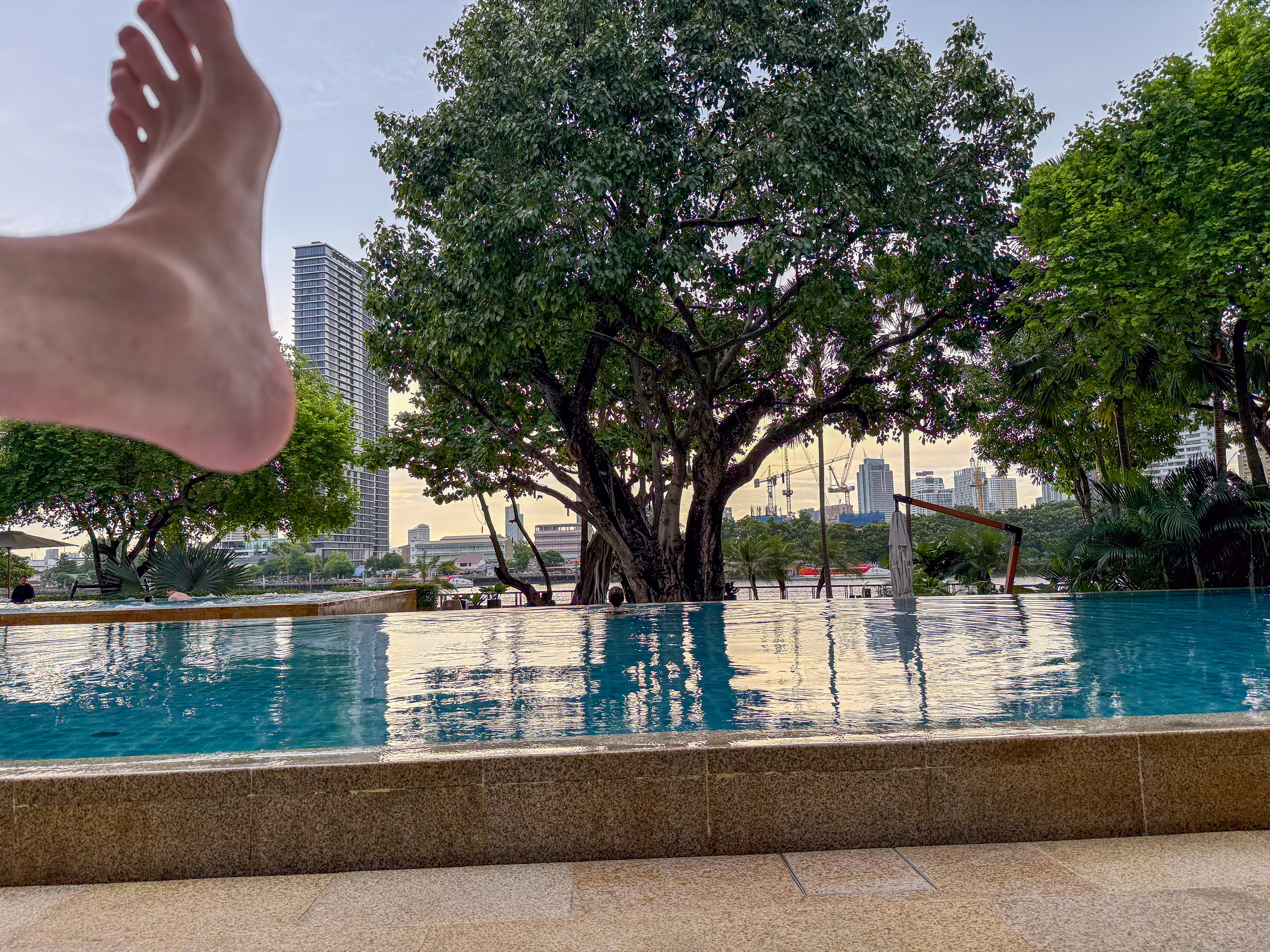
    A foot raised into frame over the still pool and the trees beyond
    The still pool, being used correctly.

    Service moments

    Quick, unfussy and noticeably young, and it holds at the edges rather than only at the centre. Nothing missed and arguably outstanding but nothing that makes you rethink every hotel you’ve been in before. Think of Four Seasons in a country like Thailand and thats what you get.

    I ordered a complex tea at the bar and it took a few minutes to make so they held it for me until I got back. They offered and assisted with a Thai smelling salts container – Ya dom – not go be confused with its even more delightful liquid cousin Ya Dong.

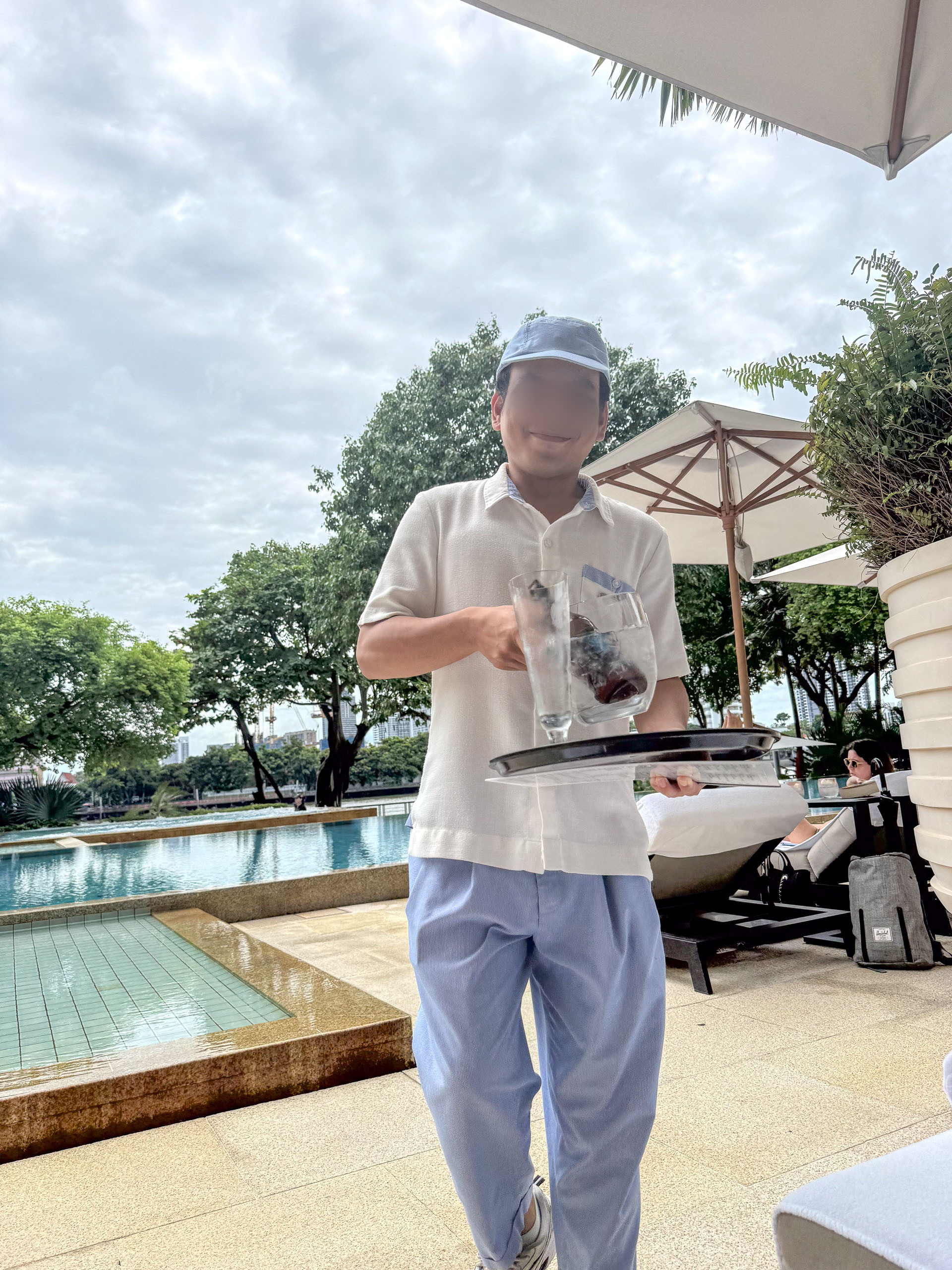
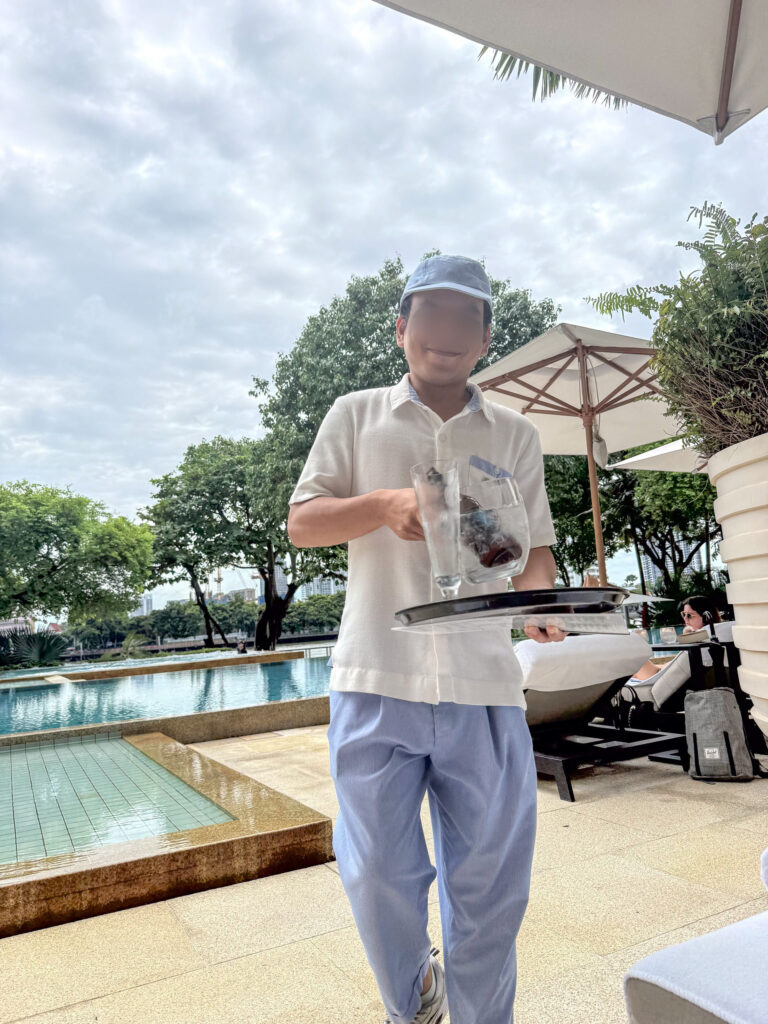
    A member of staff bringing a tray to the poolside under a white parasol
    A tray on its way to the poolside. Service here comes to you.

    A resort built inside a city that has no room for one, which is the whole point and also the whole cost.

    Who it is for, and who it is not

    Come if you want the days full: three pools, four restaurants, a bar that people cross the city for, and an art space to walk through on the way to all of them. Ask for a high floor on the river side and say so at booking rather than at check-in. Take the boat rather than a car whenever the timetable allows, and note that it stops at ten. Swim before eight.

    Look elsewhere if what you want from a river hotel is a hush and a handful of other guests. The ground floor here belongs to Bangkok as much as to you; on a Friday the courtyard was a thoroughfare. The property three minutes south does quiet better, and I have set the two side by side in Capella or Four Seasons. Look elsewhere too if the room is what you are paying for; here the room is very good and the grounds are the exceptional reason to come.

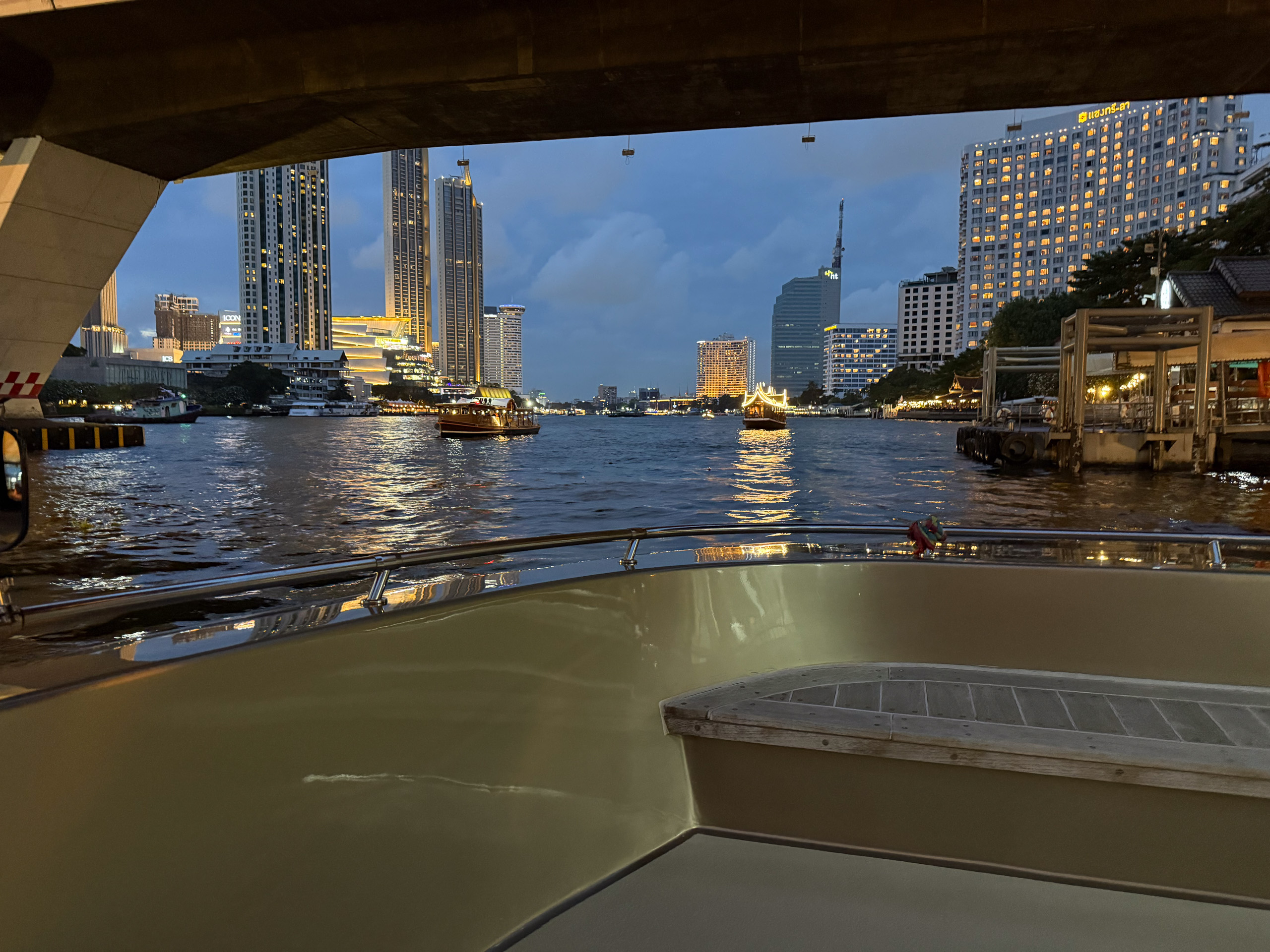
    The river at dusk from the hotel boat, the city lit along the far bank
    The river at dusk from the hotel boat, the city lit along the far bank.

    Bottom line

    Four Seasons Bangkok is an urban resort that shares its ground floor with the city, and it is at its best when you use everything it has. Bring the family for a resort getaway with all the tours of Bangkok at your fingertips- and take the boat, not a car.

    See the full set: Four Seasons, Bangkok — in frames. More Bangkok: Capella, Bangkok.

    Four Seasons Bangkok gallery

    Every photo on this site is my own, shot on the stay. Slide through →
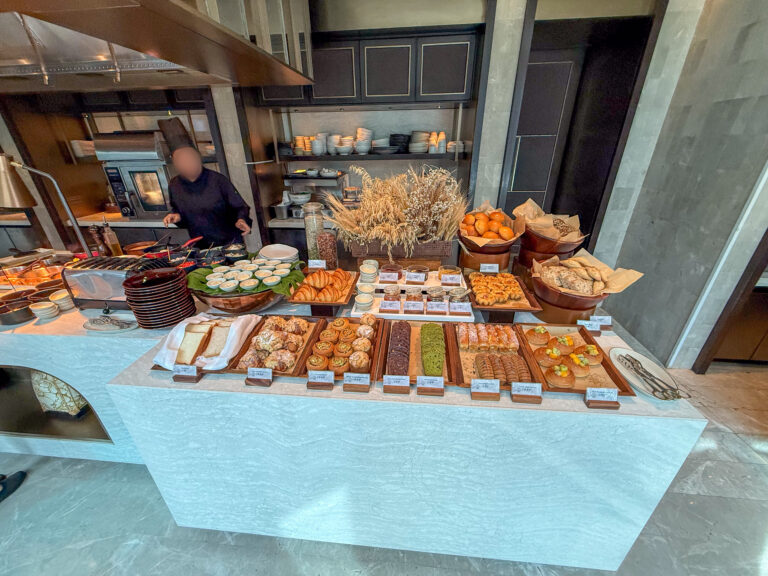
    A spray of purple-spotted vanda orchids against a pale wallA large blue and gold panel filling the wall, lit from aboveA run of lit mirrors over a dark counter, orange stools set beneathA treatment bed in a wood-lined room, folded linen on the shelves alongsideBottles, dishes and folded cloths laid out along a lit counter
  • Sorn: Three Stars, and Worth Planning a Trip Around

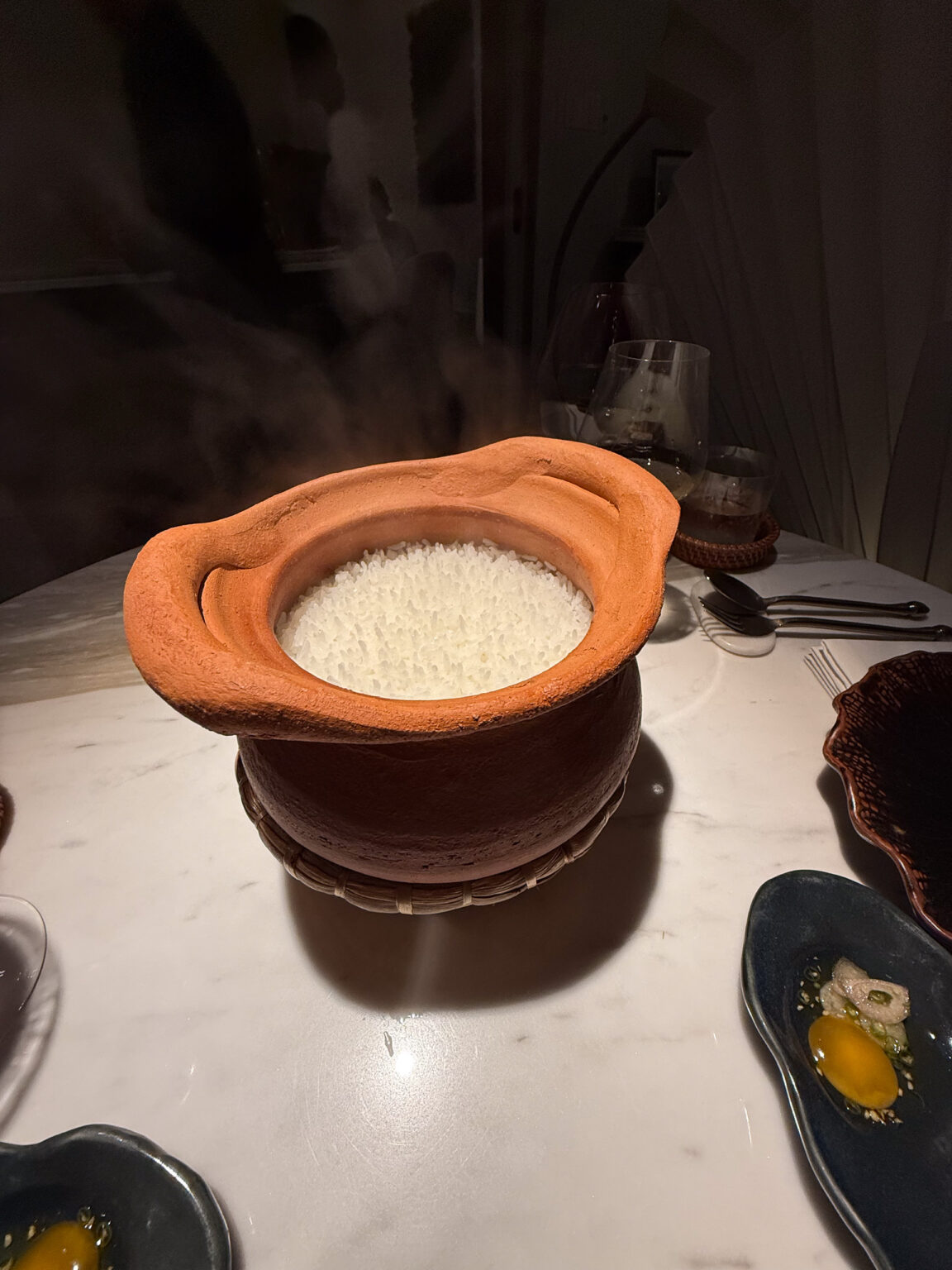
    A terracotta pot of steaming jasmine rice set in a woven basket on the marble table

    BANGKOK, THAILAND · RESTAURANT · 5 MIN READ

    Sorn: Three Stars, and Worth Planning a Trip Around

    One southern Thai tasting menu, one sitting a night, and the hardest table in the country to get. It is, to date, the best meal of my life.

    By J.C. Mercer

    Verified meal·paid in full

    • Covers Two, 6pm
    • Dined July 2026
    • Menu The tasting menu
    • Drinks Wine pairing
    • How it was booked In the monthly release, weeks ahead
    • Value verdict This is currently, to date, the best meal of my life. A MUST DO IF YOU CAN for any lover of Thai cuisine.

    Booked the way any other guest would book it.

    The house and the room

    Sorn is a restored house down a quiet residential lane off Sukhumvit 26, and you would walk straight past it if you did not know. Three stars on the door, and what it actually does is narrower than three stars suggests: one set menu, dinner only, built entirely from the food of the south, cooked over charcoal and in clay pots. This is not southern Thai food interpreted for Bangkok. It is southern Thai food brought north intact.

    Two claims before the details, so the stakes are clear. First: this went to the top of my meals-eaten-ever list, in any country, and it has stayed there. Second: it may be the most difficult table to get in the country, and not only for foreigners — Thais miss it too. I put the question to hotel staff, to the staff of other restaurants, and to people I met elsewhere in Thailand, in the United States, and even in Fiji: more than a dozen had wanted to eat here, tried numerous times, and never got in.

    The menu open on the table
    The menu, open on the table. One set menu, one sitting, and nothing to choose.

    The room is small and there is one seating a night. A board on the wall names the individual people who source for the kitchen — the prawns from the Tapi river, the crab from Surat Thani, the rice from Nakhon Si Thammarat — which is the argument made as an object: not knowing where the ingredients come from, but knowing who they come from. Read it before you sit down. The room runs cold; bring a layer.

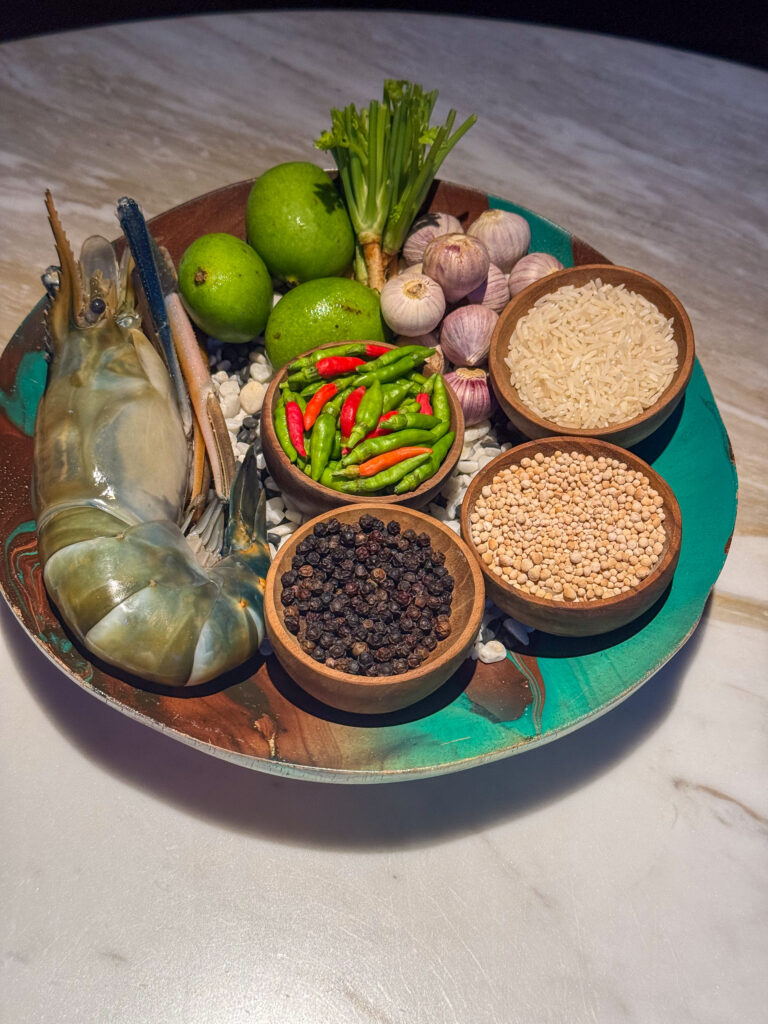
    A ceramic tray of raw ingredients: a whole river prawn, green mangoes, garlic, bird's eye chillies, jasmine rice and black and white peppercorns
    The tray that opens the meal: river prawn, green mango, garlic, bird’s eye chilli, jasmine rice, peppercorns. Sorn shows you the components before the dish.

    How the meal runs

    Nobody agrees how many courses this is, and the disagreement is really about the unit, because one course can arrive as three plates. Expect something north of twenty, across about three hours. The first act was individually plated and small: raw and lightly worked seafood, a sequence the menu calls the Ocean, a sorbet to clear. Then it pivoted. Rice arrived from a clay pot with a spread of condiments — chilli pastes, pork rinds, dried stingray, sweet shrimp, quail egg, herbs — and the southern classics came out family-style: soup, curry, stir-fry, something fried. Then desserts, then the trolley.

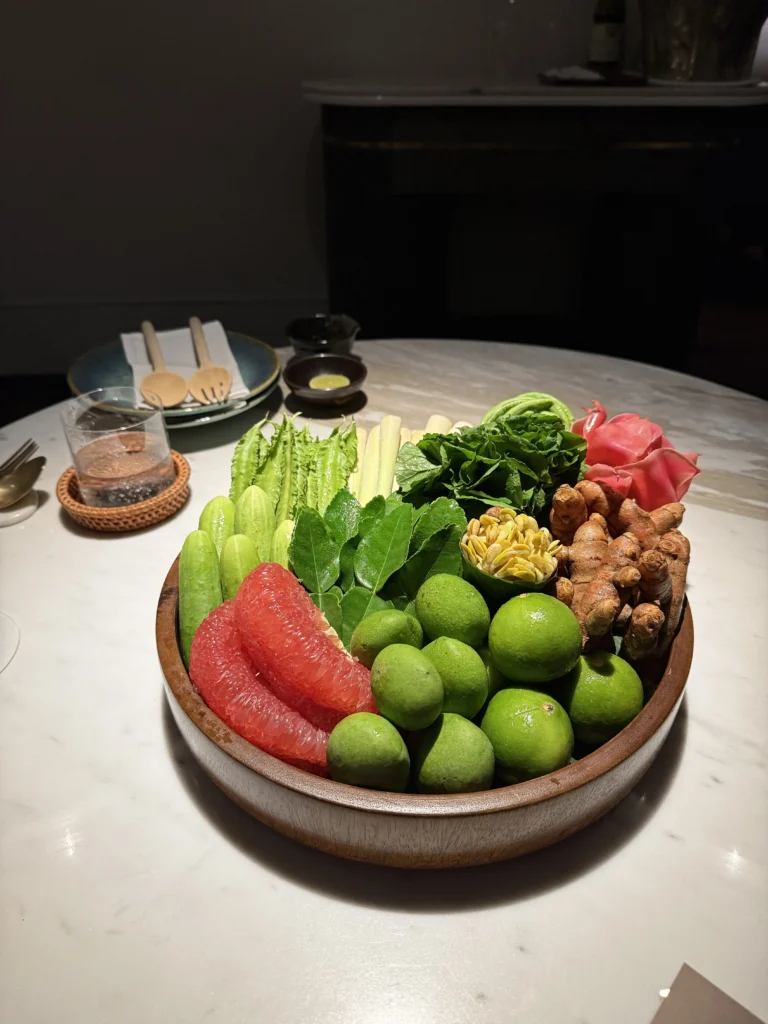
    And through it all, the ritual I have not seen done better anywhere: before a dish arrived, they showed you, on a platter, a large and beautiful spread of the actual ingredients of what you were about to be offered. It is theatrical and it adds an element most tasting menus never find — anticipation and knowledge combined. It is simply sublime.

    A wooden bowl of raw southern Thai produce: winged beans, cucumbers, baby corn, betel leaves, torch ginger flower, fresh turmeric, pomelo and green mangoes
    The bowl for the vegetable course: winged beans, baby corn, betel leaves, torch ginger, turmeric, pomelo, green mango. Presented whole, then dressed at the table.

    Southern Thai cooking is the most aggressively seasoned food in the country, and the kitchen asks about heat before service and sets it per person, anywhere from full southern to mild. Two things are worth knowing. The curries are made in batch and cannot be turned down, and they are the hottest things on the menu. And mild here is still, by most standards, hot. I said medium, the way you say it at home. The chef nodded the way a doctor nods.

    Steam off the pot as the lid comes away
    Steam off the rice as the lid comes away.

    The pace is quick, and it is deliberate rather than careless: a lot of these dishes are temperature-critical and are meant to reach you fast. The descriptions come just as quickly, and if you want to hear one twice you may be pointed at the printed menu instead. You will be too full well before the trolley.

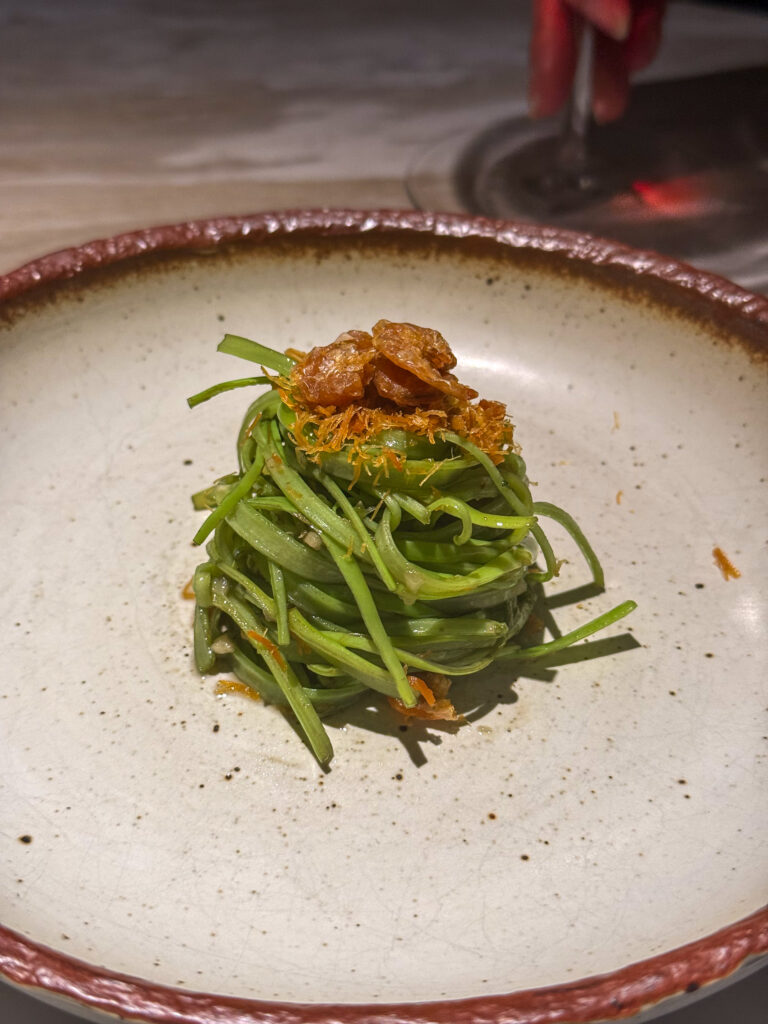
    A tangle of stir-fried morning glory crowned with crisp fried garlic and shallots in a rustic bowl
    Stir-fried morning glory under crisp fried garlic and shallots. By now the plates are shared.

    Three dishes that mattered

    The rice. It is the centre of gravity here, not a side dish: southern jasmine cooked in a clay pot over charcoal, in water brought up from the south — and like a different beast from any jasmine rice I have had before or since. It was the rice of angels. Everything alongside is built to be eaten with it, which is why the middle of the meal looks less like fine dining than the opening did. That is deliberate.

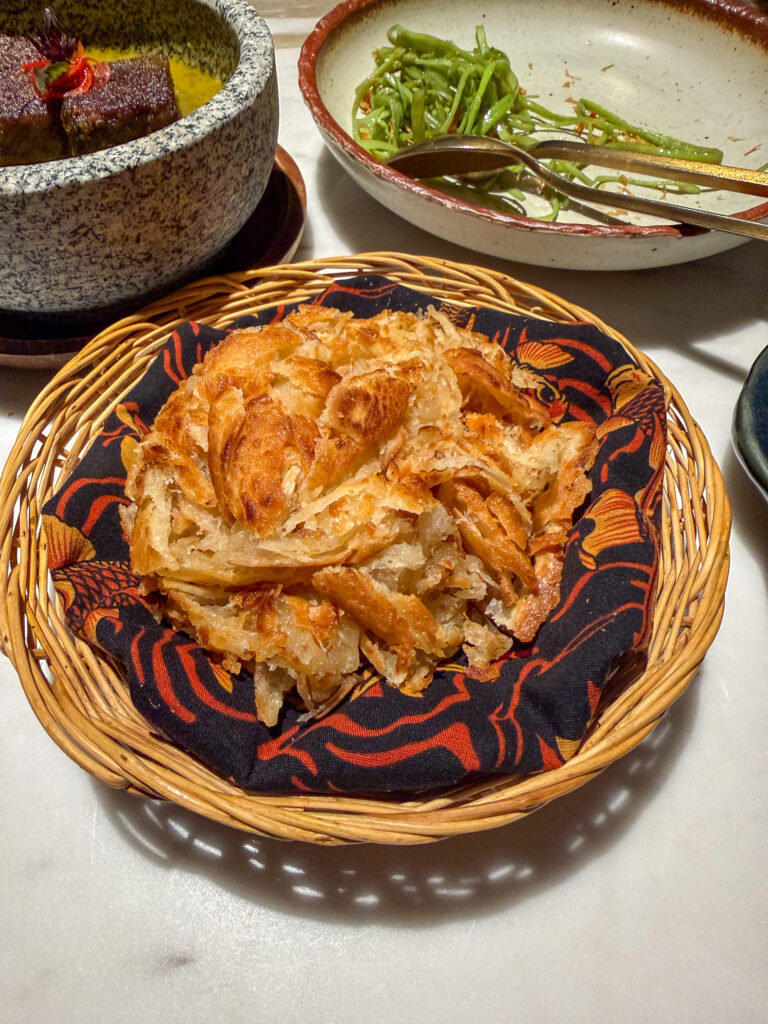
    Torn layers of flaky roti in a cloth-lined basket beside a curry and a bowl of greens
    Roti beside a curry. The green curry is the one to save room for.

    The green curry, beside roti. Save room for it. The intensity in this food comes from a time when people foraged and travel took days — the stronger the paste, the more rice it could carry — and that logic is still on the plate. Every chilli paste in the house is pounded by hand, and you can taste the difference in a way that is hard to explain and easy to notice.

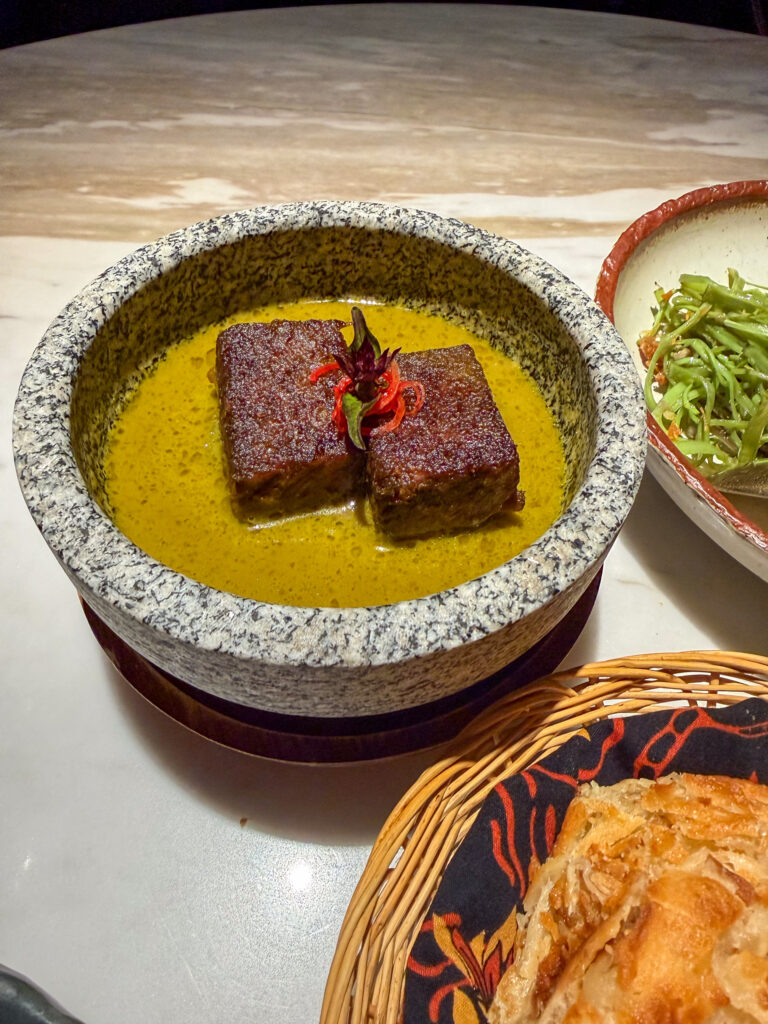
    Two blocks of dark braised meat in a yellow curry served in a granite mortar, a basket of roti alongside
    Braised meat in a yellow curry, served in a granite mortar. Every chilli paste in the house is pounded by hand.

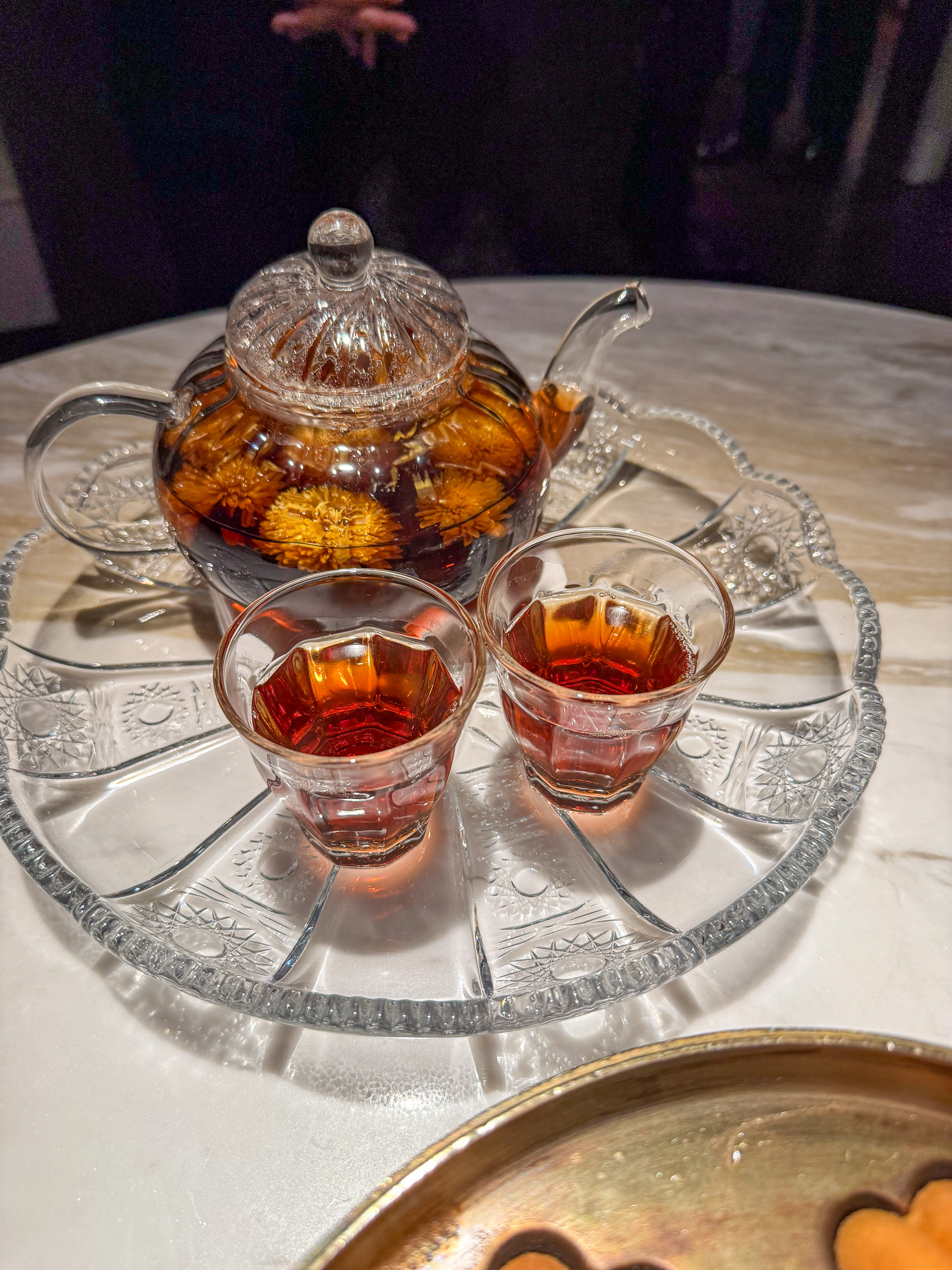
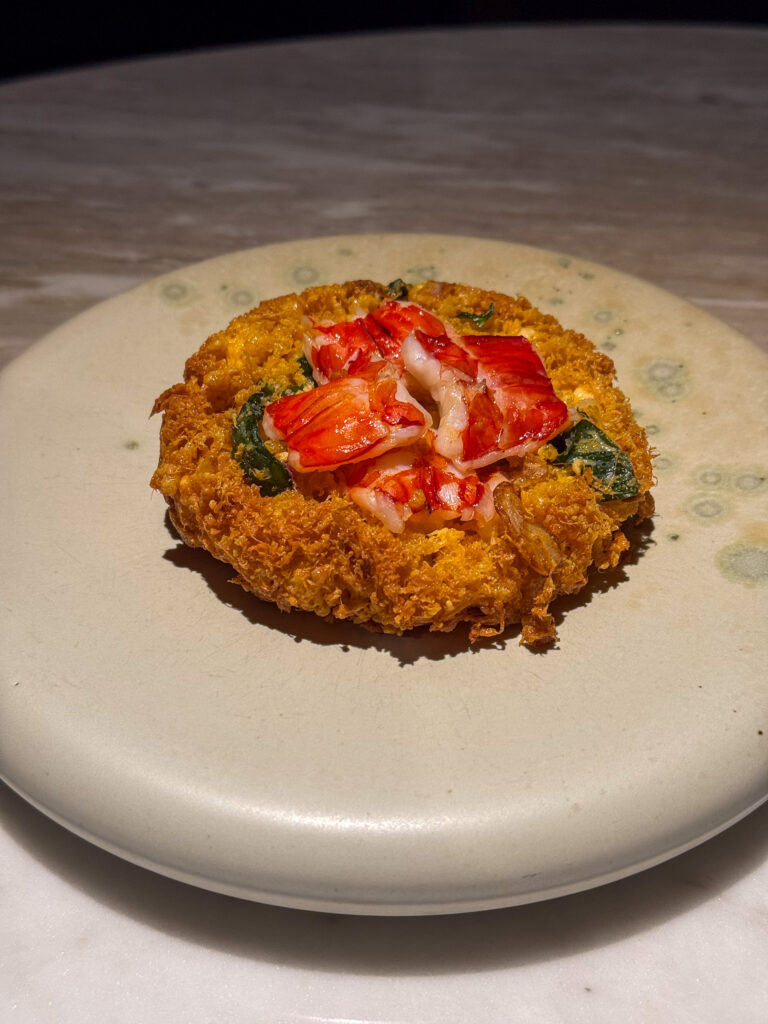
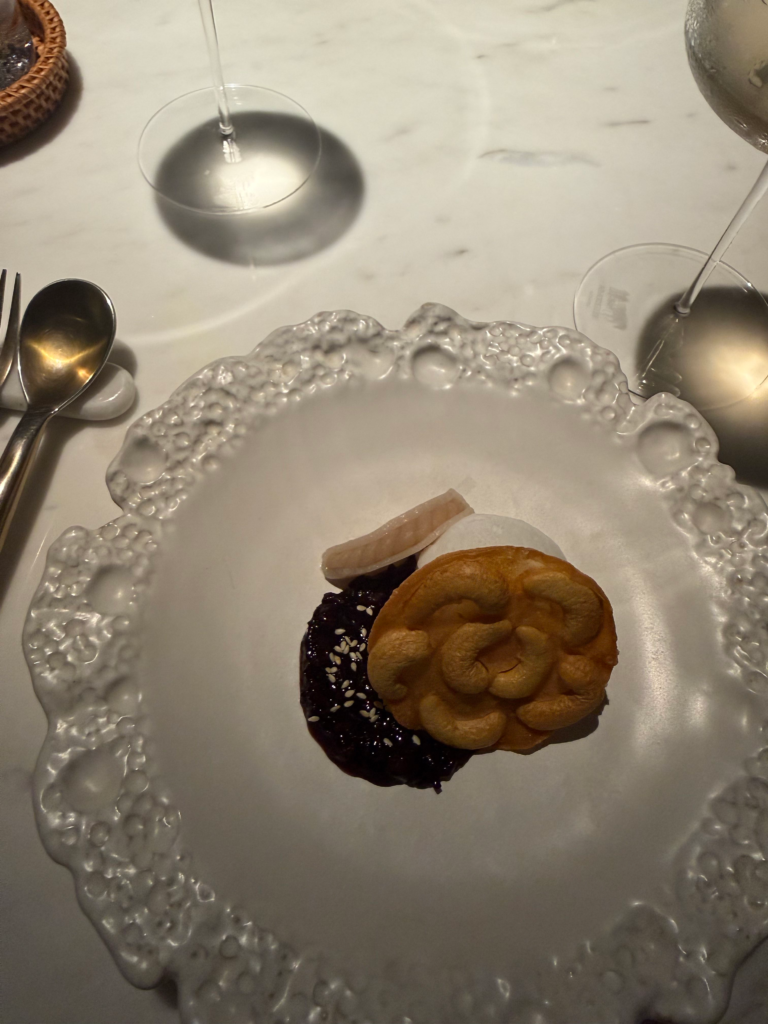
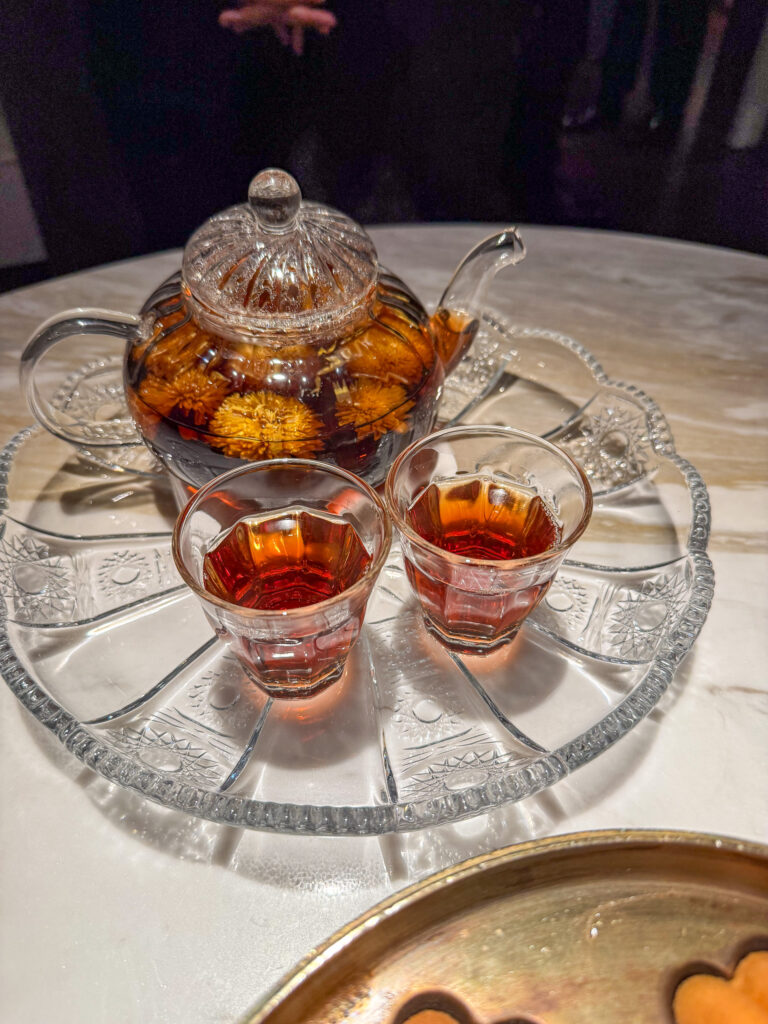
    The braised meat in yellow curry, served in a granite mortar, and the crisp golden omelette built around shellfish and greens from the family-style half of the meal. Then the last act: black sticky rice with sesame, coconut ice cream and a cashew wafer, and a trolley carrying more petits fours than anyone can reasonably eat, with no expectation that you stop at one. Flowering chrysanthemum tea to close, poured at the table.

    A crisp golden omelette ringed around chunks of lobster meat and greens on a pale ceramic plate
    The crisp omelette, shellfish and greens inside.
    A dessert of black sticky rice with sesame, coconut ice cream and a cashew-studded wafer on a textured white plate
    Black sticky rice, coconut ice cream, a cashew wafer.
    Seven Thai petits fours arranged on a dark slate plate, a coconut crisp sitting on a heap of palm sugar
    Seven petits fours on slate. The trolley does not ration.

    The glass

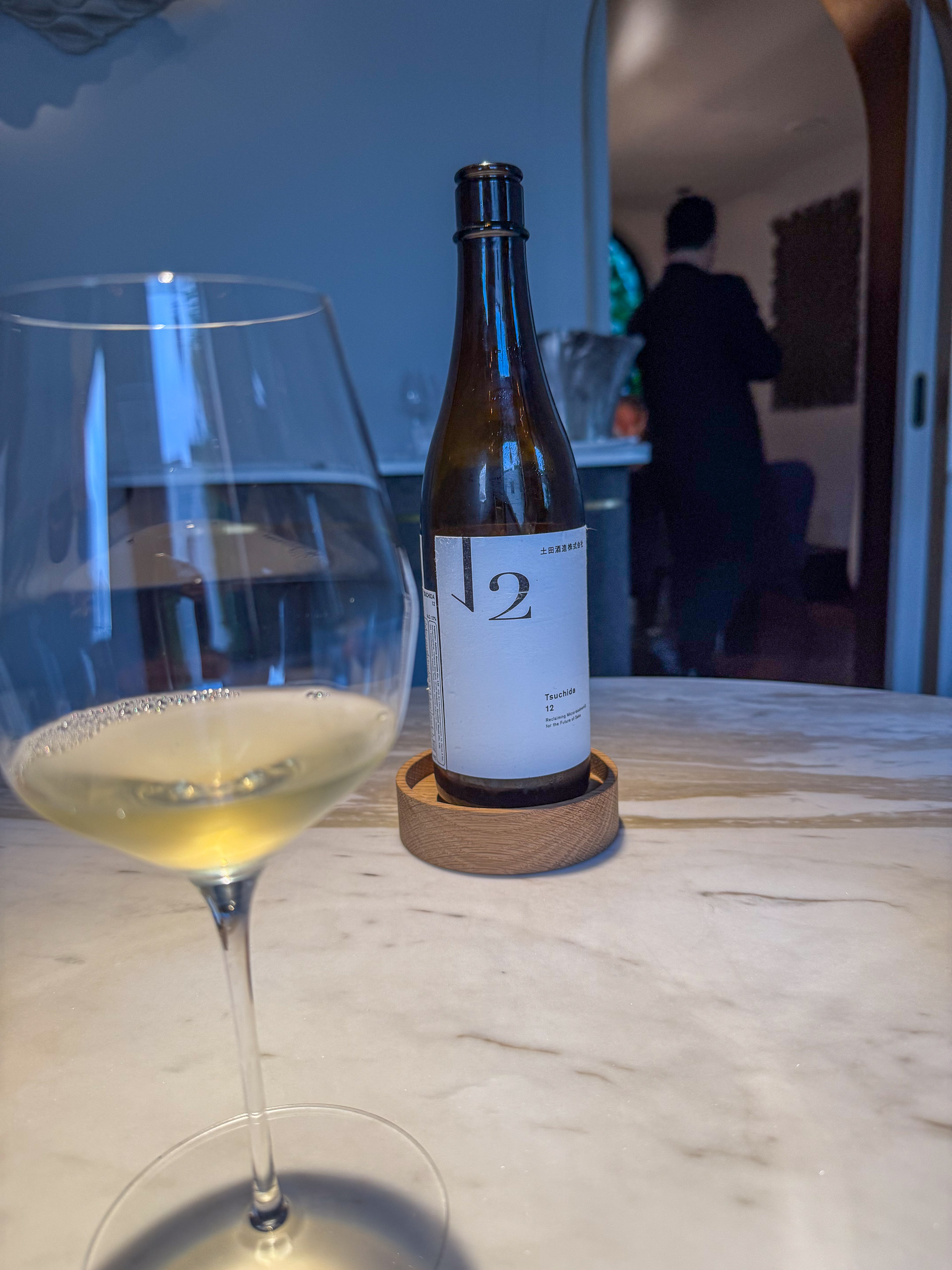
    Two wine pairings, six glasses and nine, and the shorter one is not all wine. Drinks are separate from the menu.

    A glass teapot of flowering chrysanthemum tea and two amber-filled cups on an etched glass tray
    Flowering chrysanthemum tea to close, poured at the table.
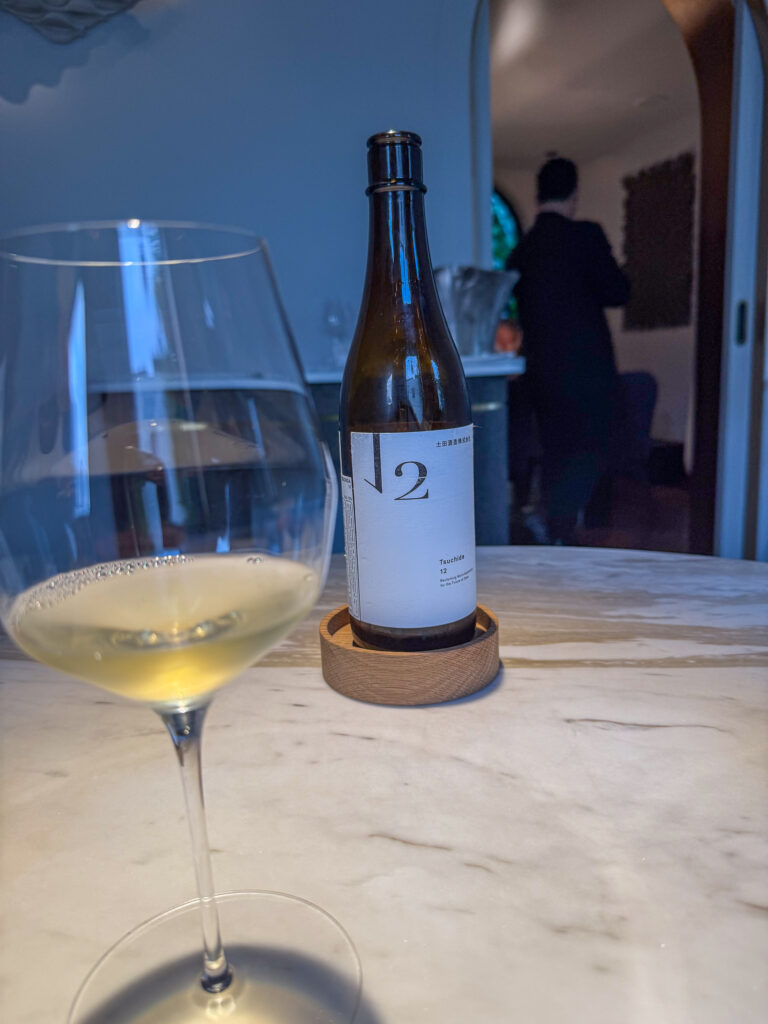
    A glass of white wine poured at the table, the bottle behind
    A white poured at the table, the bottle behind.
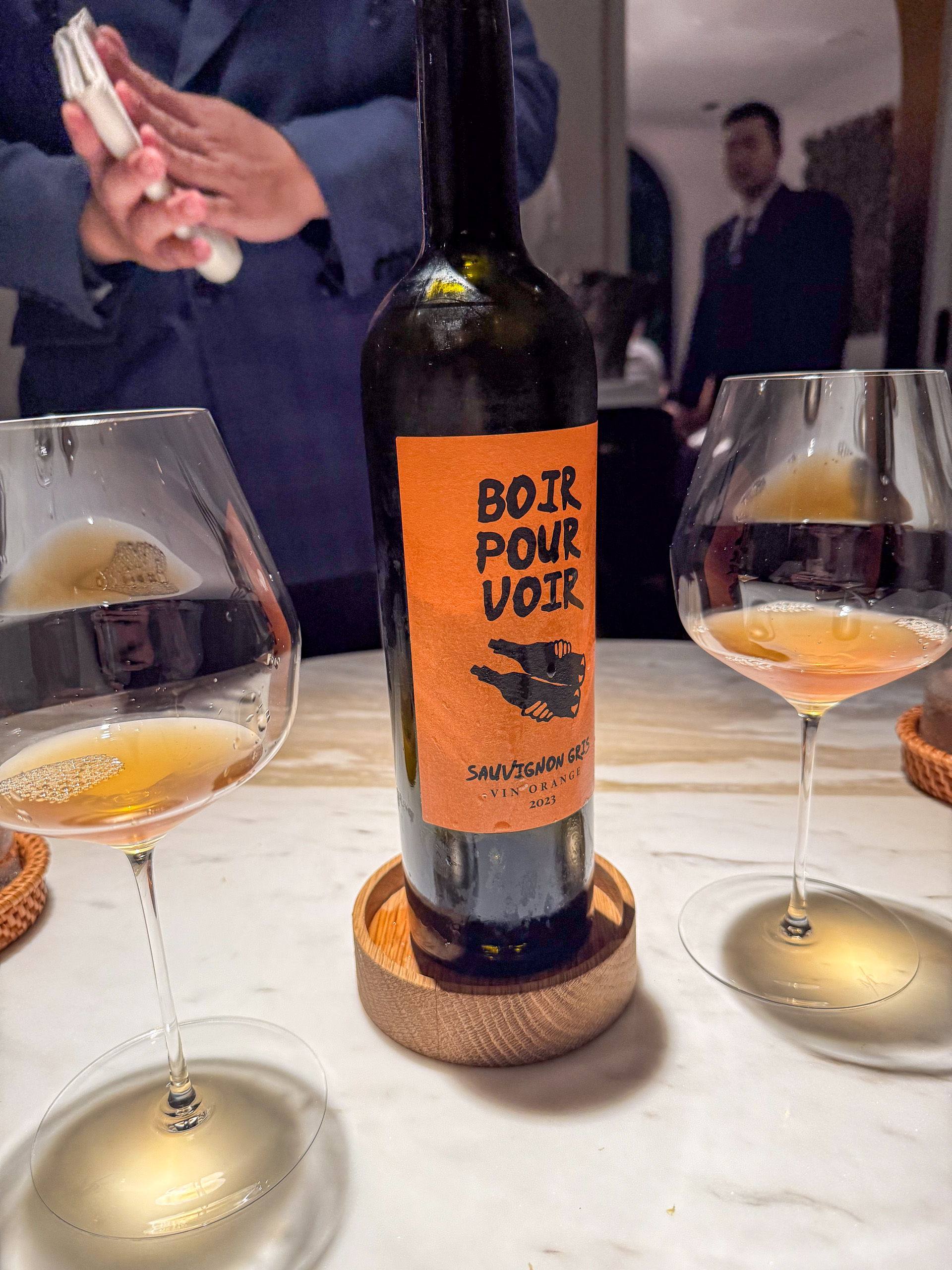
    An orange wine opened at the table
    An orange wine opened at the table.

    Booking reality

    There are two ways in. From outside Thailand you email the restaurant from midnight Bangkok time on the fifteenth, for the following month. Everyone else goes online at noon on the twenty-fifth, again for the month ahead. The restaurant has run other systems and the guidance online contradicts itself, so email early, set one alarm for the fifteenth and another for noon on the twenty-fifth, and check the restaurant’s own channels the week before.

    What you buy at that moment is not a reservation in the ordinary sense. The terms are hard: final on confirmation, no rescheduling, no cancellation. Arrive more than thirty minutes late and the booking is void, which in Bangkok traffic is a real risk; allow far more time than the map suggests.

    The printed card standing on the table before service
    The printed card on the table before service. What you buy is not a reservation in the ordinary sense.

    Turn up with fewer people than you booked and the empty seats still count. Book for four rather than two: there are more tables that size.

    And this needs saying plainly, because the commitment is final before you find out: there is no vegetarian or vegan menu, no shellfish allergy of any degree can be accommodated, and eight core ingredients — coriander root, onion, garlic, peppercorns, shrimp paste, coconut, chilli and fish sauce — will not be substituted. It is published on the same page that takes your card.

    Who it is for, and who it is not

    Come if this dinner is going to shape the trip, and book it before you book the flights. Come if you want one kitchen making one argument for three hours about the food of a region most visitors never eat. Answer the spice question truthfully when it comes. Budget three hours. Smart and unfussy is right; there is no dress code.

    Look elsewhere if anyone in the party is vegetarian, allergic to shellfish or unable to eat any of the eight, if anyone might not make the date, or if you want a table this week.

    The hardest table in the country, and the best meal of my life.

    Bottom line

    Sorn is the best restaurant in Thailand, the hardest table in it, and — to date — the best meal of my life. Set two alarms, book for four, say yes to the heat. Do what you must to get there. MUST DO BEFORE DEATH.

    See the full set: Sorn — in frames. More Bangkok: the Bangkok set.

    The Sorn gallery

    Every photo on this site is my own, shot on the night. Slide through →

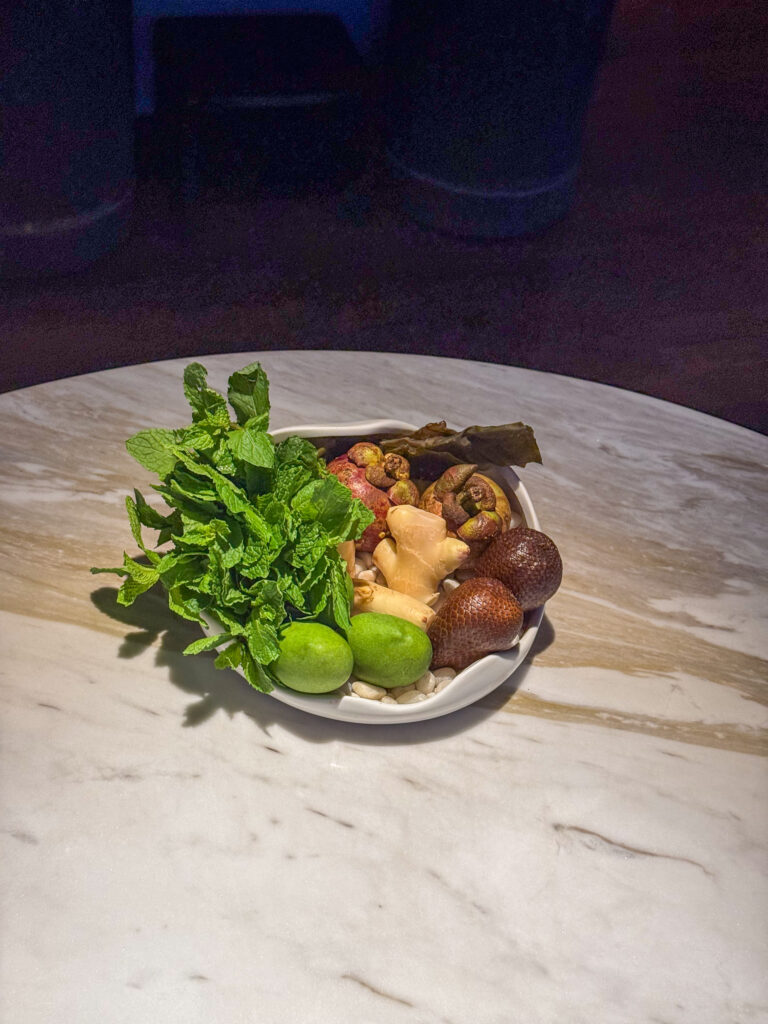
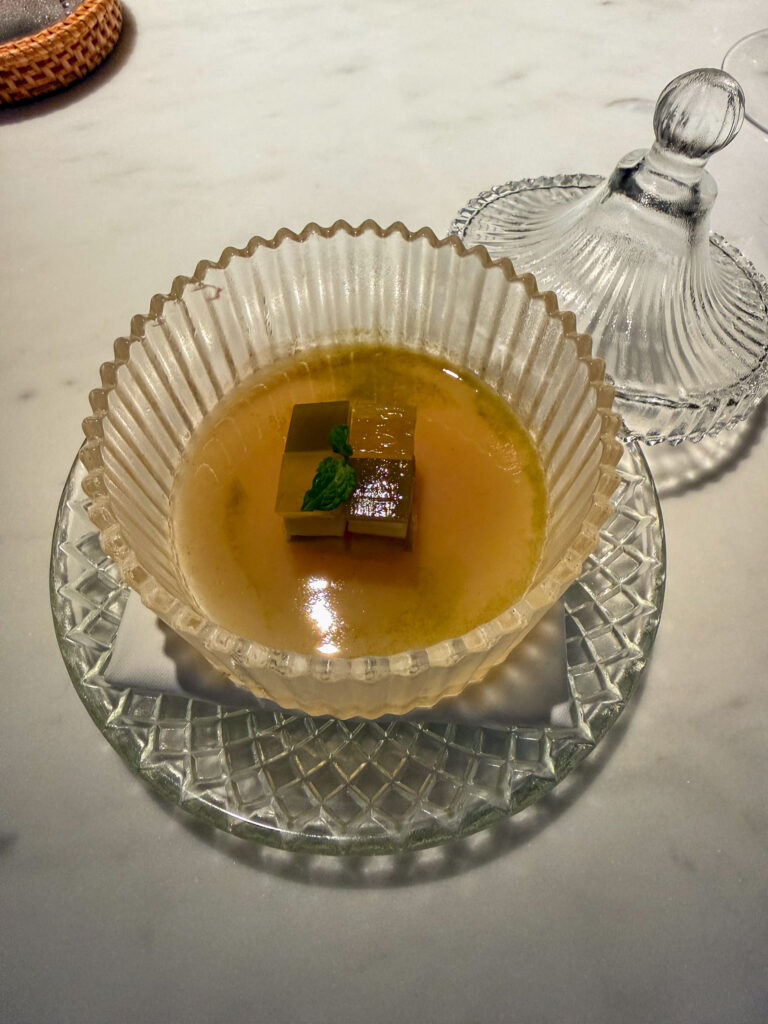
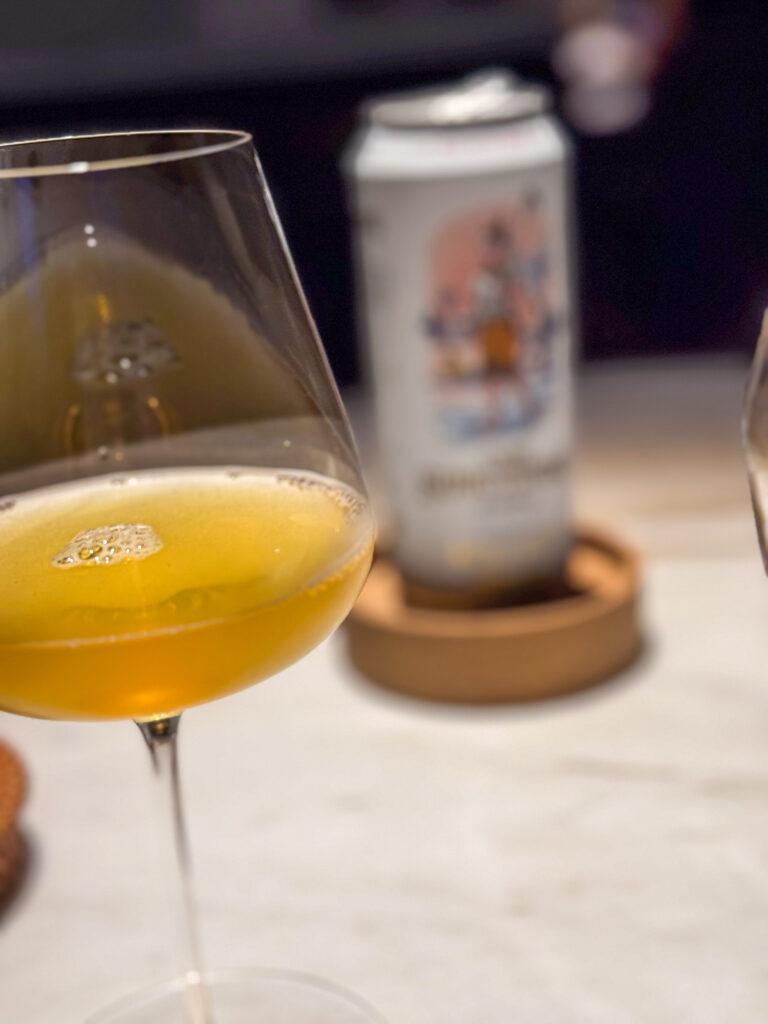
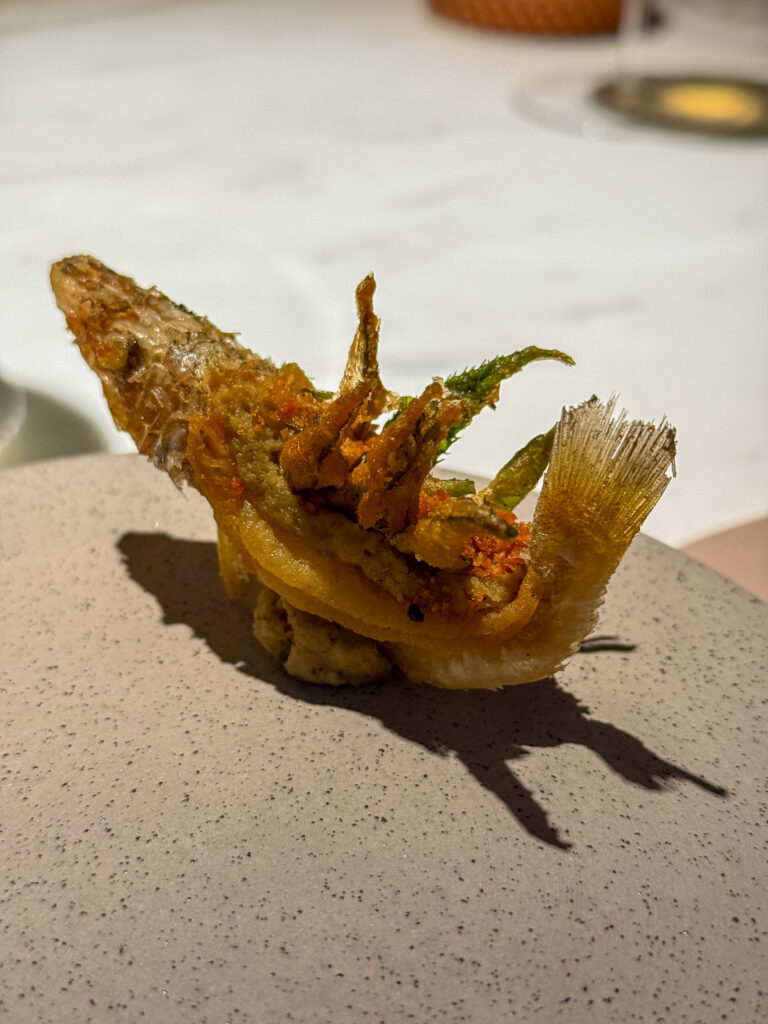
    A member of the team presenting an ingredient at the tableThe first dishes set down on the marbleA single composed course in a blue-glazed bowlHerbs, greens and shellfish arranged on a shallow plateA clear cup of jellied brothA cold beer poured beside the plateA single crisp-fried course on a plain plateThe raw ingredients of the course laid out on a trayThree small courses arriving togetherGreens, egg and shellfish on a glazed plate
  • Capella or Four Seasons: the two hotels that share a driveway in Bangkok

    CHAO PHRAYA ESTATE · CAPELLA vs. FOUR SEASONS · 5 MIN READ

    Capella or Four Seasons: the two hotels that share a driveway in Bangkok

    Same owner, same riverbank, three minutes apart on foot. I stayed at both back to back, and one of them gave me the best service I have had anywhere.

    By J.C. Mercer

    Verified stays·paid in full

    Capella BangkokFour Seasons Bangkok
    StayedJuly 2026July 2026
    Room bookedRiverfront Premier, king, third floorDeluxe River-View Room, king
    How it was bookedAmex Fine Hotels + Resorts, public rateAmex Fine Hotels + Resorts, public rate
    What the channel boughtUpgrade to Suite w/ Plunge PoolUpgrade to Annex Suite w/ Balcony
    Value verdictWorth it in any season; the service is the product.Worth it for the facilities, the name, the pools — if you do not care about these, go Capella and get more for less.
    When to goAny month — June and July are hot, less busy, and we had a wonderful time indoors. Book CapellaJune was great. Book Four Seasons

    Both stays booked the way any other guest would book them.

    The question

    The same company built both hotels on the same stretch of the east bank. They share a driveway. They share a river shuttle. You can walk from one lobby to the other in about three minutes, past a security post that waves you through without asking which guest you are. The awards lists put them next to each other too and disagree about the order, which is the most useful thing an awards list has ever done. In 2025 the World’s 50 Best list had Four Seasons at number two and Capella at number three; I rank them the other way around. But it all depends on what you want out of your stay, which is the whole of this piece.

    I stayed at both back to back, booked the same way, in the entry river room at each — and the channel upgraded me at both: a suite with a plunge pool at Capella, an annex suite with a balcony at Four Seasons. Back to back is the way to do it, and I recommend it without reservation, which is not a word I use lightly about hotels. The short version: Four Seasons is a resort that happens to sit in a city — three pools, six places to eat and drink, a spa with a boxing ring in it, enough going on that you can stay four days without leaving. Capella is low-rise, every room facing the river with a balcony that opens, a personal assistant assigned to your room, and a hush over the whole place. And Capella gave me the best service I have had in any hotel, anywhere, which settles more of this than I expected.

    River view from a Capella balcony
    The view that comes with every Capella room.

    Both sit on Charoen Krung, the oldest paved road in the city and the most interesting neighbourhood either could have landed in: galleries, coffee roasters, old shophouses running north toward Chinatown. The shared shuttle boat is the thing to use. ICONSIAM, across the water, is a world-class mall and a five-minute run by boat, every hour on the hour, with a two-minute walk on either side of it — I popped over for a snack and a drink more than once, and a summer afternoon there is time well spent. Sathorn pier and the Skytrain put the rest of the city twenty minutes beyond. Guests of either hotel can board, and the crews do not check.

    The shared river shuttle on the Chao Phraya
    The shared river shuttle — guests of either hotel can board.

    Side by side

    WhatCapella BangkokFour Seasons Bangkok
    LocationEast bank, low-rise, set back from the roadEast bank, same estate, three minutes north
    Entry roomRiverfront, private balcony on every roomRiver or courtyard by category; no balcony
    ViewRiver from every room, no exceptionsRiver or courtyard, depending on category
    VibeBoutique hideaway, close to silentUrban resort, full of life
    PoolsOne infinity pool, quietThree, including a lap pool long enough to train in
    SpaAuriga, seven suites; the couples’ room is the beautyTwo floors: heated indoor pool, boxing ring, aerial yoga
    GymAdequateAmong the best hotel gyms anywhere
    Signature tableCôte by Mauro ColagrecoYu Ting Yuan
    BarStella, intimateBKK Social Club, the best drink on the estate
    BreakfastBetter ceiling, less reliable floorBigger, safer, never wrong
    Service modelNamed Culturist, 24 hours — the best service I have had anywhereDeep bench, consistent, less personal
    ChildrenFine, but book a villaKids’ club, children’s pool, room to spread out
    Best forBeing looked after; the river from every window; slowing downFamilies, facilities, dining, a full day in

    Noted

    Observed on both stays, not measured.

    WhatCapellaFour Seasons
    NoiseLong-tail boats from 6am with the balcony door open; silent shutSilent; road noise never reached the room
    BedKing, medium-hard — a true delight of a night’s sleepKing, medium-firm, pillow menu — nuff said
    The bathAn attendant will draw it—
    Late checkout—Nine at night on the channel, with full run of the pools and spa
    Water pressureStrong; hot almost at onceStrong, hot on demand
    Air conditioningQuiet, held temperature overnightQuiet, held temperature overnight
    Shuttle boat to Sathorn pierAbout ten minutes across; every half hour or so by the timetableAbout ten minutes across; every half hour or so by the timetable
    Time to first greeting, morningsImmediate, both daysImmediate, both days

    Where Capella wins

    The room, if the river is why you came. Every room faces it and every room has a balcony that opens; at Four Seasons the entry rooms face the river or the courtyard and none has a balcony — the channel upgraded me into an annex suite that had one, which proves they exist and that you cannot book one by category. The courtyard is beautiful, planted with reeds standing in for rice fields. It is not the river.

    A Capella river-view suite
    At Capella, every room faces the river.

    The service, and not by a little. The Culturist is a personal assistant with a better name: mine got a same-day table for two at Gaggan on two hours’ notice, and phoned ahead as I walked past the restaurants so that staff I had never met greeted me by name.

    When I was late for the boat, someone from the front desk, without a radio, ran down the garden to hold it. I have built the Capella review around this and will not repeat all of it here. Four Seasons service is professional, consistent and impersonal by design; with that many rooms nobody is learning your coffee order by Tuesday. The floor never drops. It also never rises.

    A bath being drawn, petals scattered on the water
    The bath, drawn by an attendant.
    A staff member arranging a tray in the suite
    Service, in the suite.
    Canapés arranged on a small table
    Canapés, unasked.

    Thai food. Phra Nakhon gave me the best Thai meal I had in the city; by the second night the chef was cooking to order and came out to explain the spices. Côte, the Riviera room, is the harder table to get, so reserve before you fly. Breakfast at Capella, on the terrace, is the better meal when it lands.

    Shared Thai dishes across a table
    Phra Nakhon’s table, shared.
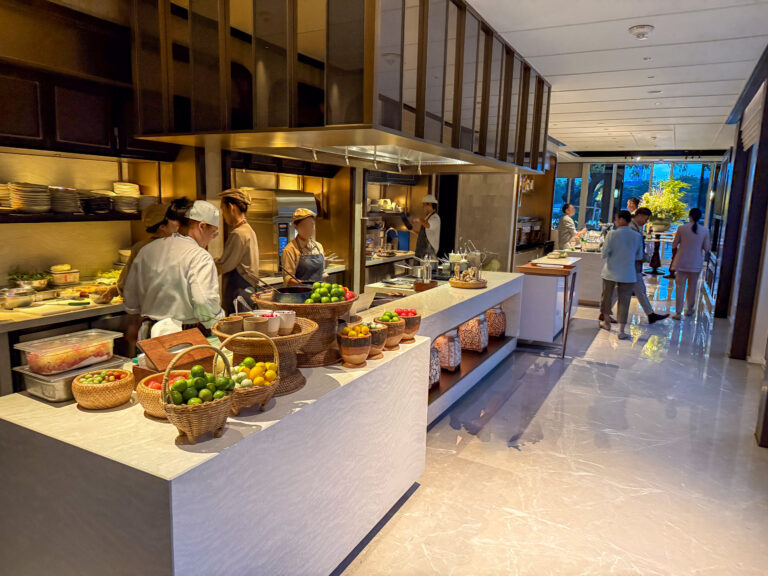
    The open kitchen at work
    The open kitchen, mid-service.
    A plated dessert
    Dessert, Four Seasons side.
    Green curry at Phra Nakhon
    Dinner at Phra Nakhon, the best Thai meal I had in the city.

    Quiet. One infinity pool that stayed calm through a weekend in high season with loungers going spare, which no Four Seasons pool will ever manage, and a couples’ room in the spa that is the most beautiful spa space I have been inside.

    The Capella infinity pool with city view
    Capella keeps a single, quiet infinity pool.

    Where Four Seasons wins

    Range. Yu Ting Yuan holds a star and does dim sum and Peking duck over the water garden; Brasserie Palmier does the French, Riva del Fiume the Italian and the breakfast that is bigger, safer and never wrong. BKK Social Club is the single best room on the estate in which to have a drink, and half of Bangkok knows it. Go before nine.

    Riverside dining at Four Seasons at night
    Riverside at Four Seasons, where BKK Social Club draws the crowd.

    Water and iron. Three outdoor pools stepping down toward the river, a lap pool long enough to train in, and a wellness centre across two floors with a heated indoor pool, a boxing ring and an aerial yoga studio. You can take a paddleboard class in the lap pool, which is either delightful or absurd, and I came down on delightful. Capella’s gym is adequate; Capella guests should walk over.

    The main pool stepping toward the river
    The main pool, mid-morning.
    The reflecting pool at the entrance
    The reflecting pools at the door.
    A spa treatment room
    A treatment room, upstairs.
    Aerial of the Four Seasons pools and skyline
    Four Seasons stacks three pools toward the river.

    The bed. The beds at Four Seasons are the best thing in either building — high ceilings, picture windows, a pillow menu — and the Noted box agrees.

    Children. A kids’ club, a children’s pool, three pools to spread a family across, and enough rooms that nobody notices a loud table at breakfast. Capella takes children and treats them well, but the place is built around quiet; with children, book a villa.

    Arrival, if you like a show. Four Seasons announces itself: reflecting pools, carved white elephants, a lobby holding more contemporary Thai art than most galleries in the city. I checked in during a rush and it stayed calm, cold towels and coconut water arriving before the bags were down. Capella’s lobby is small enough that staff clock you on arrival and keep clocking you. One hotel wants you to look at it. The other one is looking at you.

    The estate entrance on Charoen Krung Road
    One driveway, one security post, two hotels.

    Verdict by traveller type

    A couple, or anyone travelling alone who wants to be looked after: Capella, without hesitation. A family: Four Seasons, without much argument. A gym person, or anyone who will use three pools: Four Seasons. A first visit to Bangkok with the restaurants as the point: Four Seasons for range, then cross the driveway to eat at Phra Nakhon. Anyone who has stayed in enough hotels to have stopped being impressed by them: Capella. That was me, and it worked.

    Can you do both? Yes, and I would. Two nights each is enough to see the difference, and the walk between lobbies takes three minutes with a bag. Both open their restaurants to outside guests, so treat the estate as one menu and book across it. Do Capella second, and take the tired flight.

    And for balance, because the service story above tilts one way: the Four Seasons desk produced its own quiet marvel — a late checkout at nine at night, with full run of the pools and the spa until the car came. No tired flight has ever been better prepared for.

    Book Four Seasons if you want the days full. Book Capella if you want to be looked after.

    Bottom line

    Capella for the service, which is the best I have had in any hotel anywhere; Four Seasons for the days you want full. Book the high-floor river room at whichever you choose, and eat at the other one.

    See the full set: Capella, Bangkok — in frames and Four Seasons, Bangkok — in frames. More Bangkok: the Bangkok set.

    The Bangkok galleries

    Every photo on this site is my own, shot on the stay. Slide through →
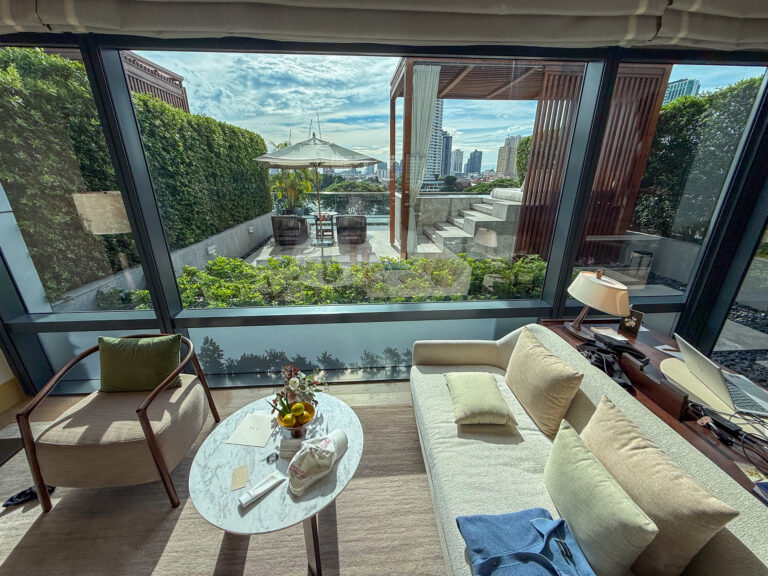
    A white-dressed bed against wood panelling, the river visible through the window beyondTwo rolled towels and glasses of water on a tray set on a marble tableA hotel bar built around a tall white sculptural centrepieceA corner living room glazed on two sides, sofa and armchair facing the terrace plantingA member of staff bringing a tray to the poolside under a white parasolLanterns and trees along a courtyard, the river catching the last lightFried rice with crab served on a betel leaf, prawn crackers and a dish of chilli alongsideA spray of purple-spotted vanda orchids against a pale wallA table of Thai dishes at the open counter, the kitchen team working behindA bartender working tableside in the low-lit bar, bottles ranked behind