BANGKOK, THAILAND · RESTAURANT · 9 MIN READ
Dining at Capella Bangkok: Two Michelin Stars Upstairs, and the Better Meal Downstairs
Five places to eat, one of them with two stars, and the meal that stays with you is the Thai room on the water two floors below it.
By J.C. Mercer
- Covers Two, dinner on the riverside terrace
- Dined July 2026, during a two-night stay at the hotel
- Menu À la carte at dinner, and breakfast at the same tables in the morning
- Drinks By the glass from the list. No pairing is sold with the food here
- How it was booked The way any other guest would
Every meal on this site is booked the way any other guest would book it.
Capella Bangkok has five places to eat and one of them holds two MICHELIN stars. That is the sentence the hotel gets written up on, and it is the wrong way round. The two-star room is upstairs, and plenty of people who sleep here never get inside it. The meal they leave describing is downstairs, at a marble table under a white umbrella with the Chao Phraya at eye level.
Everything here takes non-residents, so you do not need a room key to eat in it.
The room on the water
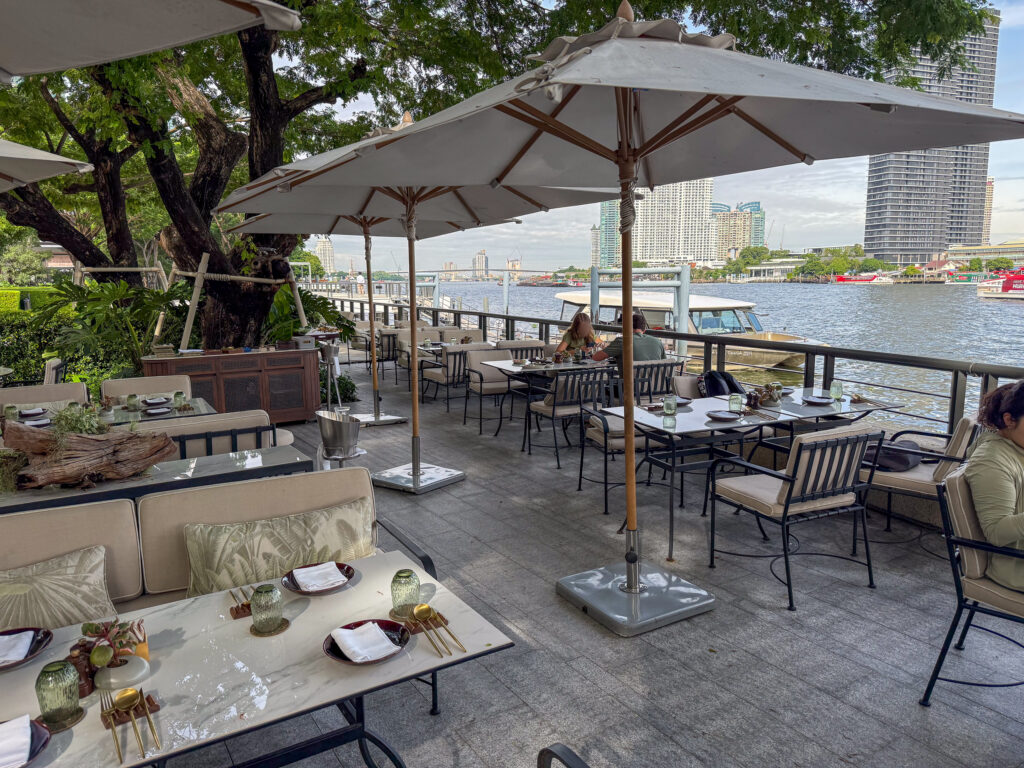
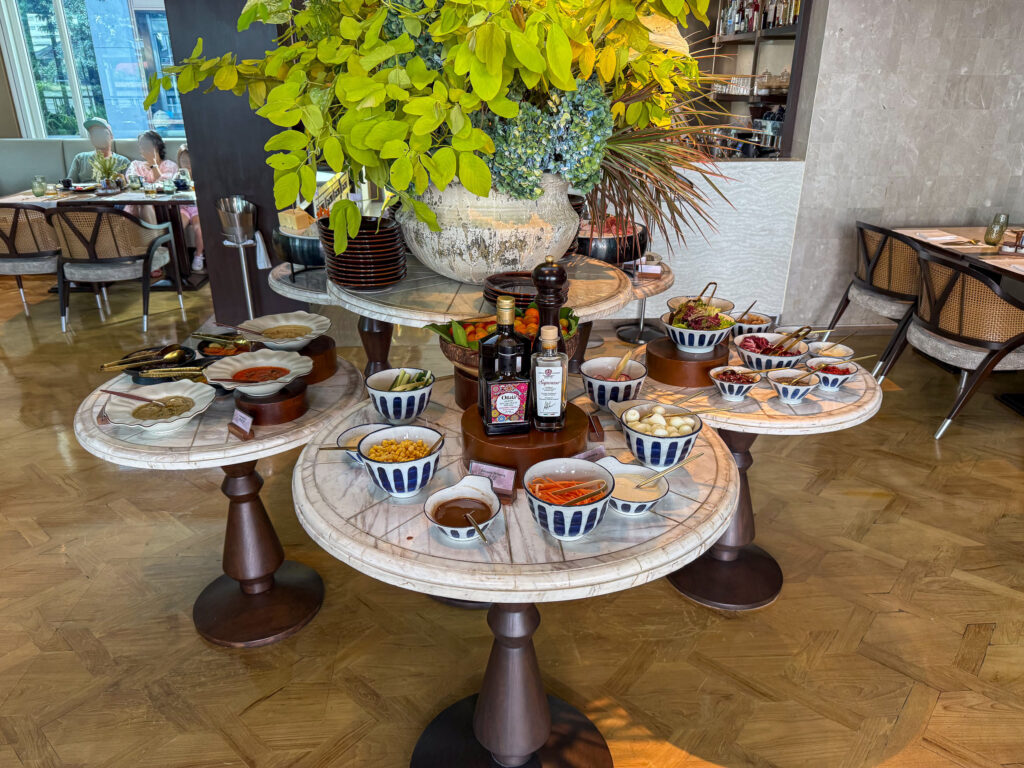
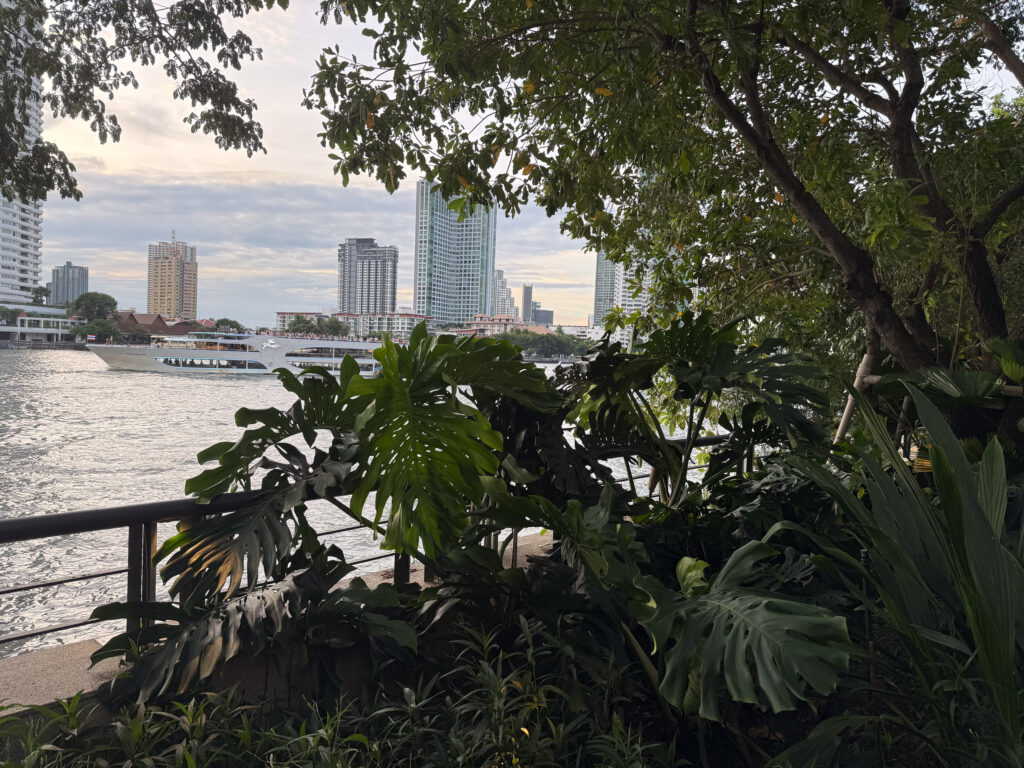
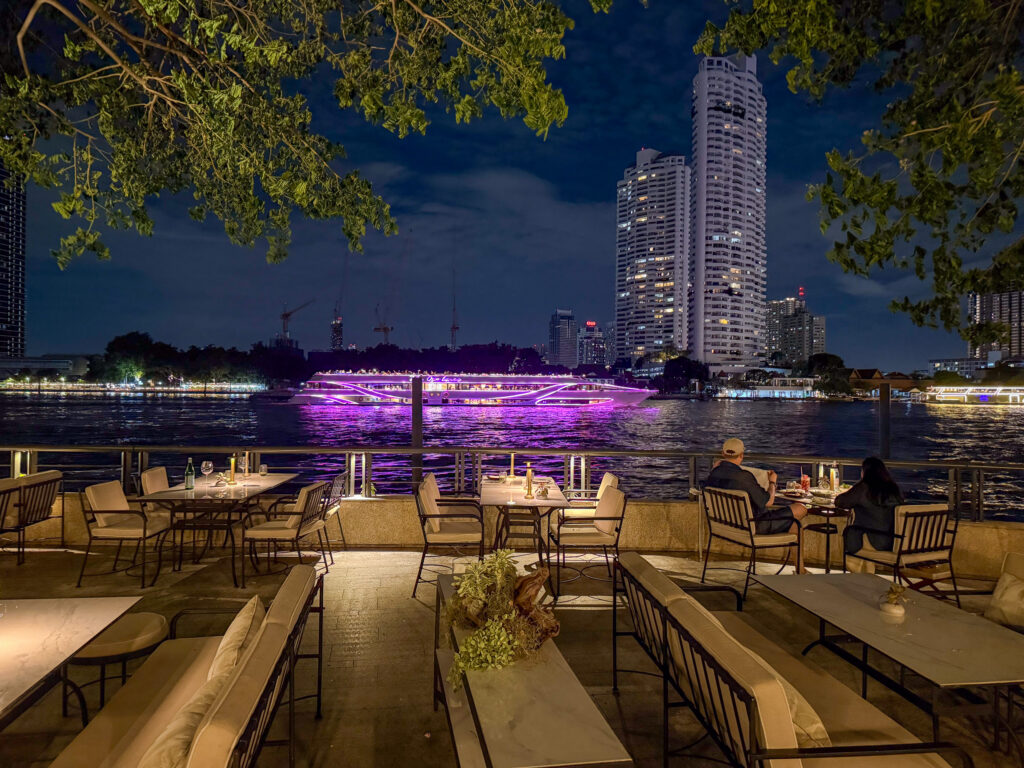
Phra Nakhon is the Thai restaurant and the room that does the most work. It sits on the lower lobby, a glass conservatory opening onto a tree-shaded terrace at the river’s edge, where almost nobody chooses to sit indoors. Breakfast starts at half past six and the kitchen runs through to eleven at night.
Kannika Jitsangworn runs it, cooks south, and buys her own seafood. Much of the leaf and herb comes from a greenhouse behind the hotel that also supplies the two-star kitchen upstairs. The menu states its case on the cover: rustic family recipes, standing relationships with farmers and fishing families, and a strapline reading Evoking Memories of Old Siam. Heavy positioning for a hotel Thai restaurant. The food carries it.
Karaoke boats work this stretch of the river after dark and carry across to the terrace, cheerfully rather than intrusively, until the noise rules bring the water quiet at about half past ten. Book at eight and you get the boats; book at ten and you get the hush.
Long Chim, and a menu organised by region
The set menus are the reason to come, and they are built by region rather than by course. Two Long Chim lunch sets, seven courses each, sold for two people. One I-san, from the north-east; one Pak Tai, from the south. You do not mix them.
The I-san set runs grilled beef on betel leaves, green papaya salad, house-fermented pork with crispy rice, a whole fish char-grilled in banana leaf, and sticky rice with longan. Take the southern one if you take only one: turmeric-battered baby shrimp, grilled squid in kaffir lime, a hot-and-sour curry with heart of palm and Phuket pineapple, Phuket-style braised kurobuta pork belly, and banana prawns with stink beans and shrimp paste. Lunch as it lands.
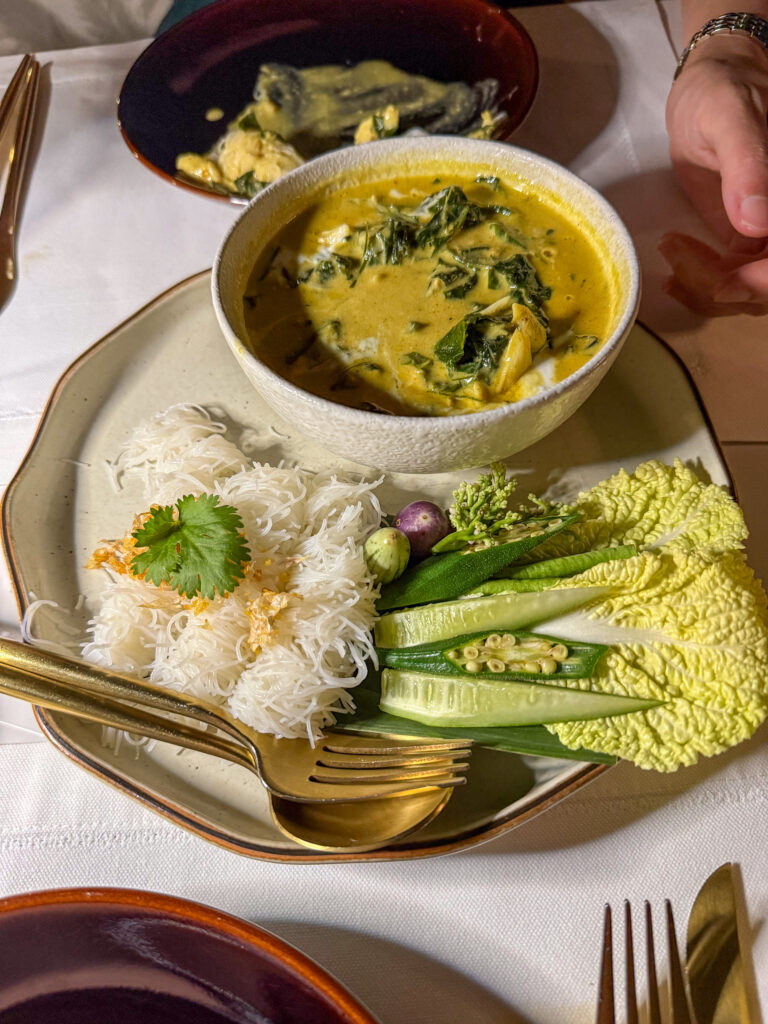
Off the sets, order the wok-fried roasted pork belly with crispy chilli and garlic, and the crab and betel-leaf curry with vermicelli. Children’s menus exist across the restaurants, which is not always true at this level.
Breakfast is the same room and a different proposition: a small, very good cold table and an à la carte list on a tablet that runs to pages. Order the pad kra pao with an egg, and the coconut water, served in a shell shaved so precisely the staff will tell you, deadpan, that they send it out to be done. It is also the one meal here with a reliability problem: a broken hollandaise returning re-plated rather than remade is what this room does on a bad morning. High ceiling; uneven floor.
Two floors up, and no menu at all
Côte by Mauro Colagreco cooks the Riviera, Nice to Genoa, and has held two MICHELIN stars since the 2025 Thailand selection, having gone in with one. Colagreco is the name on the door; he does not cook in Bangkok. This kitchen belongs to Davide Garavaglia, on the Mirazur team from 2015, chosen to open the room in 2020, and holder of the Thailand Young Chef award of 2023.
There is no printed menu and nothing to choose from. Every service is a carte blanche: the kitchen decides, it changes with what arrived that morning, and the only question is what you cannot eat. Lunch is four courses, the long menu nine. Around them comes a commentary of things that are not courses – bread with a poem attached, olive oil infused with Menton lemons and made for these two restaurants alone, and a raw cut brought to the table before it is cooked.
Almost nothing is permanent. One thing is: a beetroot macaron filled with goat’s cheese cream from Hua Hin, held over menu after menu because guests will not let it go. The other fixture is volume – seven courses eat like twelve. Pace yourself, and do not eat lunch before you eat lunch.
The cellar is the other argument: over 550 labels, most organic or biodynamic, and the deepest run of grower Champagne in the city. A sommelier-led tasting at Côte comes with the stay, and the pour people remember is a Thai red. Ask for it.
The four-course lunch is the quiet coup: the same kitchen and team as dinner, at midday, with the terrace light thrown in.
The bar, the tea, and the golden hour
Stella opens at six: small, deliberately theatrical, marble and frescoes, wicker peacock chairs, a chandelier built to look like the Milky Way, and a taxidermy white peacock holding the floor. The list is Journey into the New Siam, each drink pinned to a Bangkok neighbourhood; order the Bangkok Noir, bourbon and black orchid with Campari and two vermouths. Two hard facts: music starts about a quarter past nine, and alcohol service stops at eleven though the room is open to midnight.
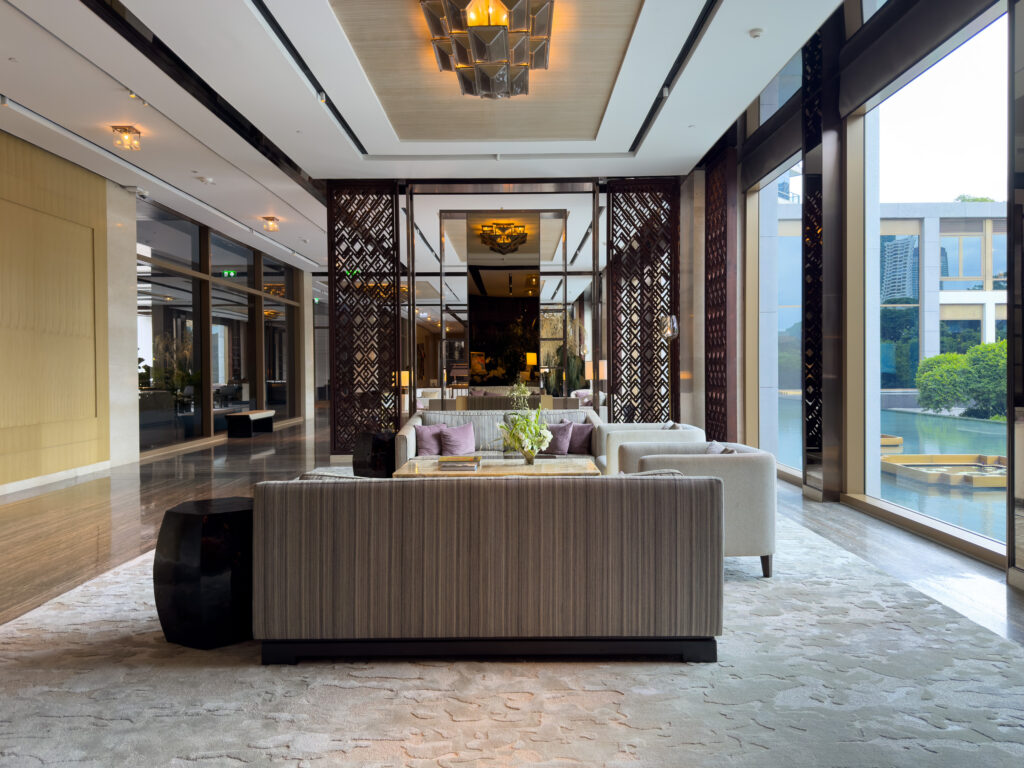
Afternoon tea is in the lobby lounge over the lily pond, from noon. The current one is a limited chocolate collaboration running to October 2026, sold by the head or as a set for two. Two things catch people out: it is sold by the set, minimum two, and tables cannot be reserved individually – first come, first served, so arrive at noon.
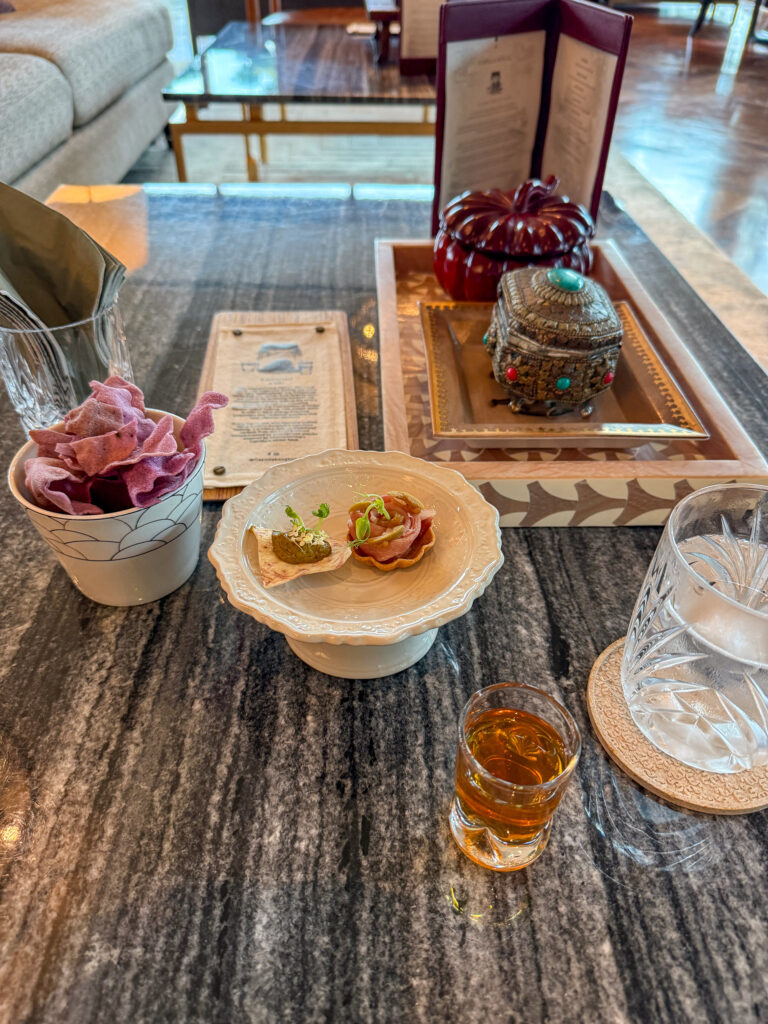
KIN is the patisserie and coffee counter beside Phra Nakhon, open eleven to eight. And then the Living Room, the part of the offer nobody writes about because it has no menu and nothing to sign. Behind the key-carded door on the guest side of the lobby, open seven to eleven, it pours sparkling wine, juice, barista coffee and tea free for the length of your stay. A tea trolley comes round between three and four, and at five there is an hour of drinks and canapés called Cin Cin Hour, which moves between the Living Room, Stella and the courtyard – ask where it is that evening, and ask for the ya dong.
The counter-argument
The complaints about eating at Capella are almost never about the food. Nobody has a bad word for what comes out of Côte, Phra Nakhon or Stella. What goes wrong is everything arranged around the food, and it goes wrong the same way every time: nobody is quite sure what was agreed.
A river-boat trip quoted three different ways in three conversations. A late check-out offered at noon, then one, then half past one, then three. A turndown skipped and blamed on a do-not-disturb light that was not switched on. None of that is a dinner, but it is the same muscle that books your table and keeps the window seat you asked for.
Then the upkeep, which should not exist at this level: a frayed robe with two more worn ones behind it, a stained lounger left on the terrace, empty water bottles not replaced. Trivial one at a time. Together, a hotel that is not checking.
And the compound. Mention that you ate Thai food somewhere else in Bangkok and you may be scoffed at for it – that has happened here twice in one stay, at two separate meals, in the city with the best street food on earth. It reads less like rudeness than like a building sealed off from its neighbourhood, which has taught its staff to treat the road outside as competition. It is also the reason not to eat every meal in: five outlets is exhausted by the third night.
Two smaller things, both outdoors. The sliding door onto a riverside room is heavy and loud, and the glass fogs when wet air meets the air conditioning – a problem in a hotel selling nothing but a view. And the low tables at the water’s edge draw mosquitoes at dusk, exactly when you want to sit at them.
Last, the awards are running ahead of the building. Michelin’s Thailand selection gives Capella two Keys. The Mandarin Oriental and The Siam, both older and both a few minutes further up the same river, hold three. A hotel called the best in the world in 2024 sits a rung below two of its neighbours.
Know before you go
Côte opens Wednesday to Sunday and is dark Monday and Tuesday. Lunch from noon, last order half past one; dinner six to ten. Book online and book ahead: Friday or Saturday dinner wants a week or two, weekday lunch is flexible, and arriving mid-stay expecting a table is how people leave this hotel without eating in its best restaurant. Dress is smart casual and enforced. Ask for a window table at lunch, or the six o’clock seating.
Phra Nakhon serves breakfast from half past six to eleven and runs through to eleven at night. It publishes no dress code, which in practice means the terrace is relaxed. The set menus are lunch menus; dinner is à la carte. Ask for a table on the terrace, at the rail.
All of it is open to people who are not staying. Charoen Krung slows badly in rain and worse when there is an event on the river, so give a fixed booking more time than the map says. Thai public holidays can suspend alcohol service at short notice and the dates move; if a bottle matters, check when you book.
Finally the season. November to February is dry, clear and dearest; March to May is punishing; June to October brings short downpours and higher water. The terrace is the point of eating here, and it is a wet-season gamble.
See the full set: Capella, Bangkok — in frames. More Bangkok: the Bangkok set.
The two MICHELIN stars are upstairs. The meal you will still be describing a year later is on the terrace two floors below them.
The Capella Bangkok gallery
Every photo on this site is my own, shot on the stay. Slide through →