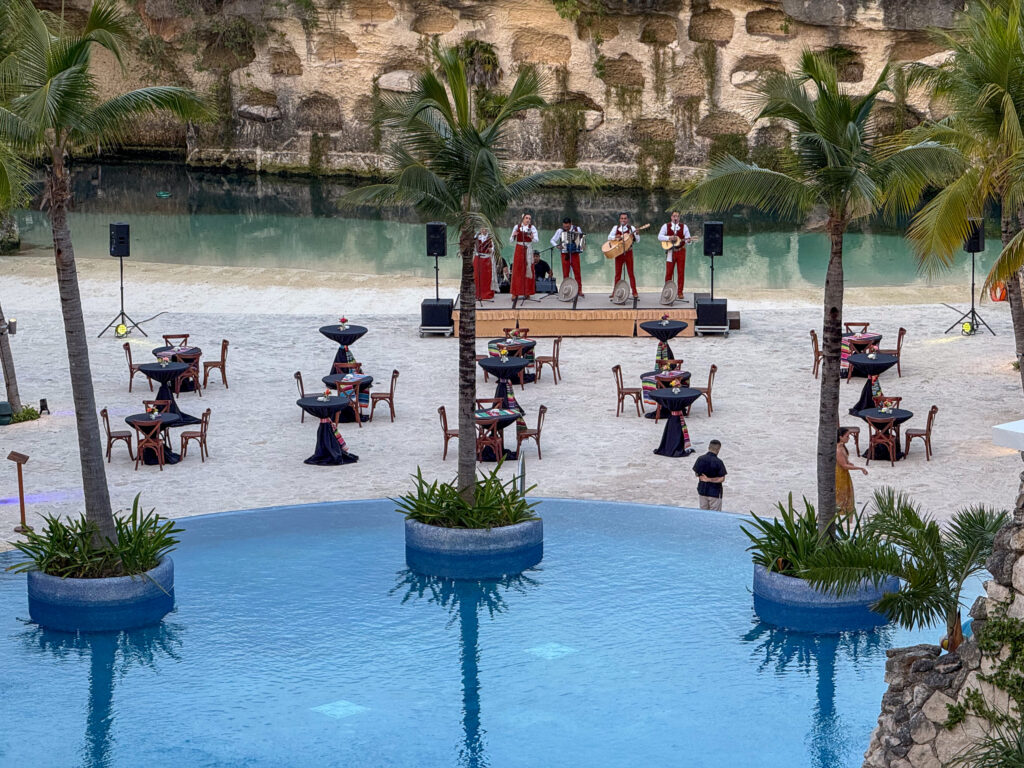
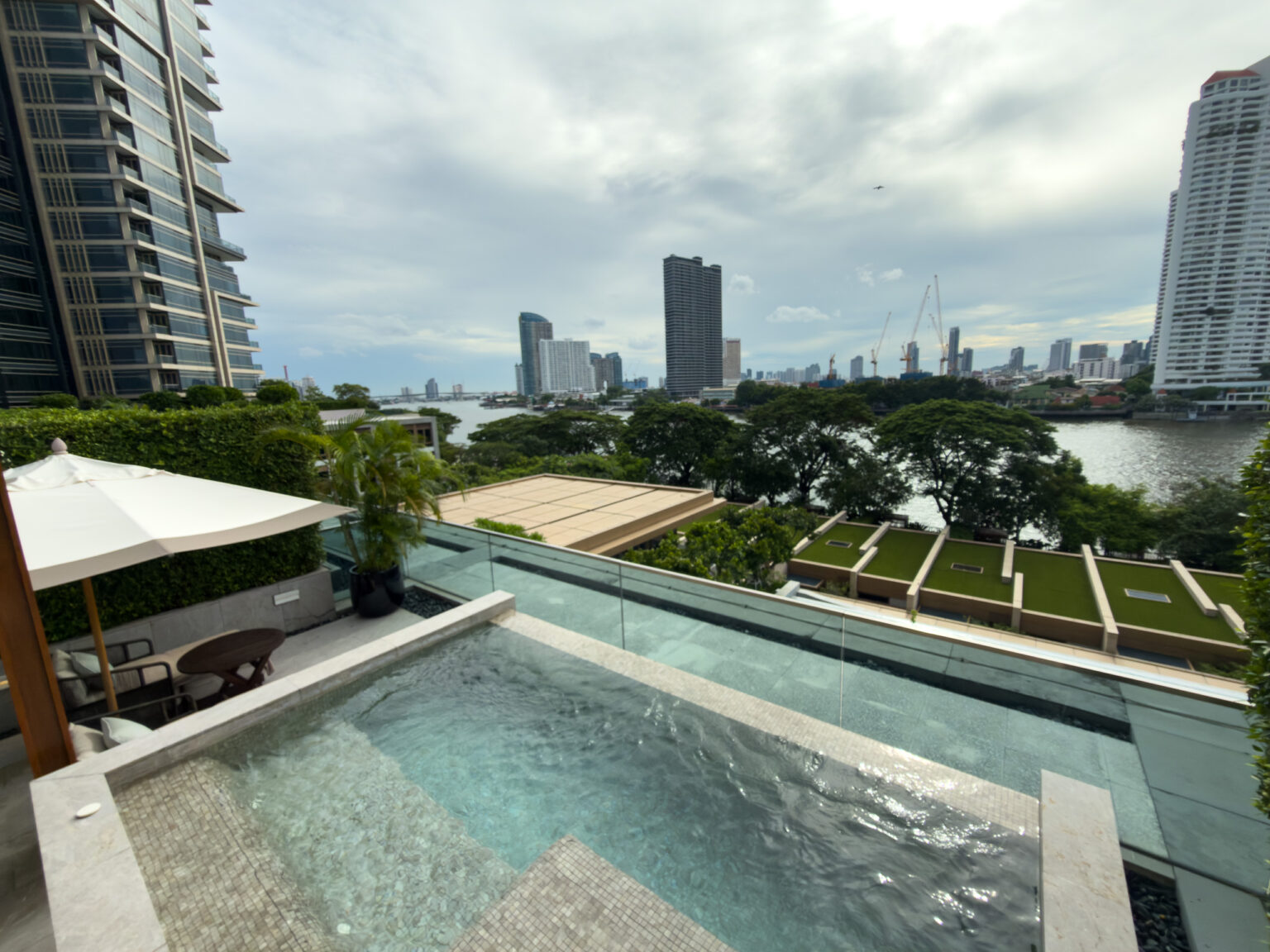
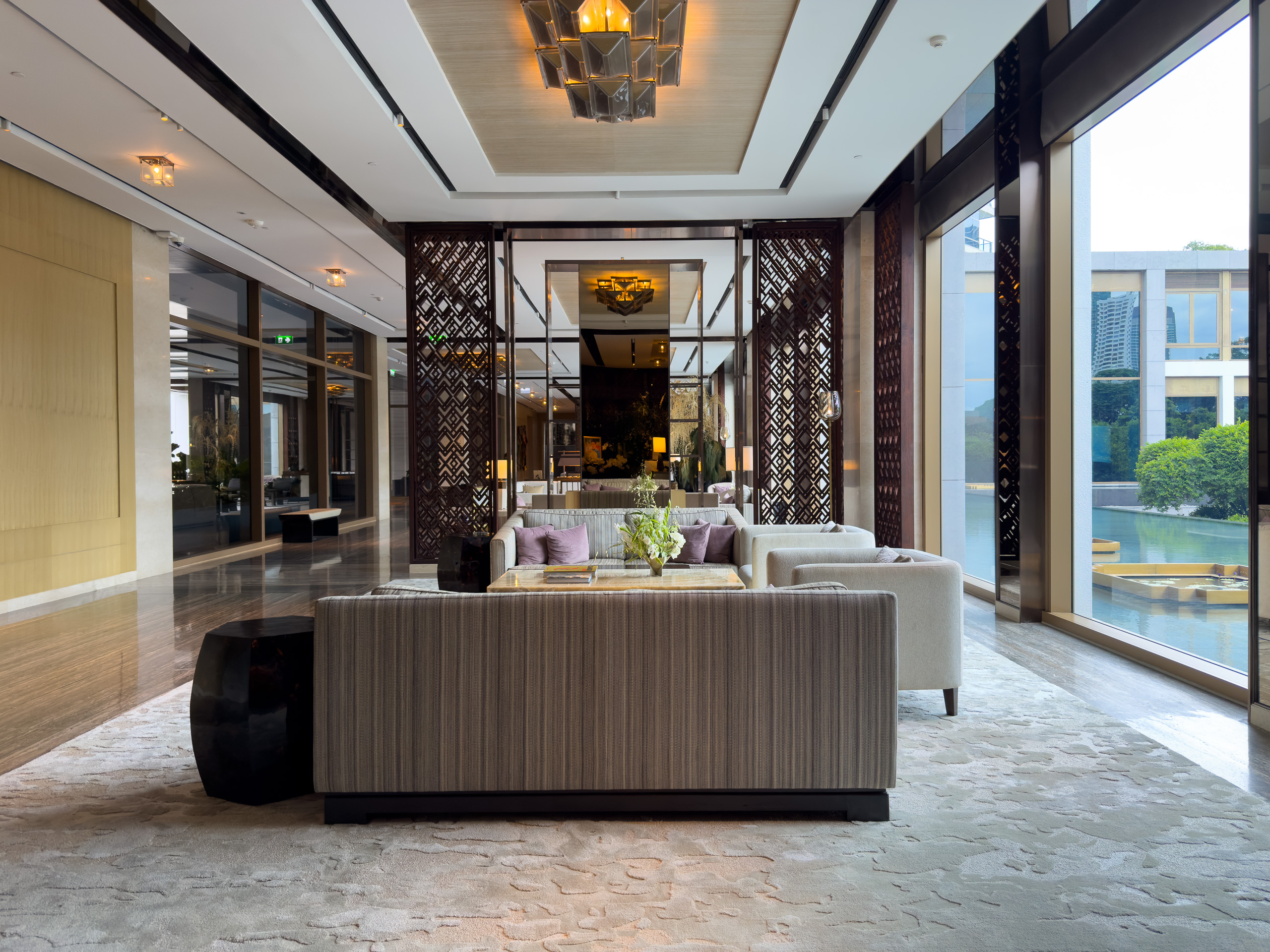
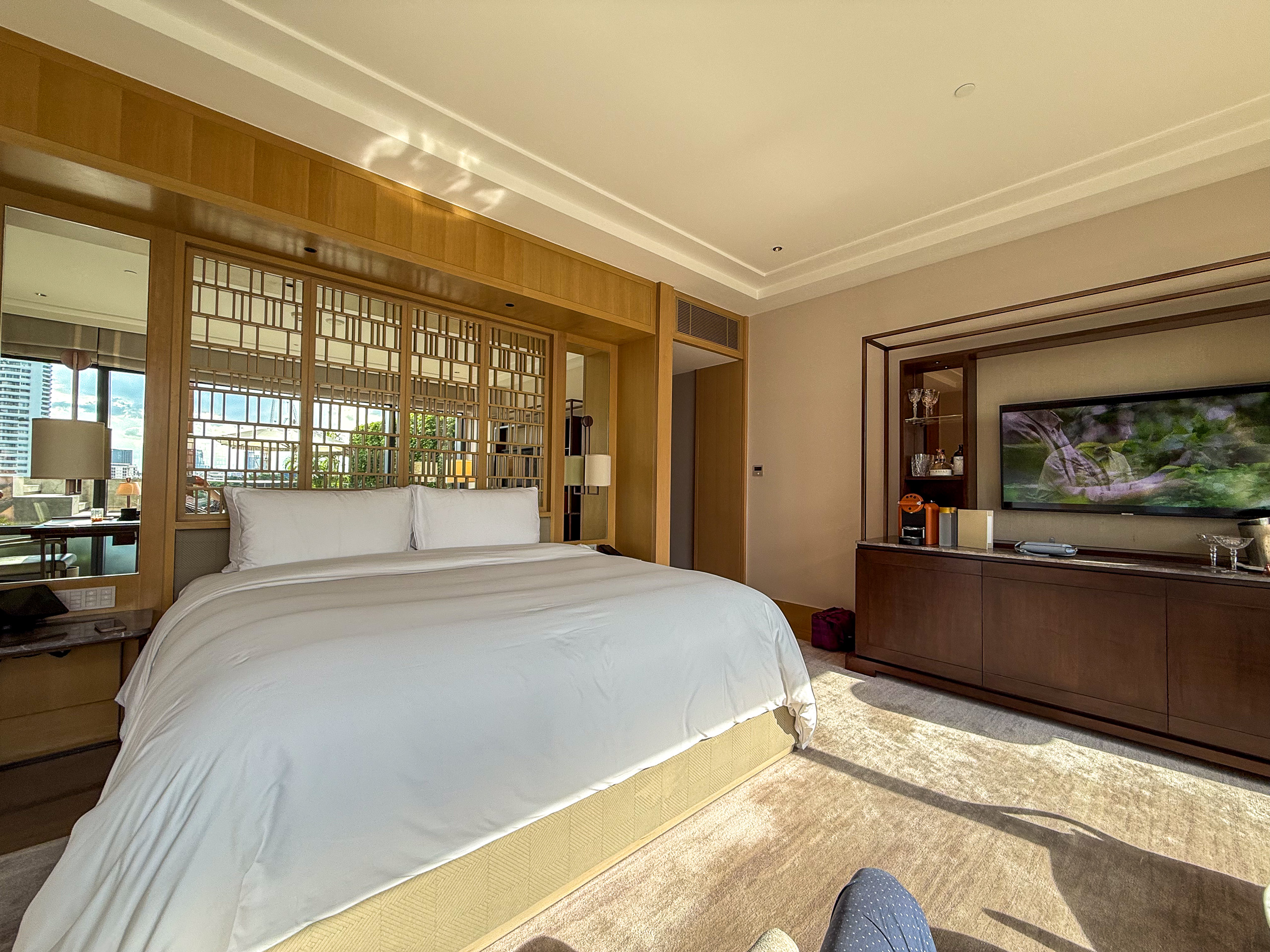
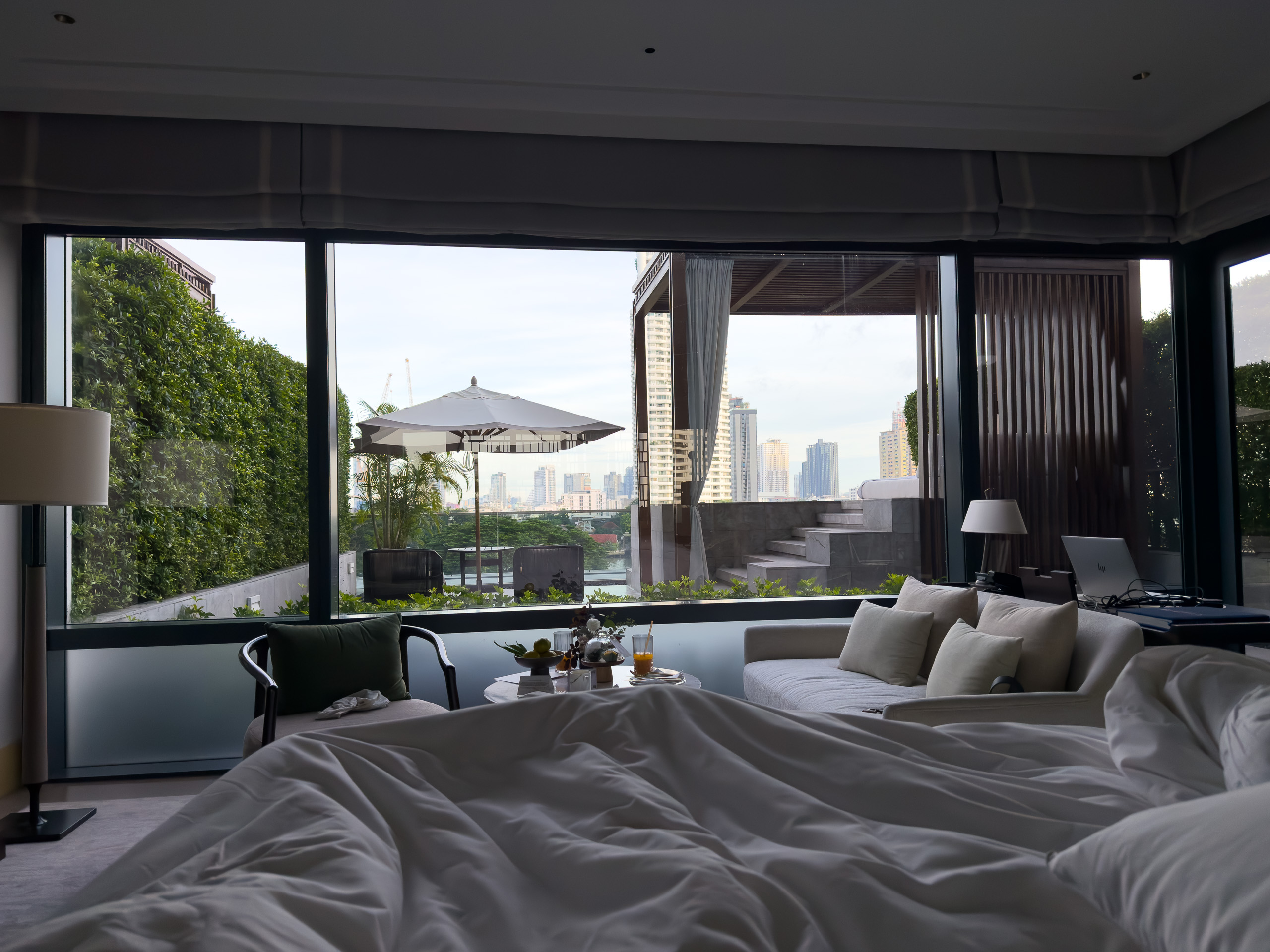
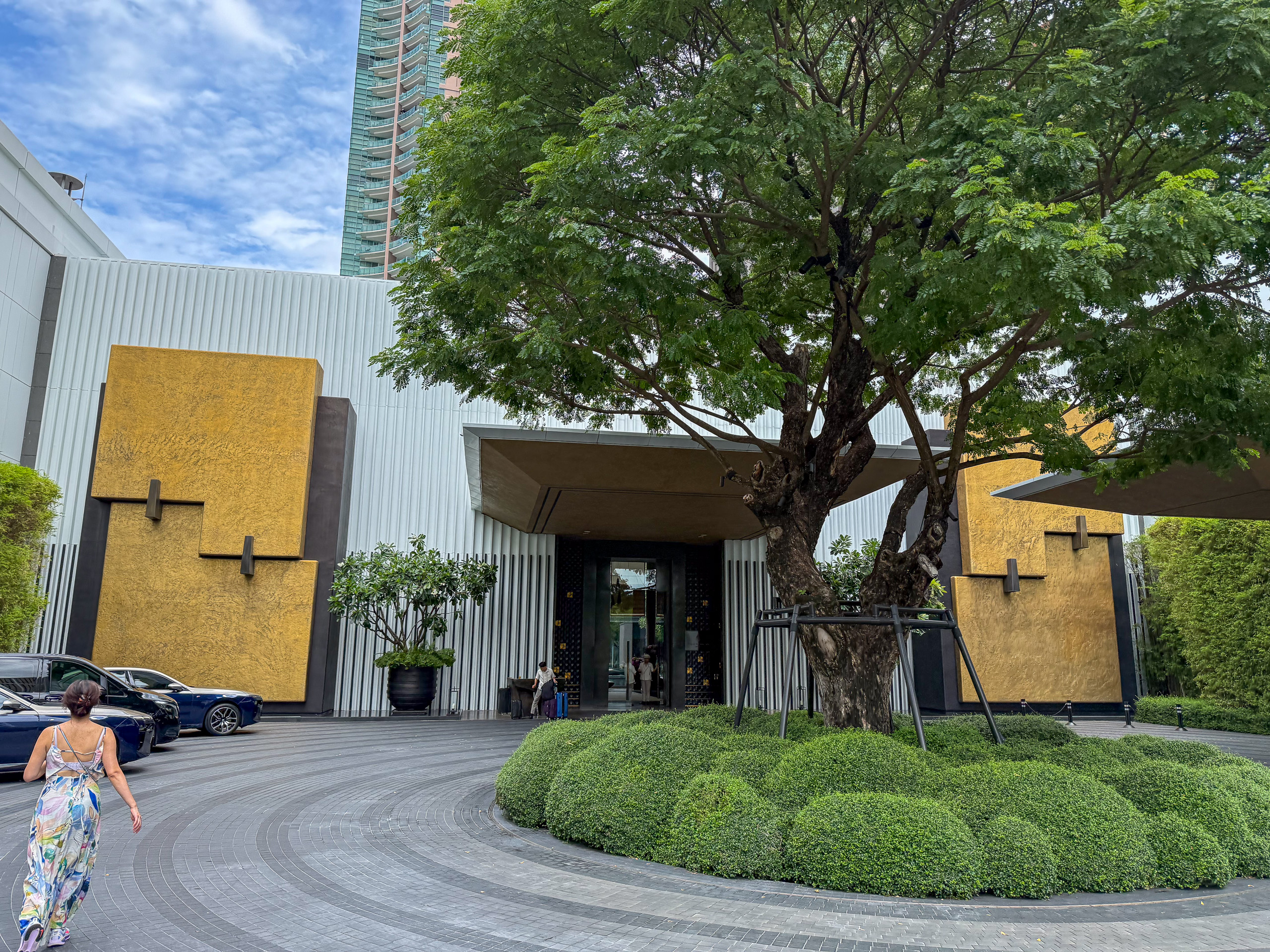
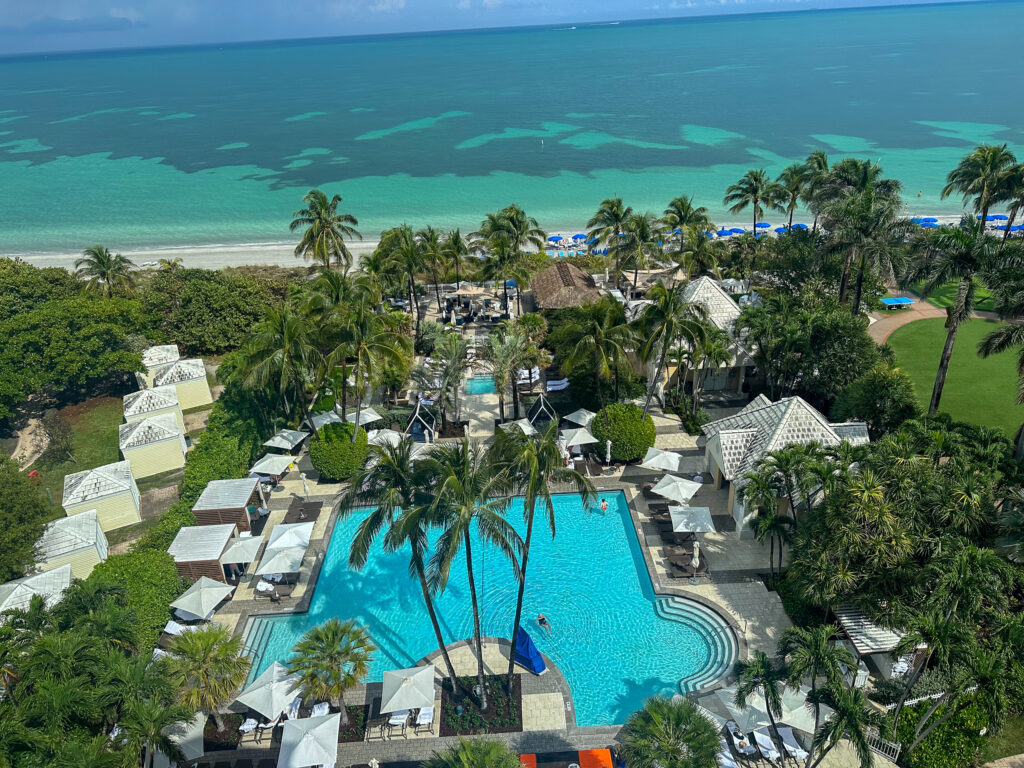
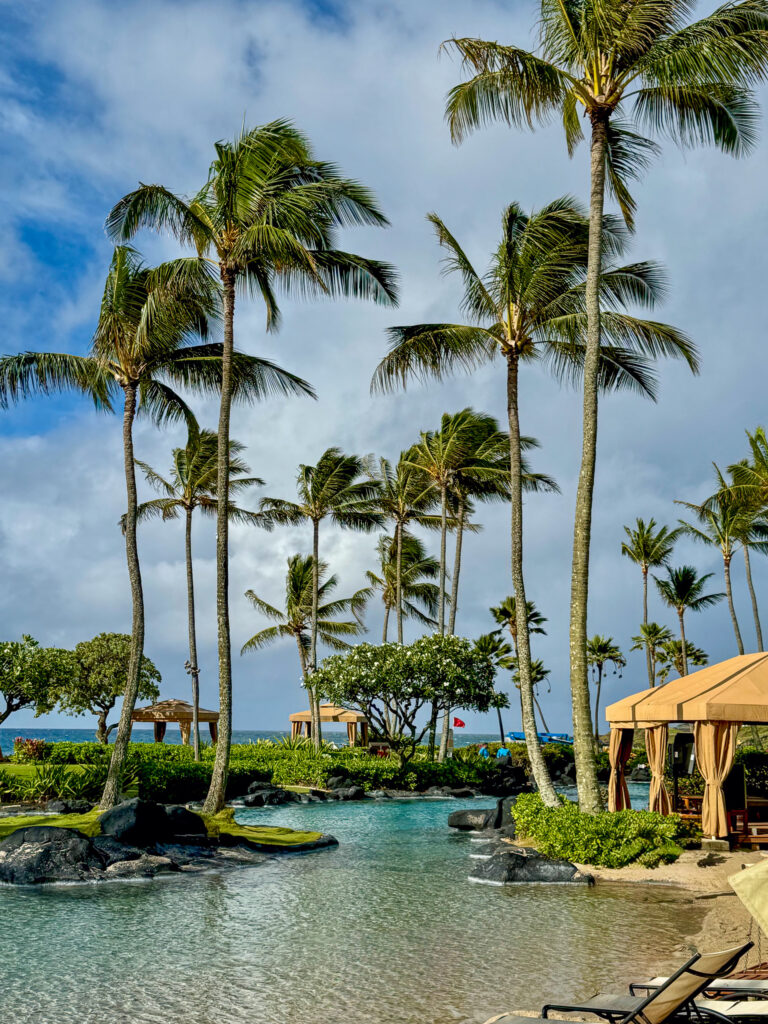
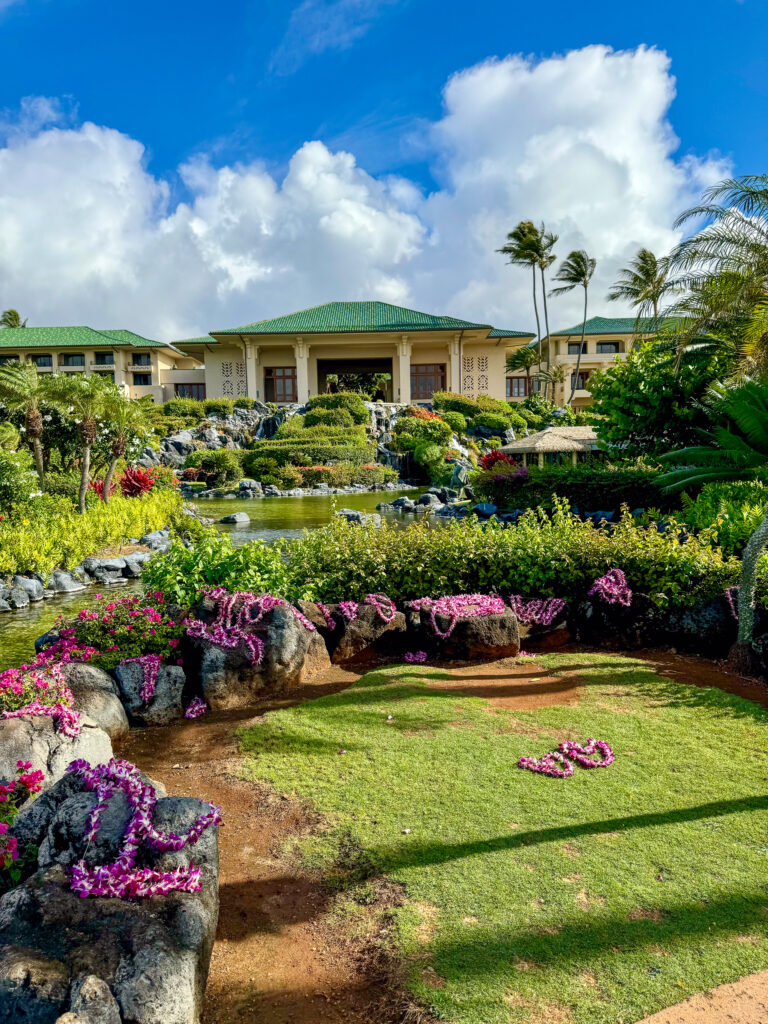
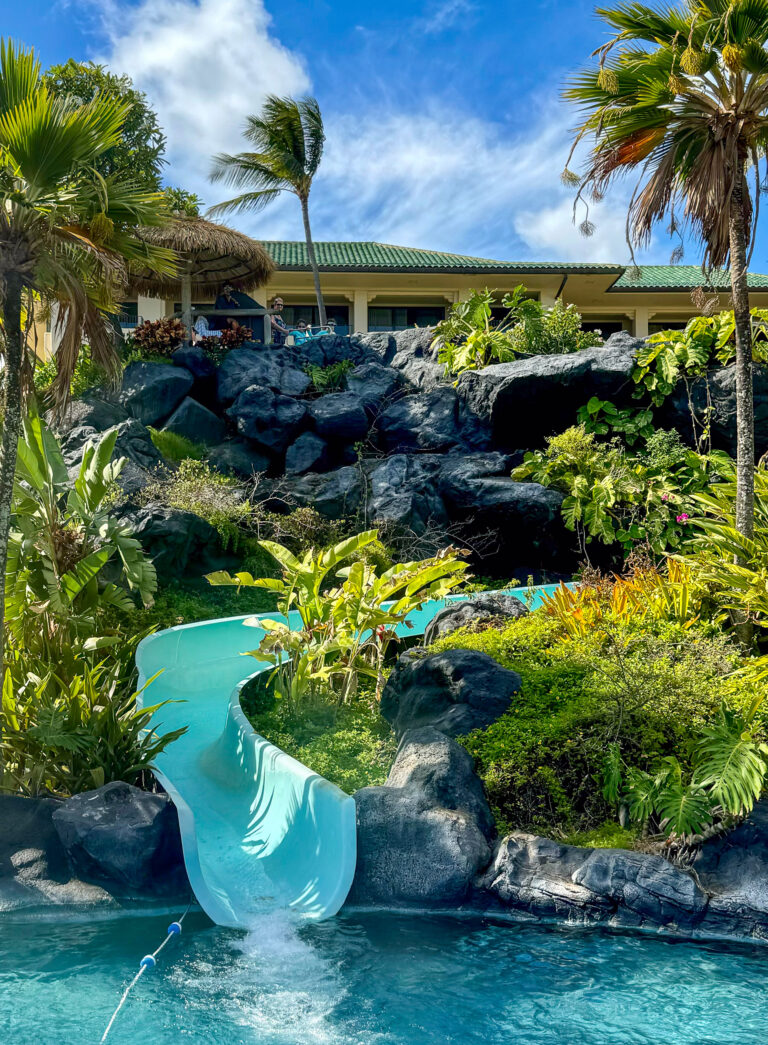
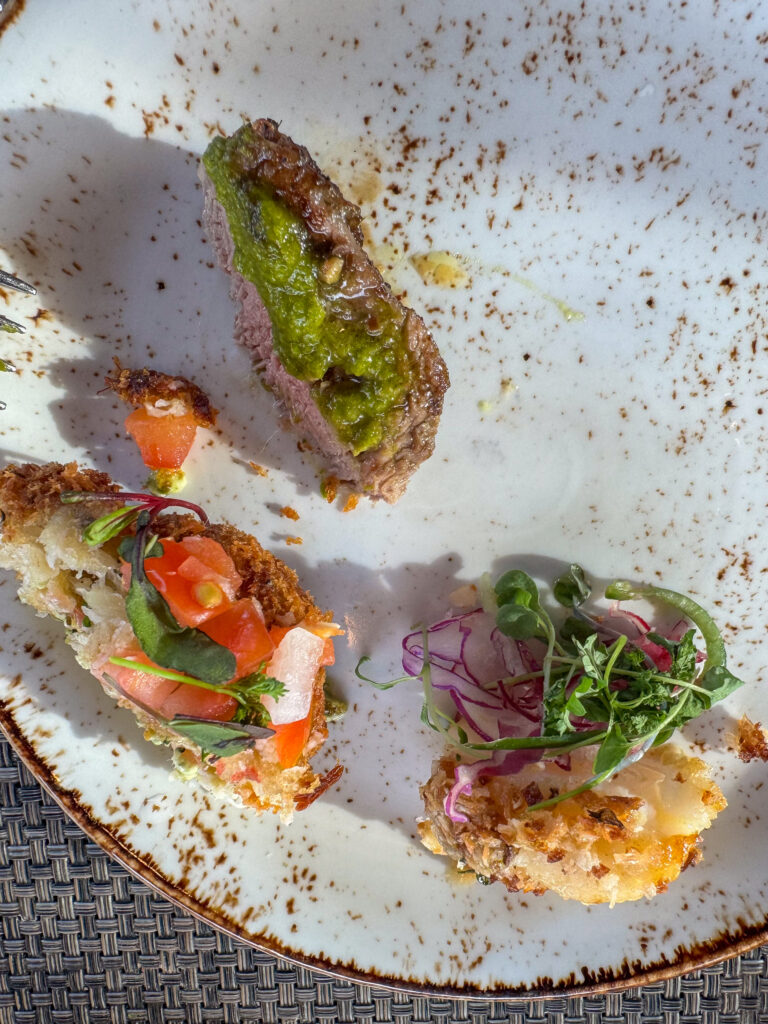
Cut into the limestone of the Riviera Maya, with the best service and food on the coast and a build-out that keeps outdoing itself. A must-see before you die.
What the channel bought Nothing beyond the public rate.
Value verdict Expensive relative to the region, but the stretch buys more here than anywhere else with something remotely like this (hint: there isn’t anywhere else).
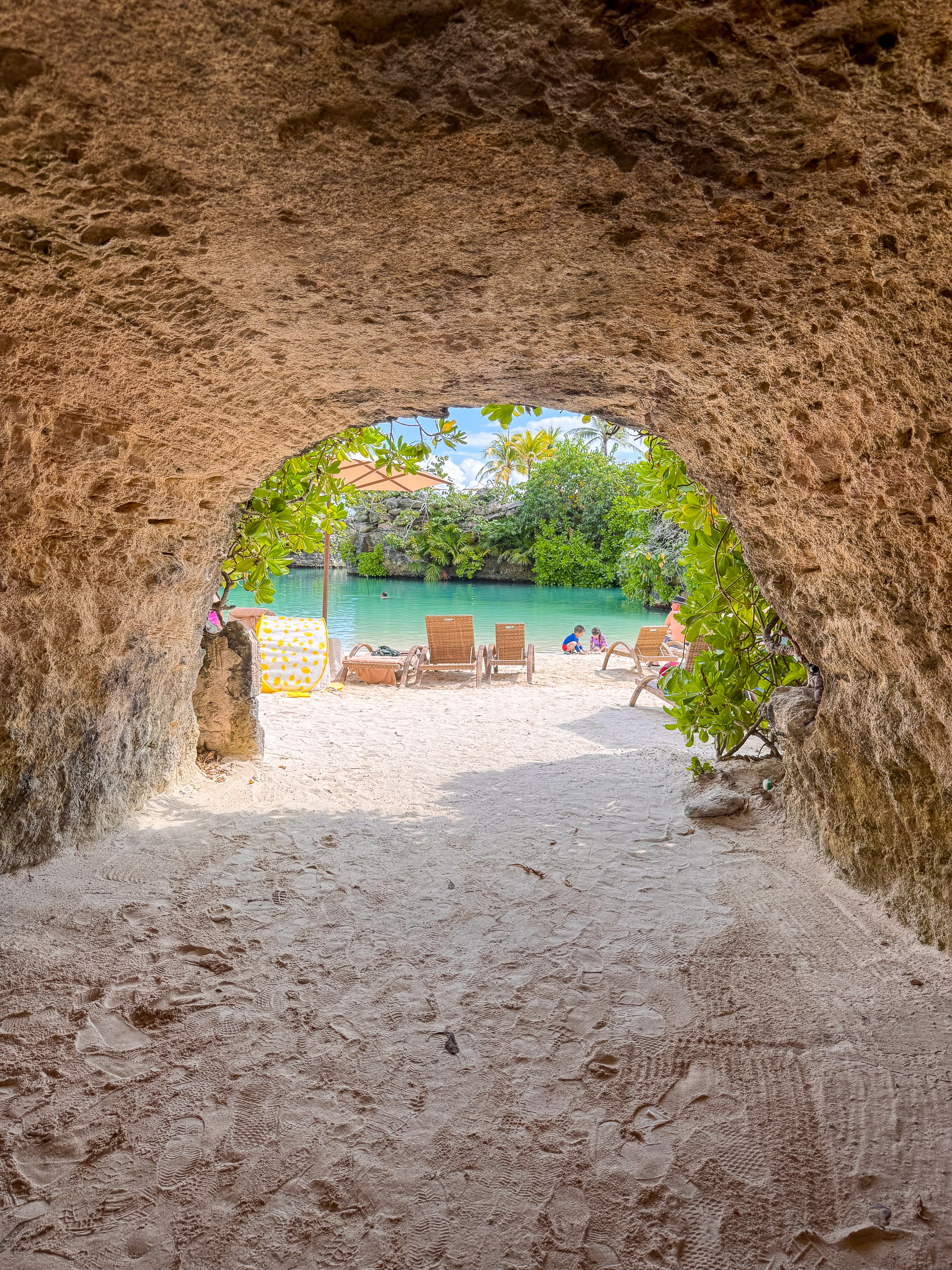
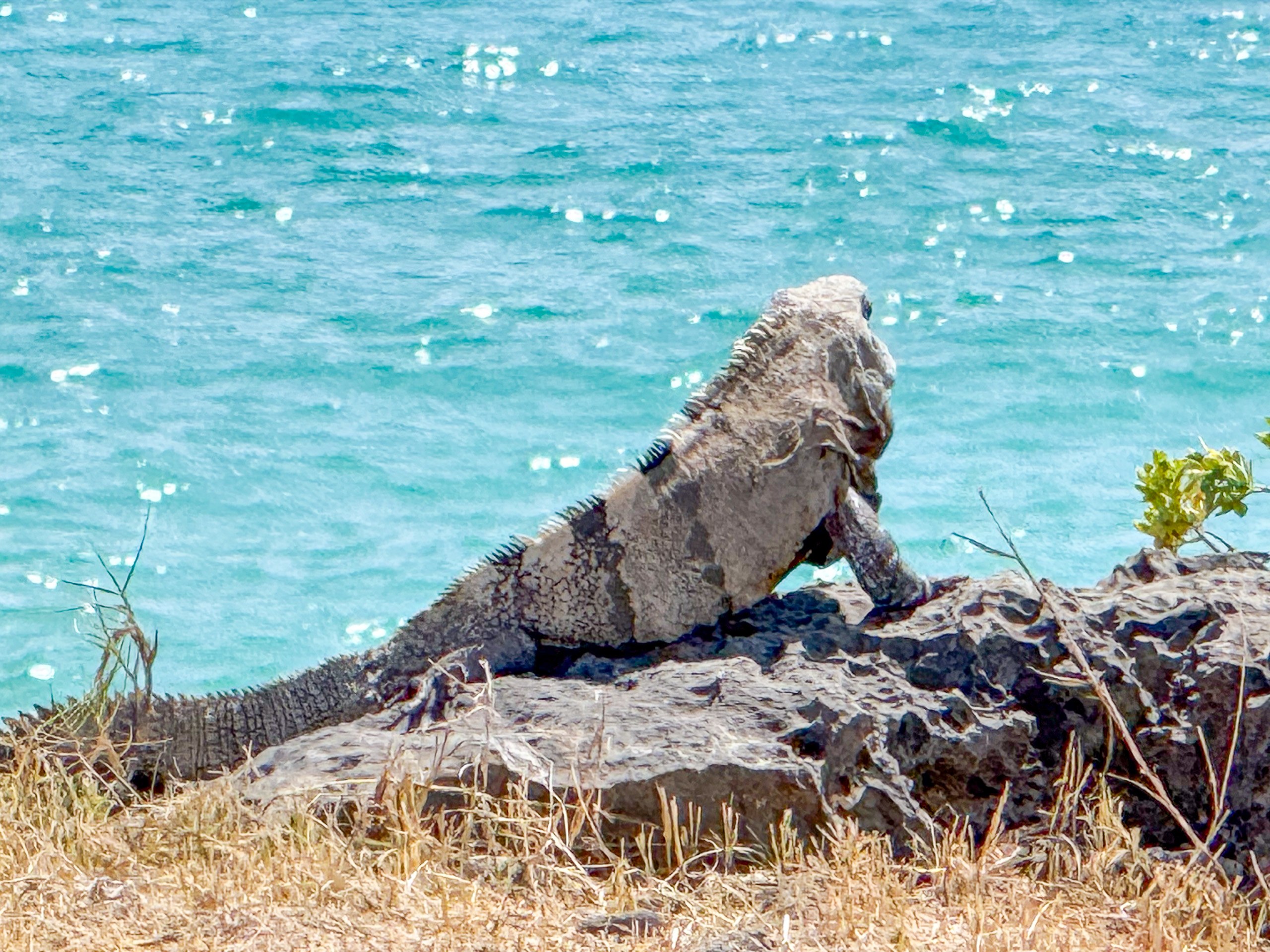
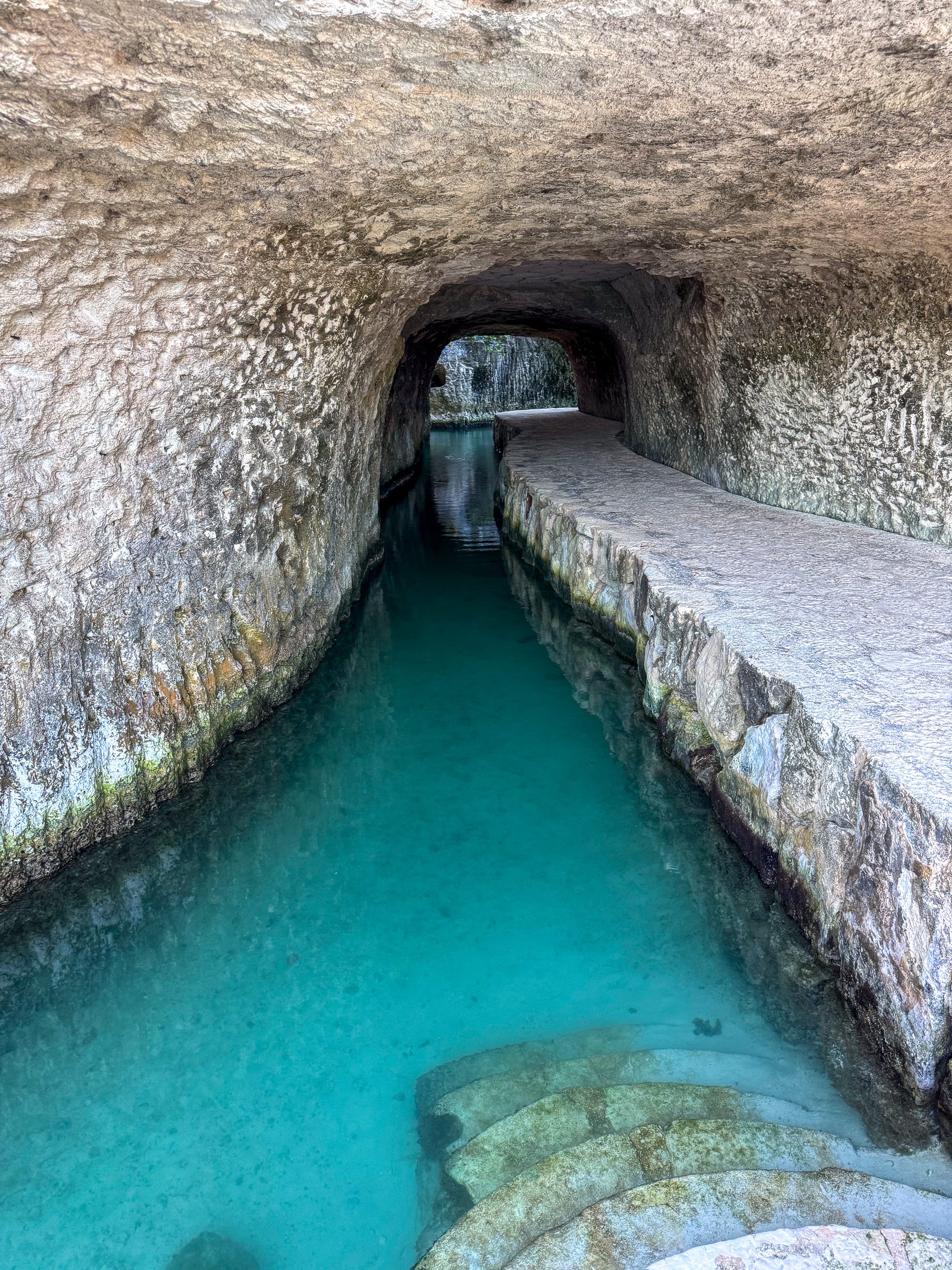
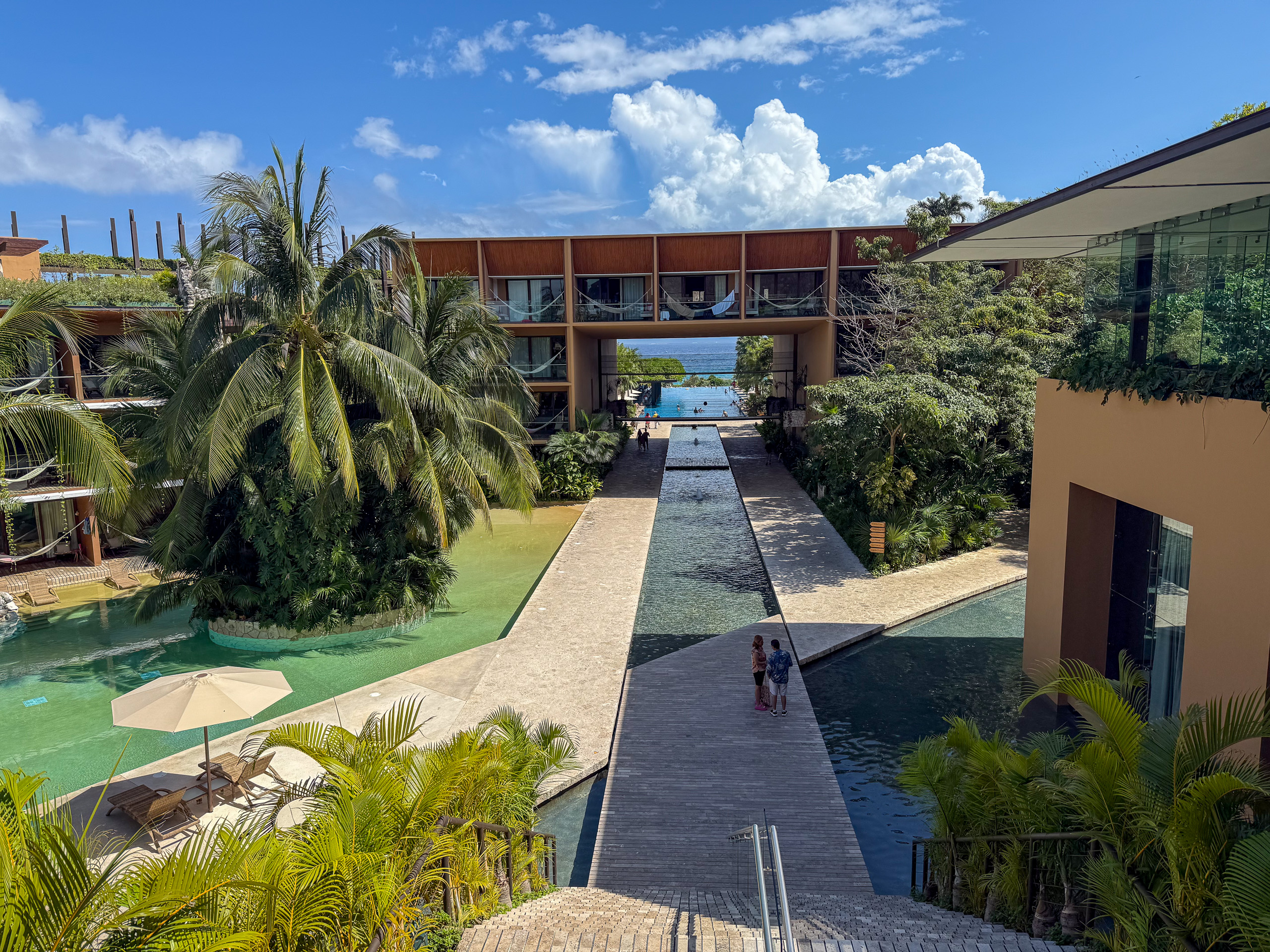
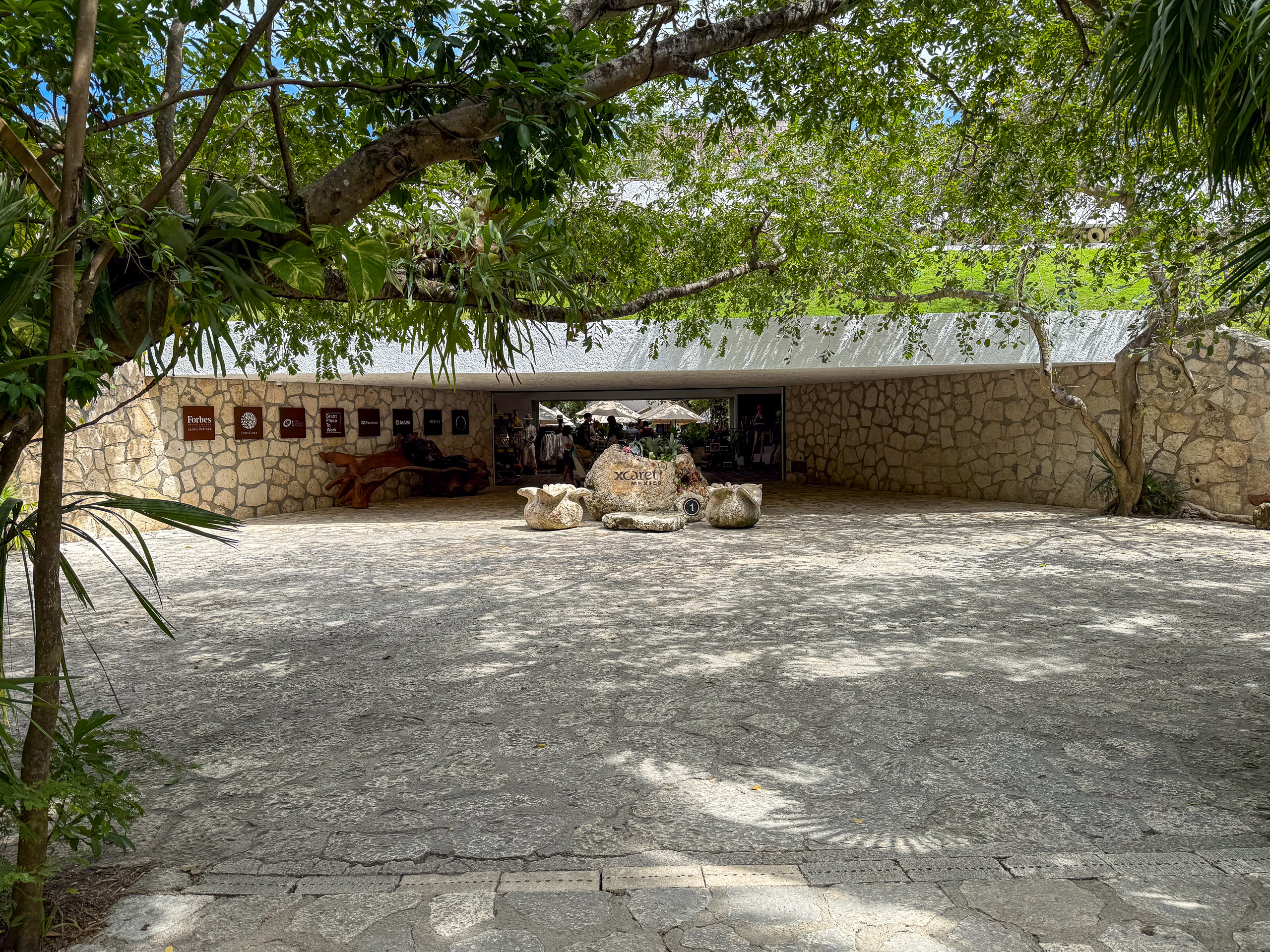
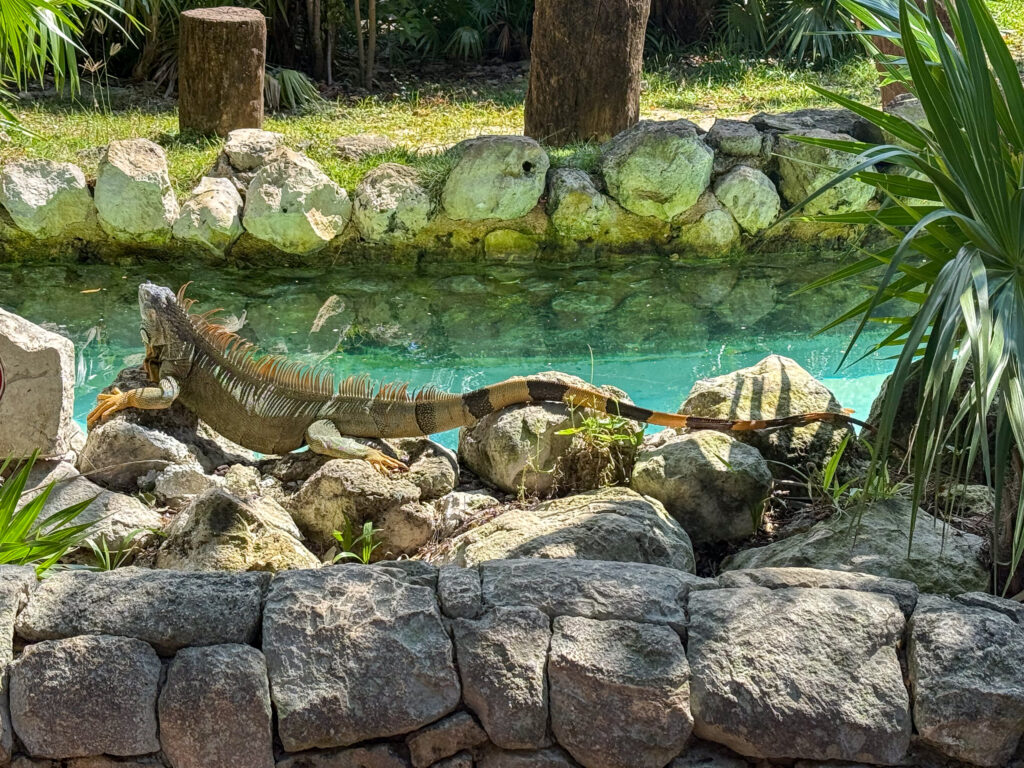
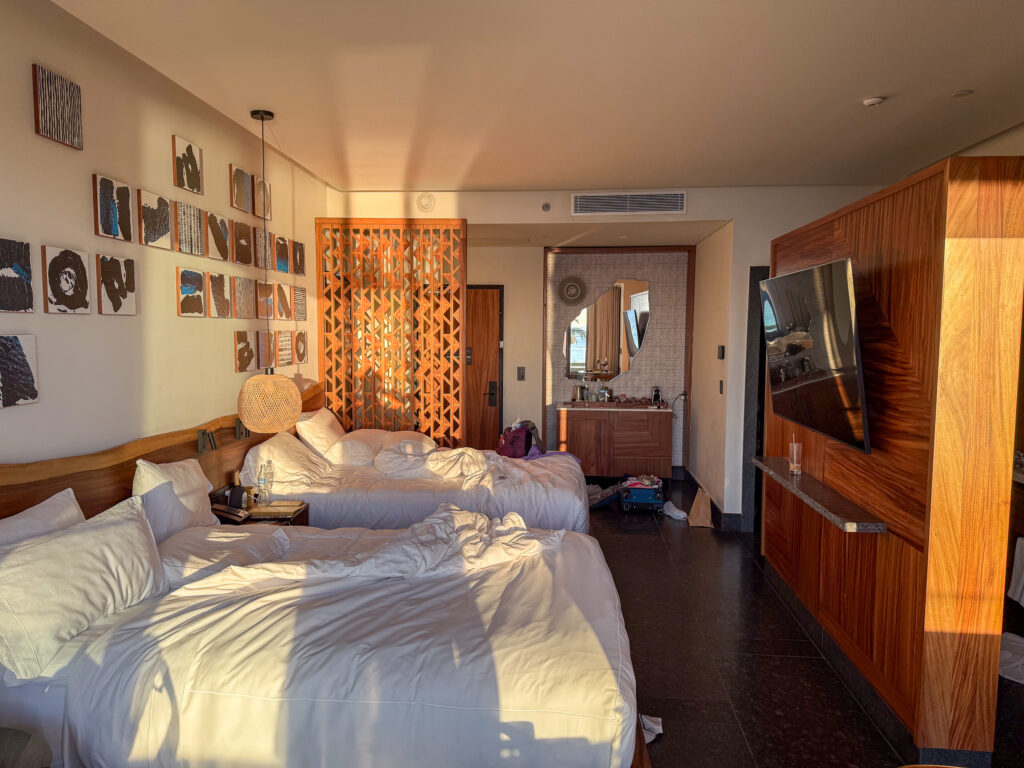
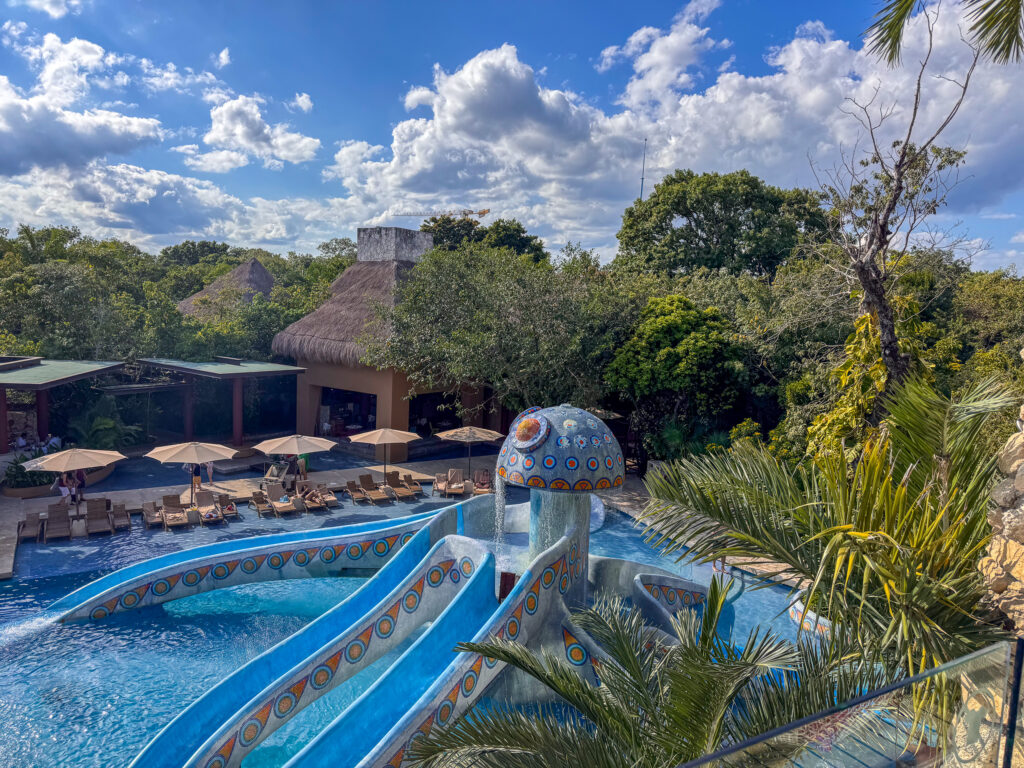
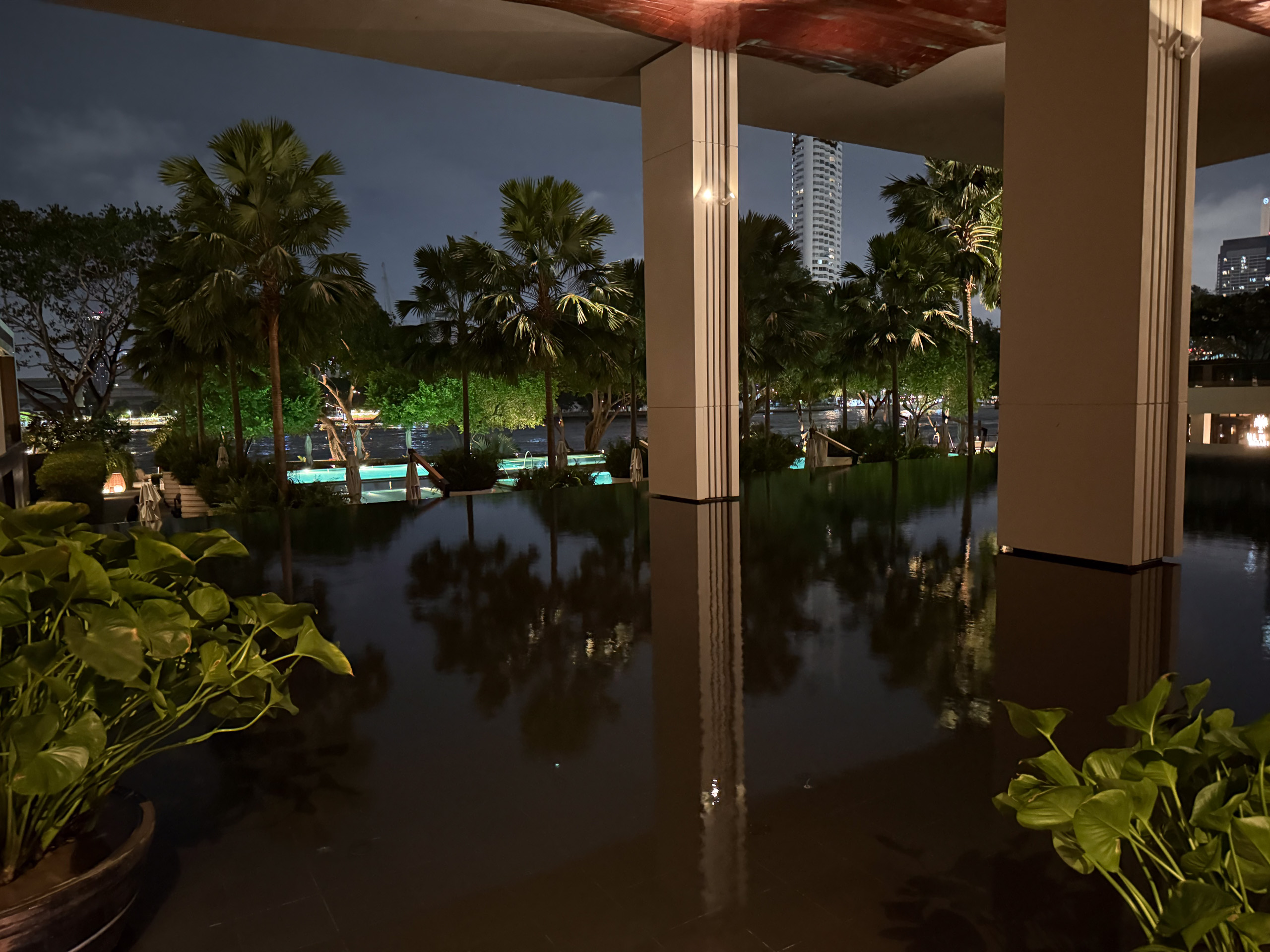
The hotel is cut into the limestone of the Riviera Maya coast, and the limestone is the architecture: passages opened through the rock to blue water, river channels running between the wings, inlets where the jungle and the sea negotiate terms. Iguanas hold the walls with the confidence of shareholders. Nothing about the arrival reads like a resort being unloaded from a truck; it reads like a place that was grown.
A passage cut through the limestone, opening onto blue water. The rock is the architecture.
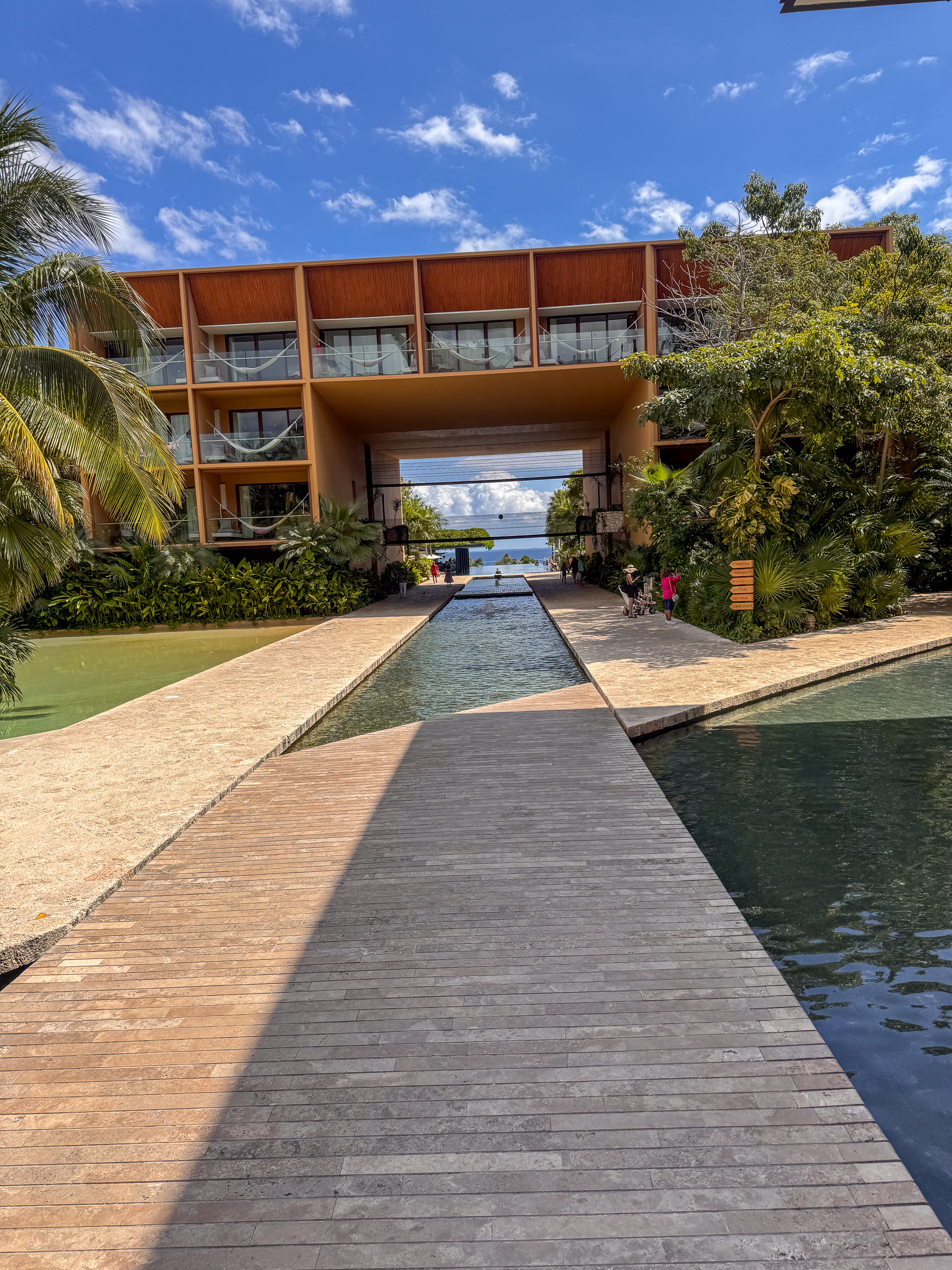
The word for the whole property is commitment. Everything here is done well to an extreme — the stonework, the planting, the water moving through the site, the way a walkway lines up with a reflecting pool because somebody insisted that it should. When a resort is this thorough it stops feeling like theming and starts feeling like a country.
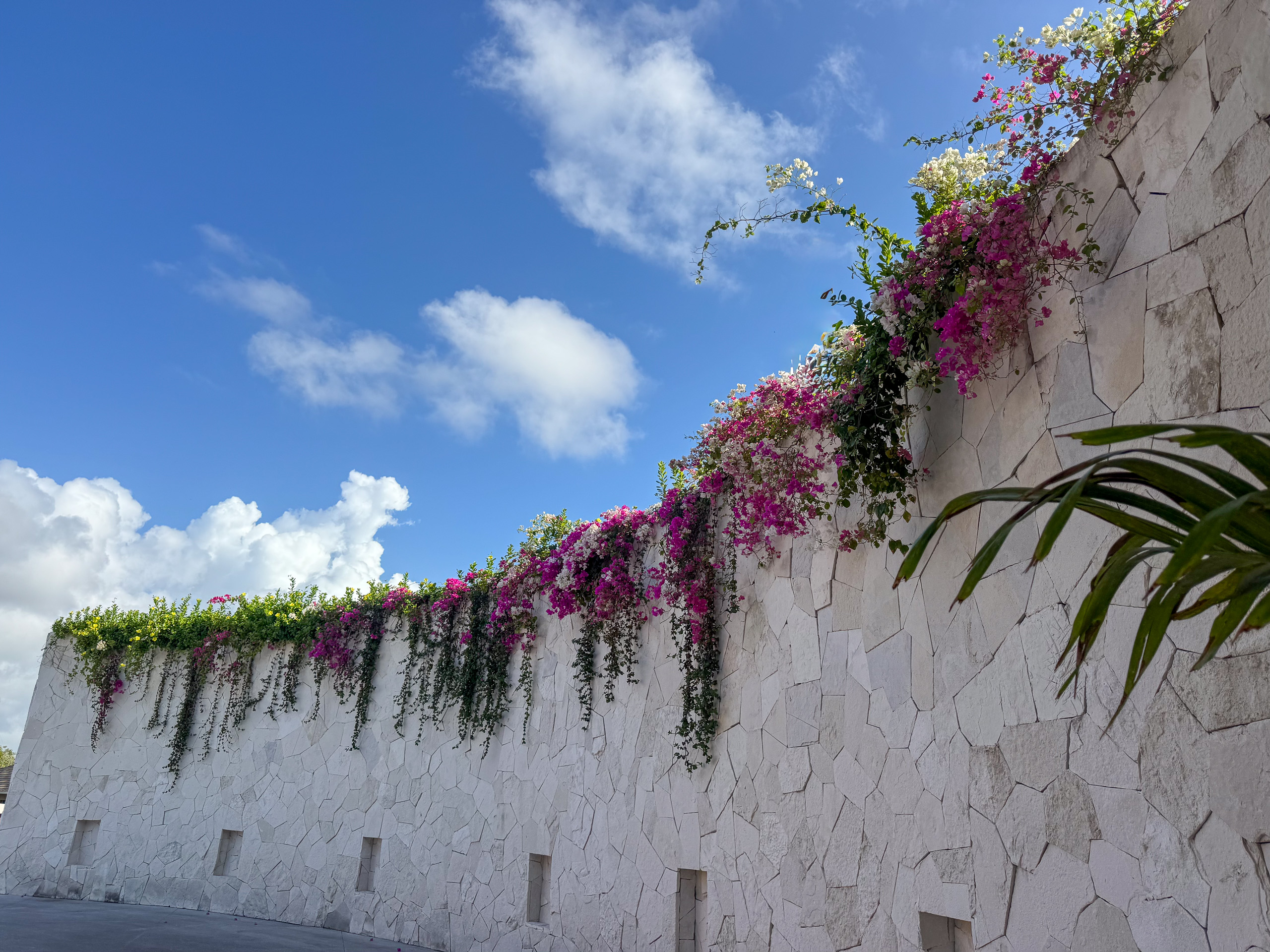
An iguana above the inlet, holding the wall.A walkway lined up with its reflecting pool, because somebody insisted.Bougainvillea over pale stone.
The room
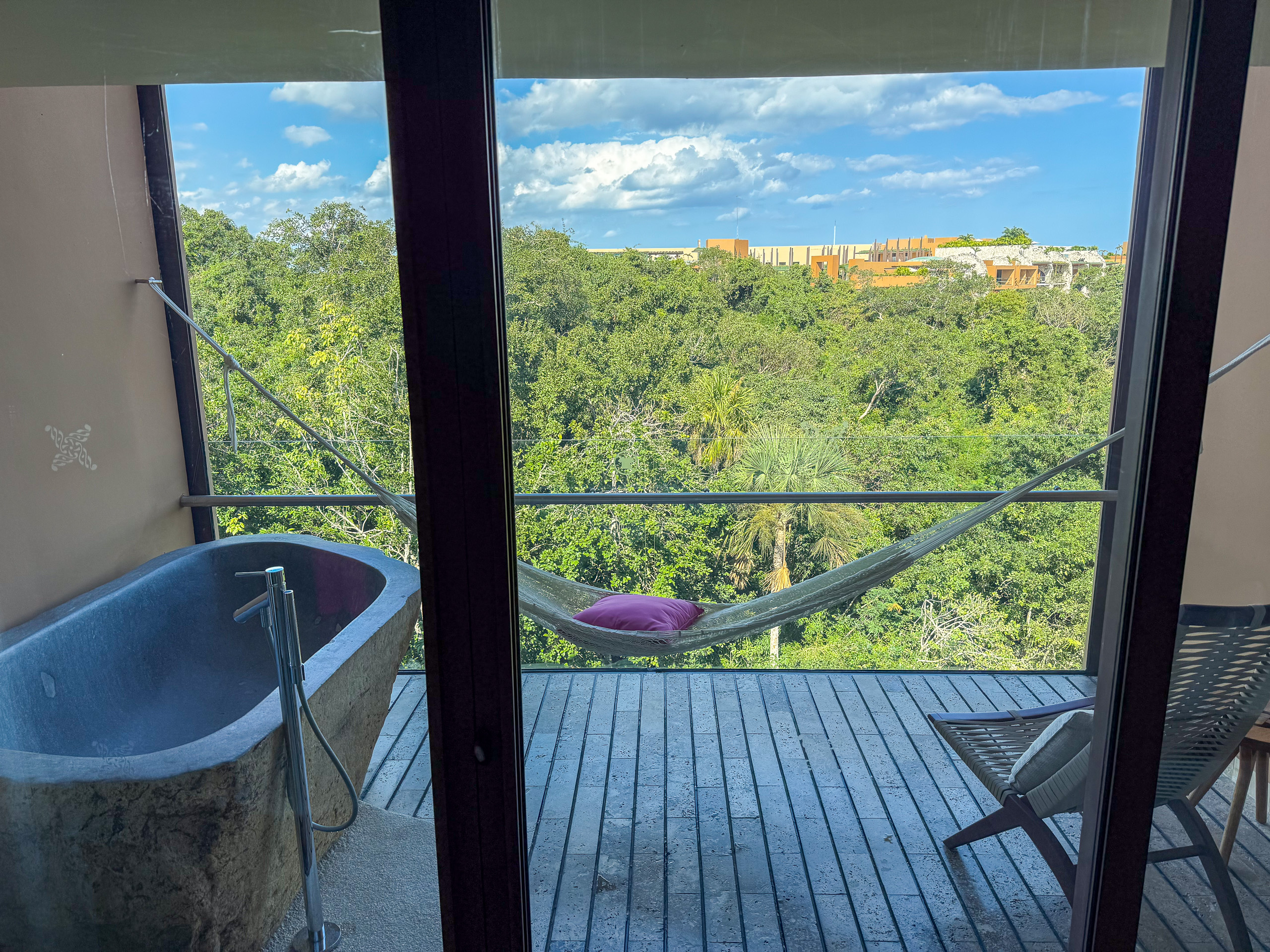
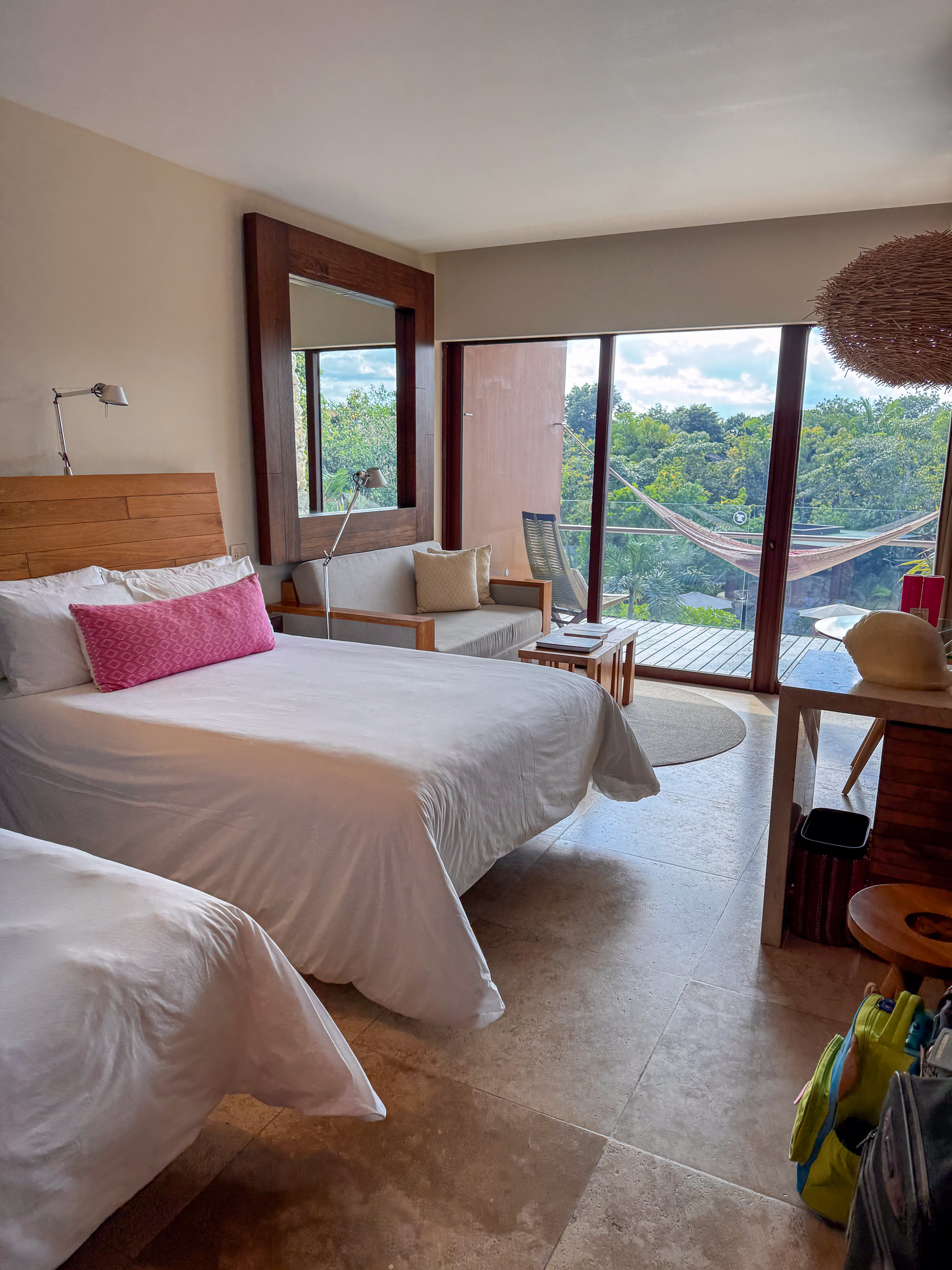
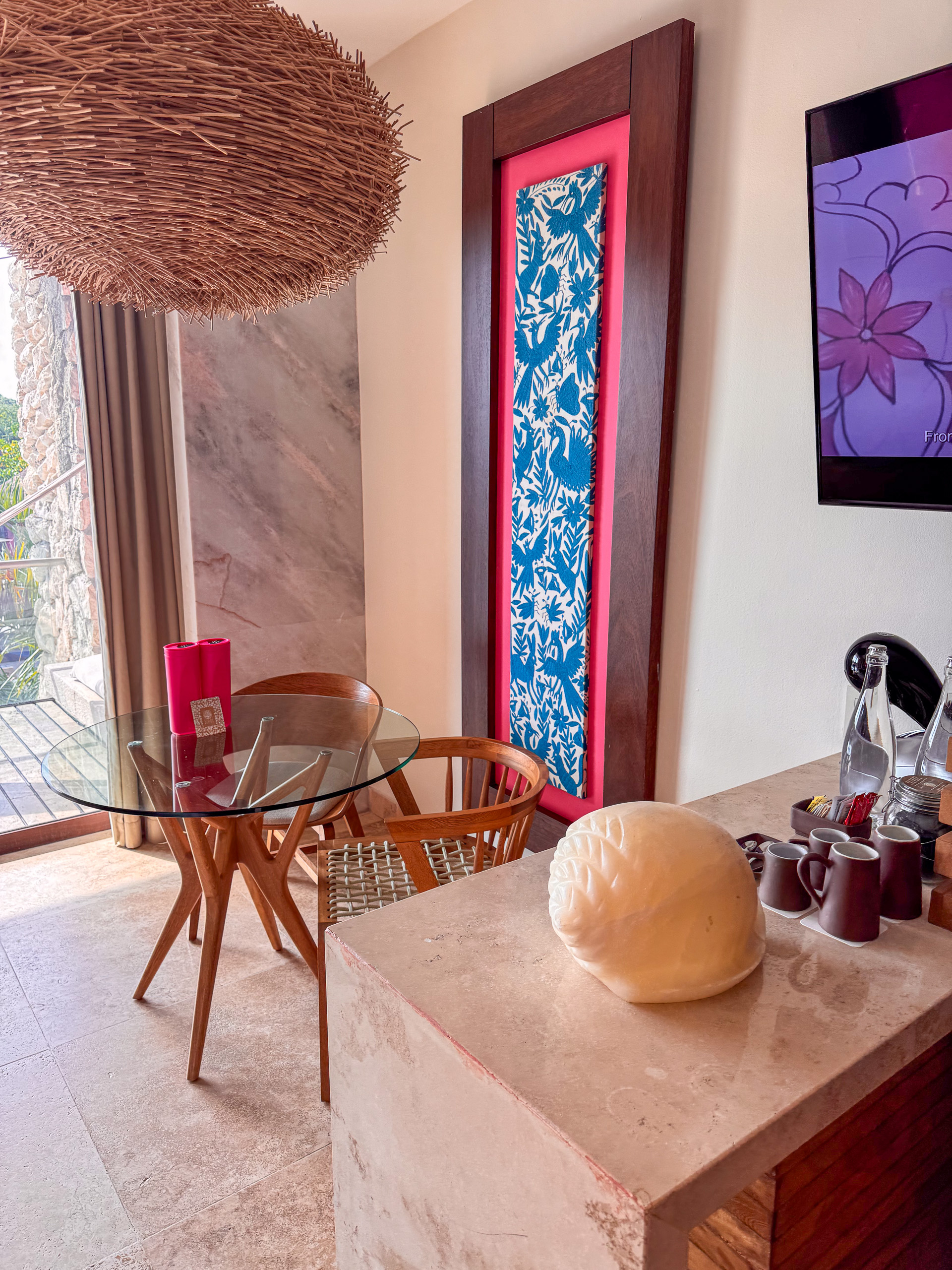
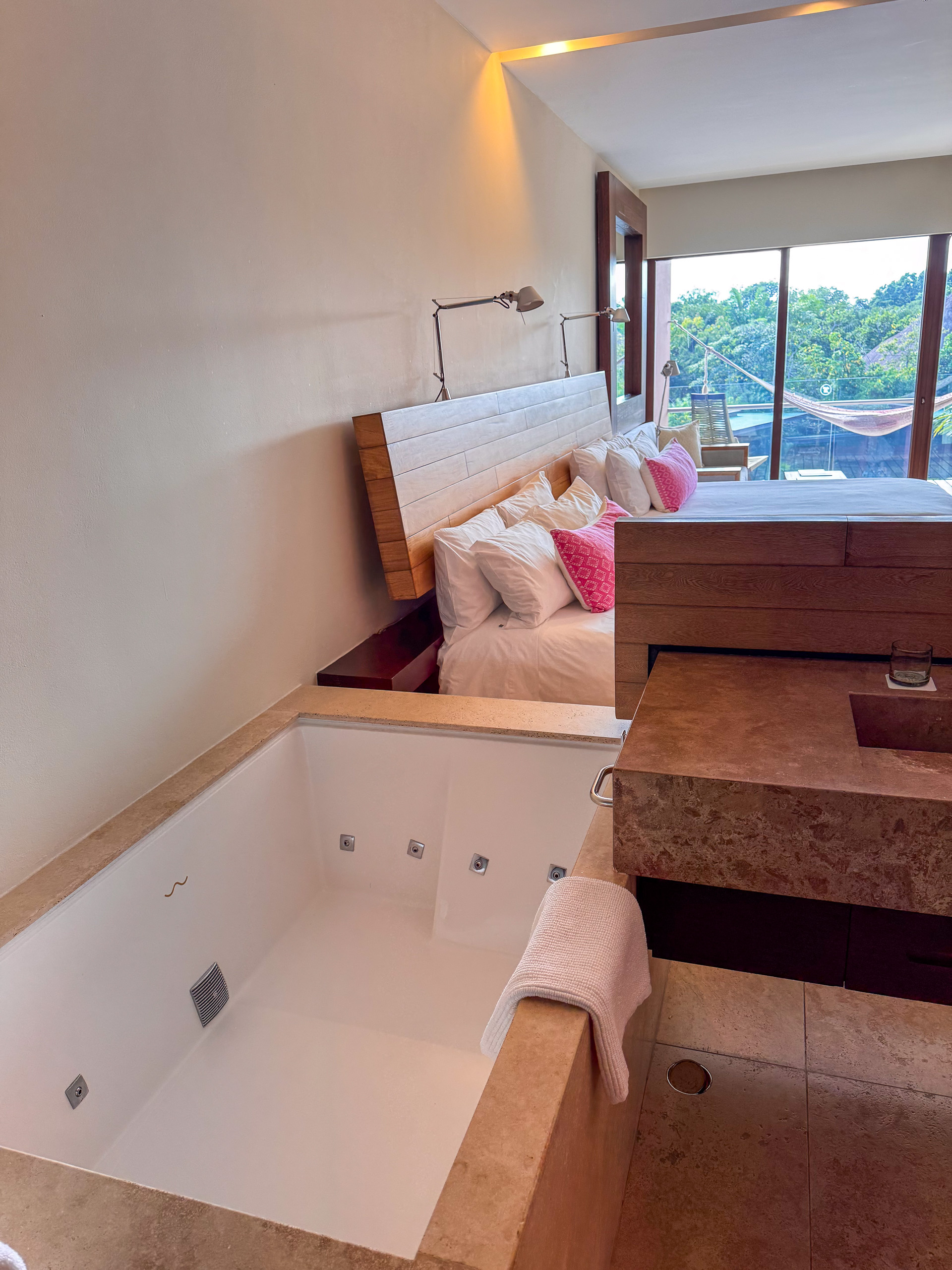
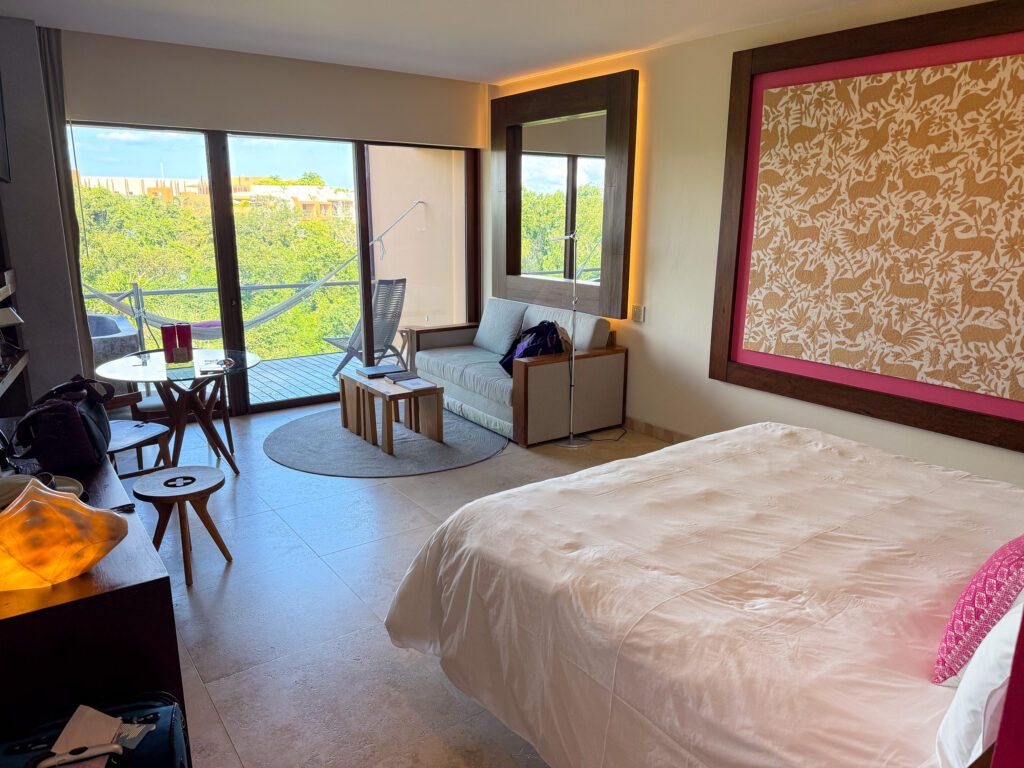
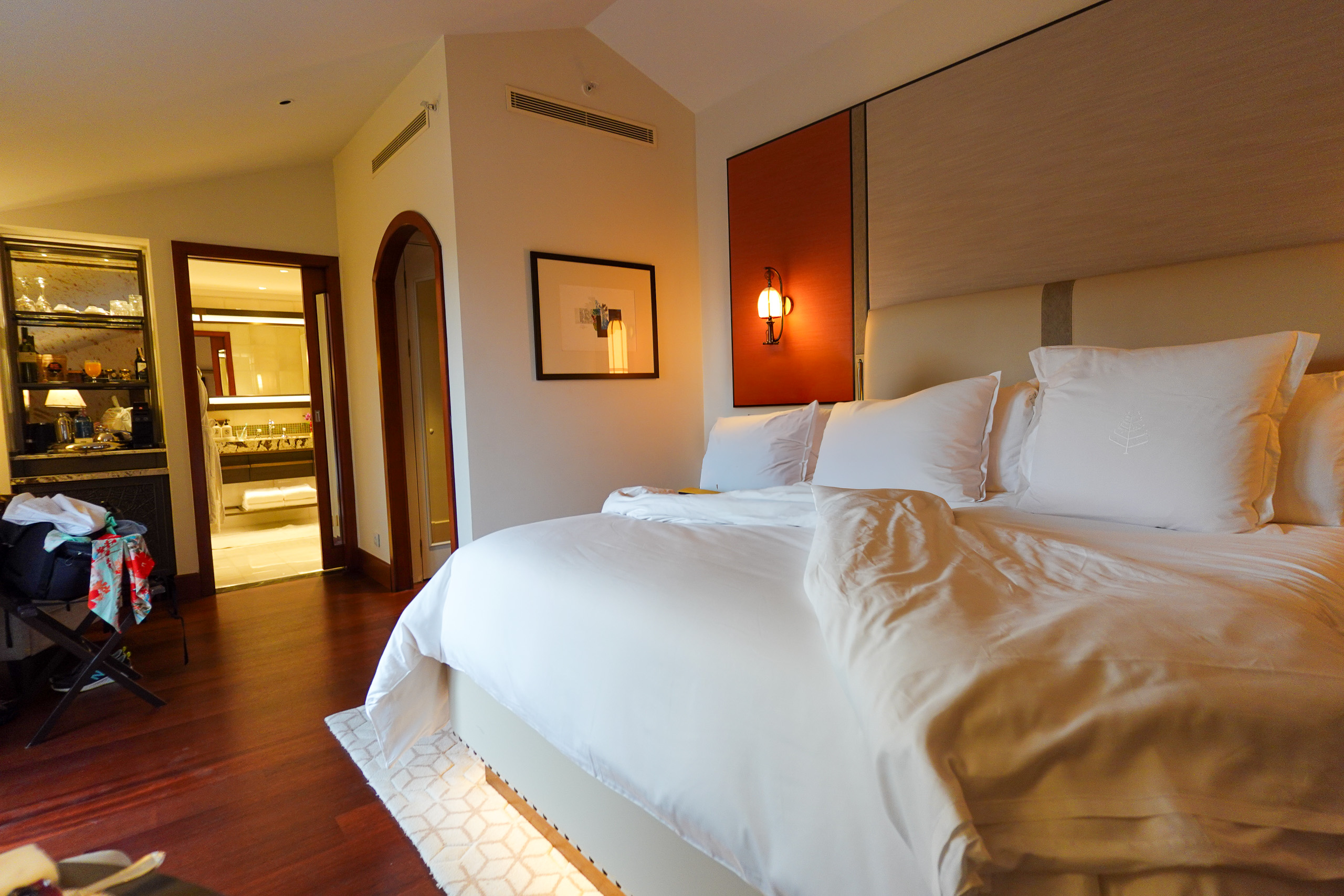
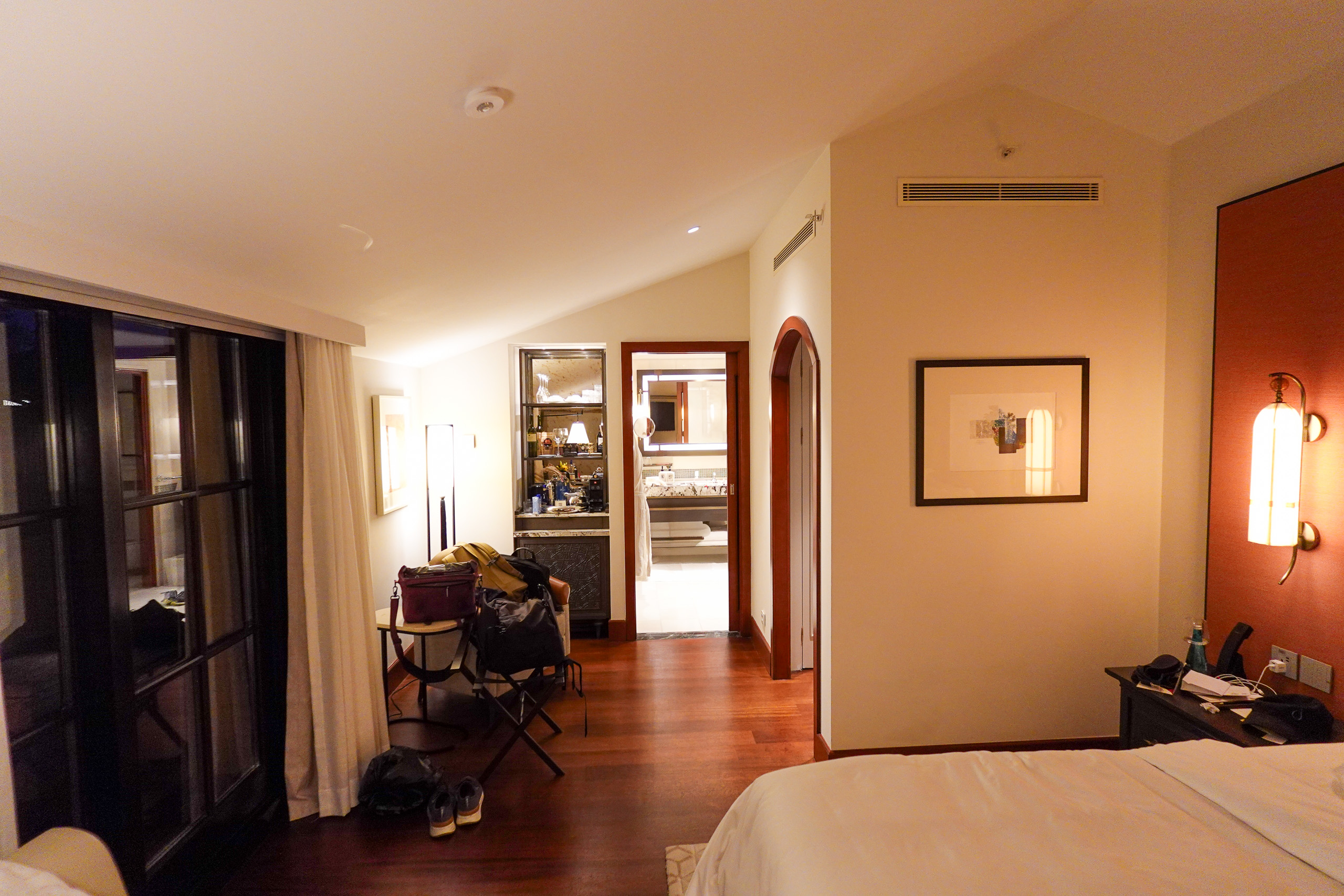
The rooms put glass where the jungle is and let it press up against the bed: white linen, timber, a woven lamp over the desk, a freestanding bath at the window and a hammock strung on the deck. It is a room that knows what is outside is the point, and gets out of the way of it.
The bath at the window, the hammock on the deck, the jungle pressing up outside.
White linen against a wall of glass.The woven lamp over the desk.The tub set below the window.
Noted
Observed on the stay, not measured.
What
Checked on the stays
Wi-Fi
Strong
Water pressure
Excellent
Air conditioning
Noisy and weak in one room; strong and silent in another
Blackout
Great
Noise
The outside can be heard, and the hallway came through one door and not the other
Eating
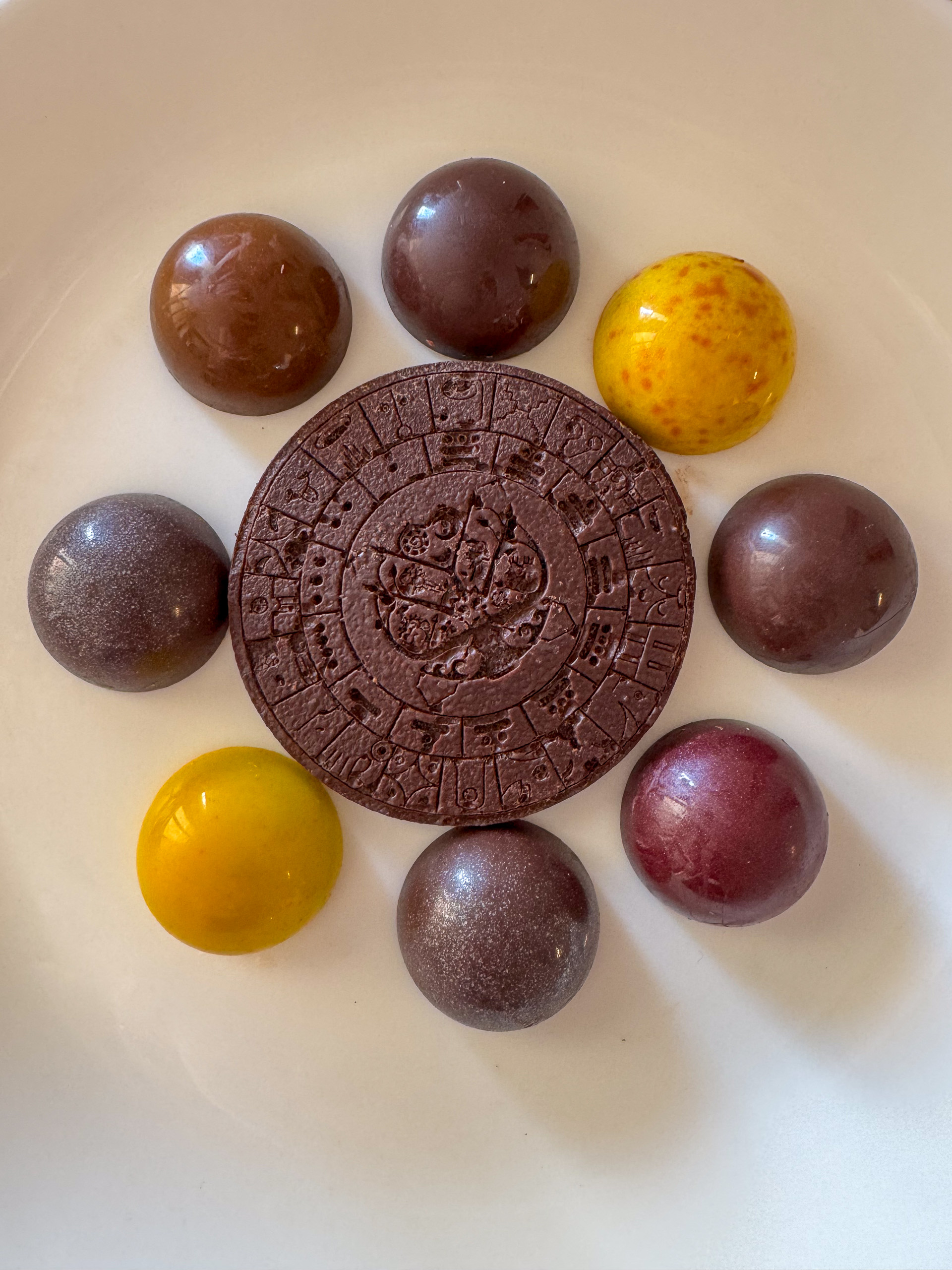
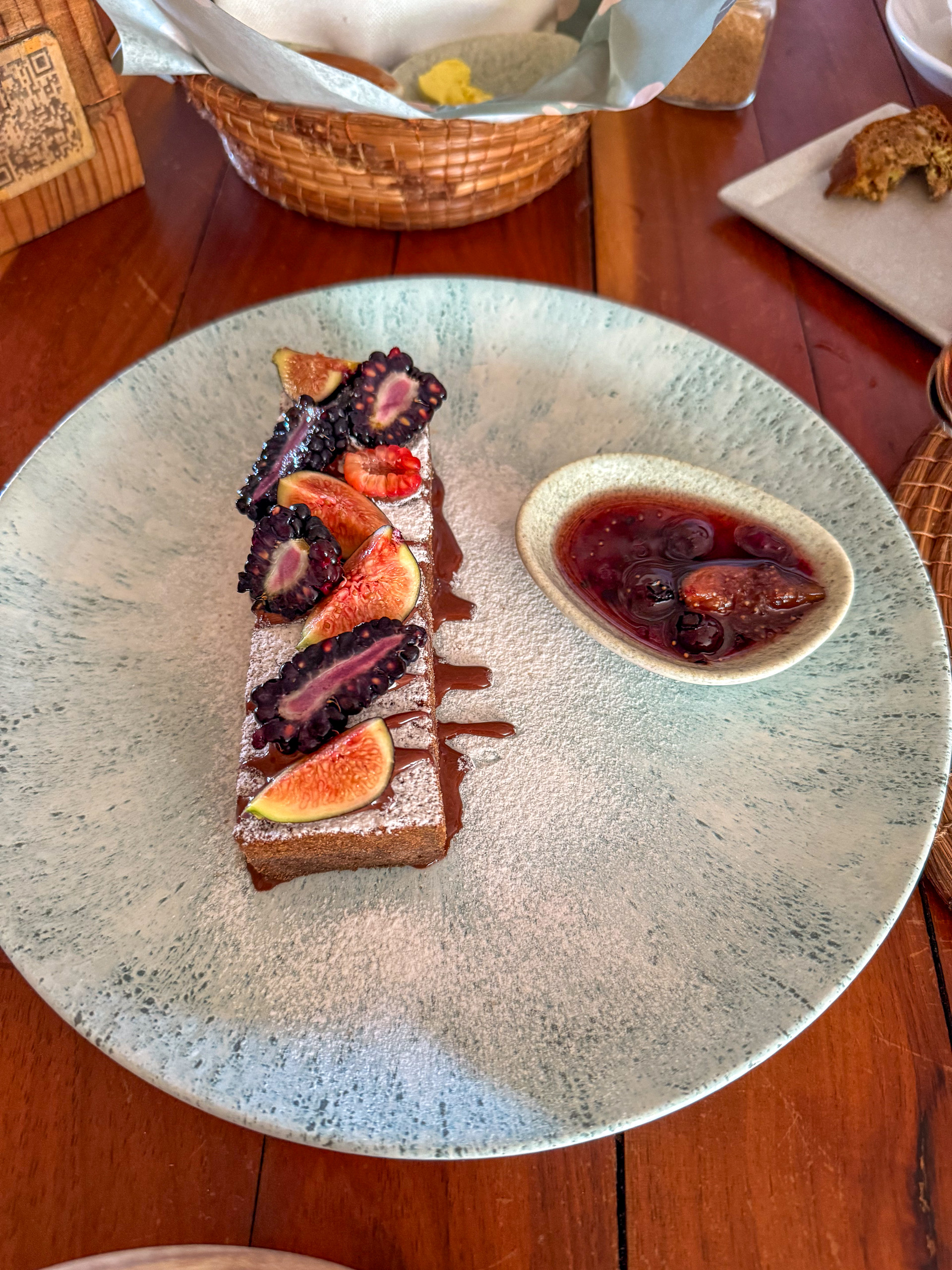
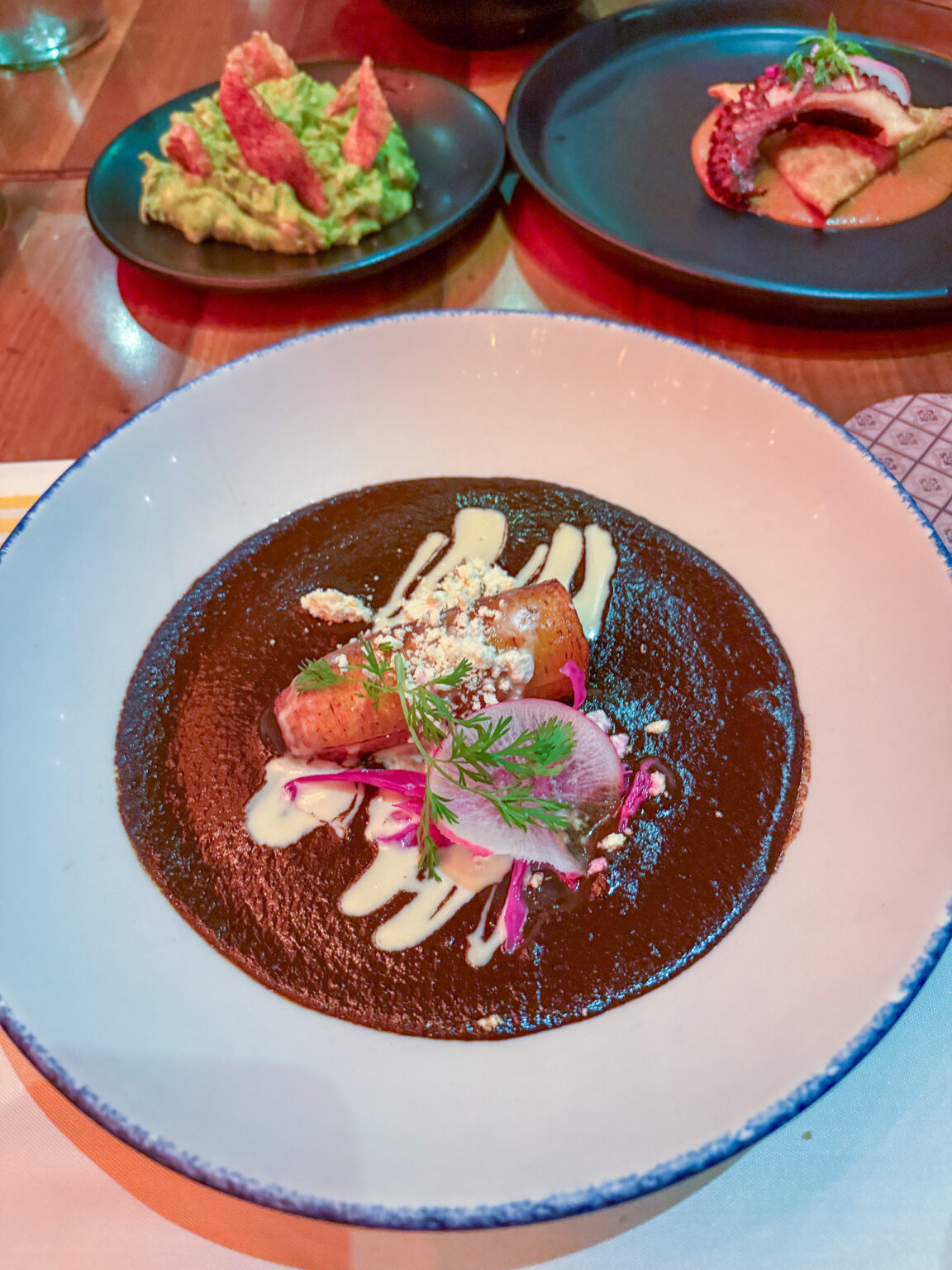
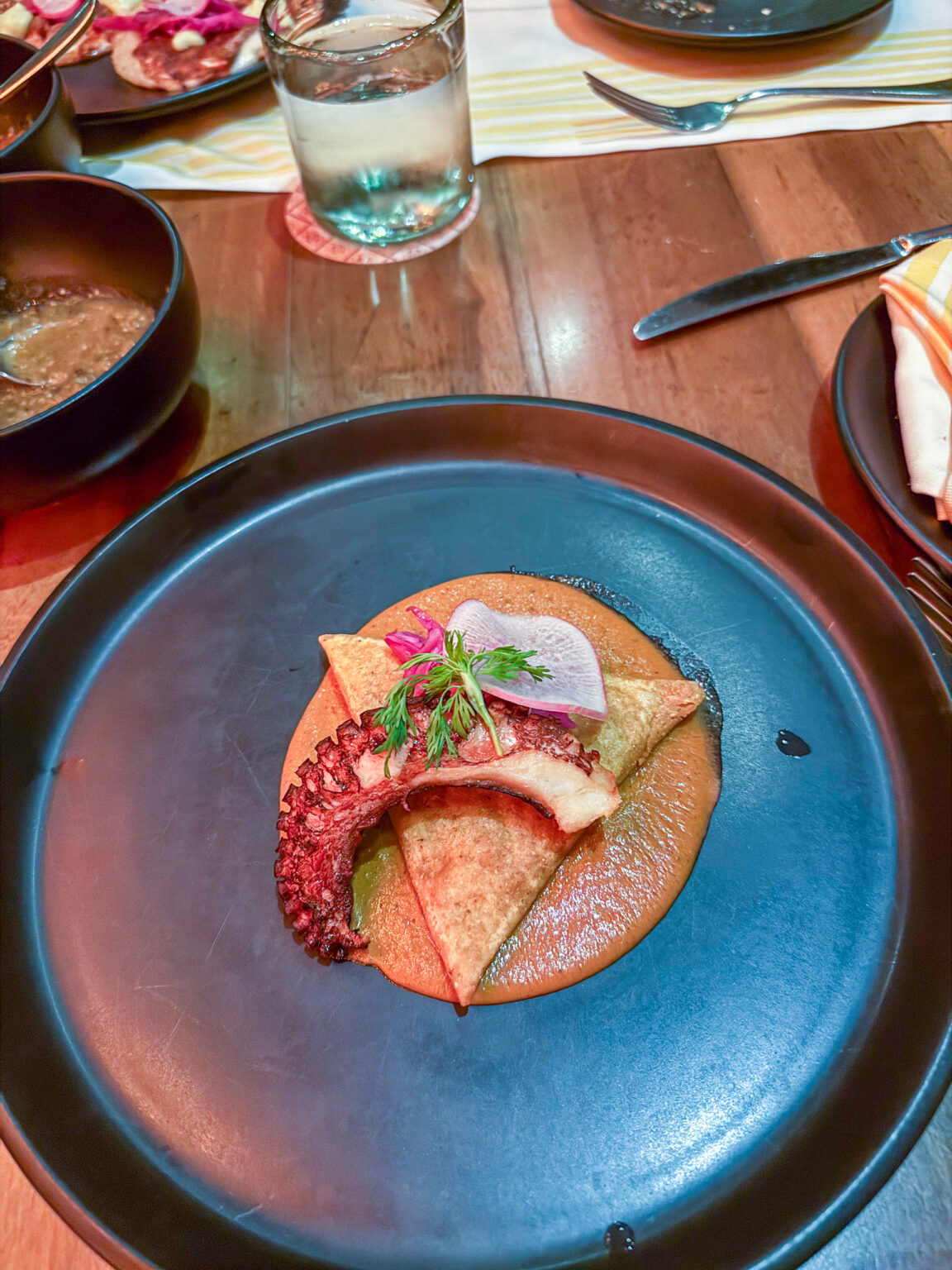
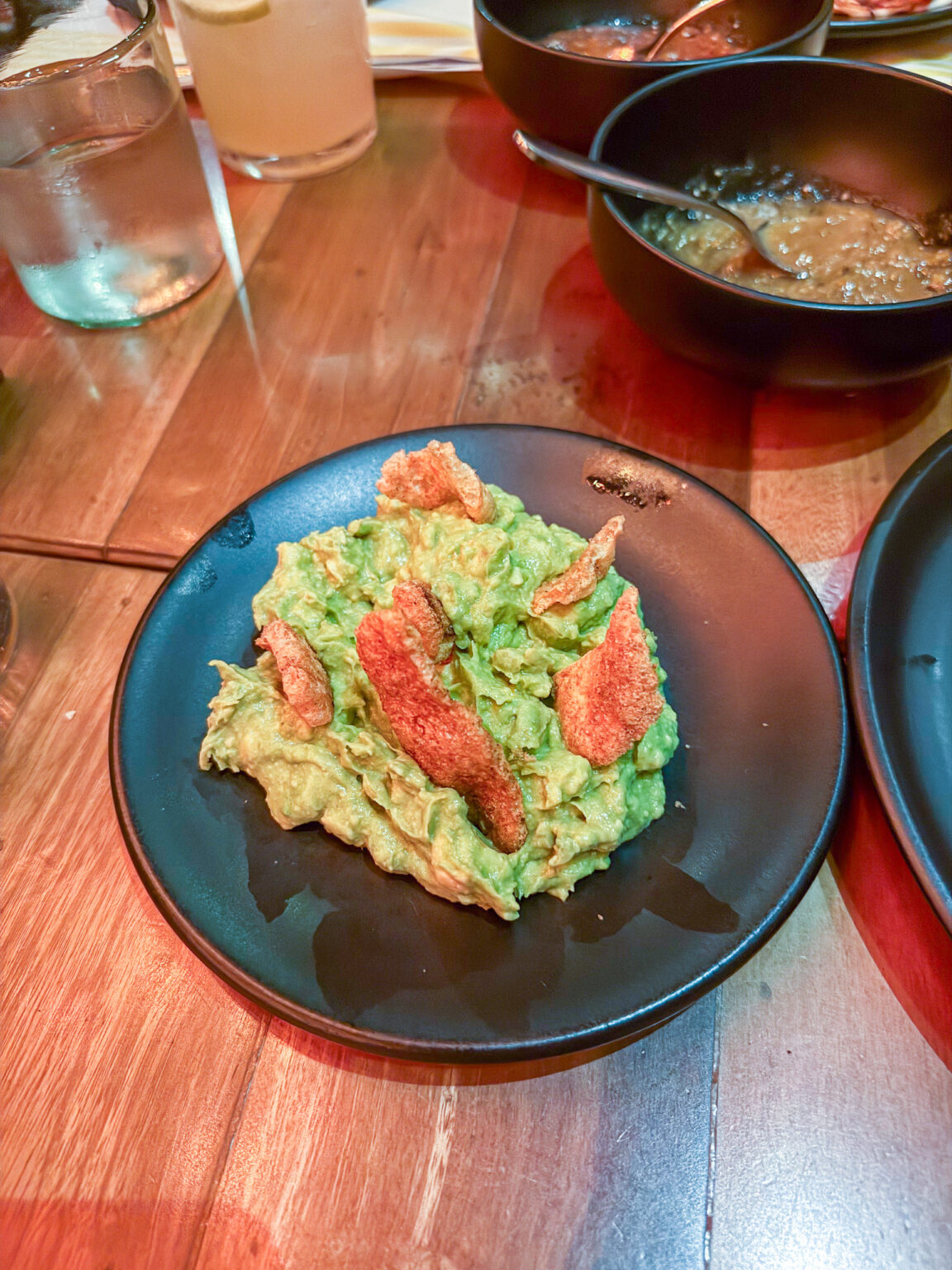
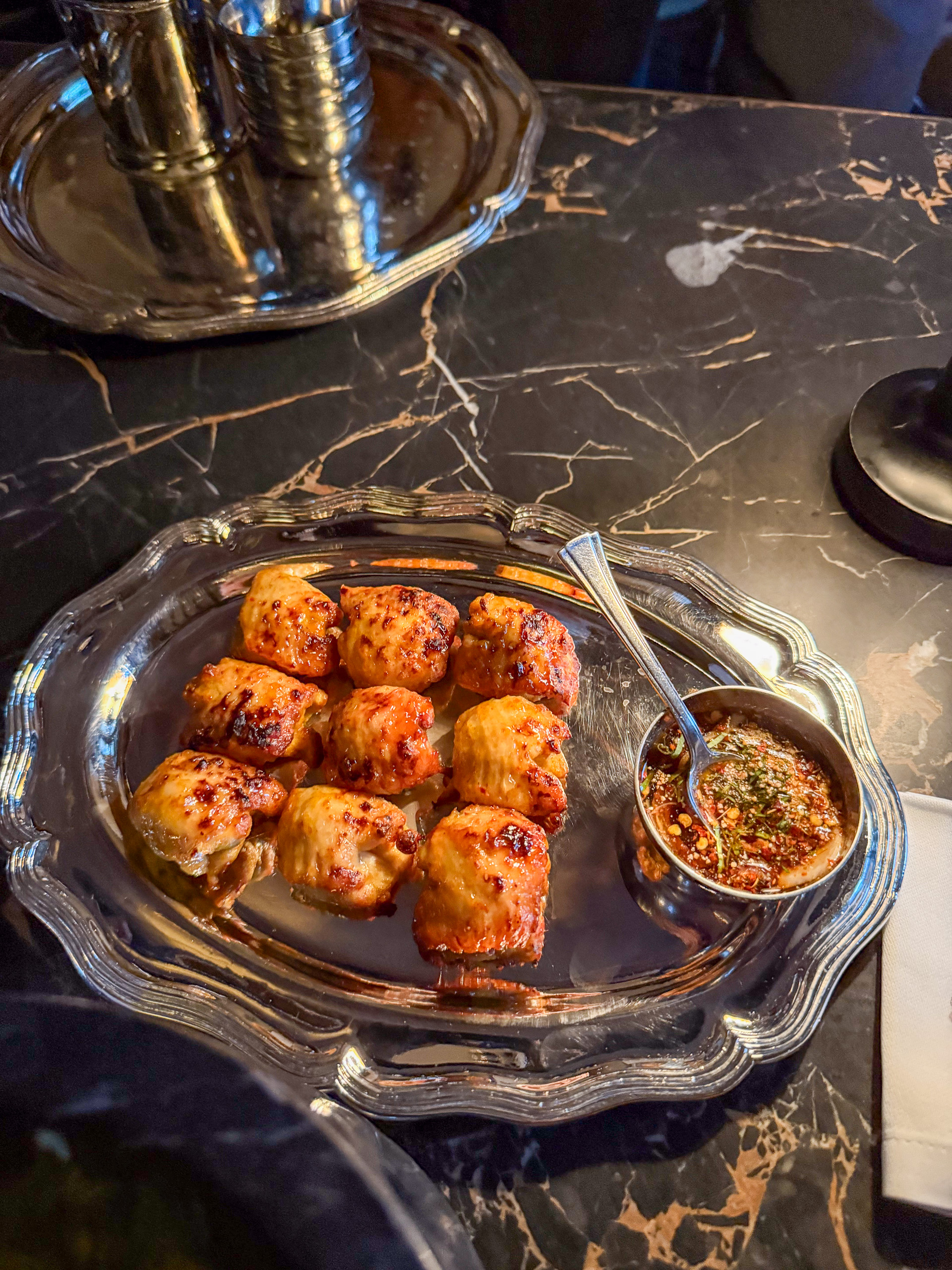
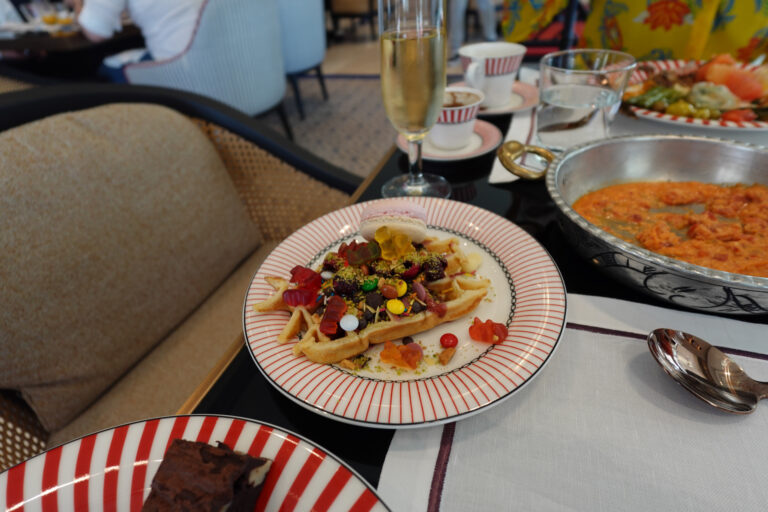
Every restaurant here is outstanding. Not most — every one I sat down in, across the stay, and I went looking for the weak one the way you do at an all-inclusive. It does not exist. The kitchens cook like restaurants that must survive on their own name, and the pastry and chocolate work would hold up in a city. There are some weak items — too true everywhere, I will tell you, with the exceptions of Sorn, Masa and Sushikoh — but every restaurant in the place had something good that I liked, or a lot that I liked, at an all-inclusive. Ever heard of the Mexican Unicorn?
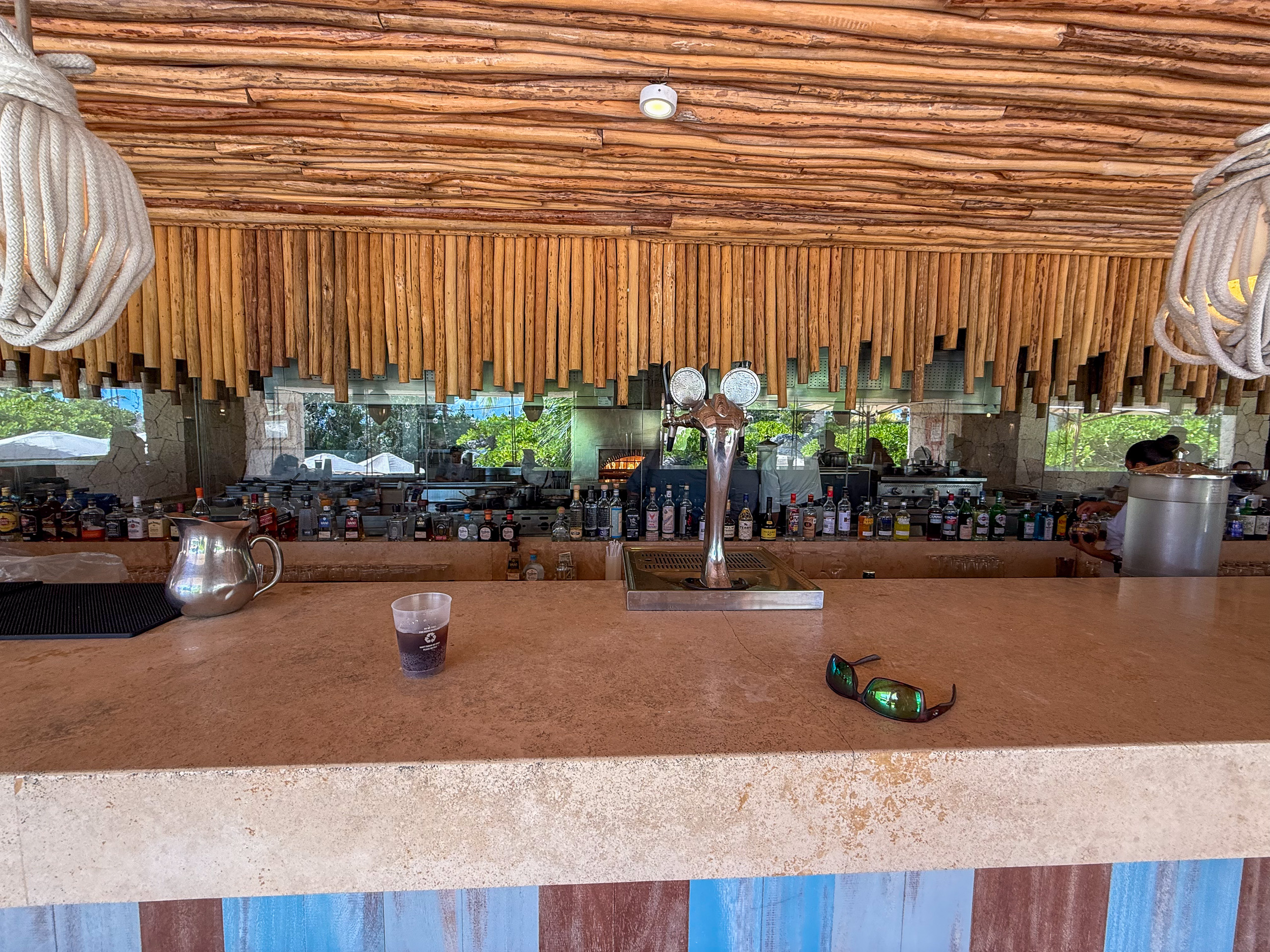
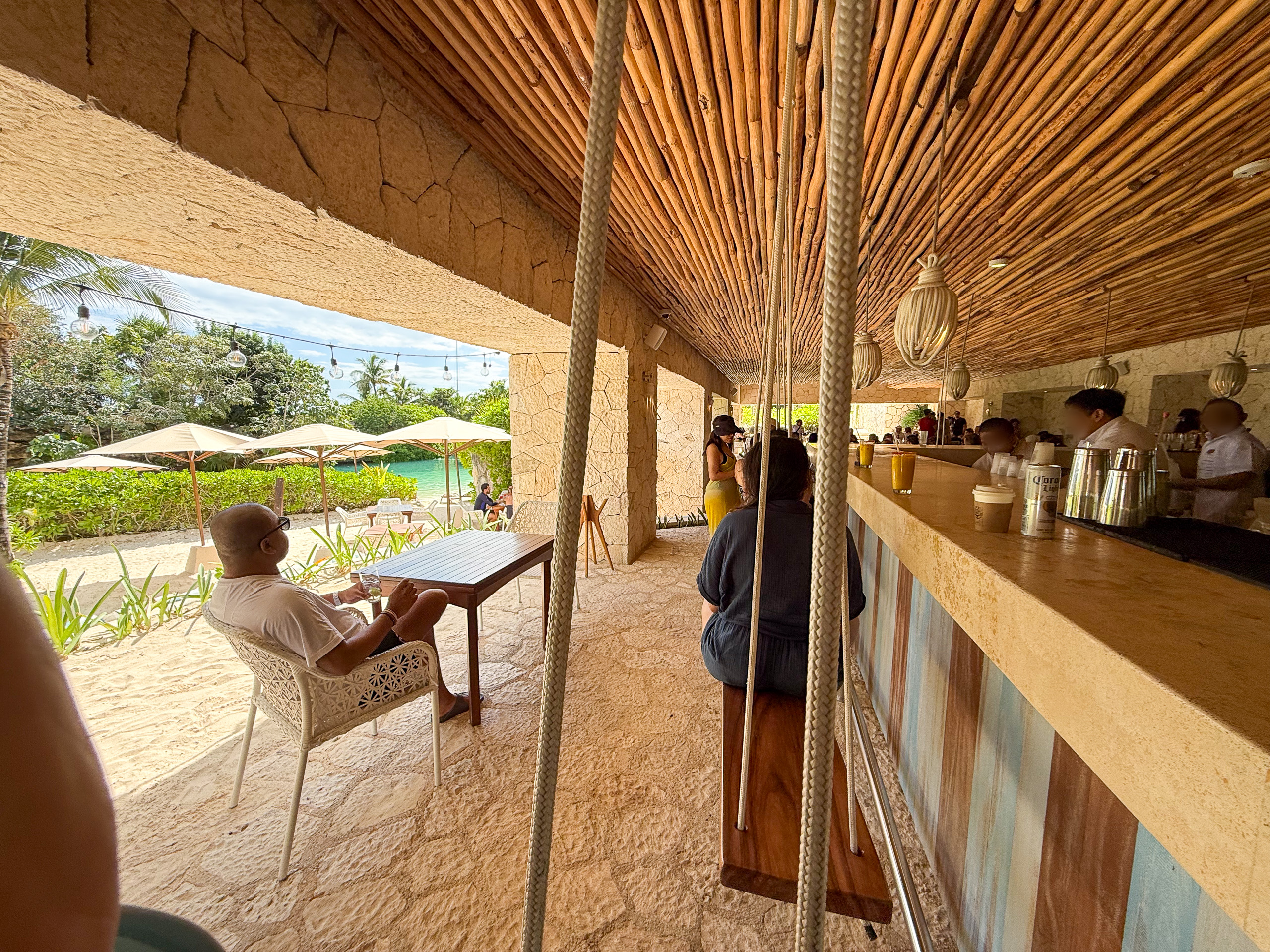
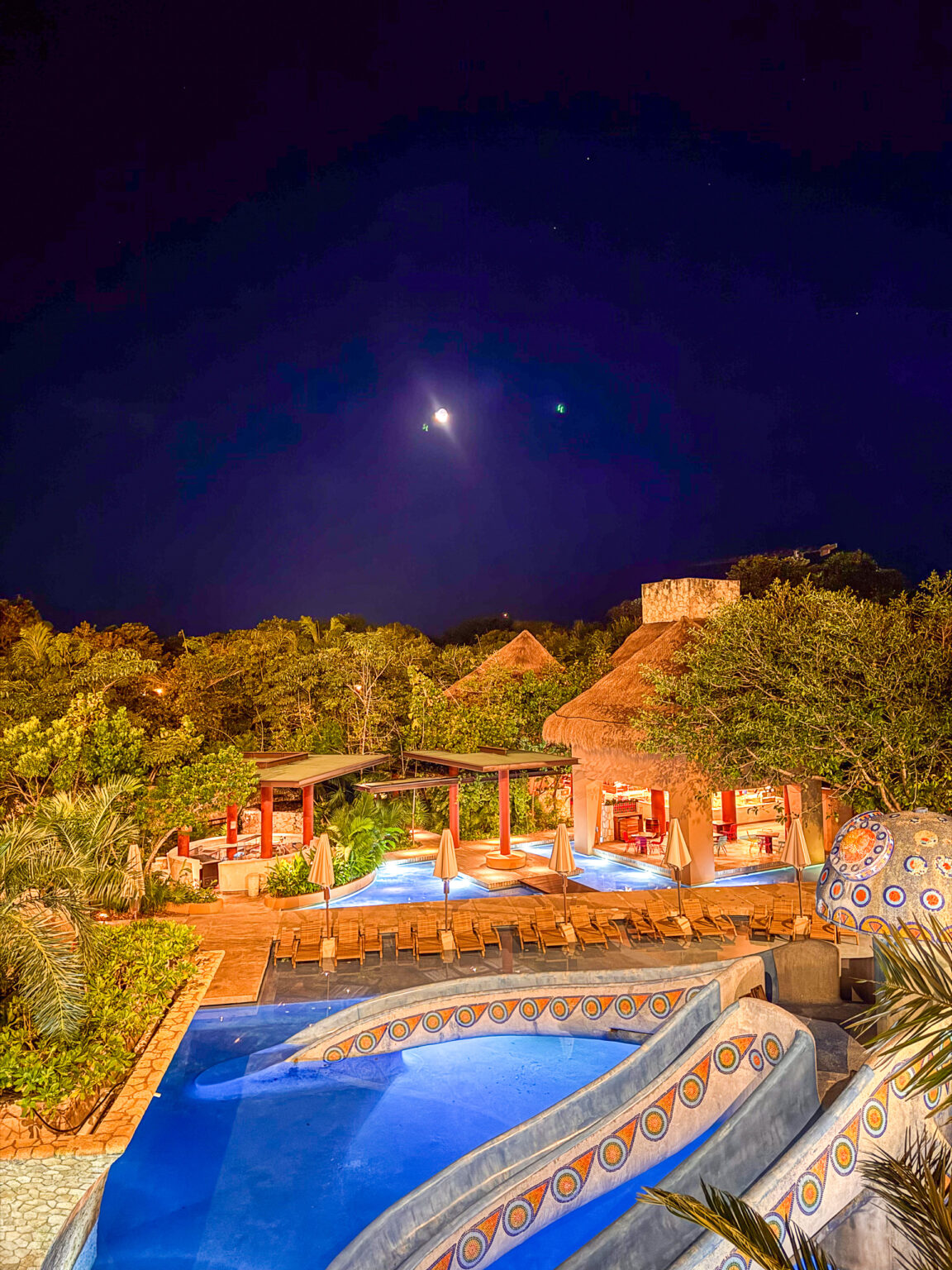
A long bar under its reed ceiling, bottles ranged along the back. There is no weak room here.
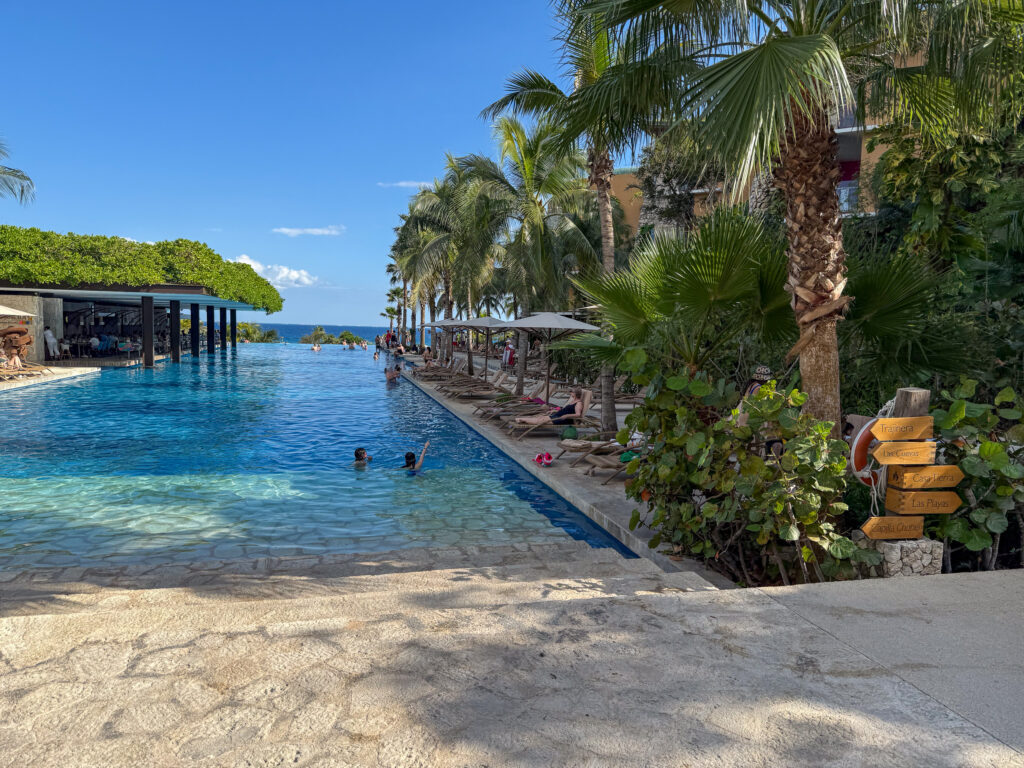
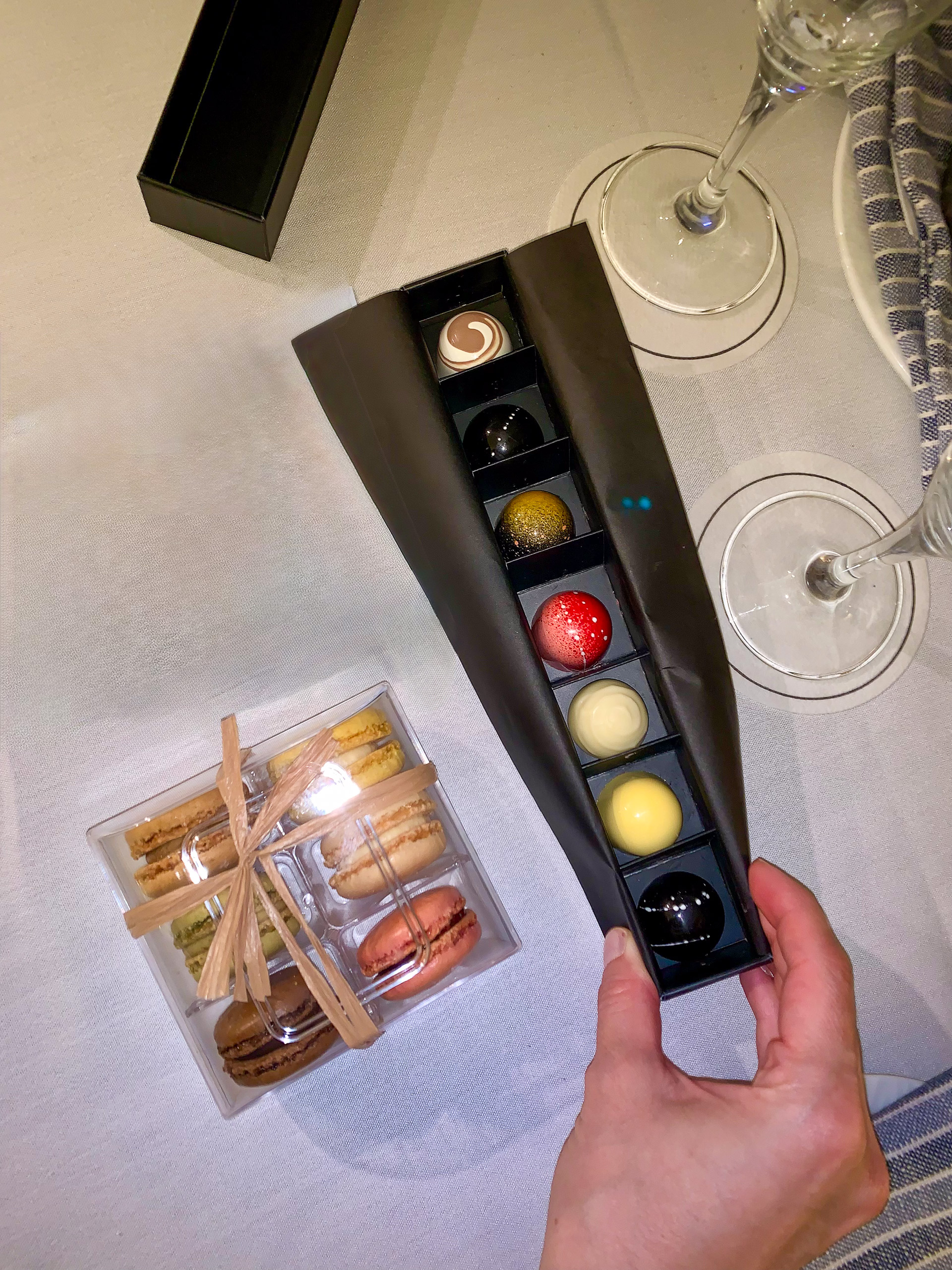
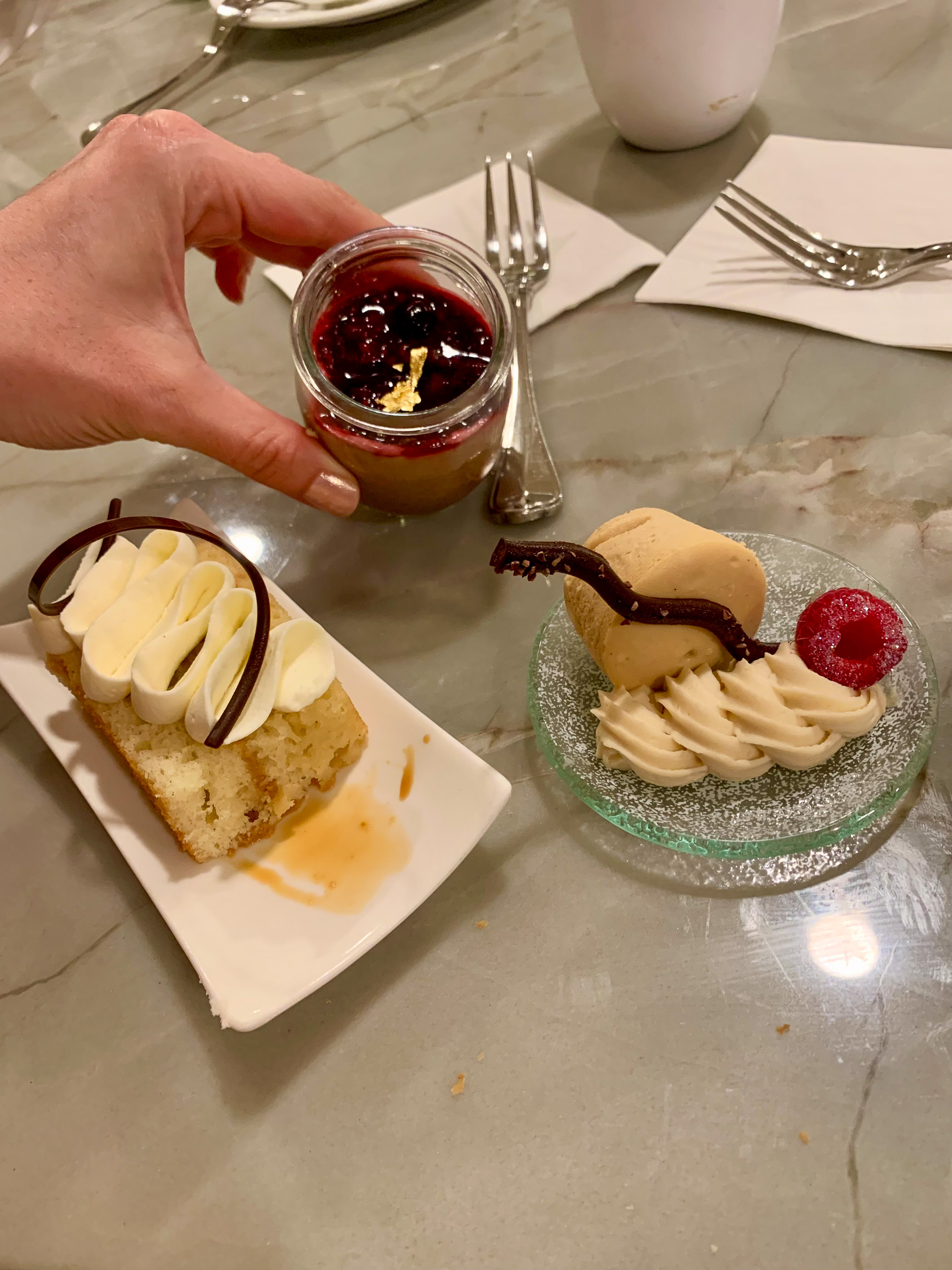
Chocolate spheres round a stamped disc.Along a pale plate, with compote.The open side of the bar, loungers and pool beyond.
The build, the old side and the new
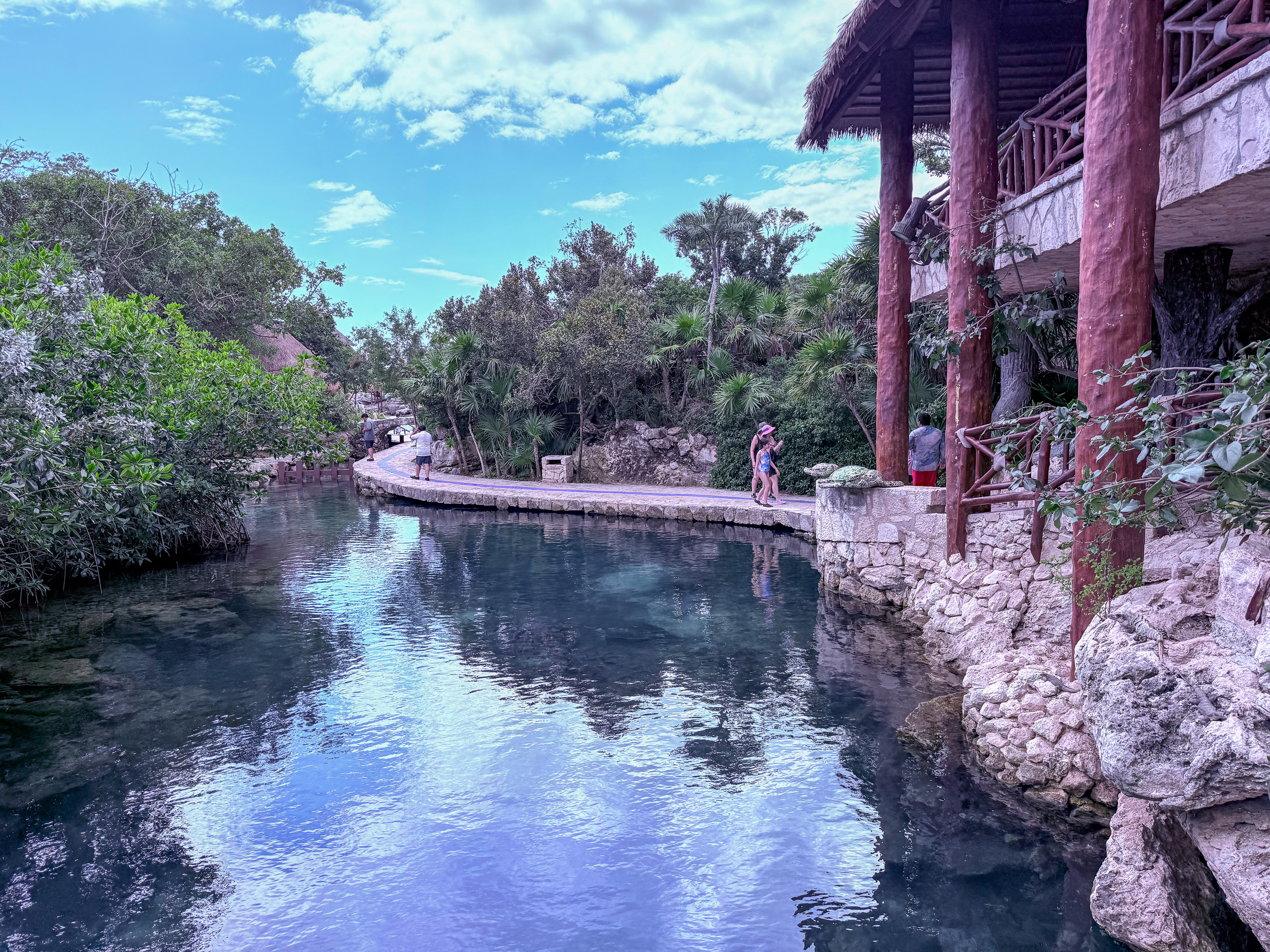
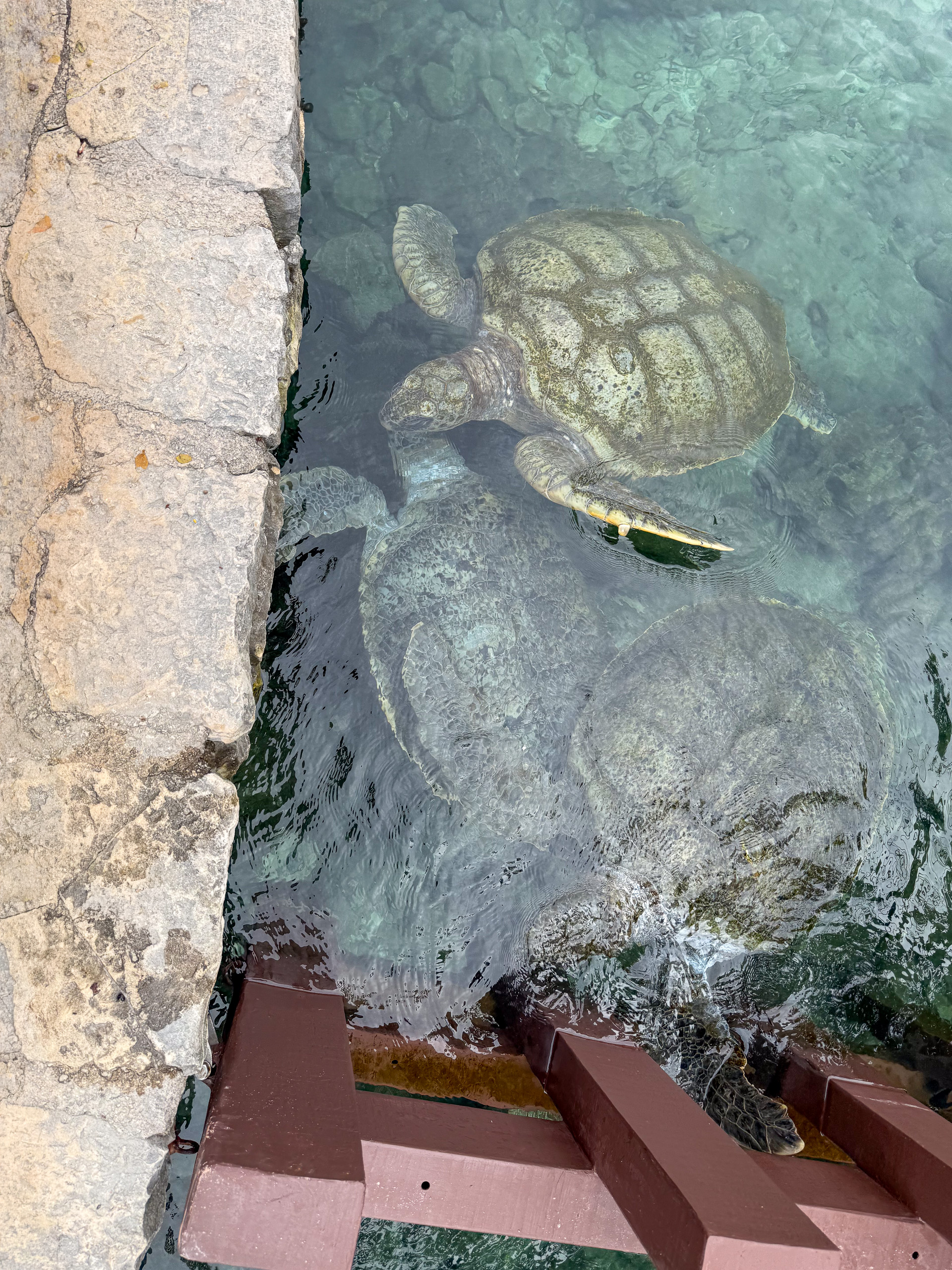
The original side of the hotel was already the best physical build-out I had seen on this coast: the channels between the wings, the rock pools with turtles working the clear water, the cut of the coast used rather than fought. Then, just as you conclude they cannot improve on it, you cross to the new half — and it is AMAZING, in the typeface that word deserves. Newer, bolder, and somehow with the same maturity the old side took years to grow.
The river channel running between the rock walls, the building above it.
The setting does the rest: the parks and the coast this hotel belongs to give it a diversity of days nothing else I have stayed at can match — river one day, sea the next, caves, shows, jungle, and the property itself worth a day of anybody’s time.
Turtles working a rock pool, from above.Turquoise water through the low limestone.The channel running out between the wings towards the sea.
Service moments
The service is the astonishment. It is as if somebody took the best service workers of the surrounding three regions and put all of them here: named, warm, quick, proud of the place, and consistent from the first coffee to the last nightcap. The food and the service together put this property clear of resorts twice as famous — even clear of Atlantis, which I love, and say so in a separate piece.
A shaded stone terrace under the trees. Somebody will have remembered your coffee before you sit.
Who it is for, and who it is not
Come if you can get here at all — this is a true must-visit for anyone who can even stretch to afford it, and the stretch buys more than it does anywhere else on this coast. Families have choice after choice; couples are hidden from them well to quietly ignore them; and the diversity of the days means no two people at the table have to want the same holiday.
Look elsewhere only if you need a city outside the gates or a beach with nothing behind it. This is a world, and worlds ask for your whole week.
It is a MUST SEE before you die. Preferably bring your children before they are twelve and start losing their sense of wonderment, because — like some kind of Mexican Disneyworld — this place has brought me some magic.
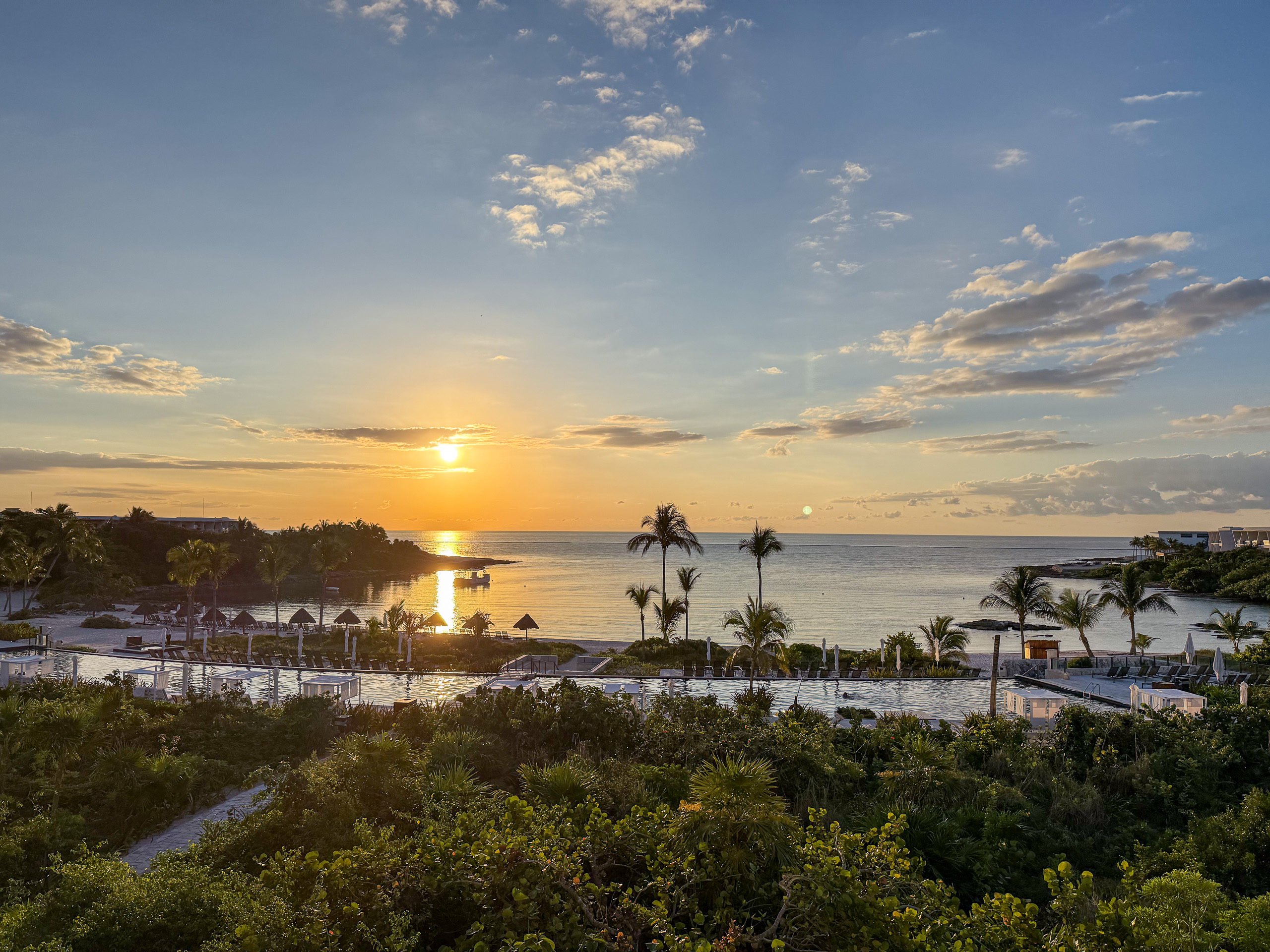
The sun going down beyond the palms and the roofs. A world, asking for your whole week.
Bottom line
Done well, to an extreme: the best service and food on the coast, in a build-out that keeps outdoing itself. A MUST SEE before you die.
PARADISE ISLAND, BAHAMAS · VERIFIED STAY · 6 MIN READ
Atlantis Paradise Island: A Lost City at Mammoth Scale
A lost city at mammoth scale: towers over lagoons, a river through the grounds, and the best water park on earth. You do not go for the service, and you should still go before you die.
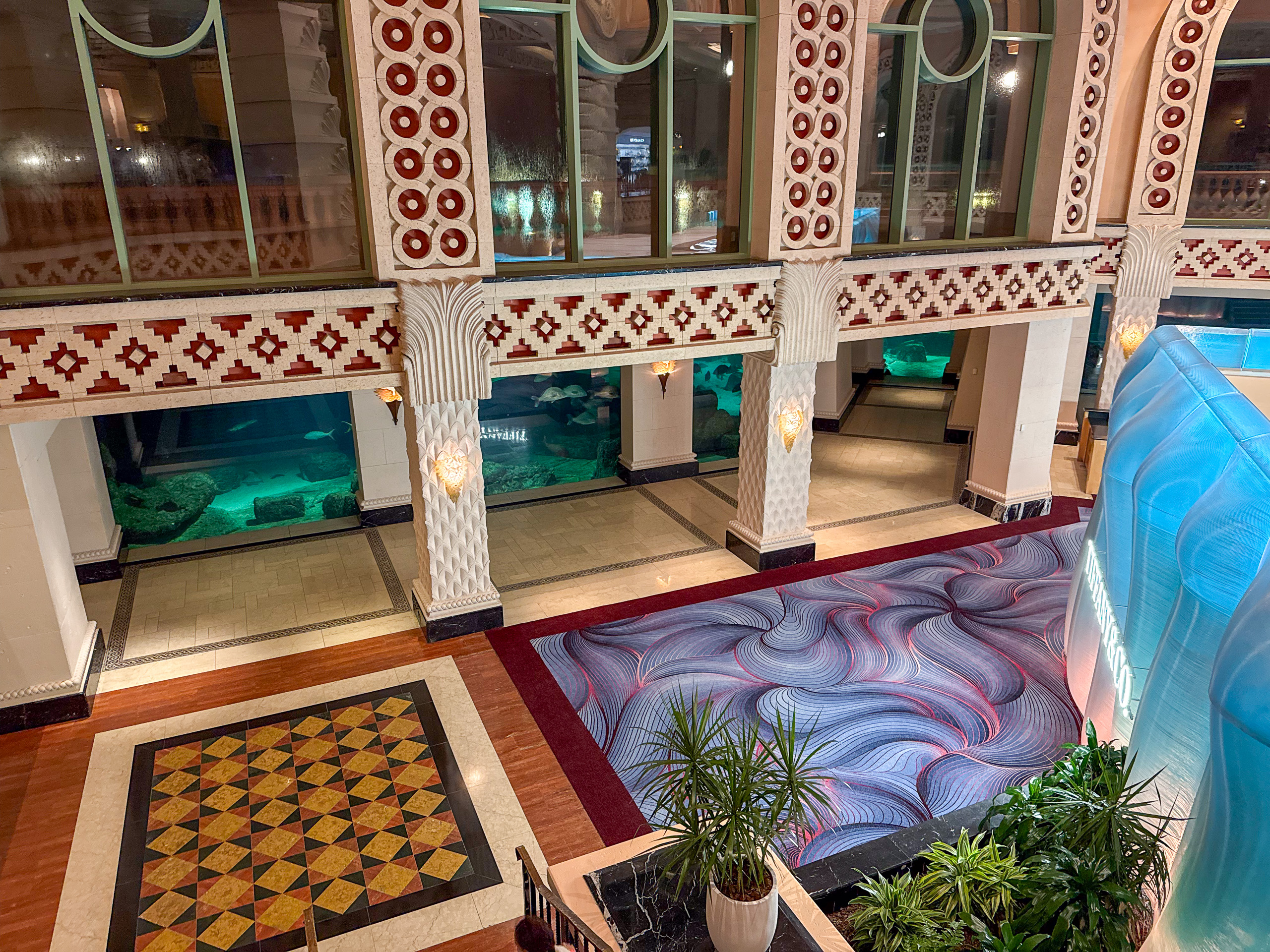
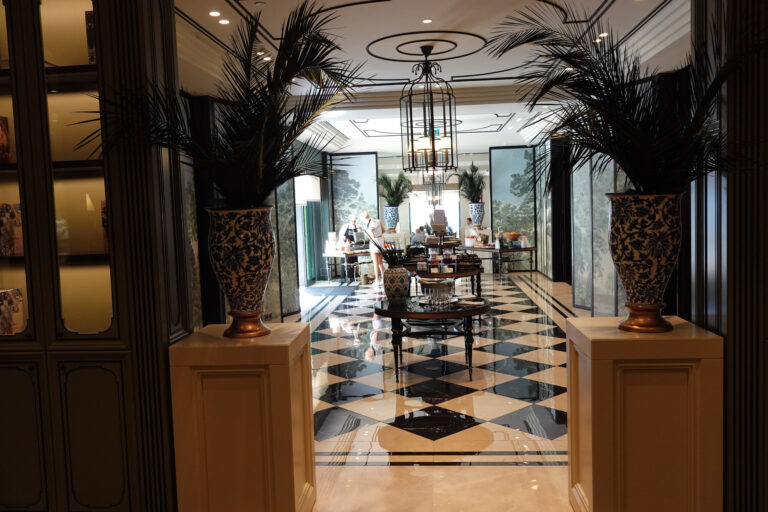
You see the towers from the bridge before you see anything else: coral-pink, joined at the crown, rising off a flat green island like something excavated rather than built. Atlantis is a themed resort, the theme is a lost city, and the thing nobody warns you about is that the theming works. The great hall runs marble underfoot and arches overhead with the aquarium glowing at the far end, and the register is not Vegas. It is closer to a natural history museum with a beach.
The way in: marble, arches, and the aquarium glowing at the far end of the hall.
The scale is the point. The grounds hold many distinct territories — towers, lagoons, a river, beaches, a marina — and every one of them is mature, grown-in, finished. Nothing reads as the new wing of an old idea. The size produces a strange, prehistoric grandeur: mammoths and mastodons, somehow, in a lost city by the sea.
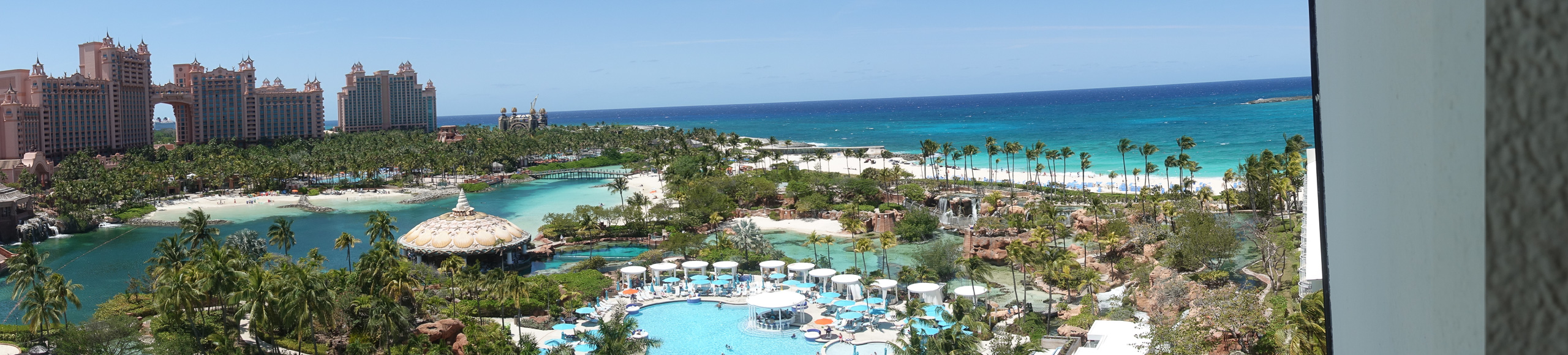
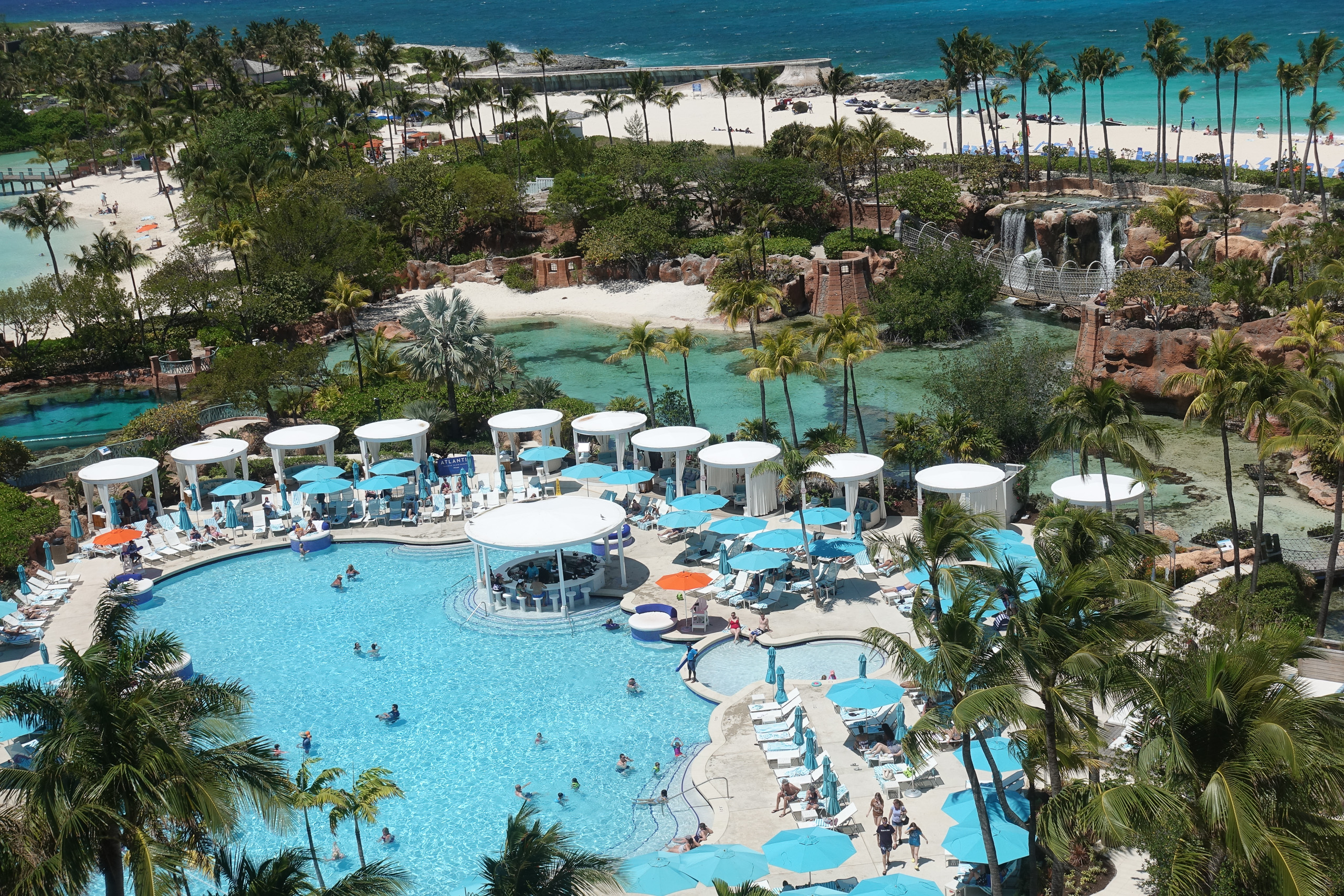
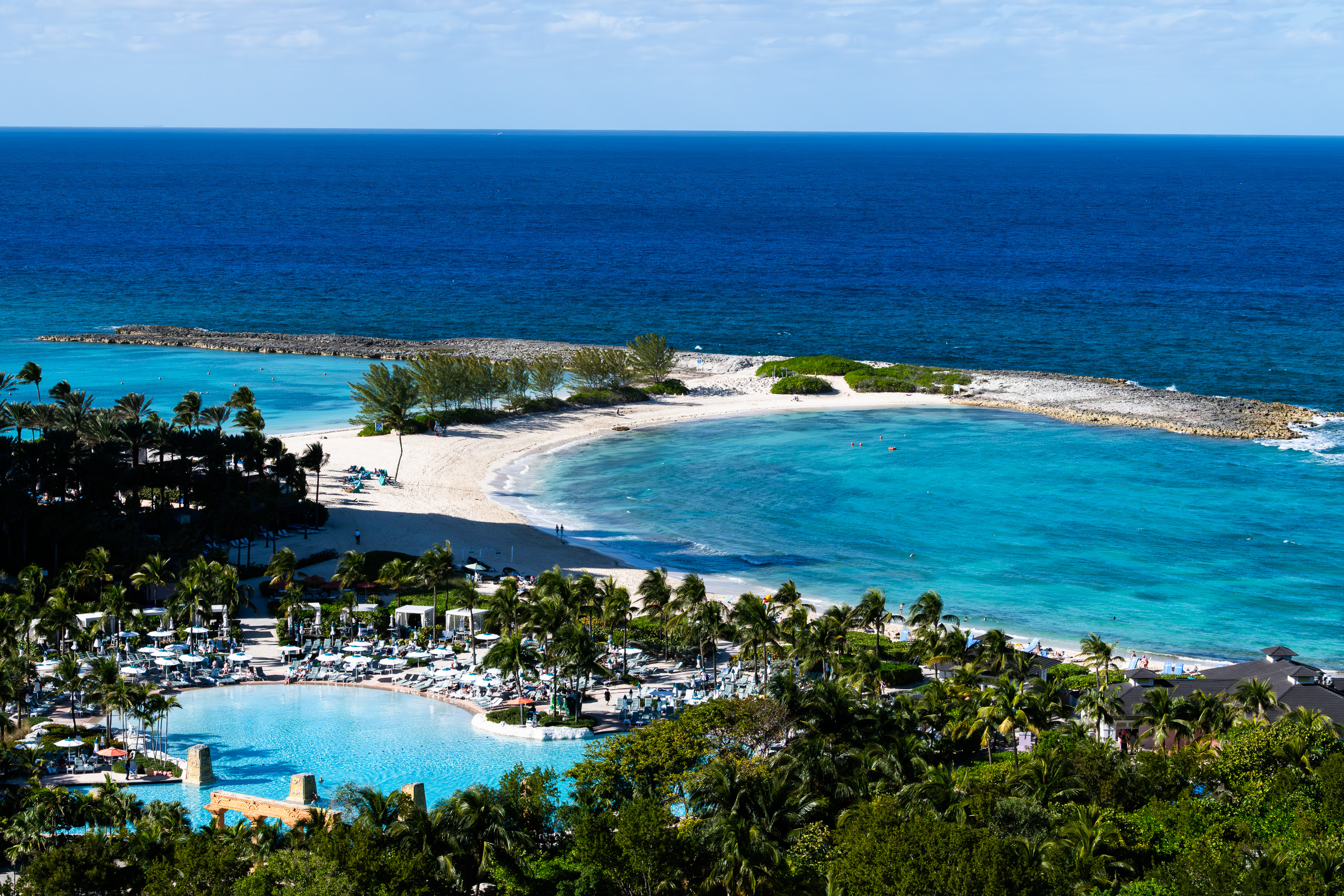
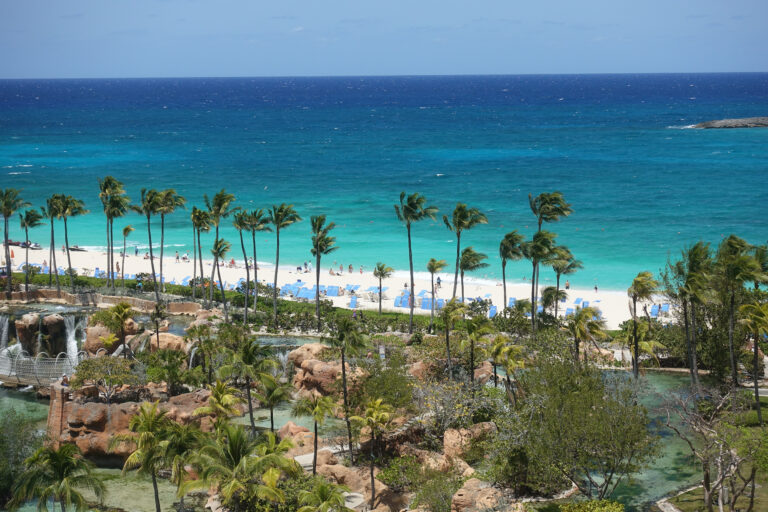
The whole sweep in one frame: pools, daybeds, palms, then the Atlantic.
Then you reach the front desk, and the spell pauses. Check-in was slow, procedural and unwarmed — not rude, just not what five stars promises, and nowhere near the standard Asia has trained me to expect at this level. It is the first thing you experience here and the worst, in that order, which at least gets it out of the way.
The room
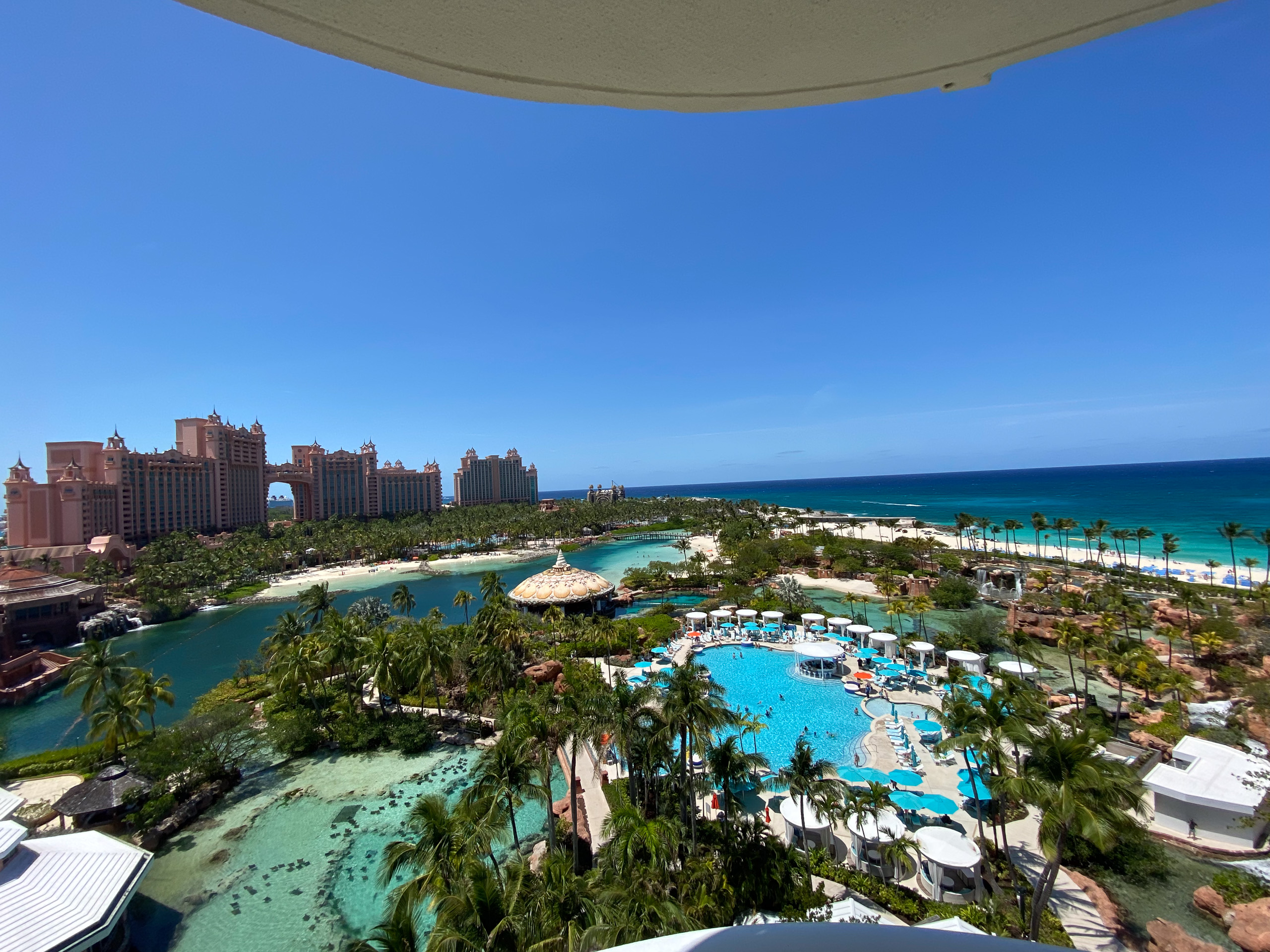
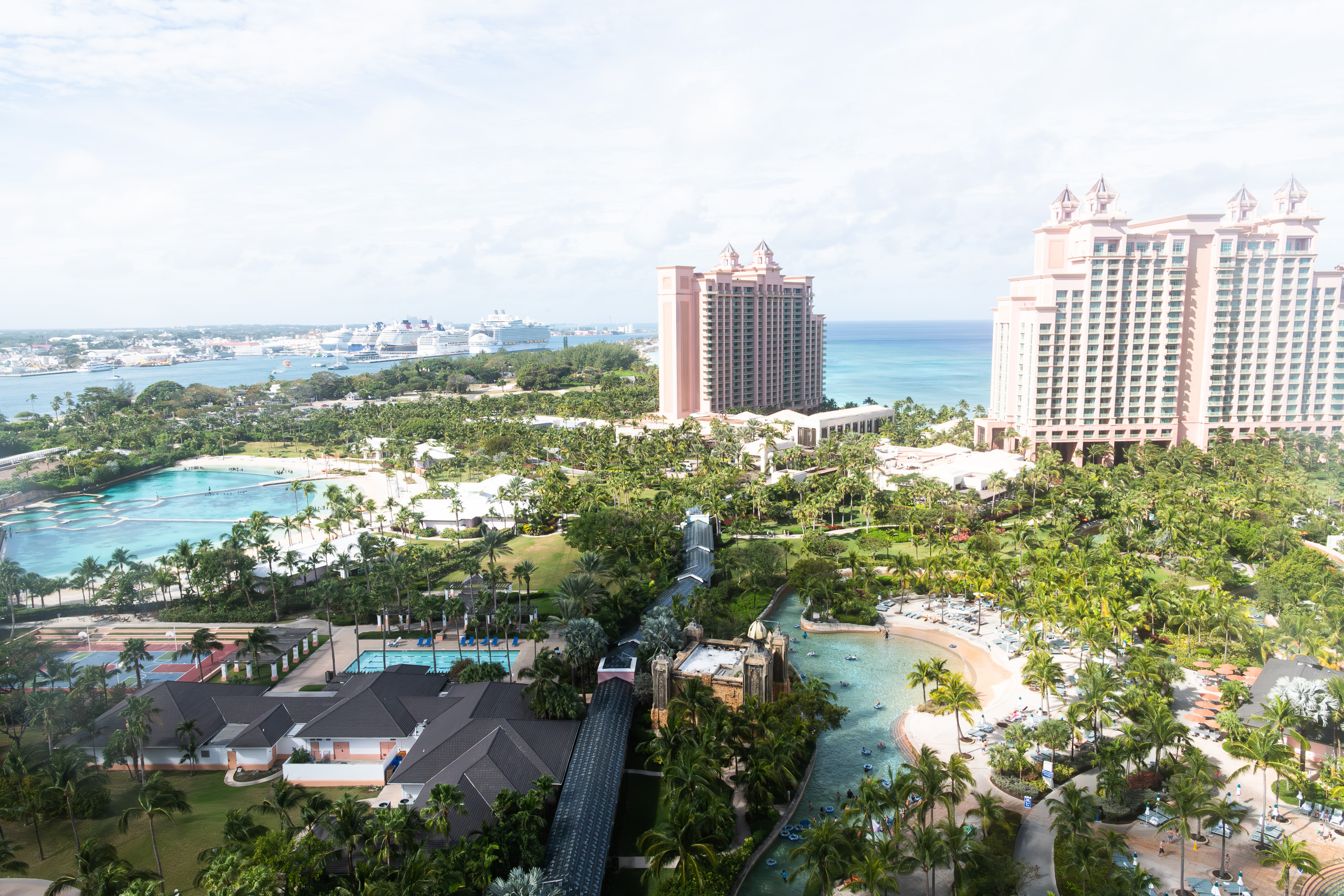
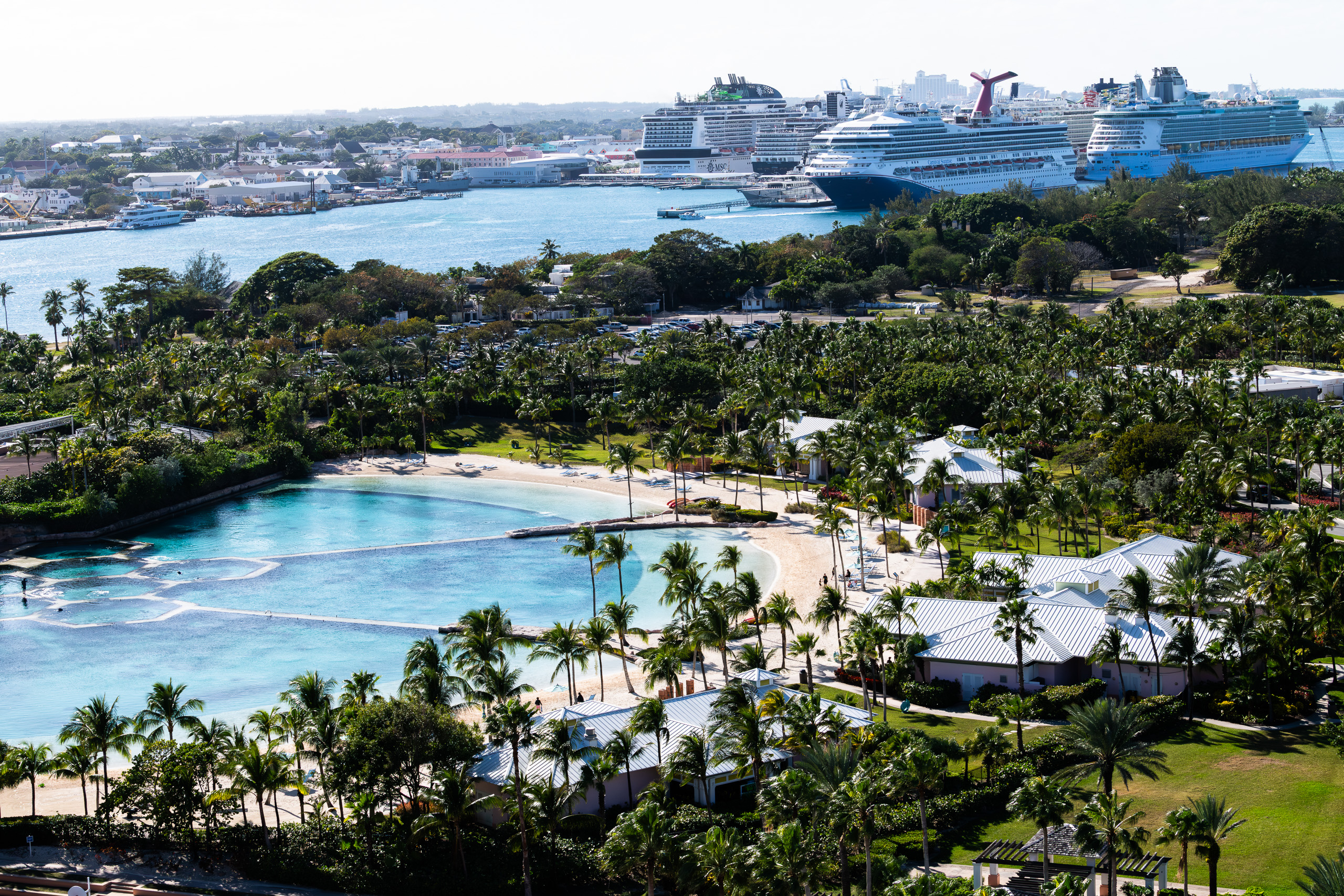
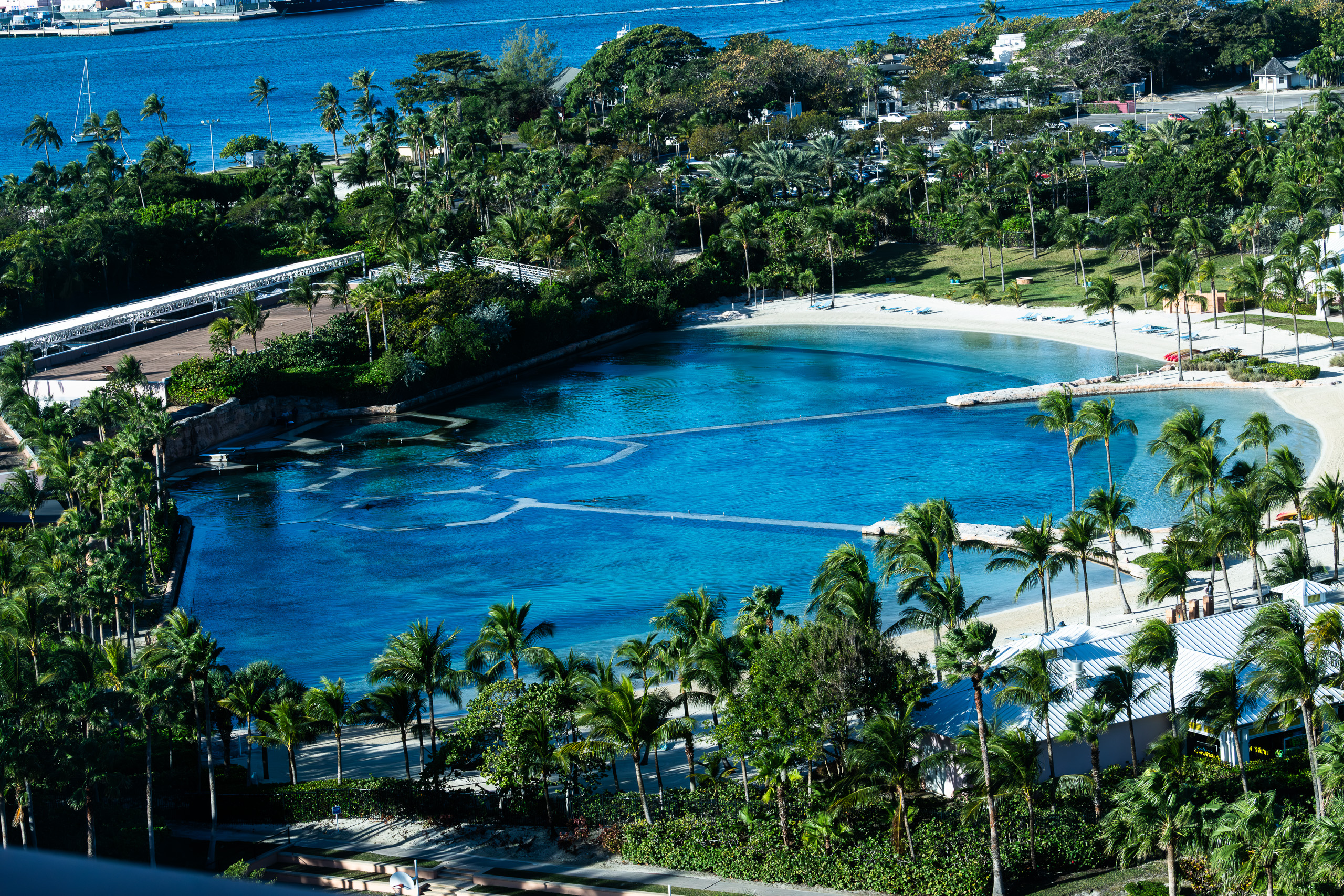
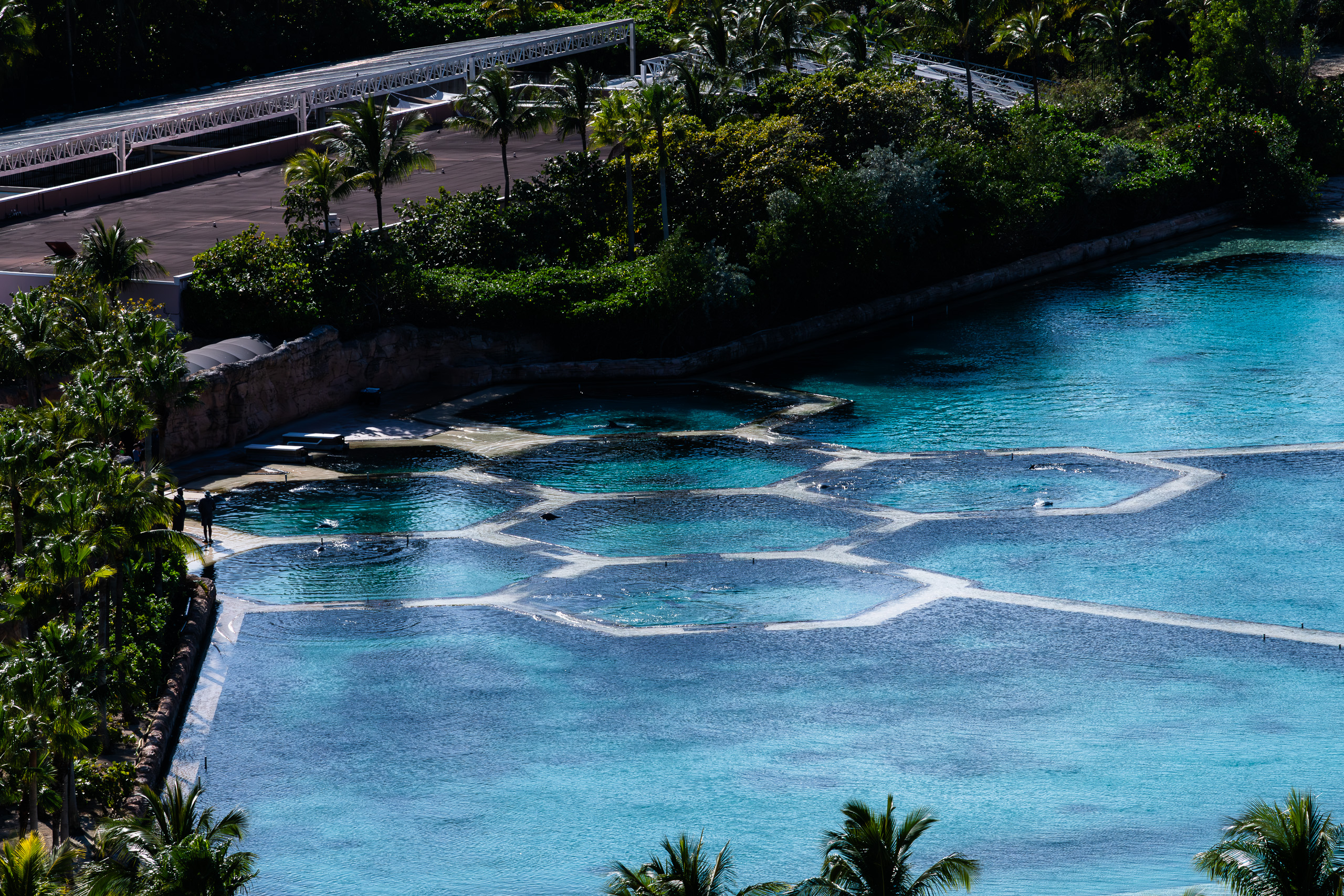
From a high floor the property explains itself. The river winds to the sea, the pools sit ringed with cabanas, Dolphin Cay is drawn in the clear water like a honeycomb, and Nassau’s cruise ships stack on the horizon to remind you where you are. I spent more time at the glass than I expected to.
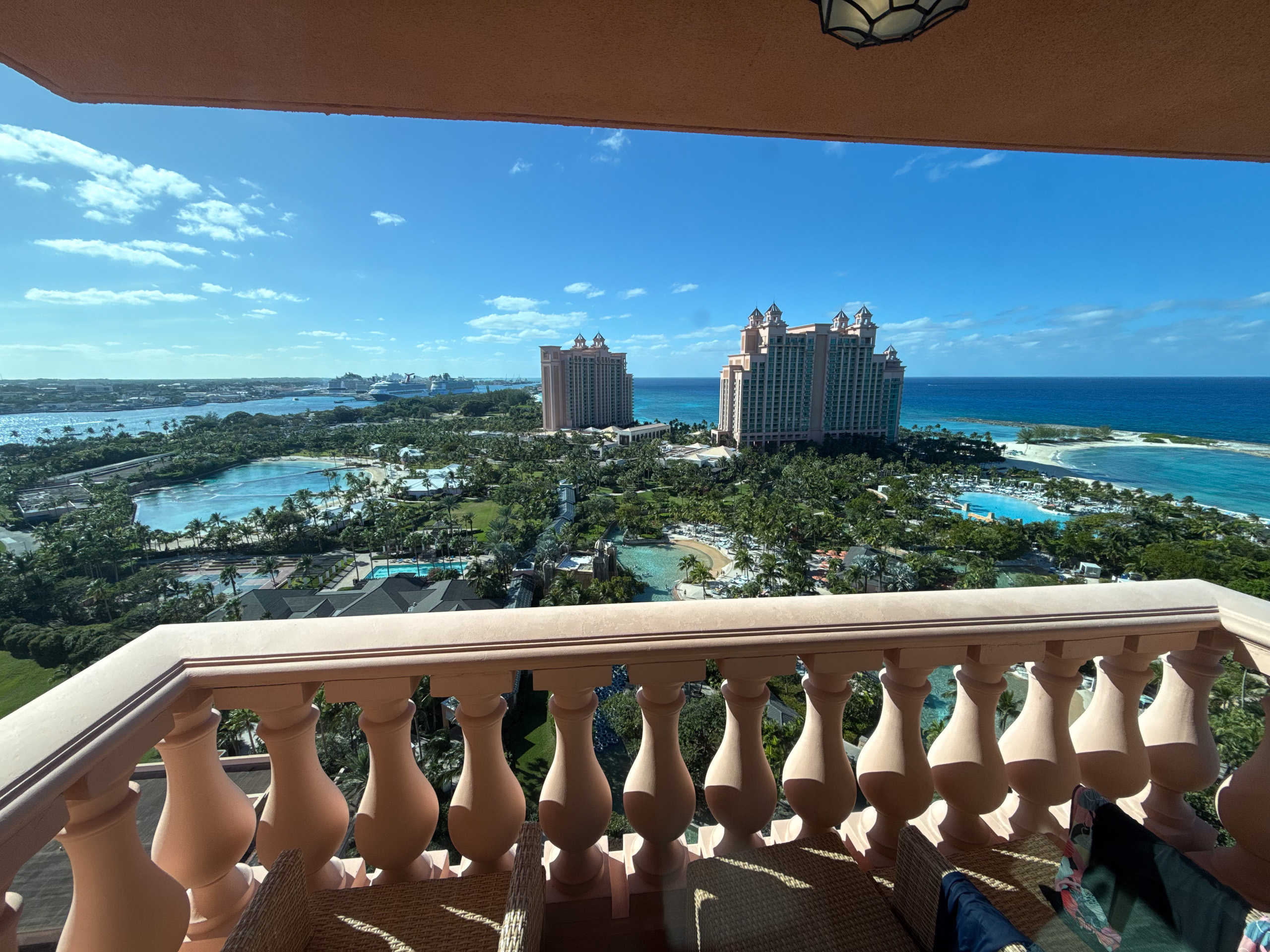
Looking down from the balcony: the pools, the palms, the harbour beyond.
The eleventh floor of the Royal does indeed provide a royal view.
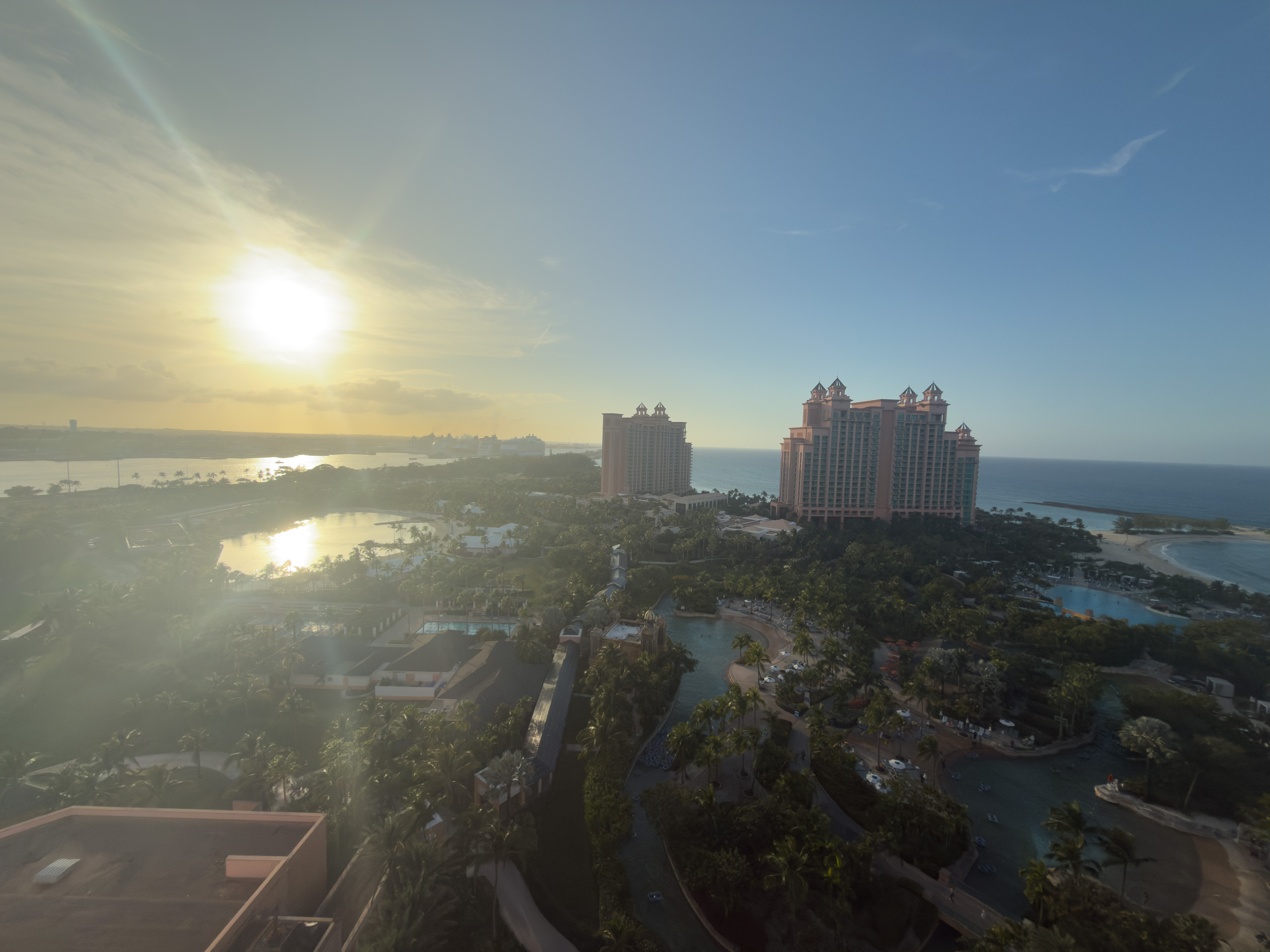
The towers through the balustrade.First morning, haze over the grounds.Nassau’s cruise ships, in port next door.
Noted
Observed on the stay, not measured.
What
Checked on the stay
Wi-Fi
Strong through the hotel; spotty on the park grounds
Air conditioning
Noisy, but not unbearable; the humidity stays under control
Water pressure
Strong
Bed
Medium, and it sleeps hot
Blackout
Mediocre curtains
Noise
The park is inaudible from the room
Eating
The food in the towers is so-so, and the best restaurants are a short walk into the casino and harbour quarter. A resort feeding this many people has every excuse to cook by the thousand, and down at the harbour the eating became one of the pleasures of the stay — across the range, from the quick and casual to the proper sit-down at night.
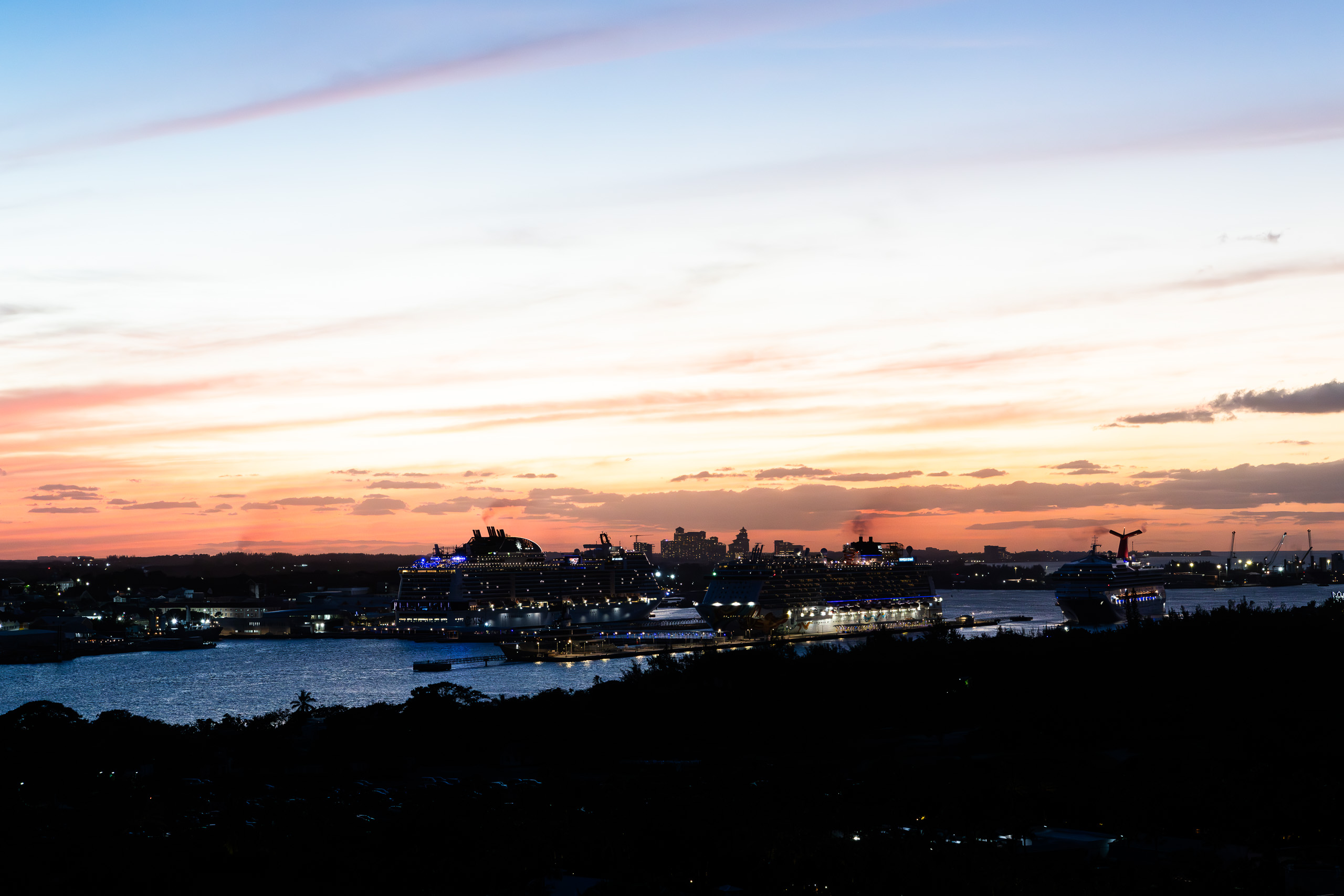
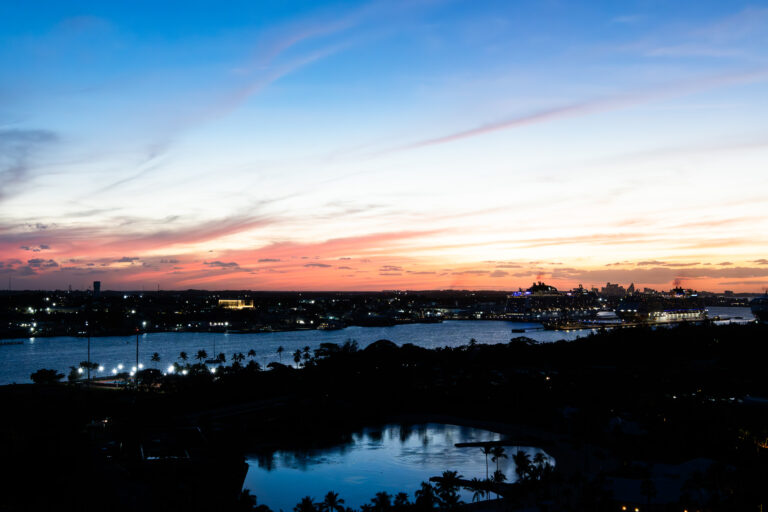
Ships on the horizon beyond the lagoon at the golden hour. The evenings here are half the meal.
The casino is the counterpoint. It could be nicer and it is getting outdated — a room the rest of the property has moved on from. Walk through it on the way to dinner and you will not miss anything by not walking back.
The park is the reason
Aquaventure is the best thing of its kind on earth, and it is not close. The river alone would justify the trip: hours of current, rapids and conveyors carrying you through the grounds, past rock and under bridges, with the towers turning overhead. I went in alone. On the river I fell in with another guest travelling solo, and we rode the tubes together for hours — the park is like that; it dissolves the awkwardness of adults on inner tubes by making everyone an adult on an inner tube.
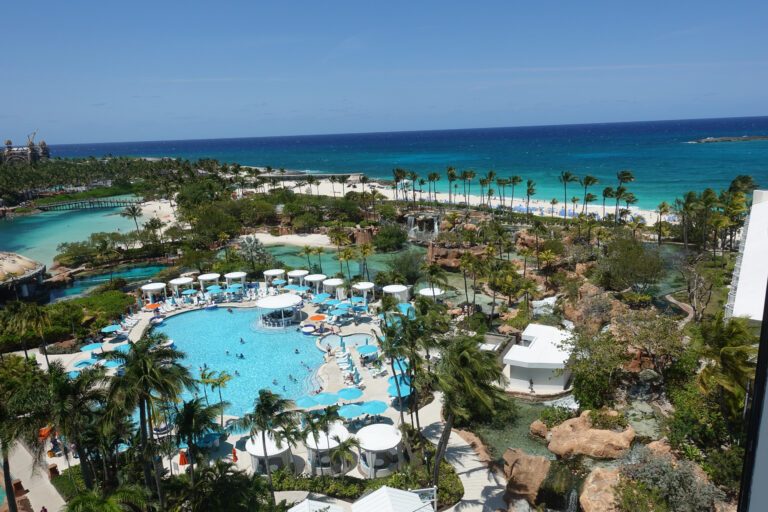
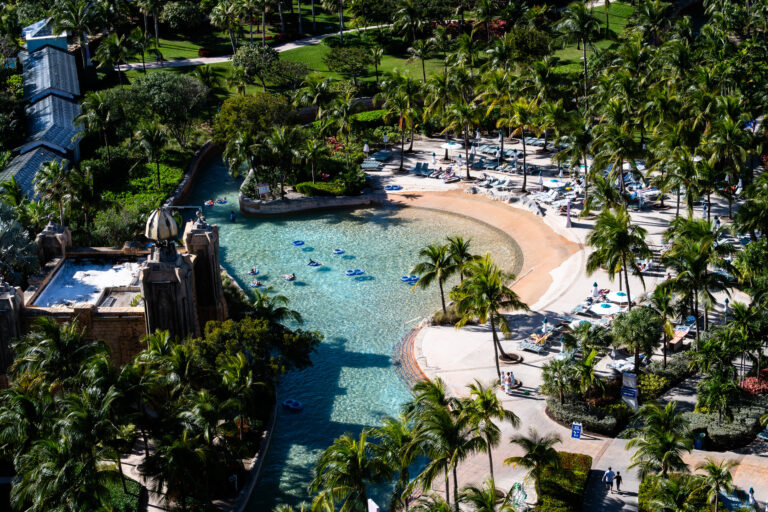
The main pool ringed with cabanas, from a high floor. The river runs somewhere under all of it.
A word of caution earned the hard way: if you are long of leg, mind the slides. The flumes have their nooks and crannies, and a tall frame can catch in one, spin you sideways, and hand you a bruise or worse. Keep the ankles crossed and the elbows in, and read the slide before you ride it.
Under the slide tower.The swimming lagoon and its buoy line.Fountains on the quiet pool.
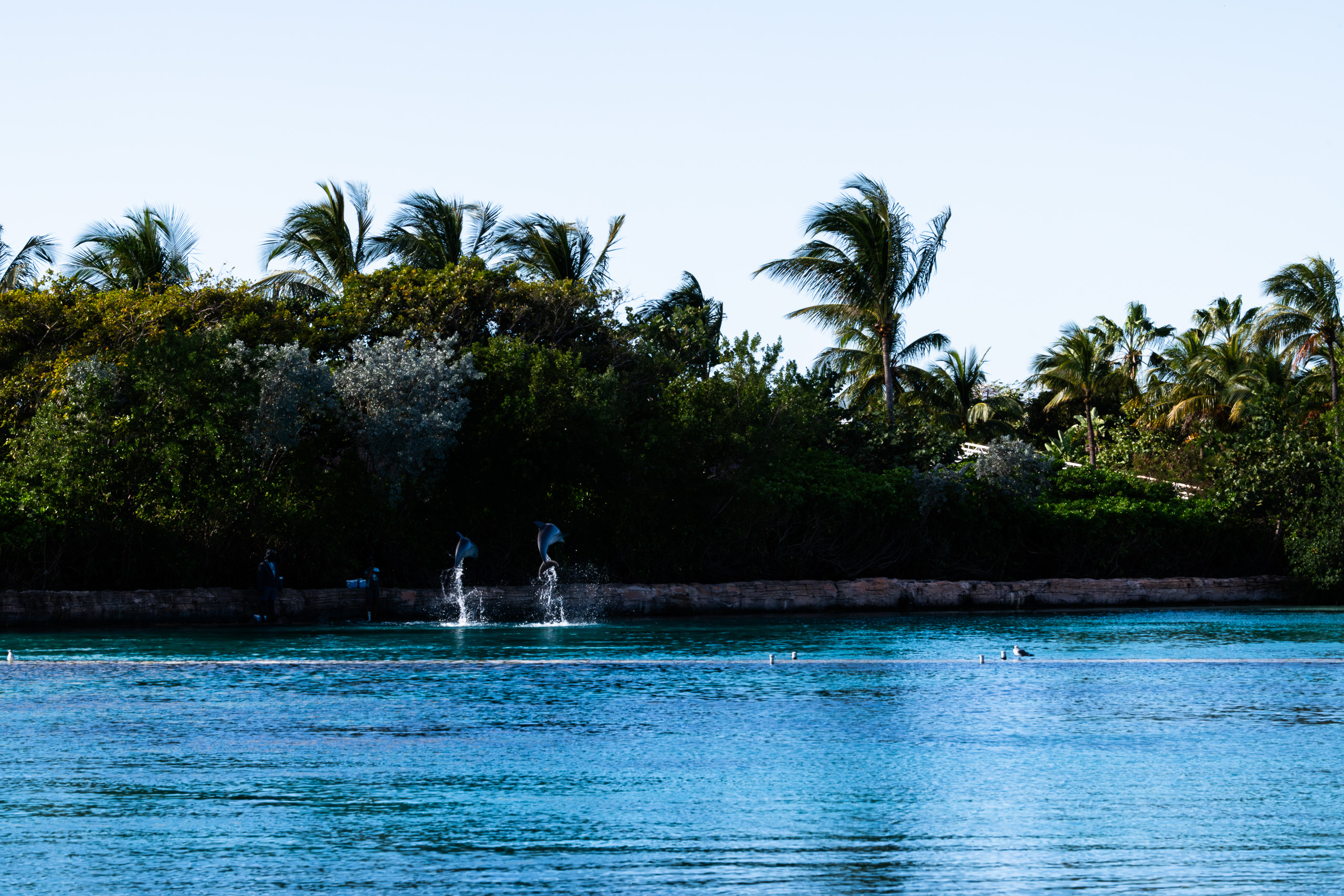
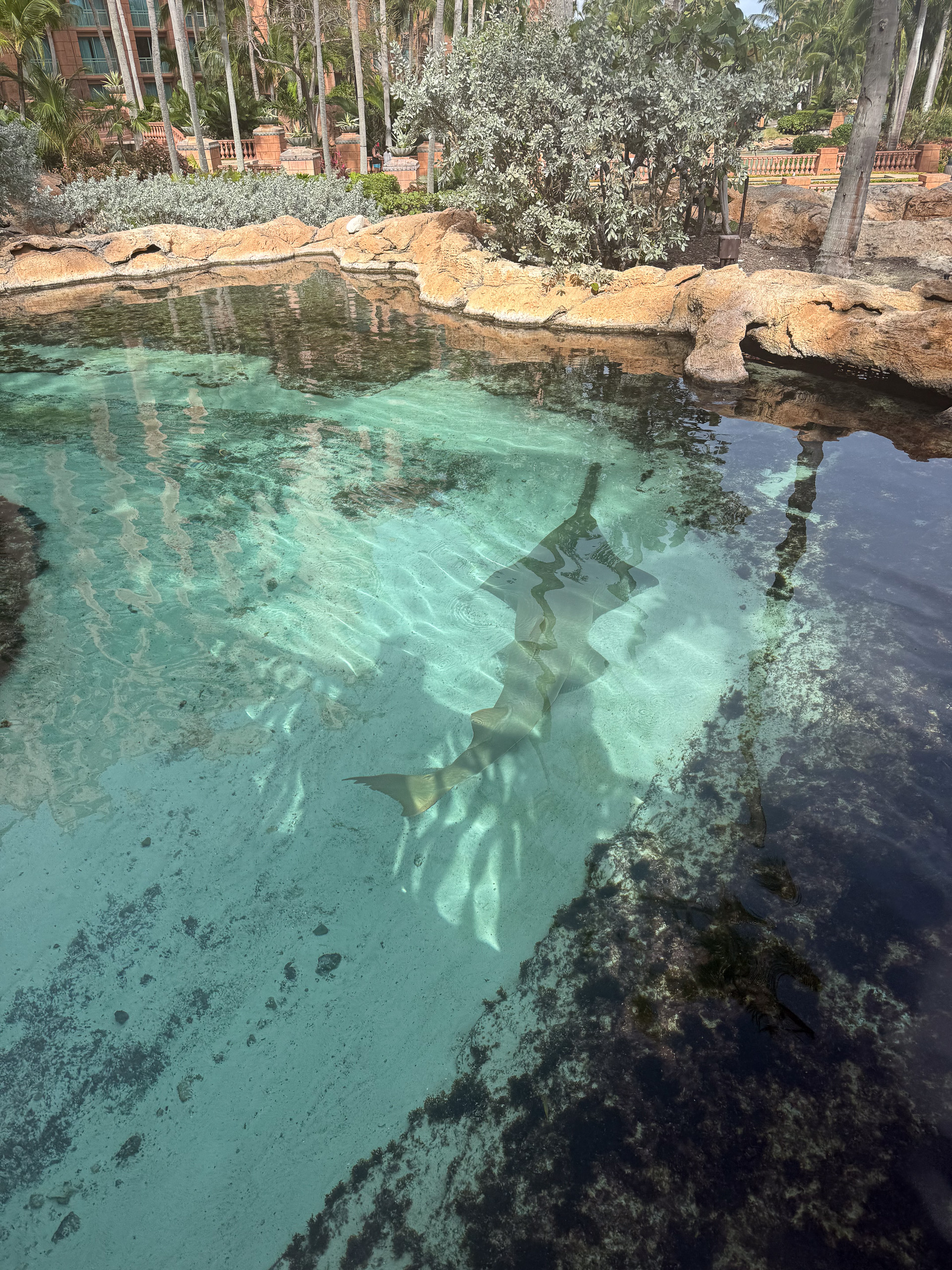
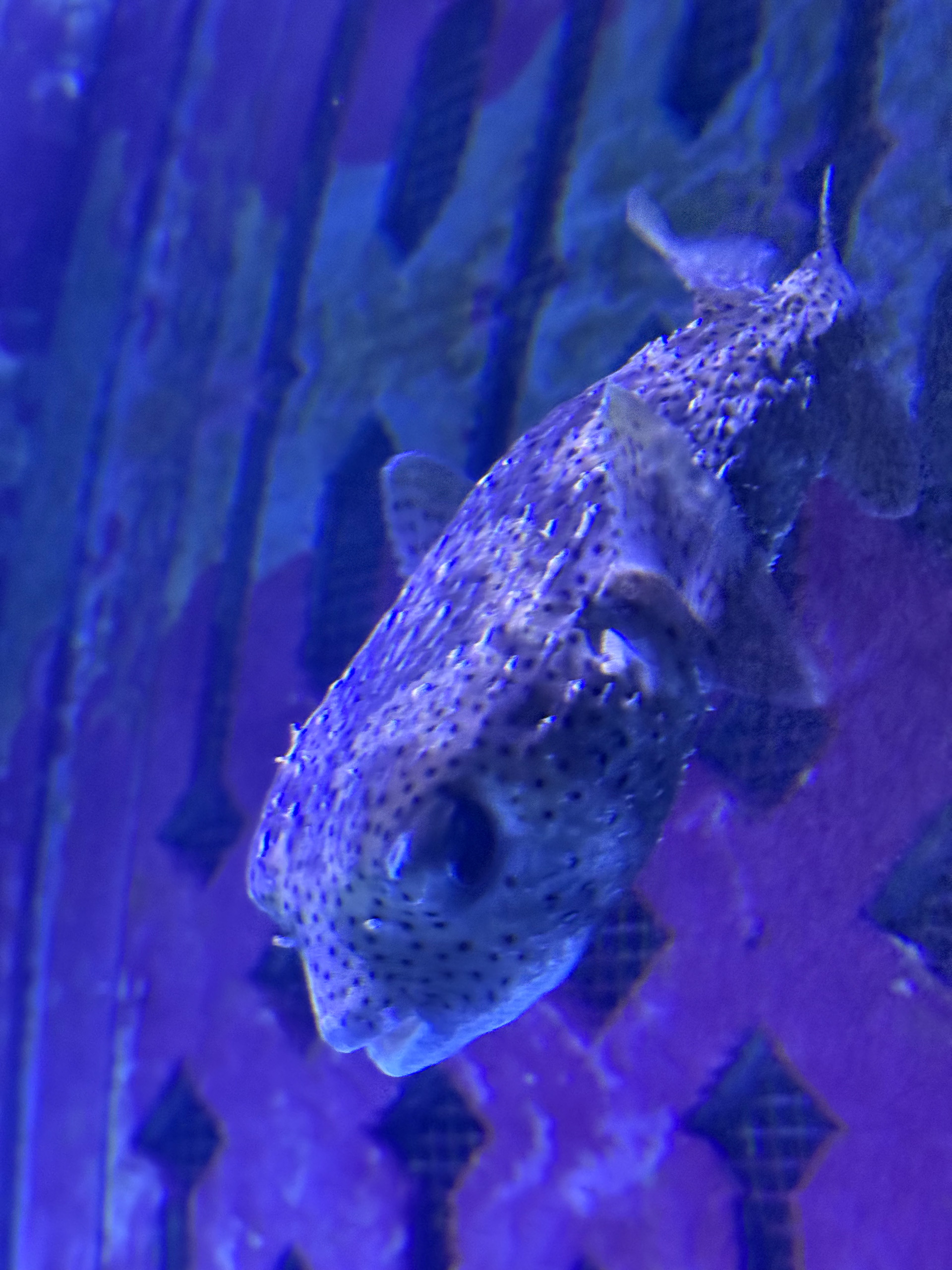
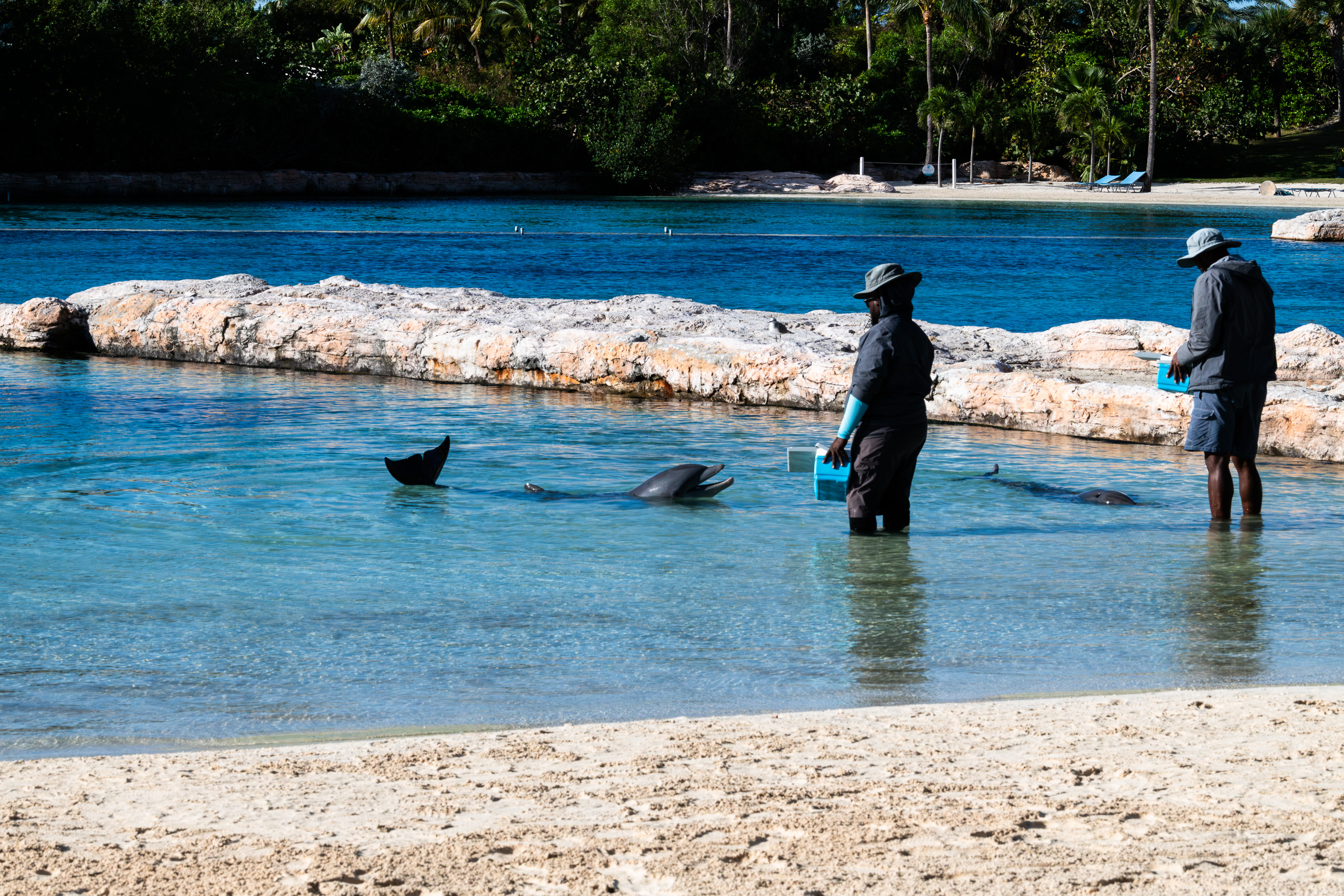
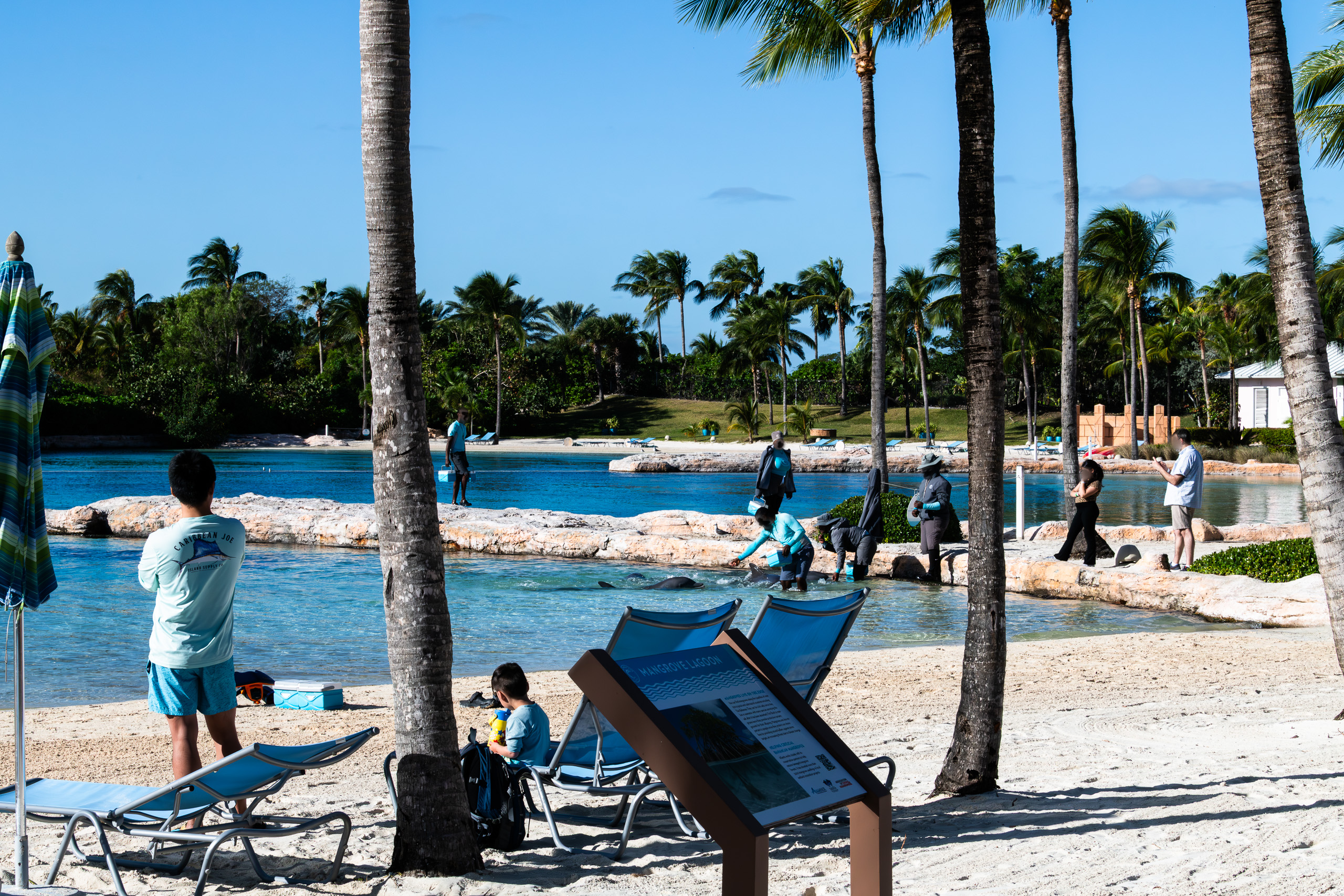
Below the towers, The Dig runs violet and silent, the fish drifting past glass a child’s face is usually pressed against. Outside, the water clears over rock in the predator lagoons and dark shapes patrol it; the famous slide drops you through that water in a clear tube, which is either the argument for the place or against it, depending on the family. Dolphin Cay holds the far lagoon, trainers standing in the shallows with their pupils alongside.
Clear water over rock in a predator lagoon, dark shapes patrolling. The famous slide drops through this in a clear tube.
Families abound here and all of them are smiling — I did not see a single child bored — and this is, first and last, the great family resort of the hemisphere.
The Dig, running violet and silent.Dolphin Cay: a trainer in the shallows, pupils alongside.The honeycomb of the pens from above.
Service moments
You do not come to Atlantis for the service, and once that is said, the place is honest about the deal. The desk is slow; the floors are staffed for volume, not for names; nobody is going to learn your coffee order. What they do instead — the grounds, the water, the animals, the sheer mad completeness of the idea — they do like nowhere else on the planet, and no butler has ever handed me a shark lagoon.
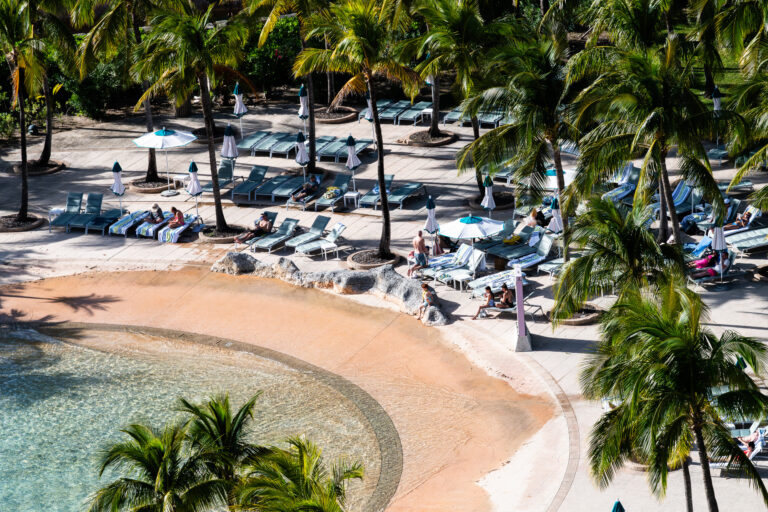
The lagoon beach filling in under the palms. Staffed for volume, not for names — and the volume is the point.
Who it is for, and who it is not
Come with a family, first and always: there is no resort in this hemisphere that does more for one, and the smiles on the grounds are not an accident. Come alone too, which nobody says out loud: the park makes company by the afternoon, and the evenings on the lagoons are better than a solo traveller has any right to expect. Start the river early, before the queues, and take the last light on the west-facing rail.
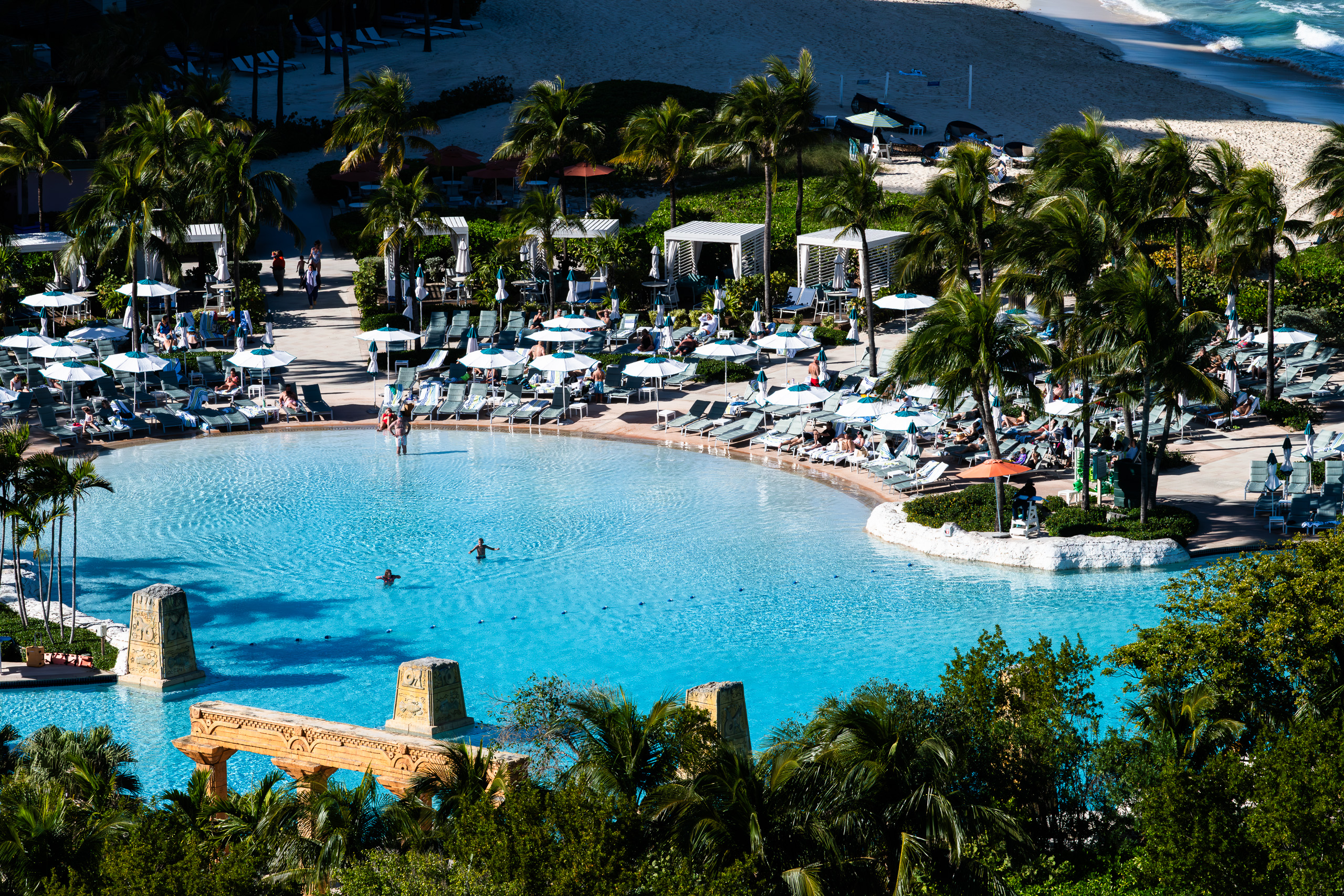
The mouth of the lagoon: the spit of beach, then the two blues of the Atlantic.
Look elsewhere if service is the product you are buying — the desk is not five stars and does not pretend hard — or if a quiet pool and a book is the whole plan. This is a park with towers on it, at a volume that never fully sleeps. That is not the catch. That is the offer.
It is a MUST SEE before you die. I mean that literally: it belongs on the list.
The cruise ships depart in silhouette at the last orange of the day. Go before you die.
Bottom line
What Atlantis does right it does like nowhere else on earth, and front desk quickness is not on the list. Go for the park and the grounds — it really is a wonder of the world — and keep your elbows in on the slides!
Sapodilla Bay: Where a Villa Is Not the Better Option, It Is the Only One
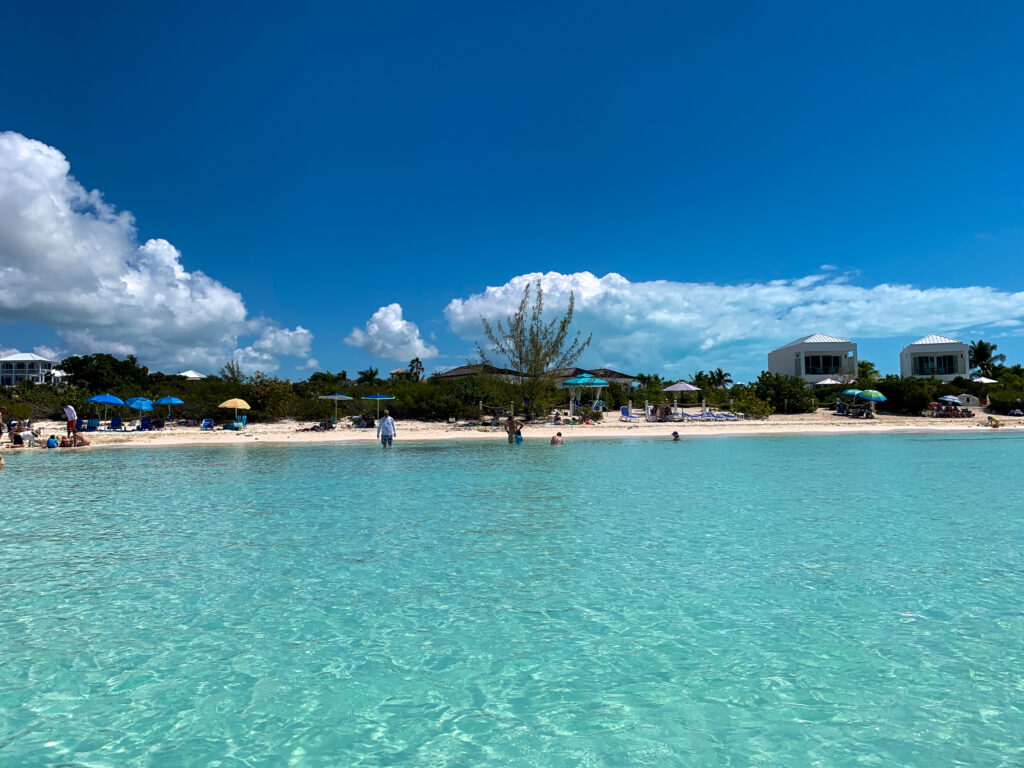
Ten miles from Grace Bay, the south coast of Providenciales has no resorts, no beach service and no restrooms, and about four feet of water for a hundred yards.
Where high ground in the southwest corner of Providenciales, looking down over shallow water. Not on the sand
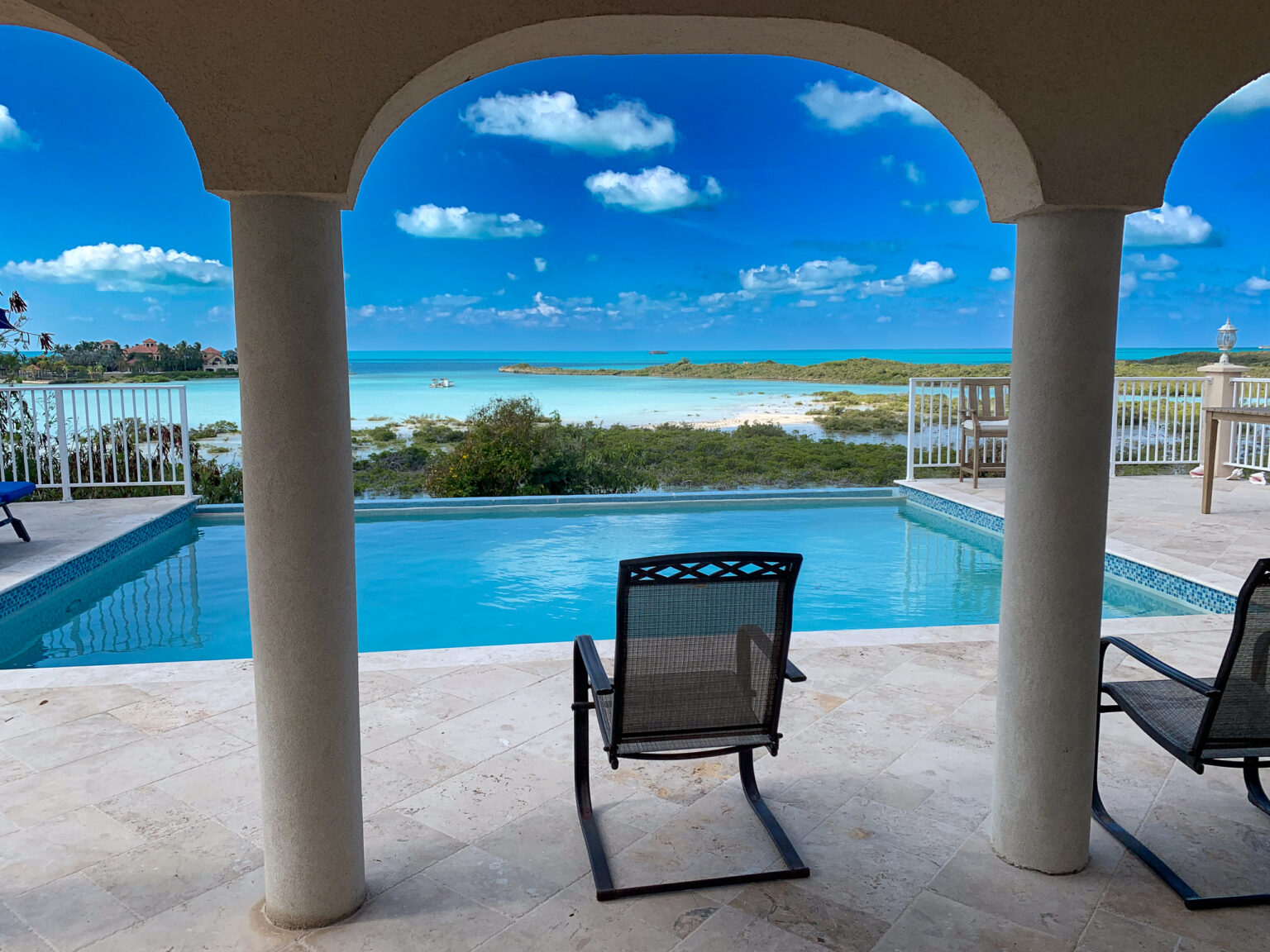
The house two storeys in cream stucco under a white standing-seam roof, an arched colonnade the length of the ground floor, a first-floor balcony behind white timber balustrades
Outside a long rectangular pool with a mosaic waterline on a travertine deck, and a raised side terrace with a bar-height table and a red parasol
The beach Sapodilla Bay, down the hill and reached by car
How it was booked Direct with the villa’s managing agent
Every stay on this site is booked the way any other guest would book it.
Drive southwest out of the Grace Bay strip and Providenciales empties in about a quarter of an hour. The hotels stop. The roundabouts stop. The road climbs a low ridge over salt flats, scrub and standing water so bright it looks like an error in the photographs, and somewhere up there is the house you have rented, because on this side of the island there is nothing else to rent. Sapodilla Bay has no hotels on it. Not a small one, not a discreet one. None.
The lie of the land
Where the southwest corner of Providenciales, ten miles from Grace Bay and ten to fifteen minutes from the airport, nearer to arrivals than the resort strip is
Three places, not one Sapodilla Bay and Taylor Bay are separate sheltered beaches a headland apart on the south coast. Chalk Sound, the islet-studded lagoon behind them, is a national park and a different body of water again
The beach 900 feet of very fine white sand facing the Caicos Bank. Public, free to park, and with no lifeguards, no restrooms and no beach service of any kind
Where you sleep there is no hotel on this bay. The frontage and the ridge behind it are private houses, from one-bedroom cottages to nine-bedroom estates
Three places, one corner of the island
Get the geography straight before you book anything, because almost everybody gets it wrong. Sapodilla Bay is a 900-foot cove on the south coast. Taylor Bay is a separate beach, roughly 2,000 feet long, one headland to the west. Chalk Sound is neither: it is an inland lagoon three miles long, a national park, only a few metres deep at its deepest and studded with hundreds of small rocky islets, nearly every vegetated one of which has rock iguanas living on it. A winding channel joins the lagoon to the sea, motorboats are not allowed in it, and you do not swim in it from a beach: the bottom is clay-like and unpleasant underfoot. The three together are the island’s southwest corner, and villa listings use all three names more or less interchangeably. They are not interchangeable.
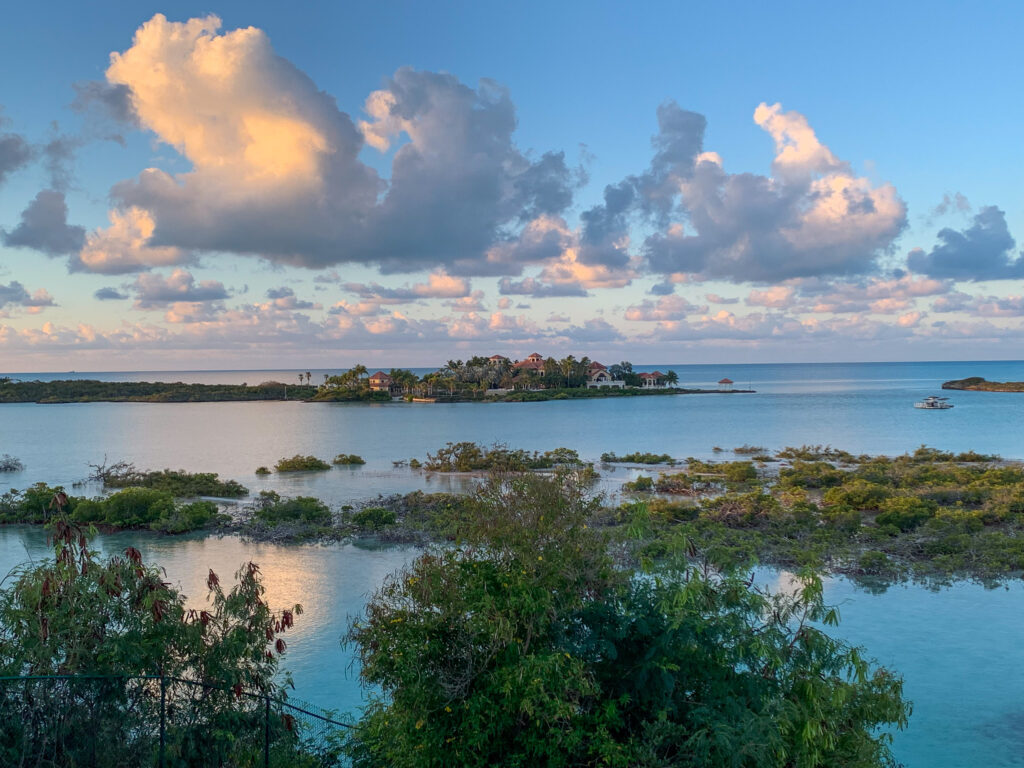
From the ridge: sand bars, low scrub islets, a neighbouring estate on a point, and the open sea beyond it. Nothing in the middle distance is more than a few feet deep.
What makes this side of the island feel like a different country from Grace Bay is not the development, or the lack of it. It is what the water is sitting on. Grace Bay faces the Atlantic across a barrier reef about a mile offshore, and has the deep, clean, swimmable floor that goes with it. Sapodilla Bay faces the Caicos Bank, some 1,700 square miles of shallow marine shelf that is nowhere deep. One coast has swell and the other has none. The sand follows the same logic: the grains here have travelled a long way across the bank to arrive, and they are worn to something closer to silt than to sand. It is fine enough to feel powdery underfoot and fine enough to hang in the water when a crowd stirs it up.
The consequences all point the same way. The water is warmer than the north coast, because a shallow sheet in full sun heats up and a deep one does not, and waves are essentially a hurricane-season phenomenon, June to November. The airport is also closer than it is from Grace Bay, five or six miles and ten to fifteen minutes, which on a day with small children and a late flight is worth more than it sounds.
The house is above the water, not on it
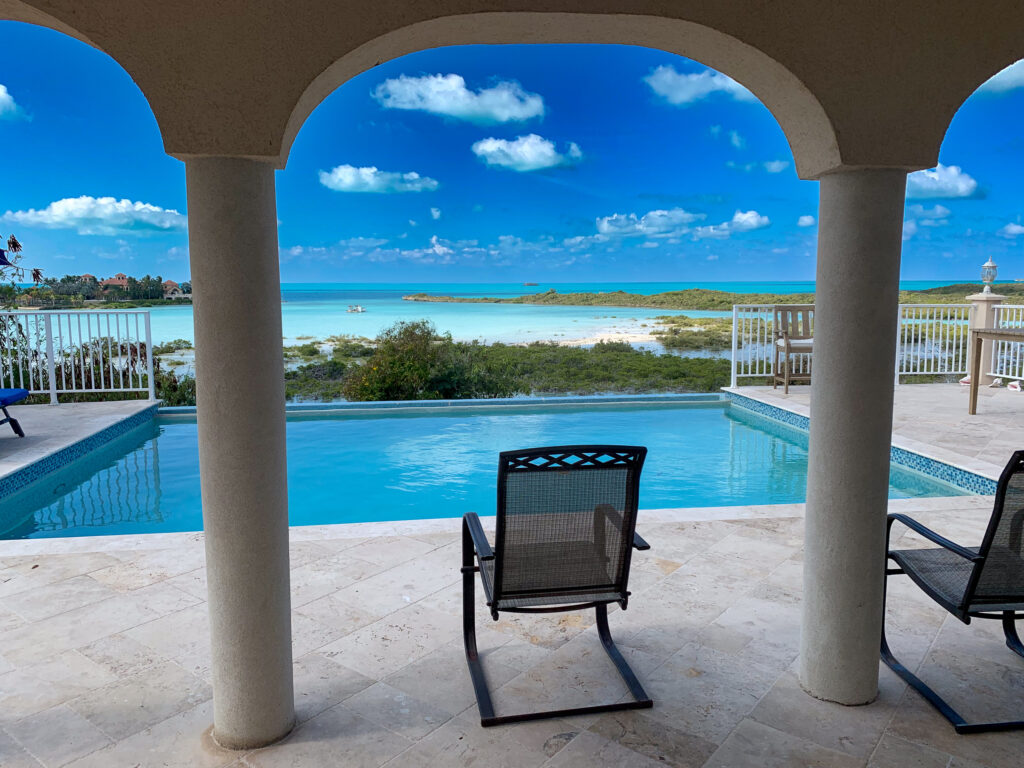
This is the thing the listings are least clear about, and it changes the shape of the week. The houses on this side are not, for the most part, beachfront in the sense a Grace Bay resort is beachfront. They are on rising ground behind and above the shallows, and what they sell you is the view down onto them. Every frame I have of this house looks down: the pool deck, the railing, then a drop through scrub to sand flats and standing water, then a low green point with somebody else’s red-tiled roof on it, then the sea.
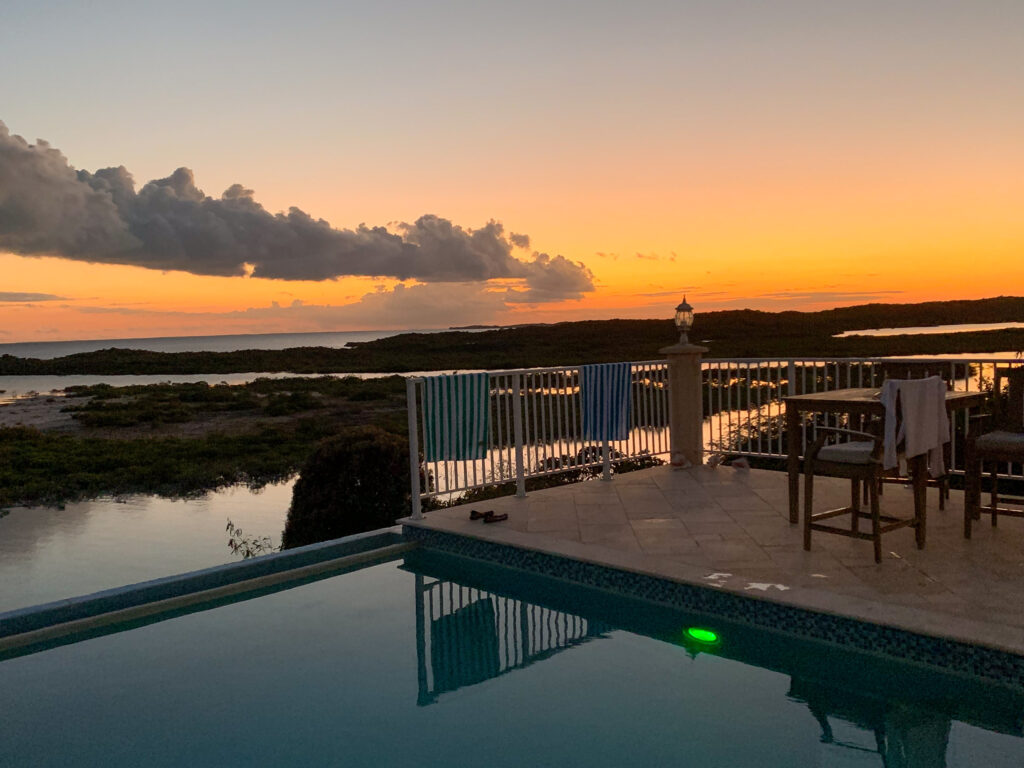
The terrace at the end of the day. Towels on the rail, two stools at a bar-height table, and the whole width of the flats going orange.
The house itself is unmistakably a house rather than a resort unit: two storeys of cream stucco, a white metal roof, an arched colonnade running the full length of the ground floor and a balcony above it behind white timber balustrades. French doors on both levels. A long rectangular pool with a mosaic waterline tile, set on a travertine deck wide enough that nobody has to walk behind anybody’s lounger. A raised terrace to one side carries a bar-height table, stools and a red parasol. There is a barbecue. There is a hose. It is somebody’s actual house, let out.
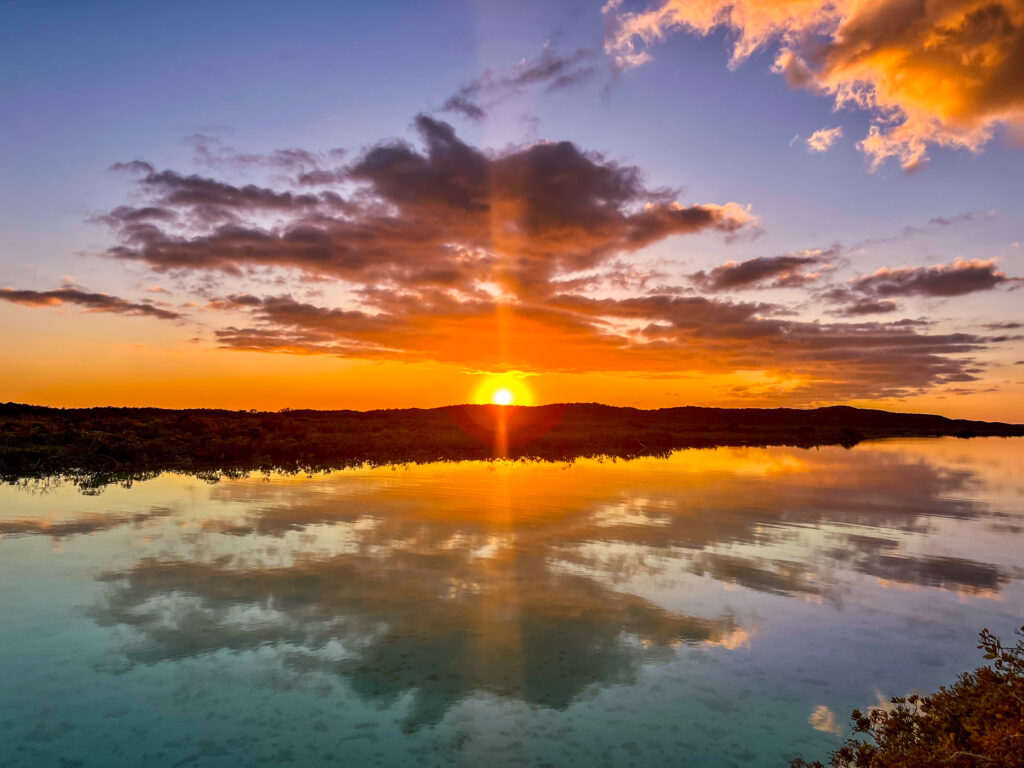
Elevation is the product, and it is worth knowing what you trade for it. You lose walking out of the bedroom onto sand. You gain most of the sky, which on this coast is the better half of the bargain: the flats hold a mirror-flat film of water at nearly any state of the tide, so the sunset arrives twice, once overhead and once upside down below you. Two of the best frames in the set were taken from a bar stool without anyone standing up.
The beach below
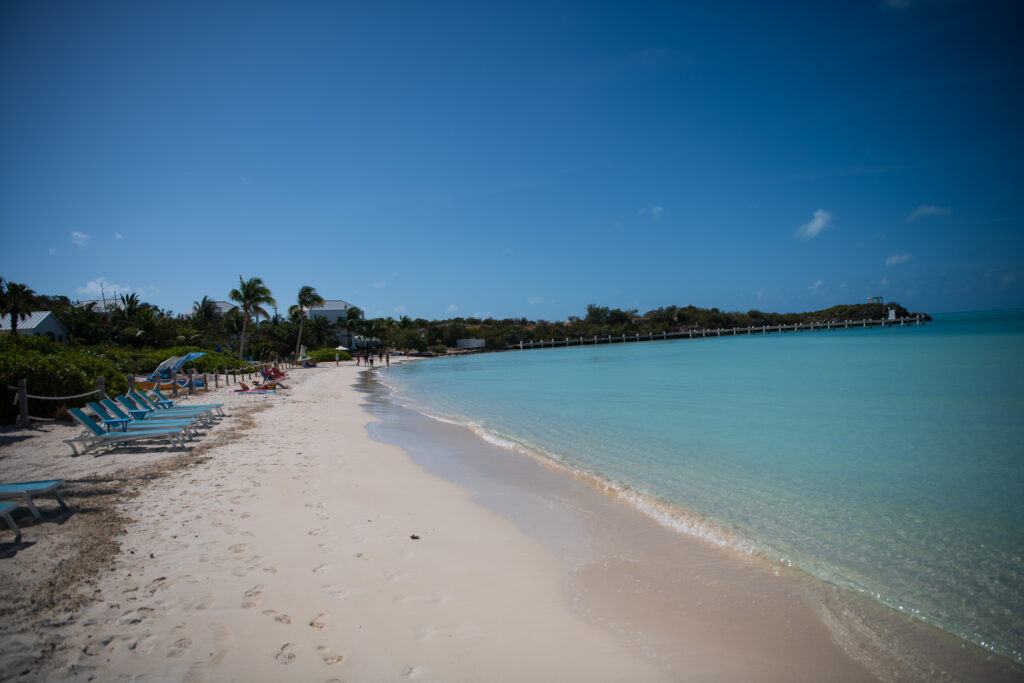
Sapodilla Bay is small. Nine hundred feet, end to end. You can walk its whole length in the time it takes to decide where to put the towel. There are two ways in, both free and both unpaved: a southern approach by Sapodilla Hill and a northern one off Chalk Sound Drive, where the parking is dirt, the curbs are unfriendly to a low rental car, and the path to the sand is a sandy scramble through the scrub. There is no gate, no attendant and no ticket. It is a public beach in the fullest sense.
The bay early, before the loungers fill: a shallow curve of very fine sand, and the timber pier running out to the rocky point that closes the eastern end.
A timber pier runs out from the eastern end towards a low rocky headland. The ridge above it is a little over fifty feet high and carries something truly old: carvings cut into the rock by ships’ crews and shipwrecked sailors between the mid-1700s and well into the 1800s. It is a short climb on a path that is loose, slippery and better done in shoes than flip-flops, and it is the only place on this coast where you see the whole arrangement at once, including the thing no listing mentions, which is that the country’s main cargo port sits immediately over the ridge to the east.
The bay is a working anchorage as well as a beach. Sailboats and small yachts lie off it, and with no lifeguards the standing advice is to watch for boats rather than for surf. Snorkelling is thin: small schools, the occasional ray or turtle near the pier. There is a wreck offshore, but it is a twenty-minute swim with fins and not a casual one.
Nobody is swimming
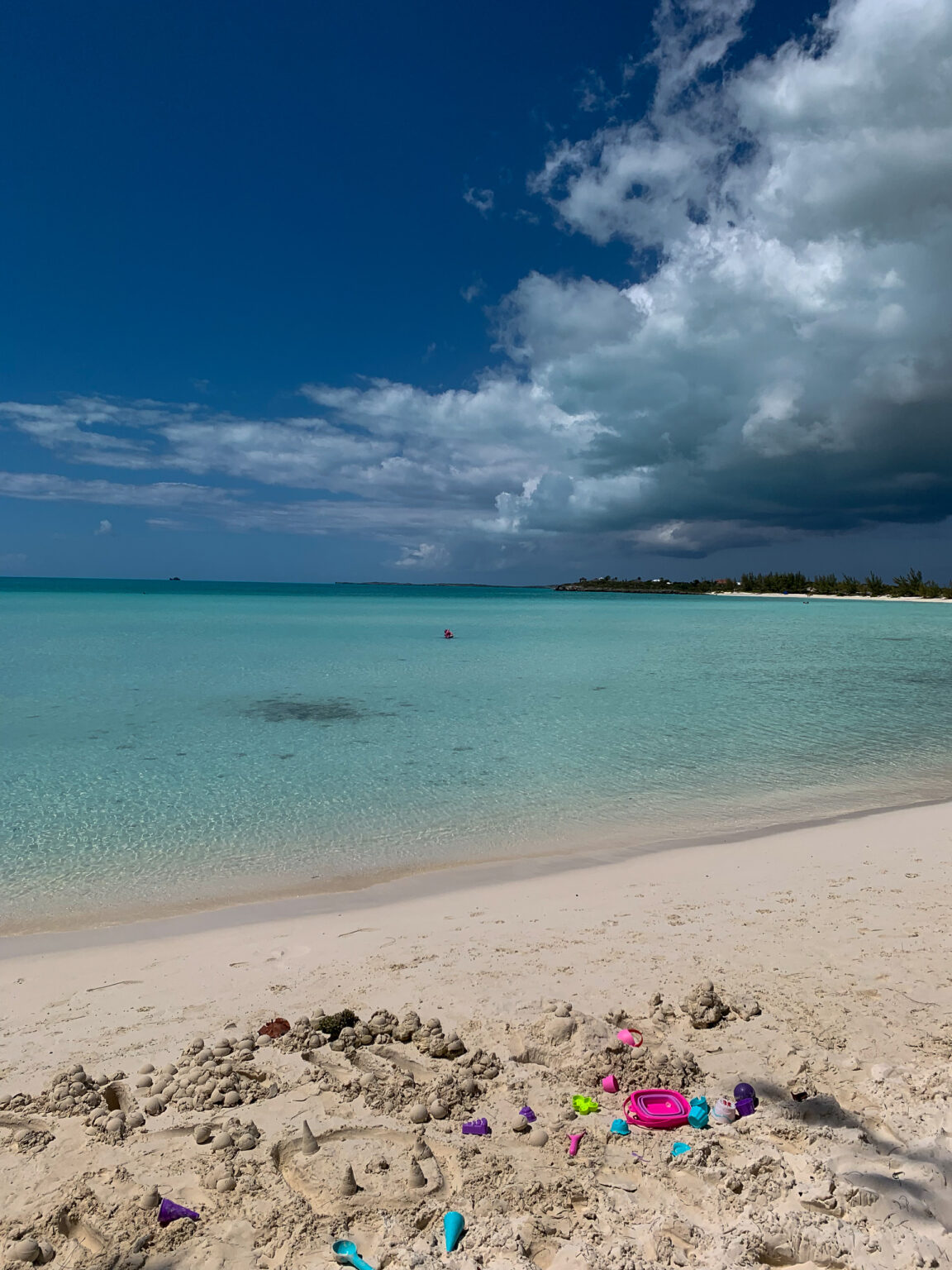
Look at any wide frame of the water and count the heads. Everybody is standing up. The bay rarely gets above about four feet deep for the first hundred yards, which means the wade out to a depth where you can actually float is longer than the beach is wide. People walk out until they are the size of a thumbnail and they are still only wet to the ribs. If your idea of a beach involves swimming, proper swimming with arms over and going somewhere, this is not that beach, and no amount of turquoise fixes it.
A hundred yards out and still waist-deep. This is the single most useful photograph in the set: it tells you what kind of week you are booking.
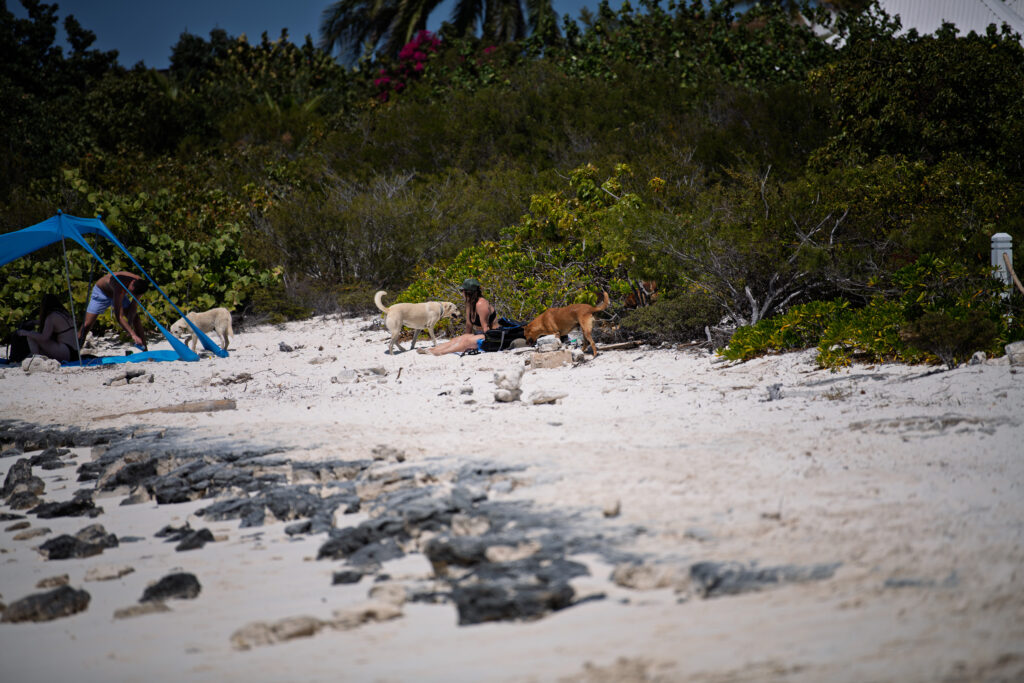
The same fact is the reason to come. Warm, glassy, ankle-to-waist water with no current and no undertow, over a floor of fine pale sand, is about as safe as a sea gets for a four-year-old, and this is one of the safest beaches in the country for exactly that reason. The evidence in the photographs is entirely domestic: a starfish lifted out of six inches of water and put back, a collapsed sandcastle with the plastic moulds still where they were dropped, somebody’s dog trotting the tideline. Nothing dramatic happens here. That is the offer.
Two practical caveats the pictures also carry. Parts of the entry are not sand at all but a low shelf of grey limestone at the waterline, sharp enough that water shoes are the difference between a good morning and a bad one. And the timber pier gets properly scalding underfoot by midday.
The counter-argument
Nothing about this side of the island is difficult. It is just that everything is a drive. The lavatory, the coffee, the bag of ice, and you have signed up to be the one who drives.
Start with the lavatory, because it is the one nobody plans for. There are no restrooms on Sapodilla Bay. Not at either car park, not at either end of the sand. The nearest is a terrace restaurant on Chalk Sound Drive, about a minute away by car, which is fine once and tiresome by the fourth time on a beach day with children. It is also, incidentally, the only place within sight of the beach where somebody will bring you a drink.
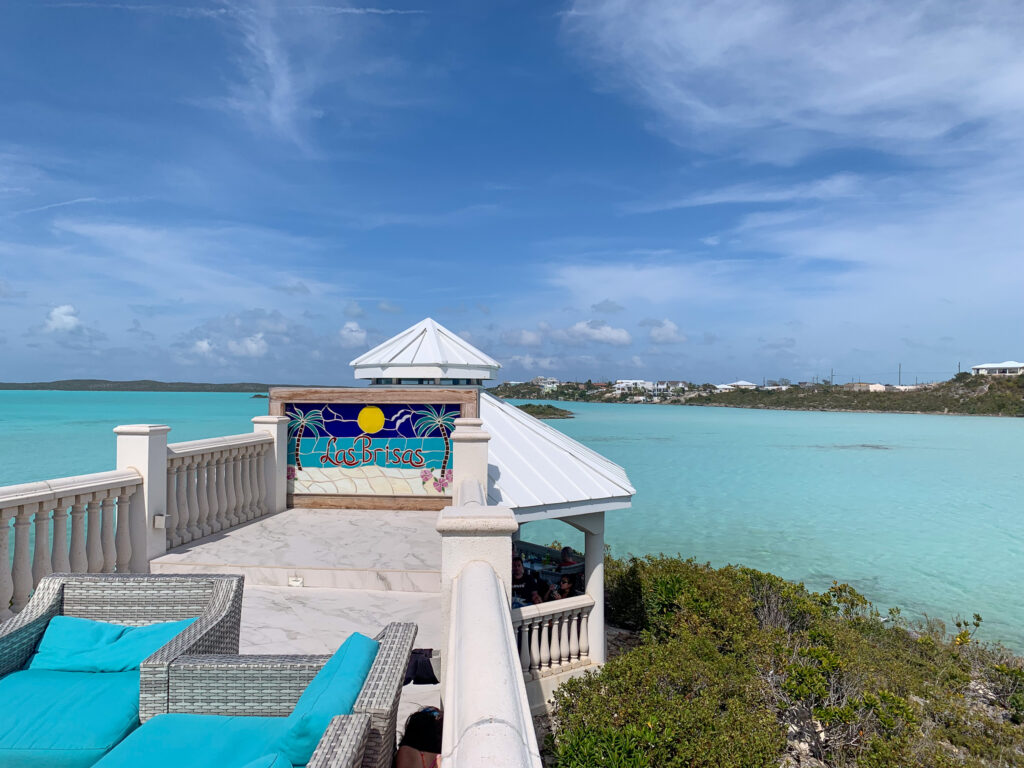
The high ground above the lagoon, where the nearest tables to the beach are, and the nearest lavatory to it as well.
A rental car is not a convenience here, it is a condition of the booking. There is no restaurant within walking distance of the villas, no beach bar, no water-sports desk and no supermarket around the corner. You drive to every meal you do not cook, and you cook a lot, which brings you to the surprise nobody plans for: island groceries are imported, and the till shows it — provision for a week of eight with your eyes open.
Then there is the beach itself, which is public and behaves like it. By late morning the pier end is a row of rental loungers and umbrellas, a jet-ski stand that smells of two-stroke, a speaker, and somebody walking the sand asking whether you want anything. Nine hundred feet is not much sand to spread that across. There is litter at the top of the beach often enough to be worth a bag in the car, and with no restrooms anywhere near it, the very shallow water takes the consequences of that on a busy afternoon. This is not a private beach attached to your villa. It is the local beach, and you are on it.
Looking back from the shallows on a busy day: a solid line of rented shade along 900 feet of sand, and the houses of the ridge behind it.
And nothing is included unless the listing says it is. The word “villa” covers a house with a pool and a set of keys and a house with a housekeeper and a butler already in it, and the listing tells you which only if you read past the bedroom count. Assume self-catering, assume you are doing your own laundry, assume the transfer is yours to arrange, and be pleased when any of that turns out to be wrong.
The limestone shelf that runs through part of the waterline. It is the reason to pack water shoes, and it is not mentioned anywhere in a listing.
Know before you go
Book the car before the house: on this coast it is the load-bearing reservation, and a low-slung compact will resent the dirt parking at both beach approaches. Pack water shoes for everyone, for the limestone at the waterline and for the pier. Expect to rent shade rather than have it brought: two loungers and an umbrella can be had for the day from the vendors at the pier end, and there is nothing else on offer.
Go down to the sand early, before the loungers and the jet skis arrive, and take the middle of the day back up to the pool, which is what the ridge houses are for. Check what your particular villa actually includes before you assume it; kayaks and paddleboards are common on the waterfront houses, housekeeping and a chef are not standard, and airport transfers are usually somebody’s optional extra. And if the beach ever feels too full, drive five minutes west to Taylor Bay, which is twice as long, has parking for about eight cars, and has no vendors, no loungers and no facilities whatsoever.
Room booked Riverfront Premier, king, third floor.
How it was booked Amex Fine Hotels + Resorts, public rate
What the channel bought upgrade, breakfast, late checkout, the works.
Value verdict Worth it in any season. The service is the product here, and is best in class. This hotel is my Number 1 for service worldwide.
When to go Any months. June/July are hot but less busy and we had a wonderful time indoors. Book this stay
Booked the way any other guest would book it.
Arrival
Capella runs low and wide along the east bank of the Chao Phraya, wood-panelled, set back behind tiered lawns and old trees that step down to the water. The whole plan is organised around one idea, which is that you should be able to see the river from wherever you happen to be standing, and on that it does not miss. What I did not expect, and what this review is mostly about, is that the people would be better than the building.
There are two lobbies and only one of them is yours. The first is enormous, open to anyone who wanders in off Charoen Krung, and looks over a pond towards the pool and the river. Past two reception desks is a frosted, key-carded door, and behind it is the hotel you are paying for. Nobody queues. Check-in happens sitting down, with a cold towel and a drinks menu on the table before anyone mentions a passport.
The Living Room, behind the key-carded door, and the river the whole building faces.
The Living Room is where a surprising share of the whole offer lives, and it is open from breakfast until eleven. Sparkling wine, juice, barista coffee, tea and jars of snacks all day; a tea trolley with egg cake at three; and between five and six Cin Cin Hour, with proper drinks and ya dong, the Thai herbal spirit, which is worth its weight in gold and is how I learned that “herbal” is not a promise. Ya dong is a must for every proper drinker. Cin Cin moves around the property. They will let you know.
Running through all of it are the Culturists, part butler and part concierge, one per room, around the clock. These beautiful people work in the open rather than behind a desk, they remember names, they pick up conversations from the day before. I have been looked after in a great many hotels. I have never been looked after like this. Four Seasons Sultanahmet was a close second where I swear they had someone follow me around the city when I went out alone to protect me.
The room
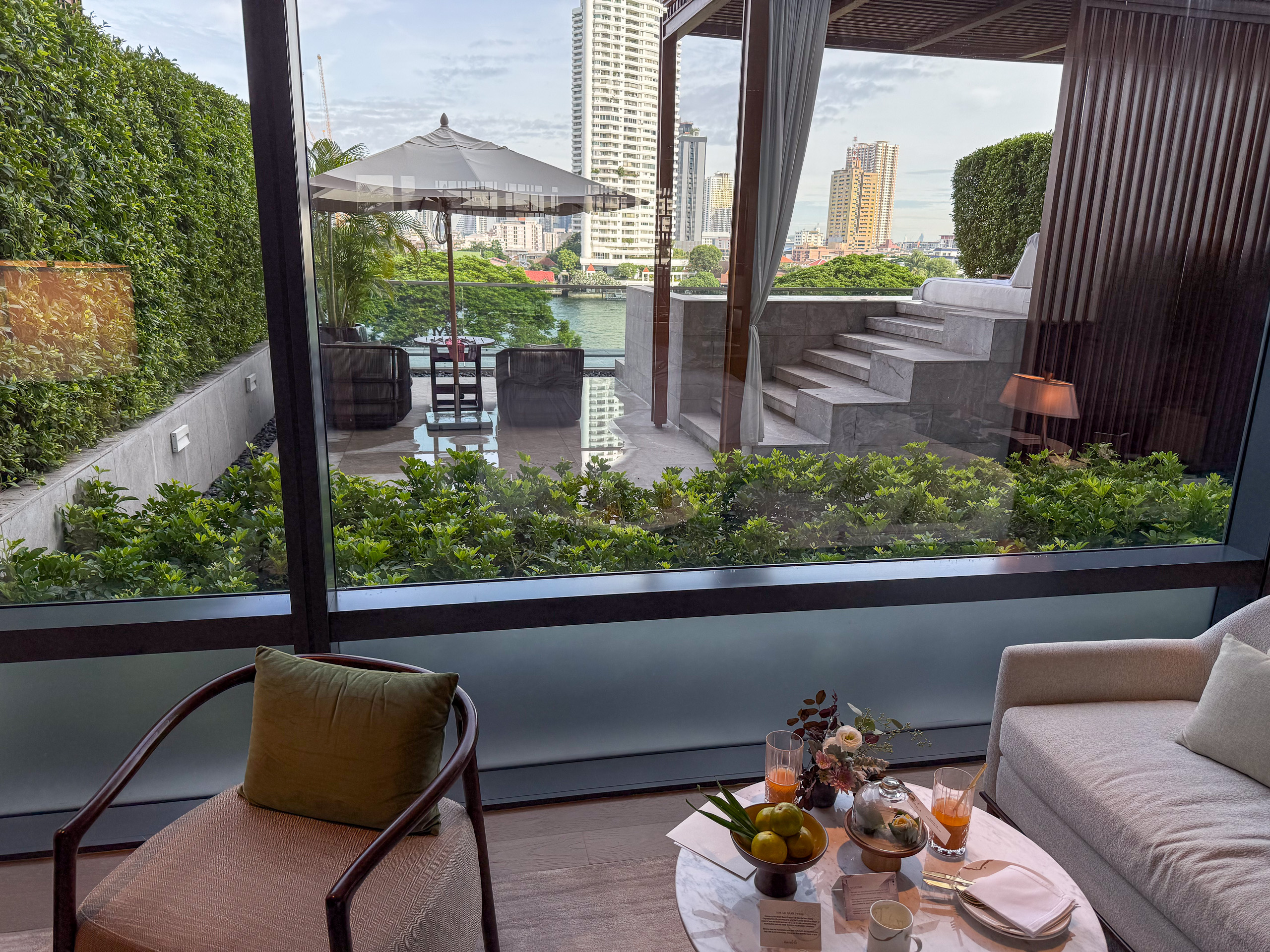
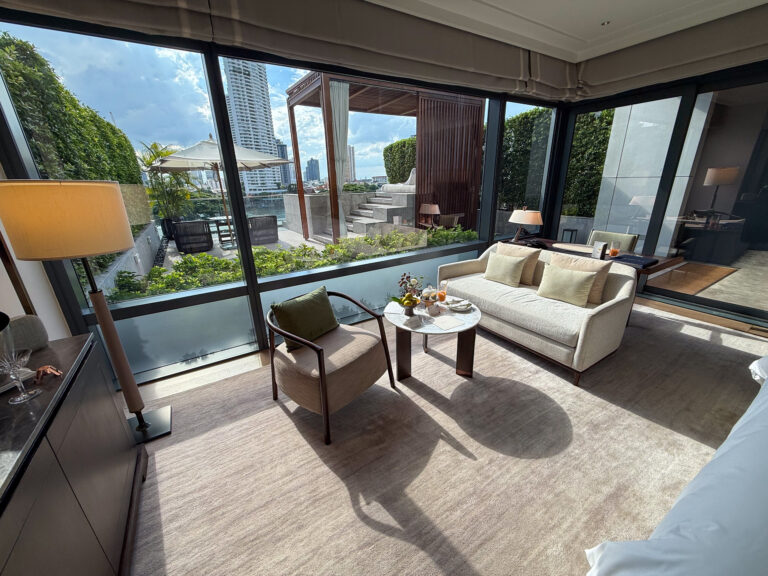
I had a Riverfront balcony with plunge pool on the third floor, which is an upgraded room on a lower floor: this room has the views you can use. This room was exceptional.
The bed faces the river. Every room in the house does.
One caveat, found at about eleven at night. Leave the slider open for more than a minute and the air conditioning switches itself off. It is an energy-saving interlock, it is entirely reasonable, and nobody tells you. I spent a warm quarter of an hour blaming the hotel before I worked out it was blaming me.
The rest is quietly clever in a way photographs never catch. A service hatch links the closet to the corridor, so laundry and pressing come and go without anyone entering the room — the best piece of design in the building, and it is a cupboard door. Bed panels run the lights and the shades. The amenity boxes, stacked side by side, reassemble an old photograph of fishermen on the river.
The river is brown. It is a working river carrying silt out of central Thailand, moody rather than postcard-blue, and if the picture in your head is turquoise, adjust it now and you will enjoy the week more. What it gives you instead is traffic: long-tail boats from six in the morning, perfectly audible with the door open and inaudible with it shut, and in the early evening karaoke boats drifting past with the volume up, which is more charming than it sounds and less charming than the singers think.
From the unmade bed, mid-stay.The tub, stone all round, being run.The terrace, and the low table for the drink.
Noted
Observed on the stay, not measured.
What
Checked on the stay
Wi-Fi
Fast and constant
Noise
Sound blocked — perfect quiet, and the air conditioning is quiet too
Bed
Medium-hard, and a true delight of a night’s sleep
Blackout curtains
Perfect dark
Lift wait
Under thirty seconds, and a concierge rides with you to ask what you need
The bath
An attendant will draw it
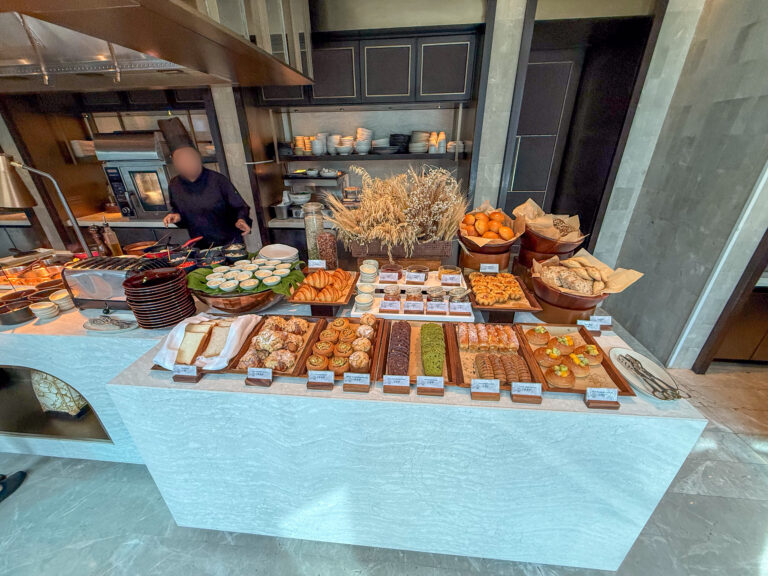
And from the same notes, the parts no table holds: water, juices, drinks, fruit and cake arrive at the room daily; flowers are everywhere; every member of staff knows your name; the happy hour is the best a hotel has ever offered us; and the sushi buffet at breakfast is a hidden gem.
Eating
I will say this carefully, because I do not say it often: the food at Capella came nearly equal to Sorn, which is the best restaurant in Thailand and which I have written up separately. That is not a sentence I expected to write about a hotel dining room.
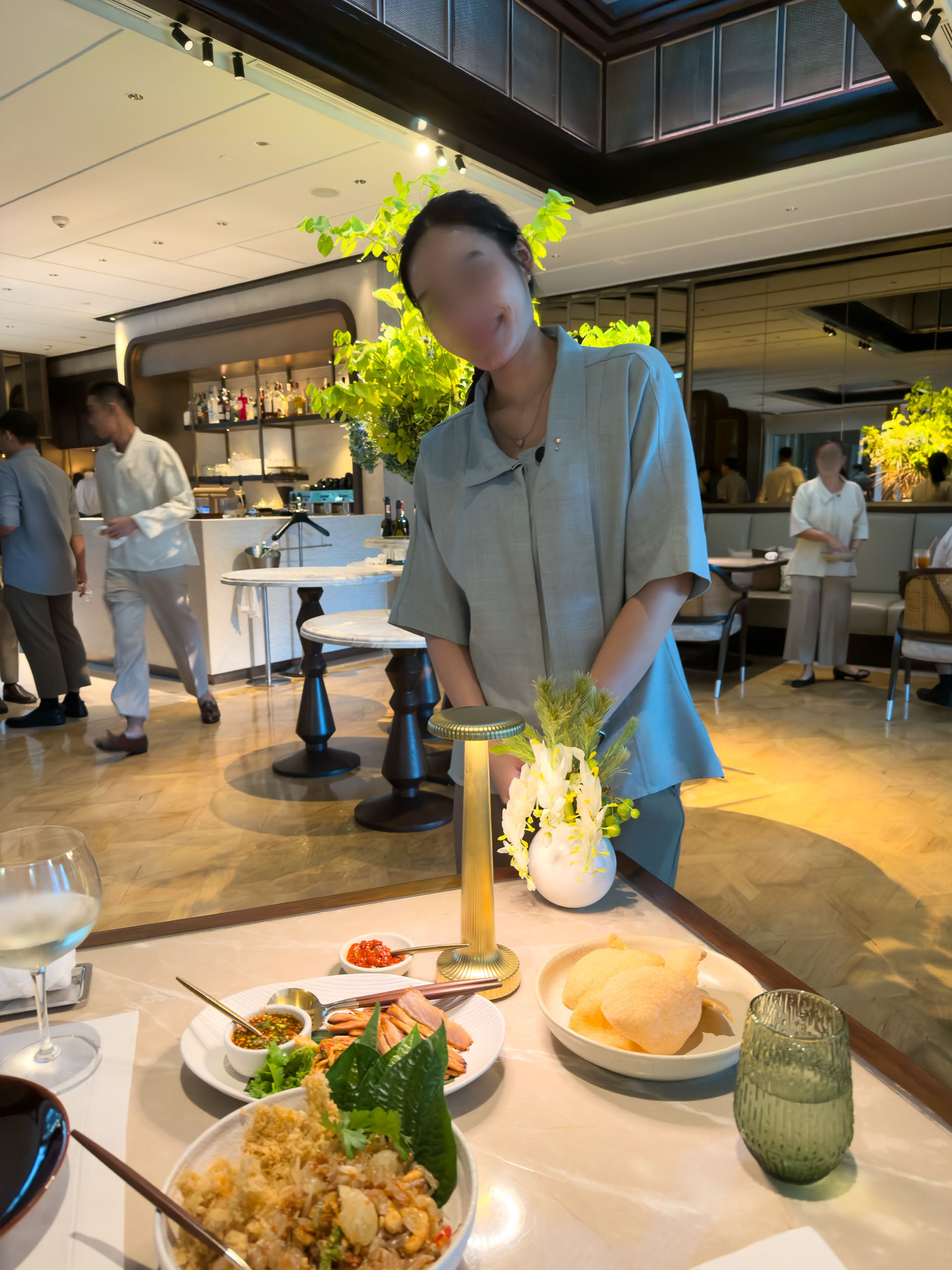
Phra Nakhon’s open counter. Chef Kannika cooks to order here, and by the second night it was perfection.
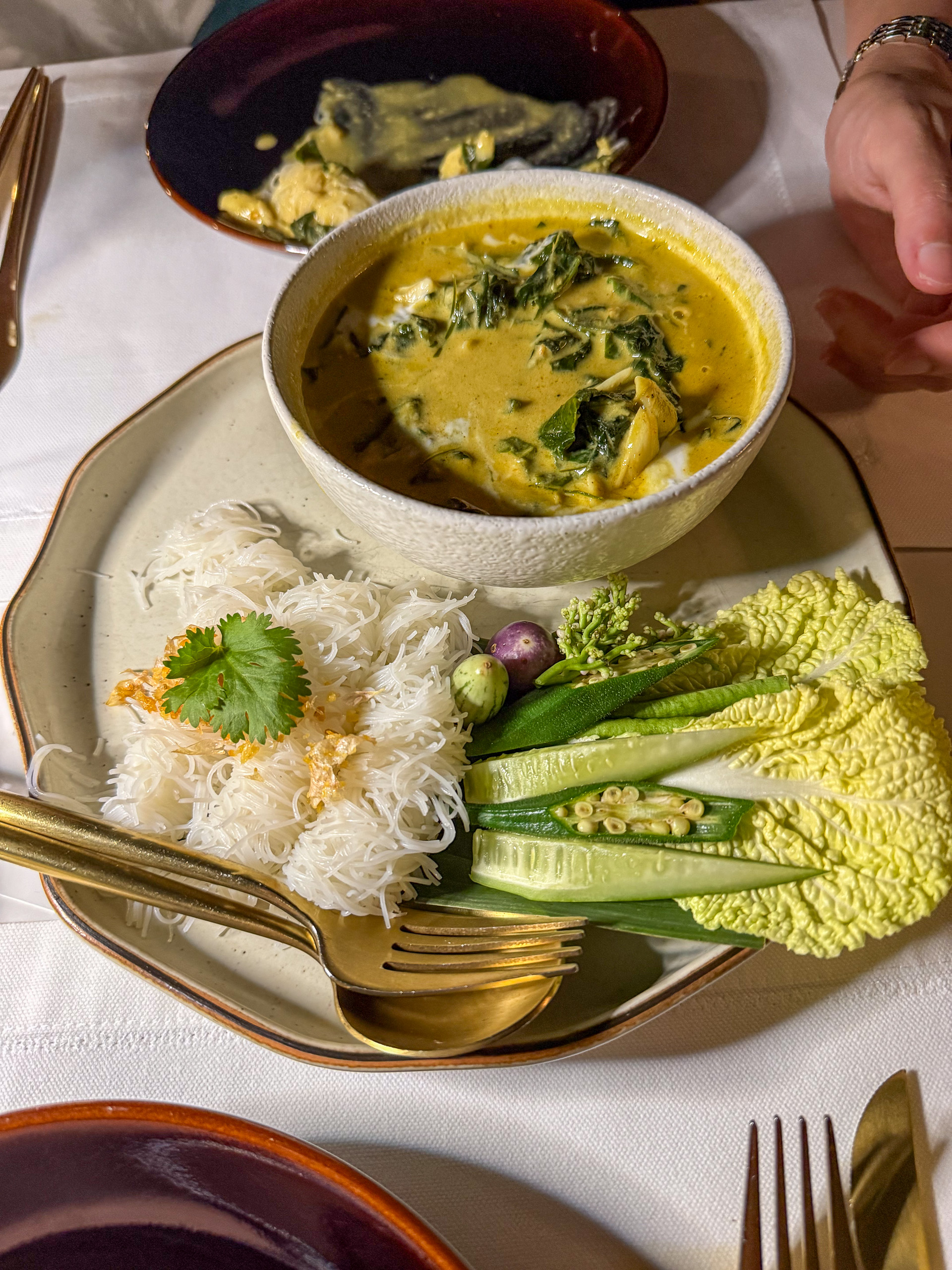
The reason is Chef Kannika, who runs Phra Nakhon, the hotel’s Thai restaurant, and who cooks to order if you ask her. On the first night we asked her to decide for us. On the second night we asked again, and it was perfection — I am not reaching for the word, it is the one I wrote down at the table. The crab curry you see below was equal to anything at Sorn.
We asked if she would come out, and she spent twenty minutes with us explaining how she had done it, which involves sourcing spices from the far reaches of the country that I had never heard of and could not now spell. I have had chefs visit the table before. This was next level and equal to Chef Caroline at Kokomo. June, the most beautiful culturist, volunteered that the spices Kannika uses are special and impossible to source even for other Thai.
Green curry with rice noodles and the raw vegetables.Fried rice with crab, the chilli alongside.Noodles and rice set out to share.
The rest is very good and, next to that, beside the point: the Living Room will feed and water you all day without a bill appearing, breakfast on the river is the meal to have included, and the sommelier’s wine tasting, which comes with the stay, pours a Thai red that is better than the phrase “Thai red” suggests. There is a separate piece on the restaurants here.
The garden, the art and the pool
The site could have carried a tower and deliberately does not. The building spreads sideways so that every room faces the water rather than looking down on it, and from a boat the panel grid plays a trick: each apparent square is three storeys, not one. The gardens step down in tiers — lawns, a lily pond, old trees, the villas at the bottom on the river’s edge — and behind the hotel a greenhouse grows herbs and edible flowers for the kitchens, some of which reached the table that night.
One panel of the art programme, in a corridor. The tour takes an hour and is worth it.
The art runs the length of the corridors and through the public rooms, much of it made in response to the river and to Charoen Krung, and there is a guided, unadvertised tour of it. Ask on the first morning rather than the last; you will walk those corridors twenty times either way, and it changes what you are looking at.
The pool is a single infinity edge over the river, open around the clock, and it stays quiet. The spa is Auriga and it is very good. The gym is a genuine walk: lift, lobby, second lift, out past the villas and through a gate. By the time you arrive you have done the warm-up. The low riverside terraces draw mosquitoes at dusk; the Culturist will have already put the repellent in your room.
Service moments
This is the section the rest of the review exists to set up, so here is the list, and it is not complete.
Two hours before dinner on a night we had nothing booked, I mentioned Gaggan. The Culturist did not say it was impossible, which it is. He said he would try. We had a table for two that evening.
Walking past one of the restaurants on the way to the boat, I was greeted by name by staff I had never met. It happened again the next day. It took me until the third time to work out that the Culturist was calling down as I passed, so that nobody in the building would ever have to ask who I was.
Plates carried through the glass to the suite. Nobody asked for this; it was volunteered.
I was late for the boat once. The person who saw it was not my Culturist and did not have a radio in her pocket; she was from the front desk, and she ran — sprinted, in uniform, down the garden — to hold it. I have thought about that more than about anything else on the stay. Nobody had asked her to. I did not know the front desk could sprint. I suspect it is not in the manual.
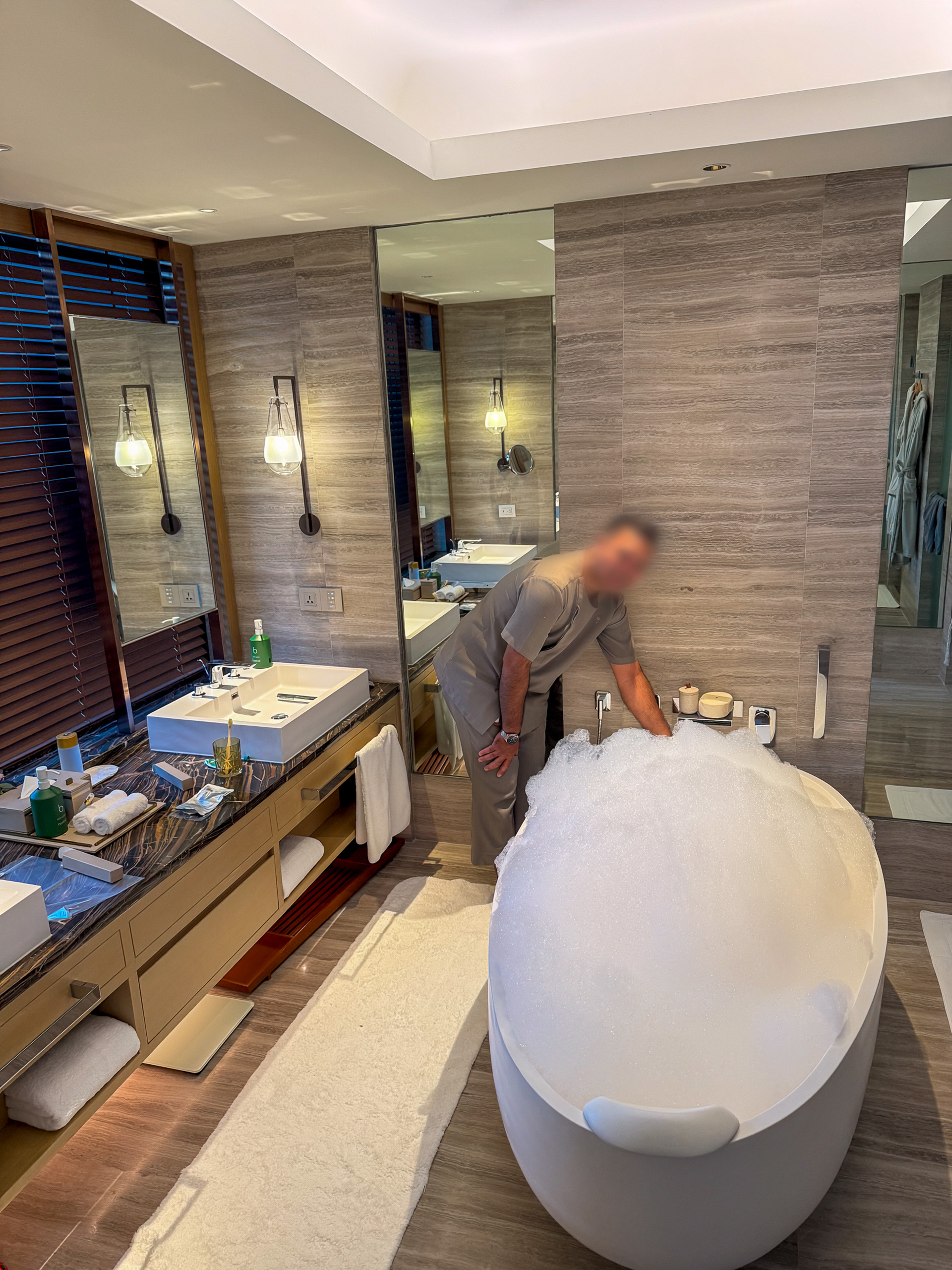
They volunteered help for things I did not know could be helped with (get the bubble bath drawn!). They never missed anything: not a preference mentioned once, not a time, not a name. And the chef came out and brought the spice. All done with a genuineness that I do not believe can be faked at this scale. Service at this level is not a series of tasks done well. It is people paying attention to you, continuously, without making you feel watched, and I have not found it better before or since anywhere else on the planet. If I ever find it better I will update this statement.
I have been looked after in a great many hotels. I have never been looked after like this.
Who it is for, and who it is not
Come if you want to find out what service can actually be, and give it three or four nights, which is the length the place is built for. Come in the rains if the calm is what you want; come in the cool season if the view is the point, and book well ahead. Ask for height; the upper floors get the sightline. Ask Chef Kannika to cook for you on the first night rather than the last, so there is a second night. Take the boat to Sathorn at least once, and be on time for it, or do not, and see what happens.
Look elsewhere only if you would rather be left alone. If you are a grump. If you have something against the world. Or still come. And this place will help. Some people want a hotel that treats them as furniture, and there are excellent ones a few minutes up the same river. This is not that. Oh and if the picture in your head is a blue river (beautiful but deceptive art from Four Seasons), the Chao Phraya is going to disappoint you at any hotel, so you may as well be disappointed here. Go here instead.
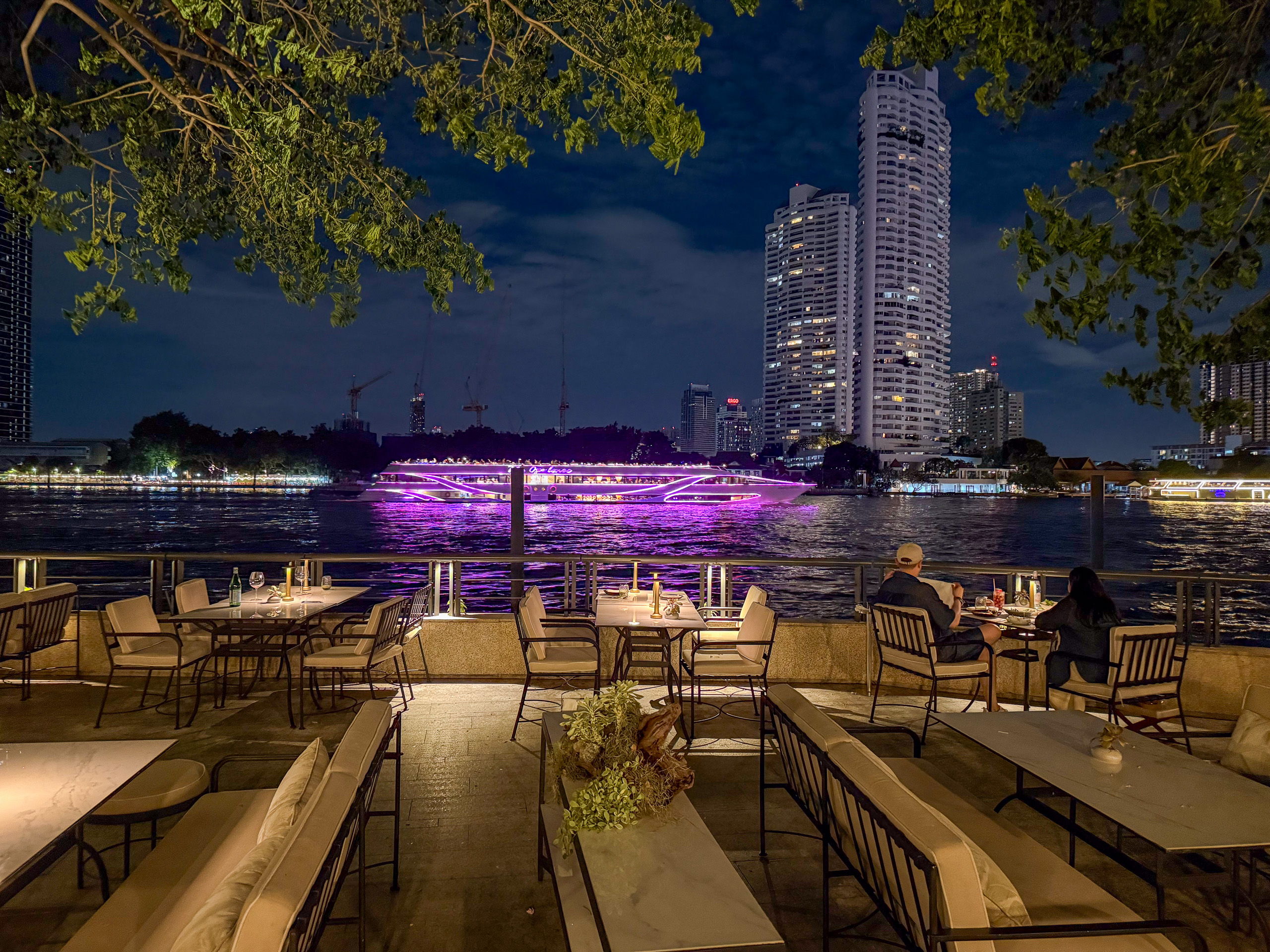
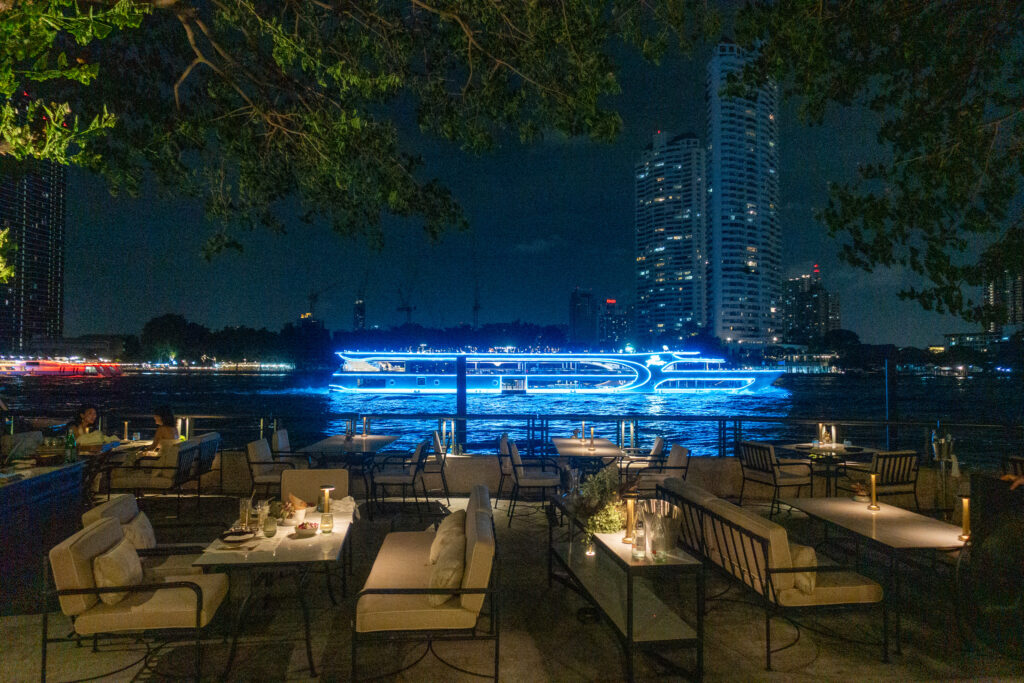
The terrace after dark, the bridge lit purple. The karaoke boats are out of frame and audible.
Bottom line
Capella is the best-run hotel I have stayed in anywhere, and the kitchen is close behind. Book a third-floor Riverfront room for three or four nights and let them look after you.
The hotel keeps a boat at Sathorn pier, and it is the right way to arrive. Bangkok turns two miles into forty minutes without warning and without apology. The river turns the same two miles into about eight, and you spend them on the water watching the city drop from towers to warehouses to the low green wall of the hotel’s own trees. By the time the boat noses into the landing, the argument the building is going to spend three days making has already been made once, for free, from the deck.
The address is on Charoen Krung, a warehouse street with a creative district growing through it — galleries, a design centre, shophouses, the old customs house down the road. It is worth an afternoon. It is not worth pretending it is walkable to anything else: the Skytrain is a long hot walk, and every departure from here is a boat you have to catch or a car you have to allow far too much time for.
The entrance under the old tree. The resort hides behind it.
Nothing about the approach from the road prepares you for what is behind the gate. The hotel is a sequence of low buildings stepping down to the water rather than a tower standing on it: courtyard, colonnade, reflecting pool, lawn, river. You are never told you have arrived. You just keep going down and the noise keeps dropping.
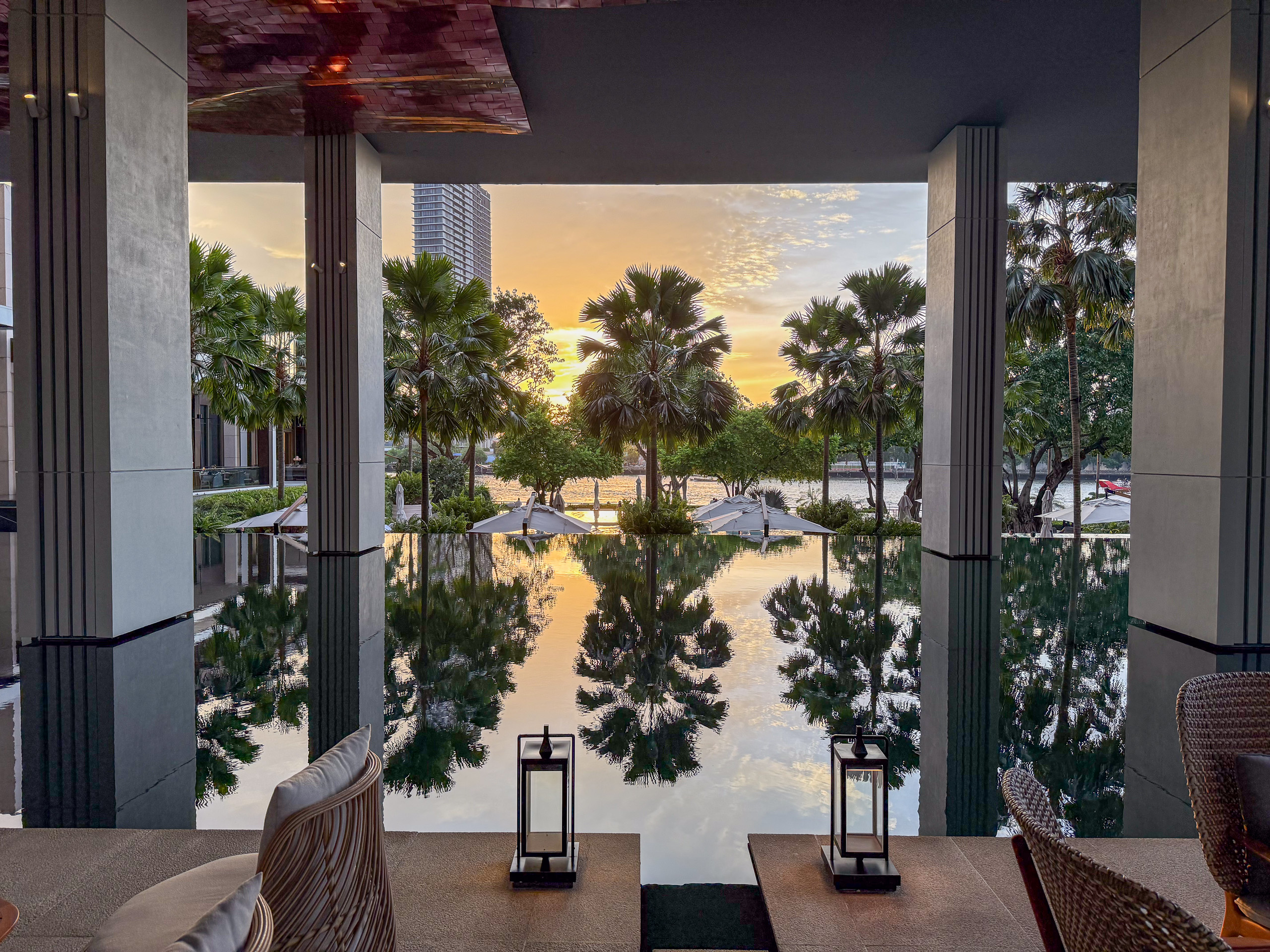
Water does most of the work. There is standing water almost everywhere on the ground floor, black and shallow and dead flat, set between pale columns so that the palms and the towers on the far bank arrive twice. It is a device, it is obvious, and it works anyway. On the second evening I walked the length of it before dinner for no reason except that it was quiet, which in Bangkok is a reason.
The courtyard at dusk. Everything arrives twice.
The room
I booked a Deluxe River-View Room, the entry river category, and was upgraded to an Annex room with a balcony and a river view: a long window wall, the bed placed to face it, a writing desk that is a desk rather than a shelf with a lamp on it. The proportions are wonderful and the view of the river and pools forces to leave the curtains open.
The tray that follows you around the property: towels, water, nothing to sign.
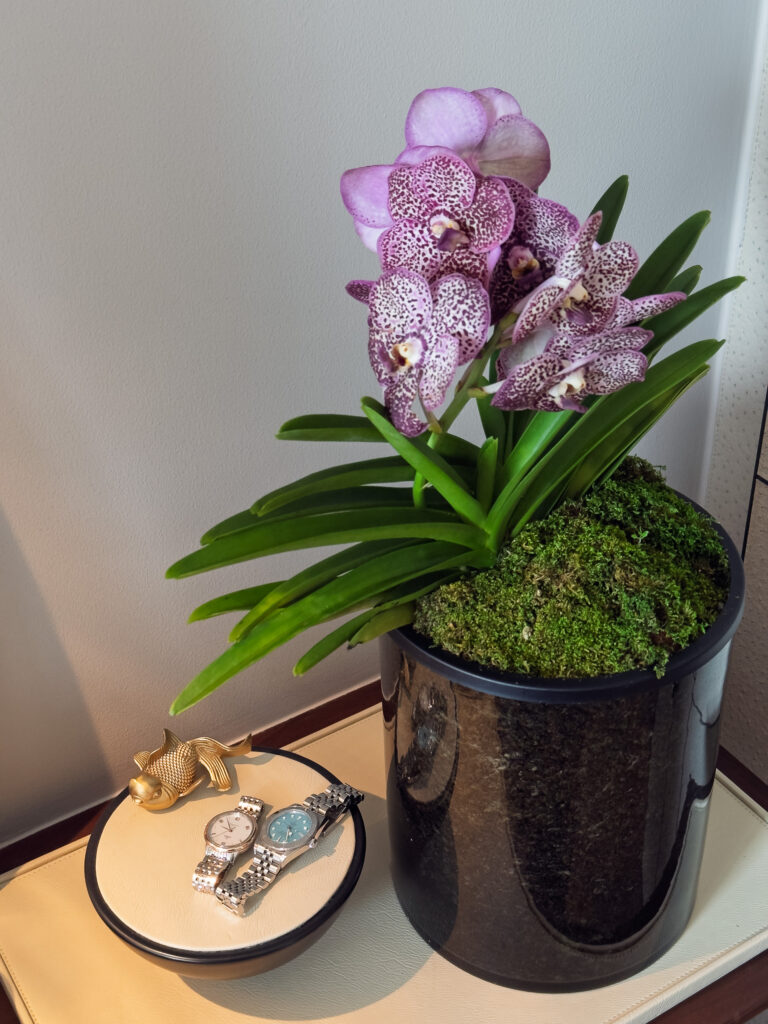
The detailing is quietly expensive. An orchid on the desk in a heavy black pot, large enough to count as a shrub and replaced rather than watered. Housekeeping moved a watch I had left out onto a small lacquer tray without being asked and without saying anything about it, which is the kind of thing that is either invisible or the entire point.
Noted
Observed on the stay, not measured.
What
Checked on the stay
Wi-Fi
Fast and stable in the room, no drop-outs across three days
Noise
Silent inside; river traffic audible on the terrace, never in the room
Bed
King, medium-firm, pillow menu – Four Seasons Bed Nuff Said
Water pressure
Strong, hot immediately
Blackout curtains
Full, motorised, no light gap
Boat shuttle
Every half hour, morning to late evening, to Sathorn pier and ICONSIAM, by the timetable
Lap pool
35 metres per the hotel; never too crowded
Eating
Yu Ting Yuan is the reason to stay in for one dinner. Cantonese, a Michelin star on the door, a tall glassy room over the water, and dim sum that is worth ordering at dinner even though nobody will suggest it. The service is formal without being stiff, and the wine list runs deep. Good but no Jade Dragon.
Riva del Fiume is the Italian on the river, handmade pasta and a wood-fired oven, and the easiest room in the hotel to eat in twice. Brasserie Palmier is the fish room, with an oyster bar and a chequered floor doing an unembarrassed impression of Paris in the tropics; lunch, not dinner.
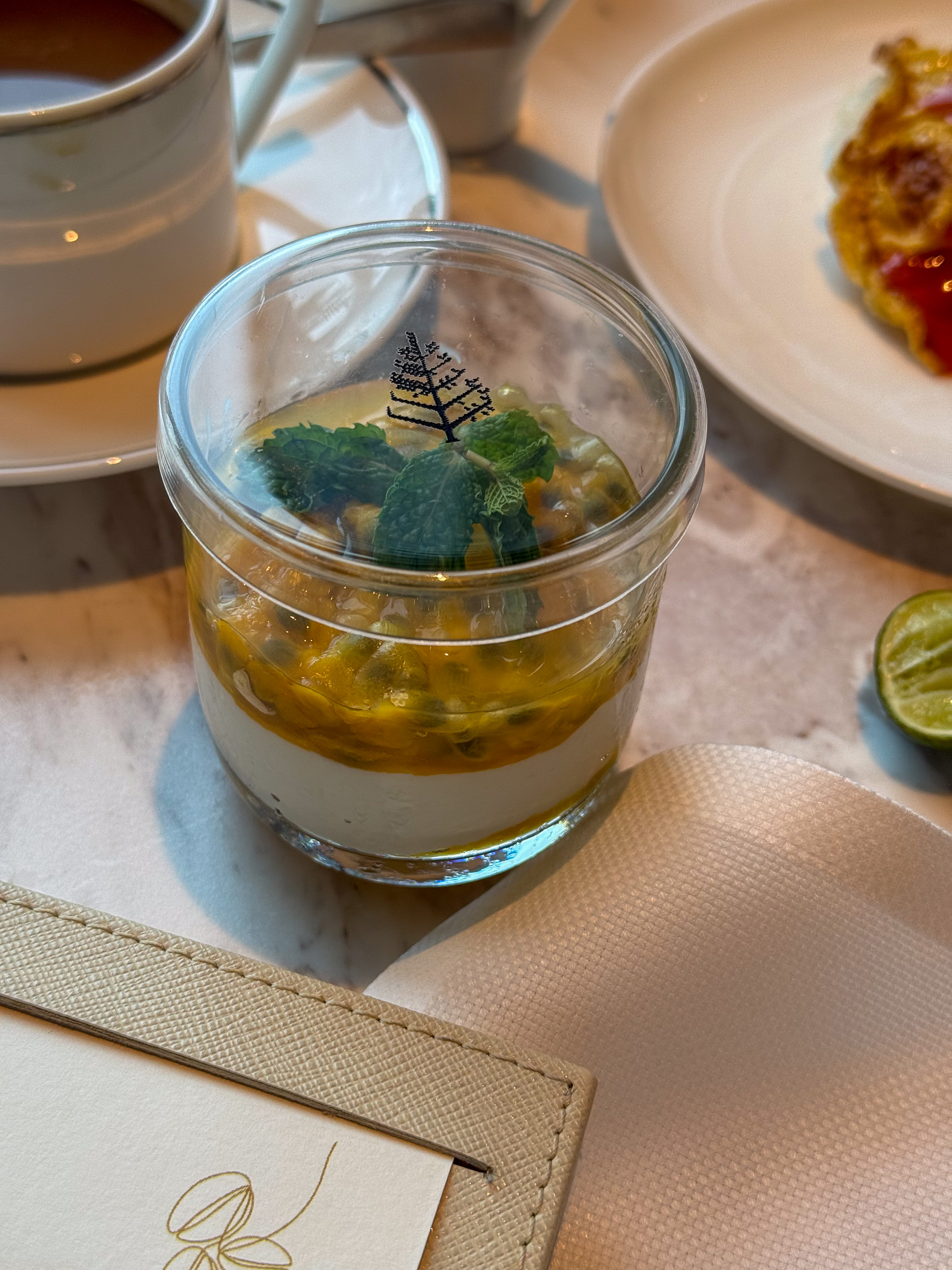
Grilled morsels at the terrace bar.Dessert in a jar, coffee behind.Dessert on the ledge, pool beyond.
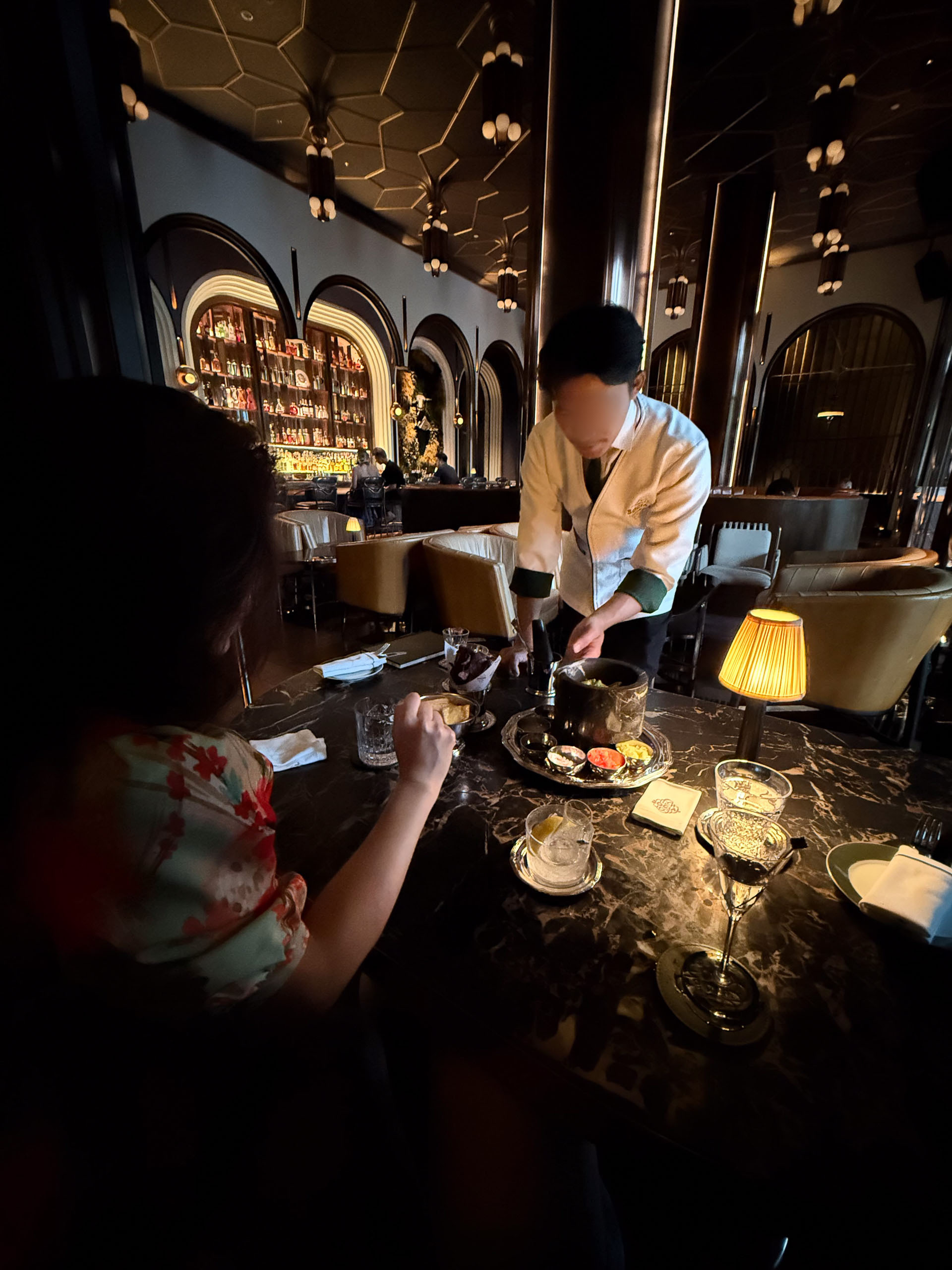
BKK Social Club is the bar, and it is a destination rather than a lobby with cocktails: enormous, gold-lit, arched, with a mirrored back bar you can see from the door. Go before nine or accept that you are queuing behind the city. Book it for the drinks not the food. The drinks were world class (the bar manager is literally best in the world) the food meh. They need to send their chef to the Yucatan to learn what guacamole can be.
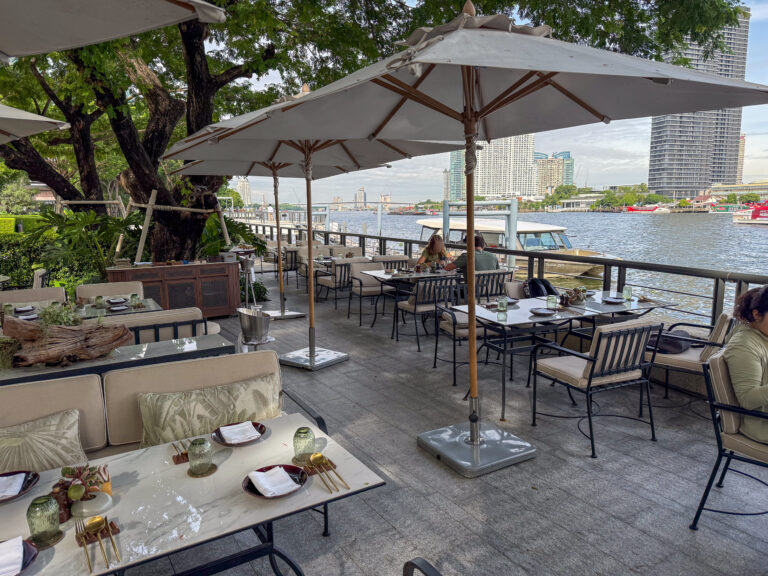
Have breakfast included. It is served properly, it is large, and it covers the morning until the pool does. It is also the only meal here where the river is not charging admission.
The low-lit bar, bottles ranked behind. The saved difference gets spent here.
Three pools, and one of them is for swimming
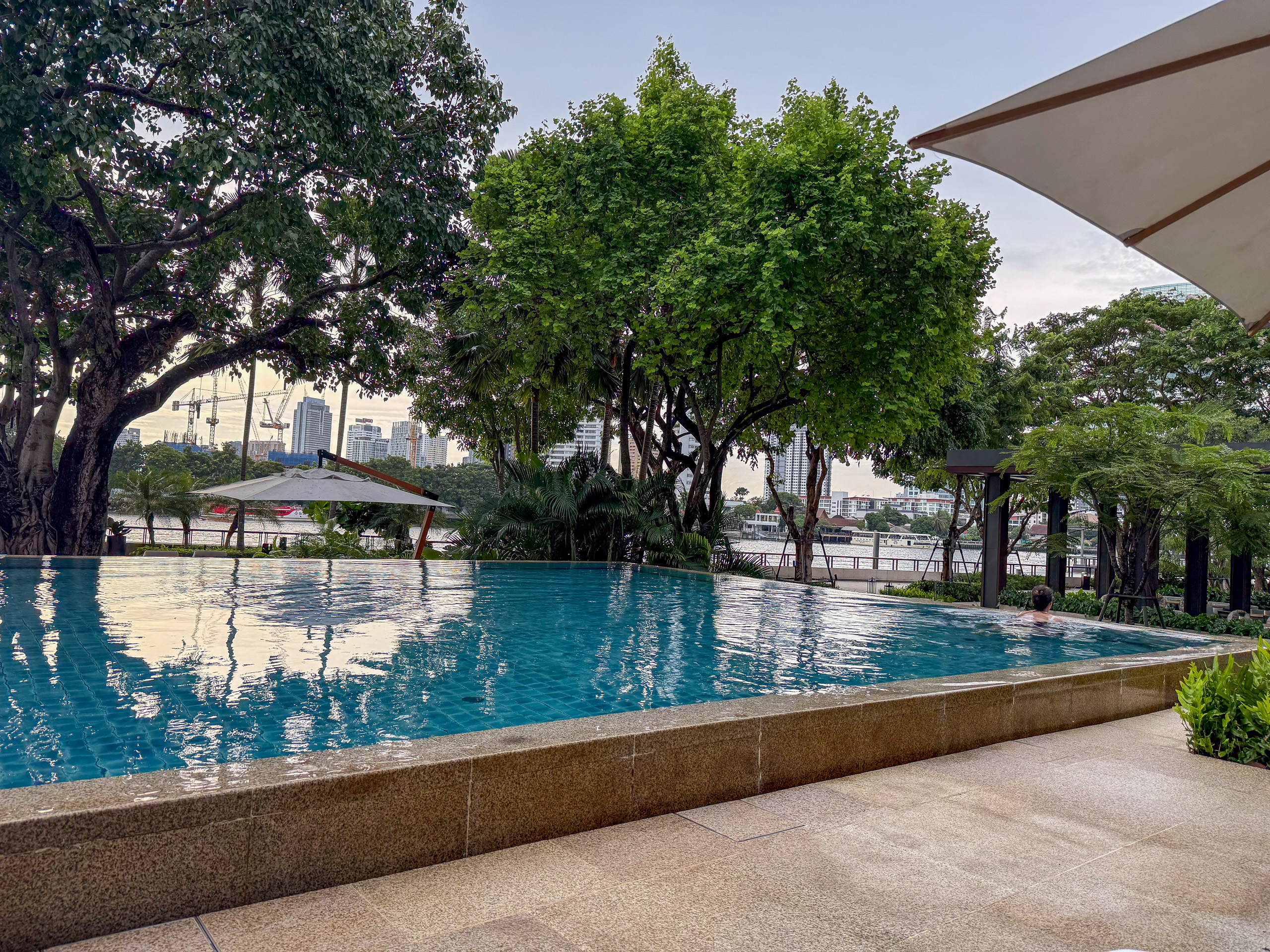
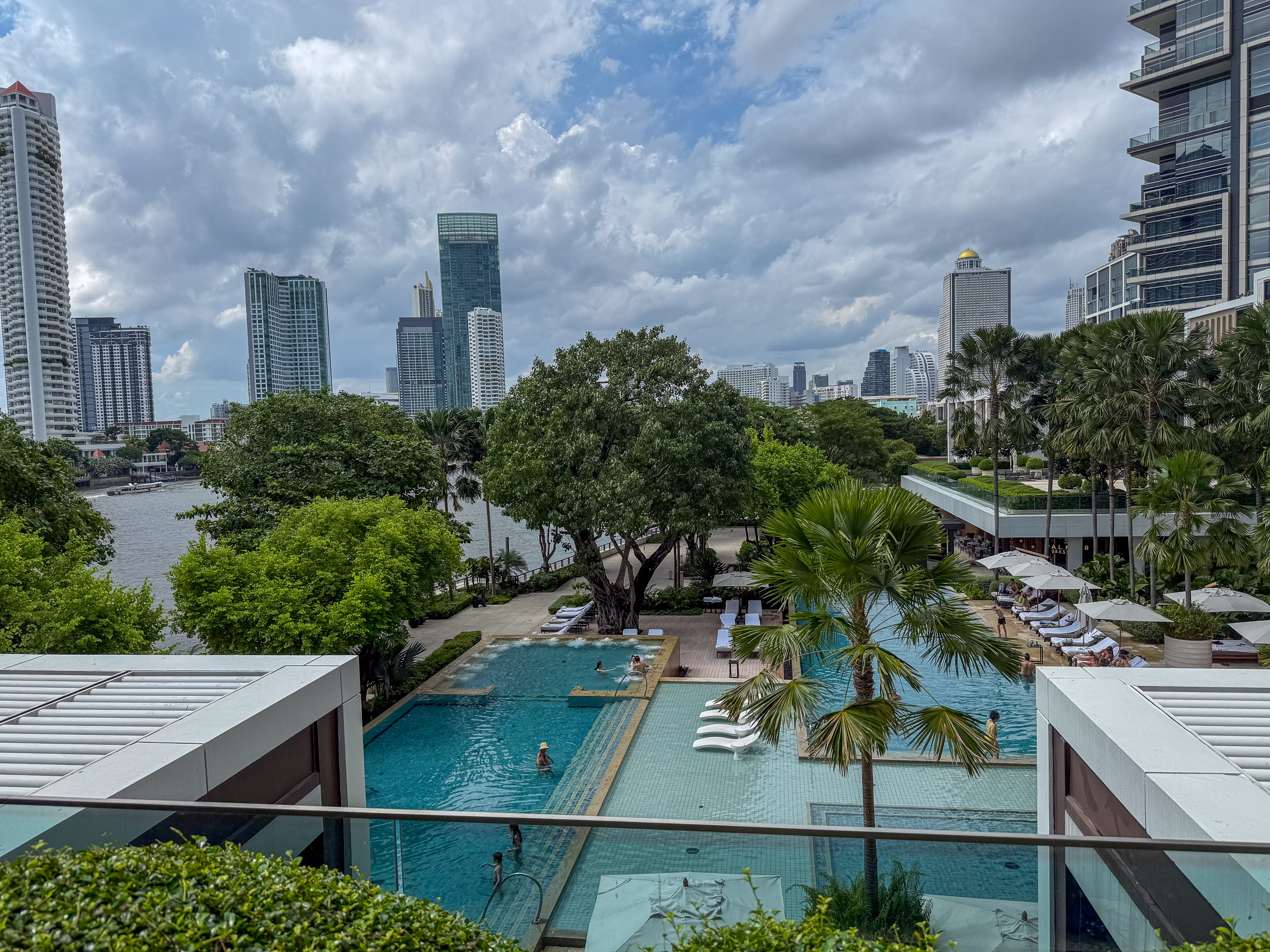
The one everybody photographs is the long turquoise pool on the terrace above the river, lined with loungers and set into the trees, and it is the sociable one. The one that matters if you actually swim is the lap pool at the wellness centre, long enough to train in rather than to stand in. The spa is in the same building; it books out, and the pools do not.
The terrace pool, the rain tree, and the city that starts again behind it.
Go early. By ten the terrace has filled and the loungers nearest the water have gone; by two the heat has made the decision for you anyway. Between seven and nine the pool is effectively private and the light on the river is the best of the day.
Six-thirty in the evening is the hour the property is built around. The heat goes out of the stone, the river turns from brown to pewter, and the far bank comes on. Take a drink out onto the terrace rather than staying in the bar for it.
Six-thirty, from the terrace. This is the hour the property was built for.
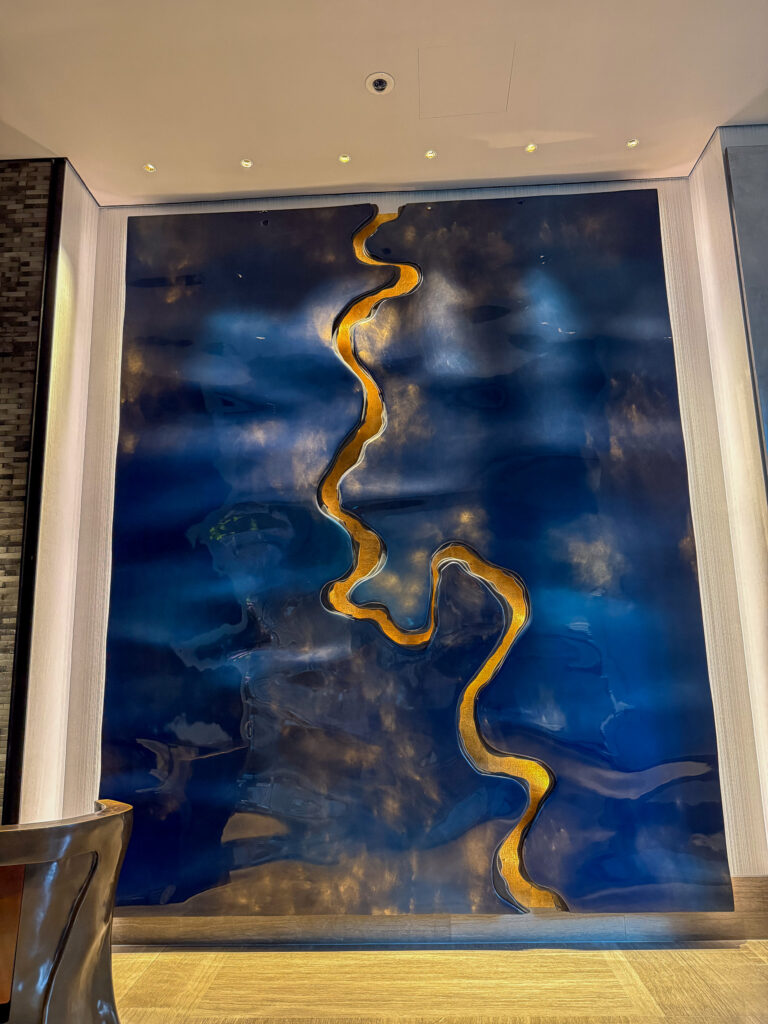
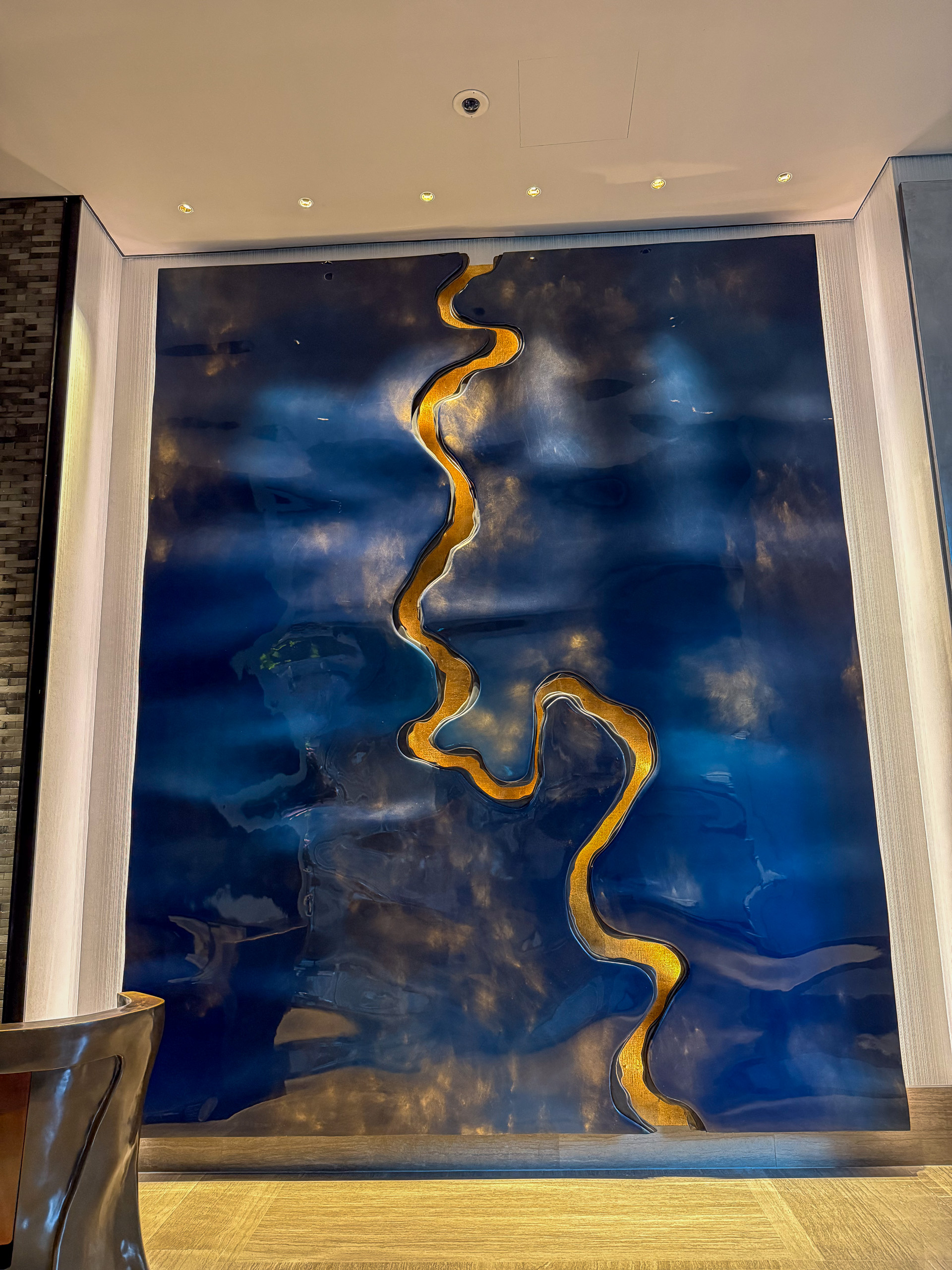
There is an art space running from the lobby down to the river, showing Thai artists in exhibitions that change, and it is the most unusual thing about the hotel. The piece I kept walking back to was a tall panel of deep blue with a single gold line wandering down it, which is the river, and which is better than that description makes it sound. Give it twenty minutes on the way through rather than walking past it four times, which is what I did before I looked properly.
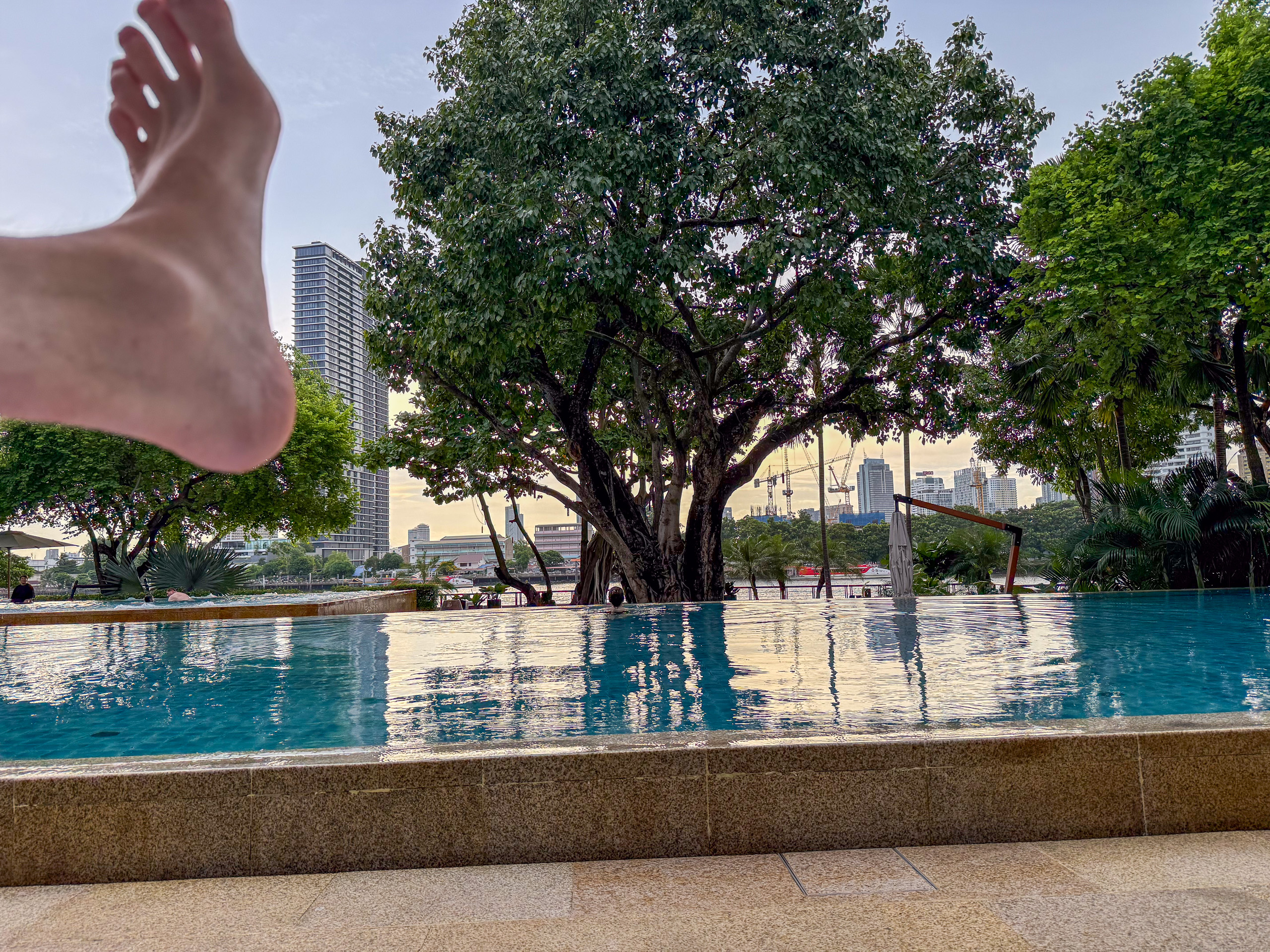
The pool terrace at three.The still pool, being used correctly.
Service moments
Quick, unfussy and noticeably young, and it holds at the edges rather than only at the centre. Nothing missed and arguably outstanding but nothing that makes you rethink every hotel you’ve been in before. Think of Four Seasons in a country like Thailand and thats what you get.
I ordered a complex tea at the bar and it took a few minutes to make so they held it for me until I got back. They offered and assisted with a Thai smelling salts container – Ya dom – not go be confused with its even more delightful liquid cousin Ya Dong.
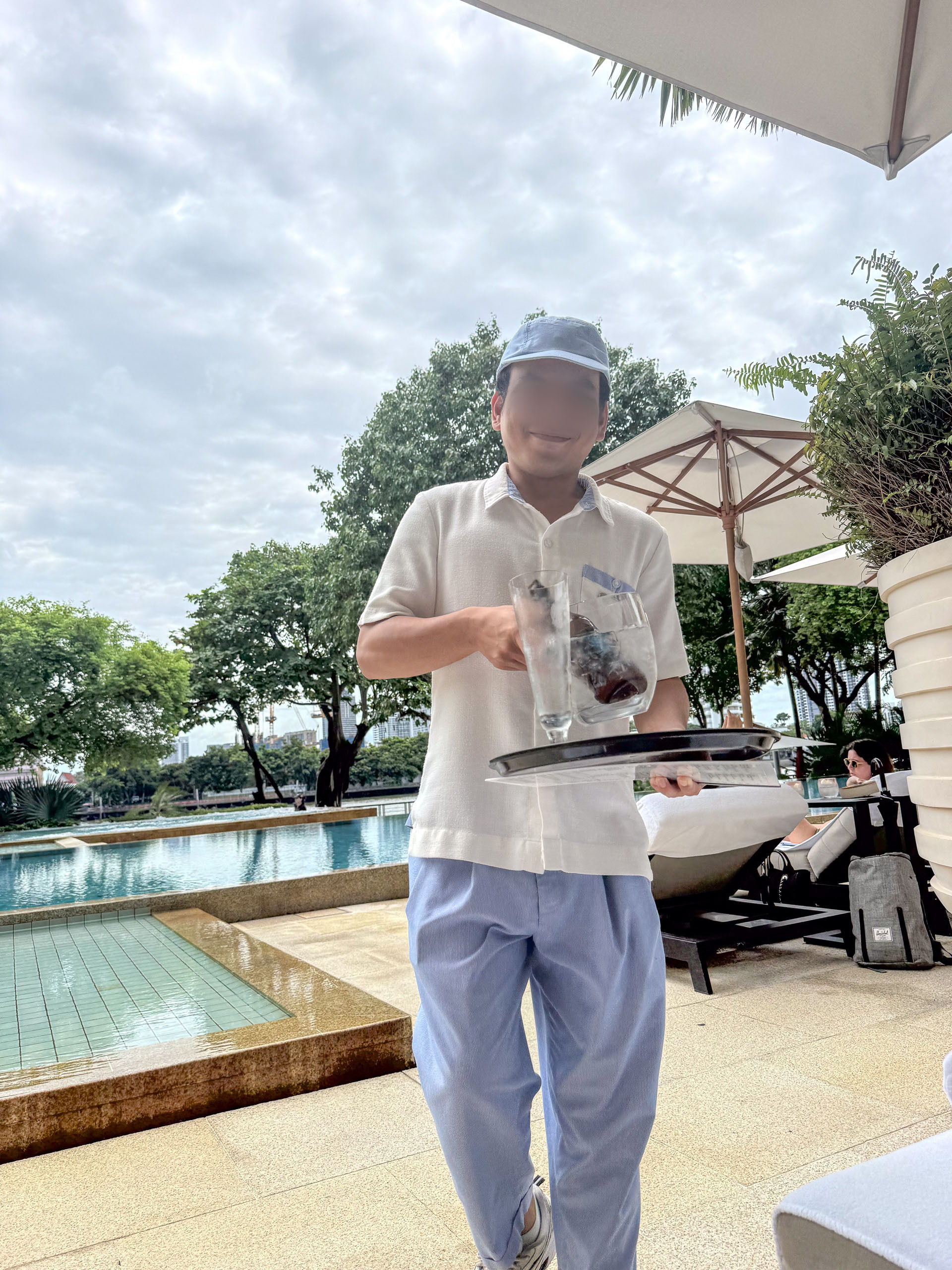
A tray on its way to the poolside. Service here comes to you.
A resort built inside a city that has no room for one, which is the whole point and also the whole cost.
Who it is for, and who it is not
Come if you want the days full: three pools, four restaurants, a bar that people cross the city for, and an art space to walk through on the way to all of them. Ask for a high floor on the river side and say so at booking rather than at check-in. Take the boat rather than a car whenever the timetable allows, and note that it stops at ten. Swim before eight.
Look elsewhere if what you want from a river hotel is a hush and a handful of other guests. The ground floor here belongs to Bangkok as much as to you; on a Friday the courtyard was a thoroughfare. The property three minutes south does quiet better, and I have set the two side by side in Capella or Four Seasons. Look elsewhere too if the room is what you are paying for; here the room is very good and the grounds are the exceptional reason to come.
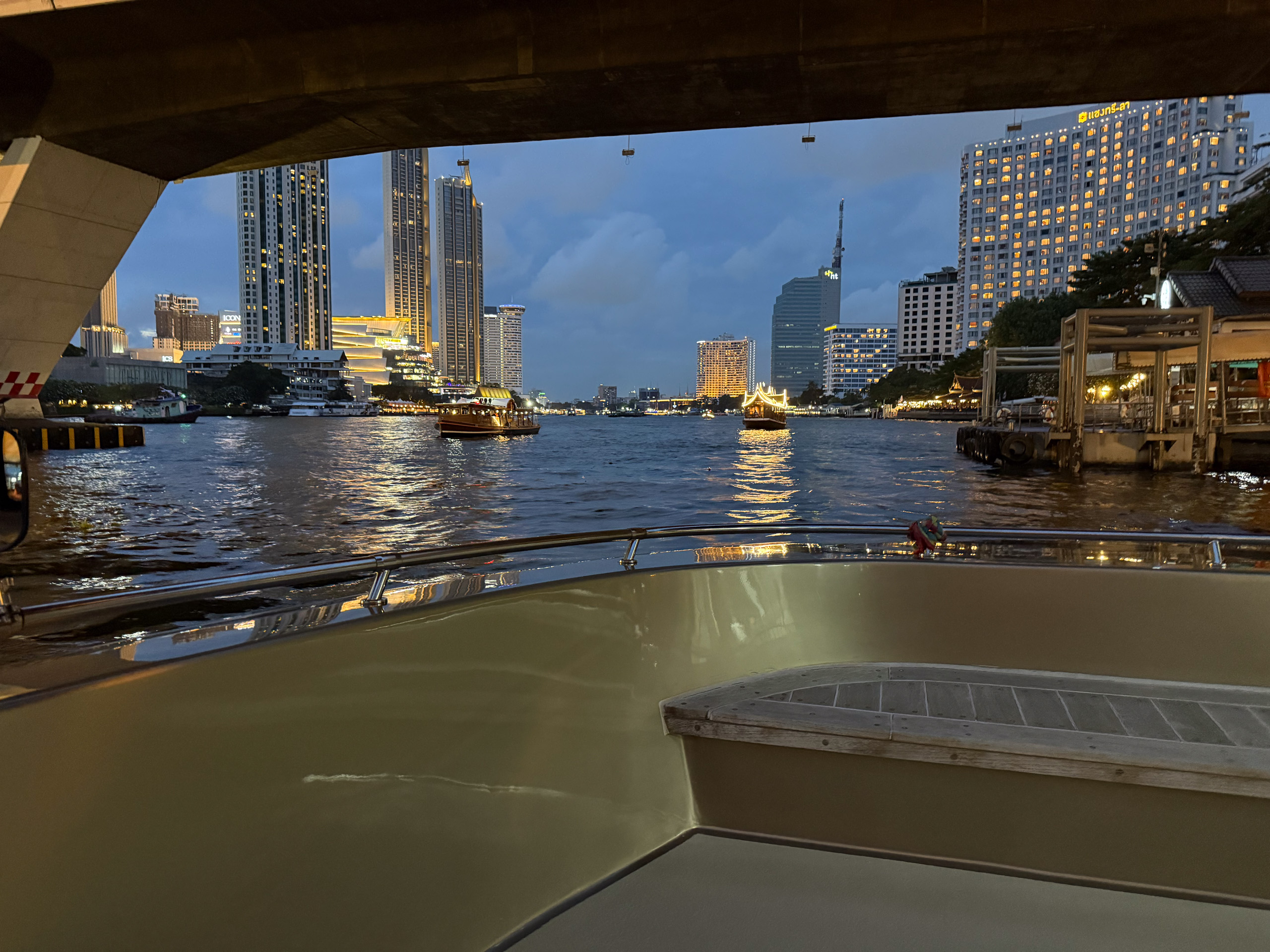
The river at dusk from the hotel boat, the city lit along the far bank.
Bottom line
Four Seasons Bangkok is an urban resort that shares its ground floor with the city, and it is at its best when you use everything it has. Bring the family for a resort getaway with all the tours of Bangkok at your fingertips- and take the boat, not a car.
The street is called Tevkifhane Sokak, which means detention house street, and the hotel is the reason. For half a century this ochre building held prisoners, a good number of them writers and journalists, and the address kept the name after the function changed. Nobody at the hotel is coy about it; the history is on the wall in the corridor, which is the right decision, because a building this shape cannot pretend to have been anything else.
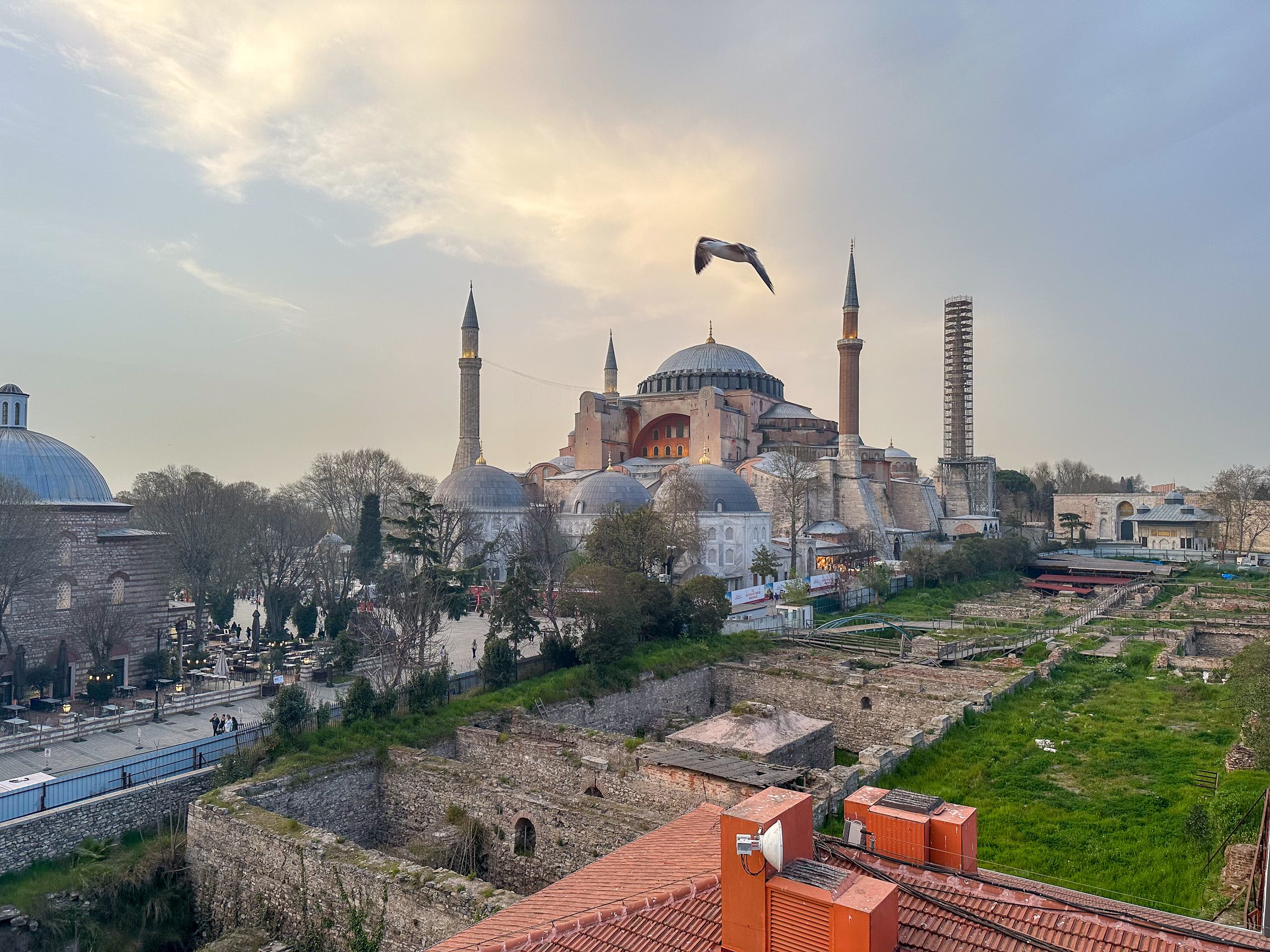
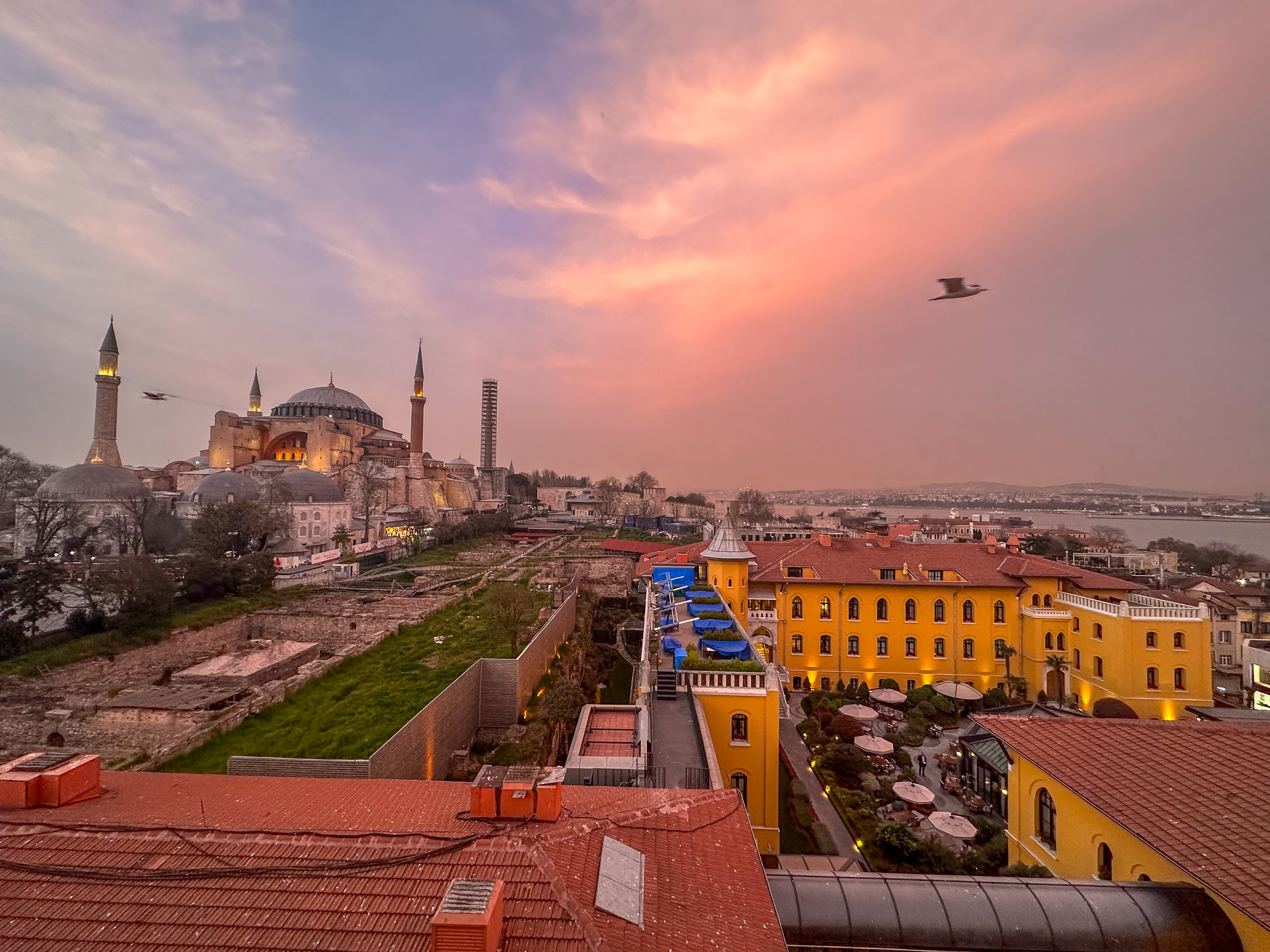
It stands about two hundred paces from Hagia Sophia, with the Blue Mosque on the ridge above and the Sea of Marmara below. There is no hotel site in Istanbul like it, and there is not going to be another one. The quarter has a rhythm you learn by the second day: at seven in the morning the square is yours, by nine the coaches have arrived, and by seven in the evening it has emptied again.
The exercise yard, now the best room in the hotel: a glazed pavilion between the ochre wings.
You can read the plan. Corridors run straight and long because they were galleries. Rooms sit in a rhythm because cells did. The proportions are tall and narrow in a way no hotel architect would choose, and the effect is better than it sounds: high ceilings, deep window reveals, thick walls that make the place quiet in a quarter that is not. It is the only hotel I know where “the walls are thick” is a matter of public record.
The exercise yard is now a garden with a glazed pavilion in the middle, and every route through the building crosses it. It is a small hotel, and the scale is the single most important thing to understand about staying here: staff learn your name on the first morning because there are not enough guests for them not to, and the courtyard never feels crowded even when the house is full. There is no lobby scrum, no queue at the desk, and no moment at breakfast when the room turns over and the staff visibly change gear. Small hotels are not automatically better than large ones. This one uses its size properly.
The room
I had a Deluxe Room on the courtyard side. Warm ochre walls, a dark timber headboard, an arched doorway through to the bathroom, a wall sconce rather than a downlight, dark boards underfoot. It is a warm, low-lit, slightly old-fashioned room, and it is a great deal more comfortable than the exterior leads you to expect.
Deep reveals, thick walls, and a room that is quieter than the address suggests.
The variation between rooms is real and worth managing. The building has a fixed geometry and the rooms were fitted into it rather than the other way round, so some look at the courtyard, some at a wall, and a small number look at the monuments. If the view is why you are booking, name it at the time of booking and be specific. The difference in the room is small. The difference in what is outside it is enormous. Nobody will volunteer this at check-in, for the same reason nobody volunteers the view from the lesser seats.
The lamp, the framed prints, the door to the sitting room.The alabaster basin in black marble.A private roof terrace, two chairs, the tiles.
Noted
Observed on the stay, not measured.
What
Checked on the stay
Walk to Hagia Sophia
Three minutes, and you are inside the site boundary before that
Noise
Silent in the room; the call to prayer carries on the roof, which is the point
Bed
King, medium-firm
Water pressure
Strong and hot, no wait
Pool
None on site — guests use the pools at the sister hotel on the Bosphorus
Spa
Kurna Spa, hammam, steam and sauna; books out
Eating
Avlu is the courtyard and the pavilion, contemporary Anatolian, and it is the rare hotel dining room in a monument quarter that locals will cross town for. Breakfast there is the meal to plan around rather than the one to rush: a full Turkish spread rather than a continental one with olives added, served outside under a blanket in April. Have it included, and book the dinner before you arrive. Best in class honeycomb and bread. DO NOT SKIP.
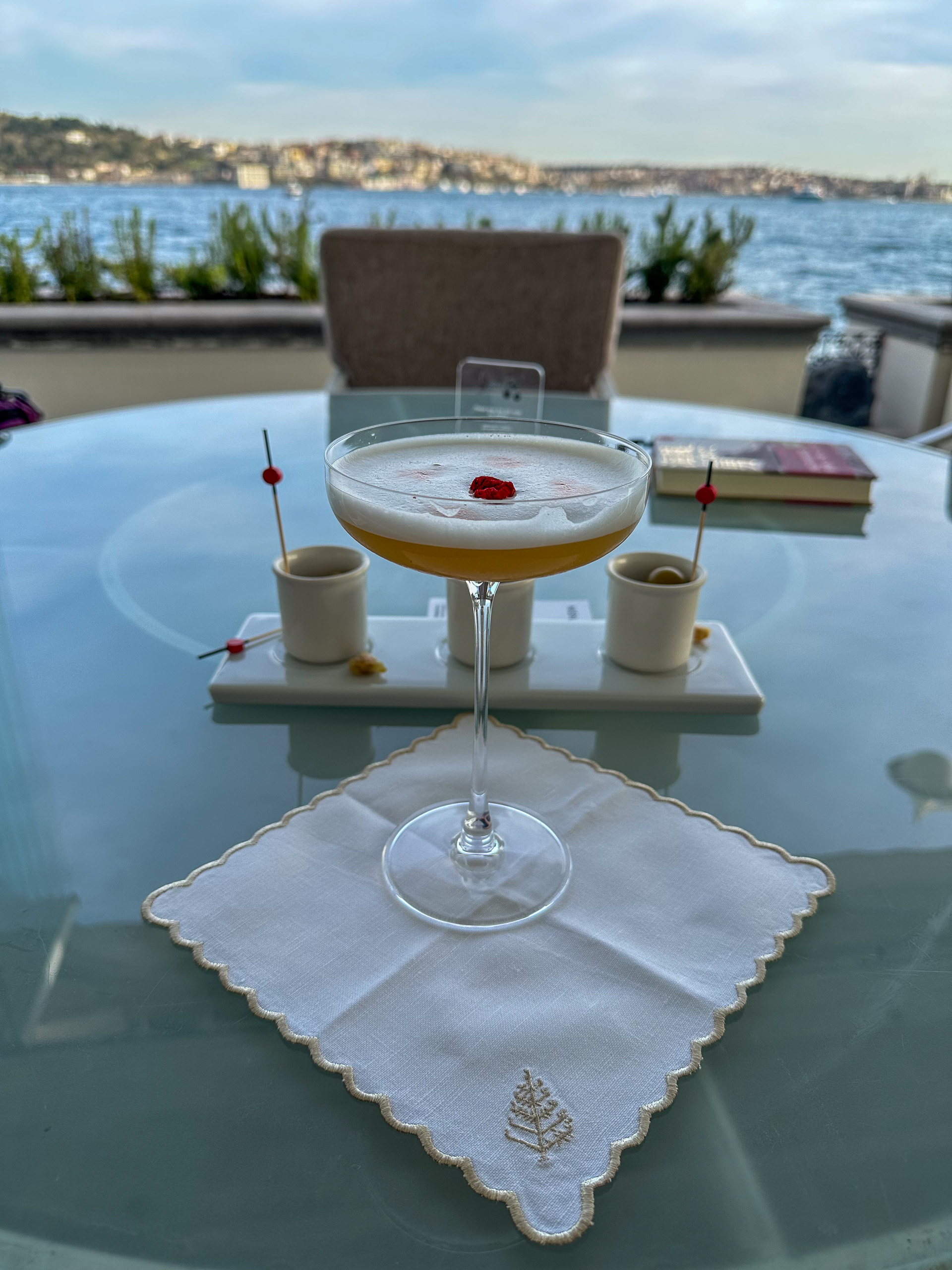
A cocktail and its accompaniments on the roof, on a tray, looking out to the water.
Lingo Lingo is the bar and restaurant, La Pistache the patisserie, and The Rooftop is where the evening ends. Four rooms in a hotel this size is generous, and none of them feels like a room that exists because the brand standard required one.
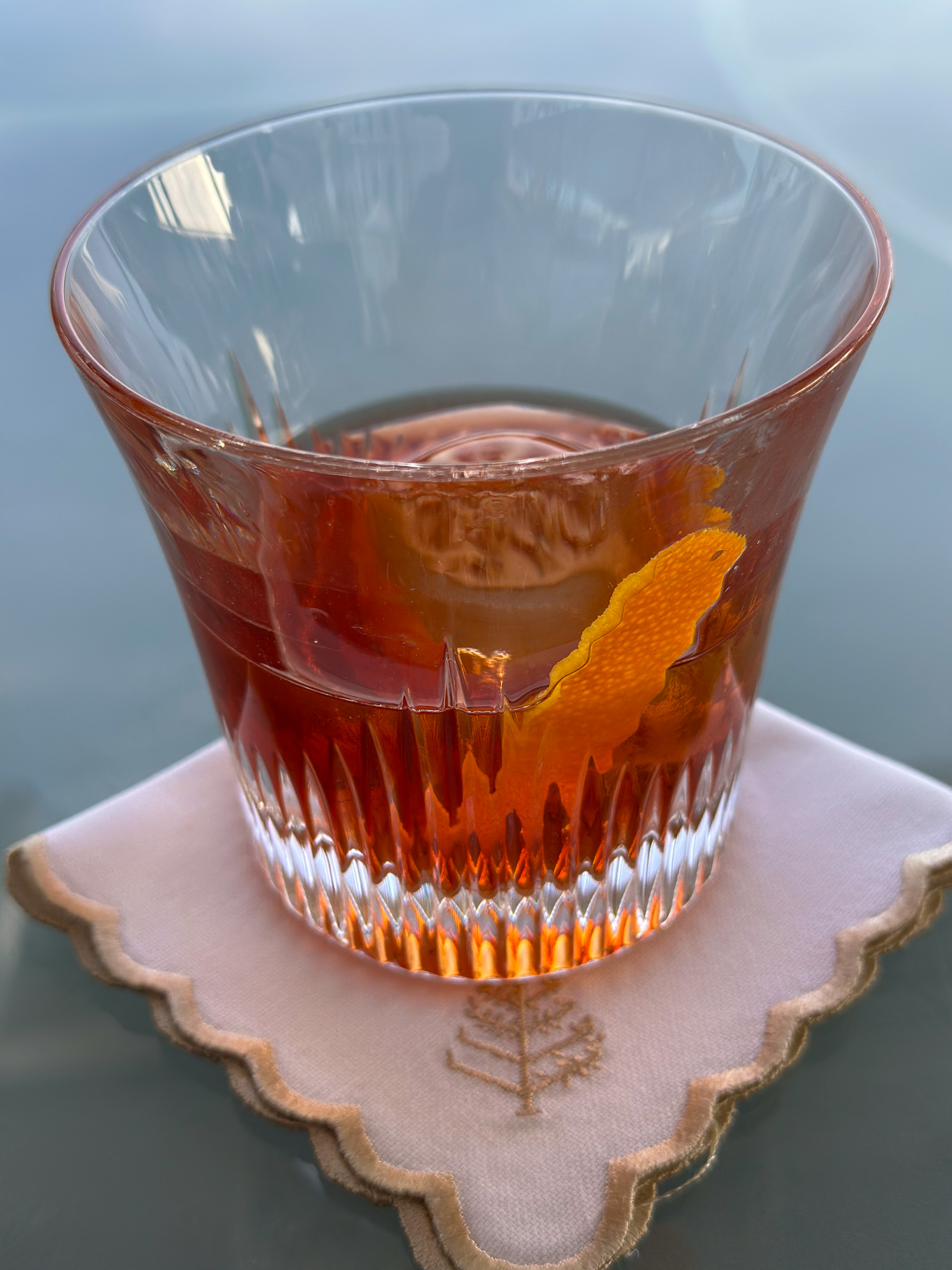
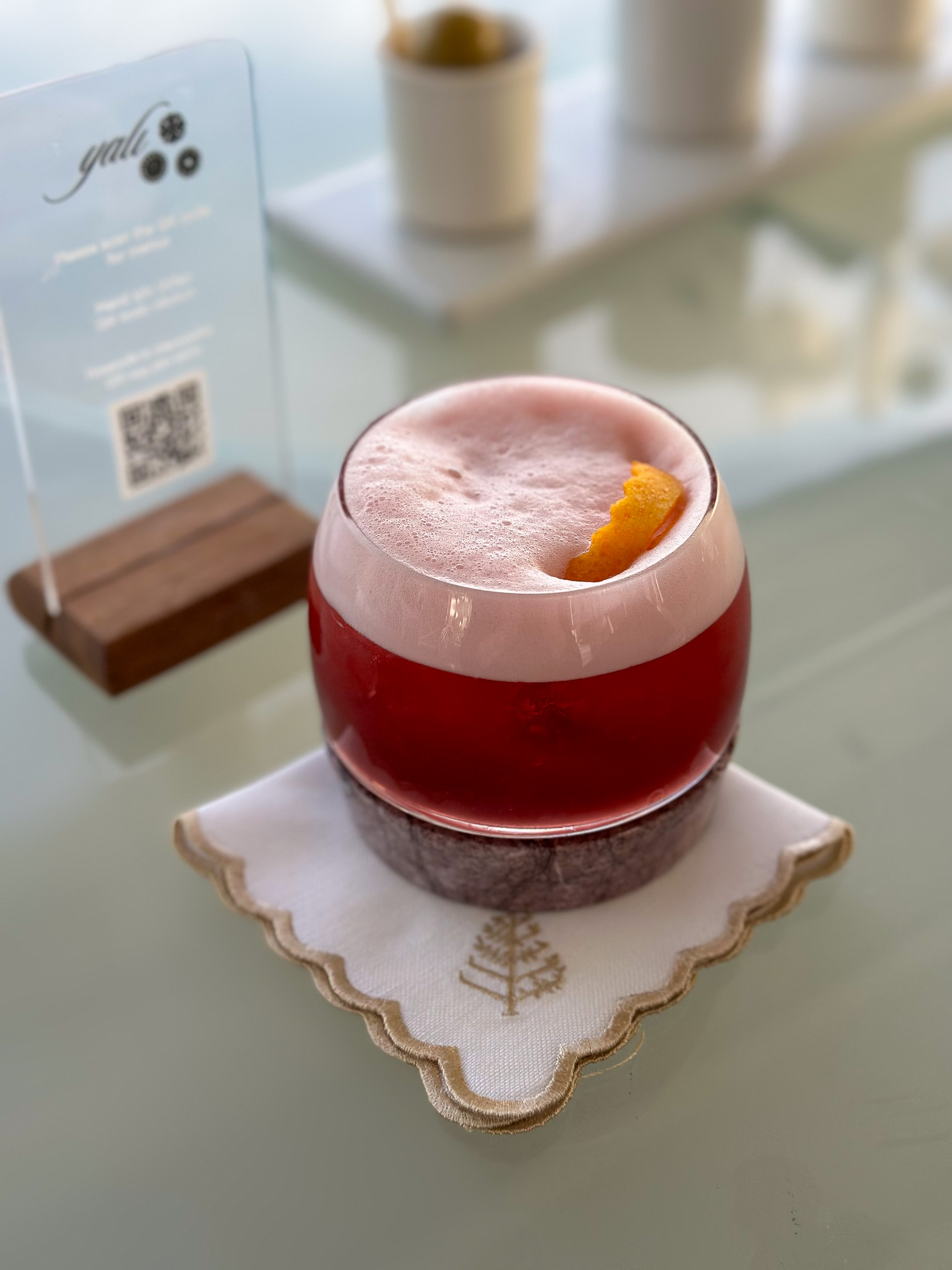
A negroni, the orange twisted, on linen.The pink one, foamed, on marble.A gull crossing Hagia Sophia at dawn, from the same table.
The roof, the hammam, and the pool that is not here
The Rooftop is the single best thing the hotel owns. From it, Hagia Sophia sits square in front of you across the archaeological garden, the Blue Mosque rises to the right, and the Marmara opens out beyond both with the shipping lane running across it. Go half an hour before sunset and stay through the call to prayer. In April the sky went pink and stayed pink for twenty minutes.
Half past seven in April. This is what the address buys.
Half the people up there are not staying in the hotel, which tells you two things: that it is a destination in its own right, and that you should go up before the hour everybody else does. Go on the first evening rather than the last, because if the weather turns you want the second chance.
The spa is built around a hammam, which is the correct thing for a hotel to offer in this city and an easy thing to do badly. This one is done properly: marble, heat, a scrub that is not a gentle exfoliation, and a rest afterwards you should allow an hour for rather than the twenty minutes you will be tempted to take. Book it for the afternoon of a heavy walking day, and book it before you arrive, because every guest in the house wants the same two slots. A Hammam of this quality is a must do before death.
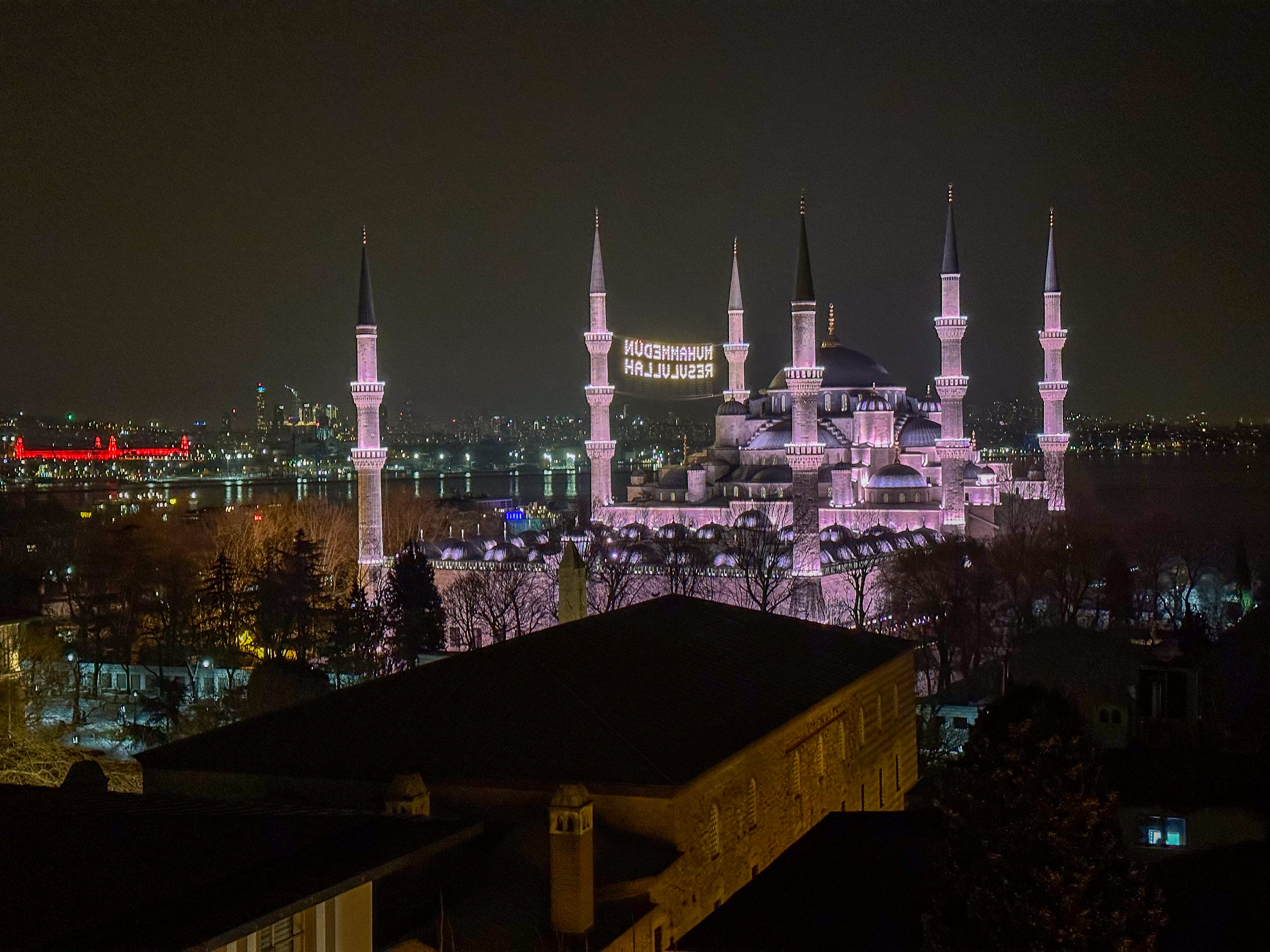
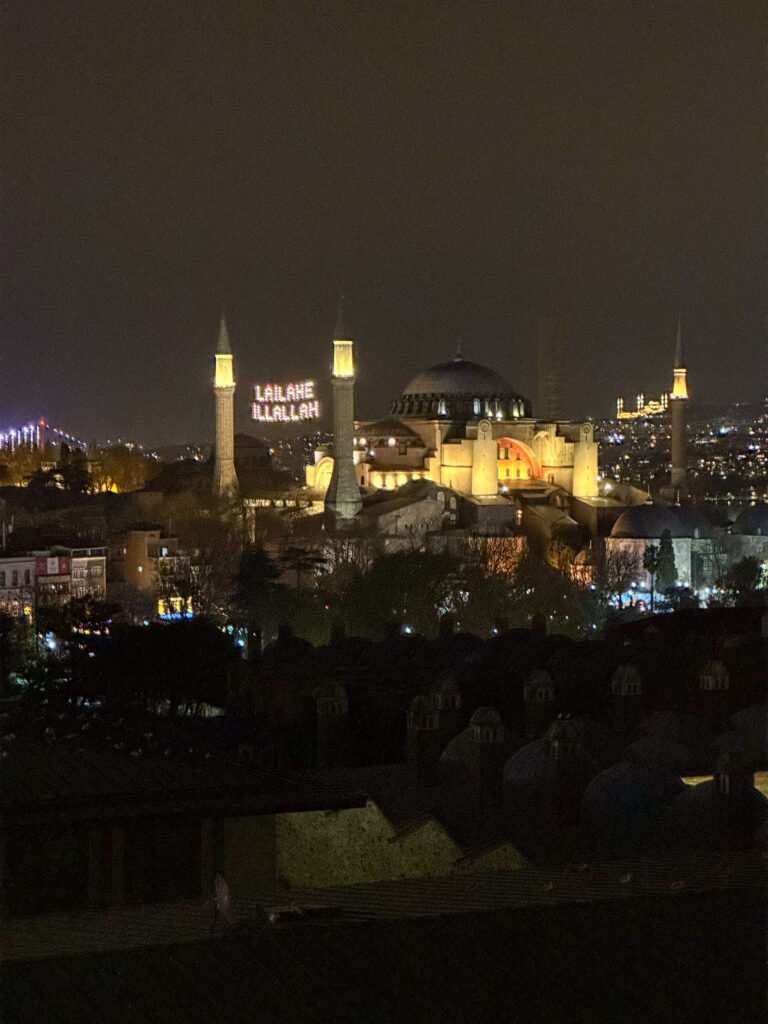
The Blue Mosque at night from the roof, the minarets picked out in floodlight.
There is no pool. Guests are sent to the sister hotel on the Bosphorus, which is a car ride across the city, and on a hot day in July that is not a facility, it is an outing. I did it and vote worth it. The hammam is excellent, but nobody has ever done lengths in one.
Service moments
The concierge desk is expert on the old city, which is rarer than it should be in a quarter this heavily toured, and the advice I was given about when to walk to which monument was better than anything I had planned. Ask, and then do what they say. Spend on a guide rather than on the minibar; the monuments are better with one, and the desk will find you one who does not end the tour in a carpet shop.
Names by the first morning. Breakfast under a blanket without having to ask for the blanket. A second Turkish coffee that arrived because the first cup was empty, not because I had looked up. The history of the building told to me in the corridor by someone who had clearly told it a hundred times and still liked it.
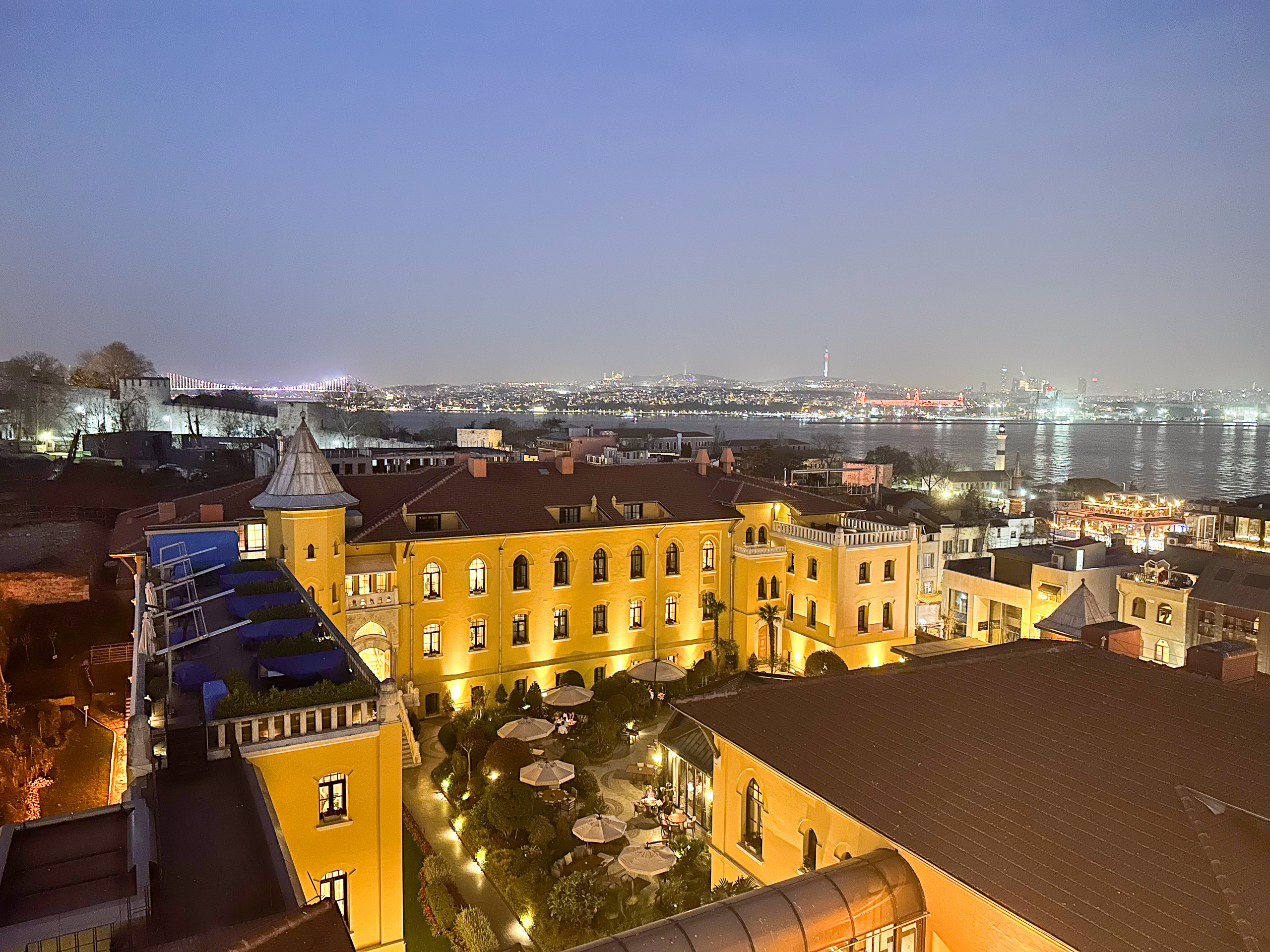
The streets running down to the water at dusk, from the roof. The hammam is under them.
The address is the argument. Everything else here is good; nothing else here is unrepeatable.
Who it is for, and who it is not
Come for two or three nights of the old city on foot, for a first visit to Istanbul, or for the roof at sunset. Walk to Hagia Sophia at opening rather than after breakfast. Take the tram or a boat rather than a car when you cross to the modern city, because the traffic on the bridges will otherwise decide your evening for you.
Look elsewhere if a pool is part of what you are buying; the other Four Seasons in this city has one and this one does not pretend to. Look elsewhere for a week-long base: Sultanahmet empties at seven and fills with coach parties at nine, and the eating and drinking that make Istanbul worth a week are across the water in Karaköy, Beyoğlu and Cihangir. Every evening here involves a decision to leave. The Çırağan, on the Bosphorus, is the other way to do this city, and I have written it up.
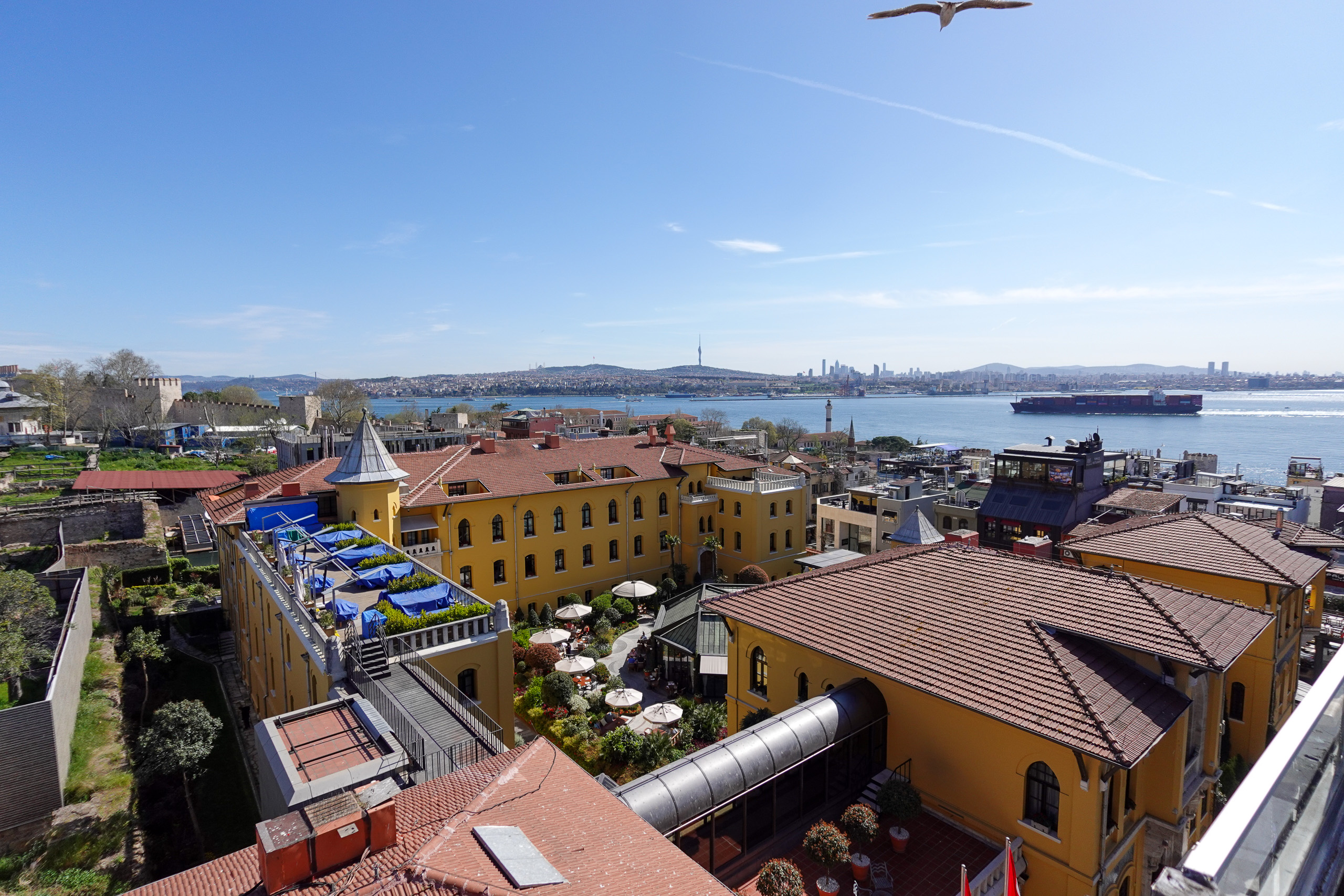
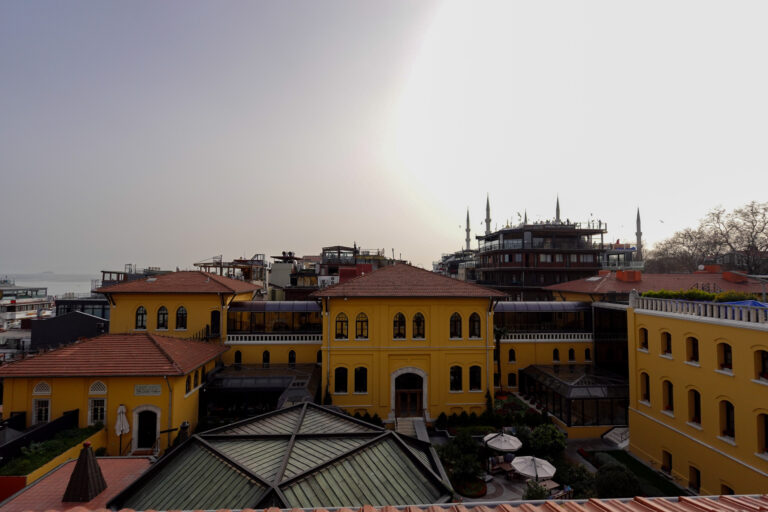
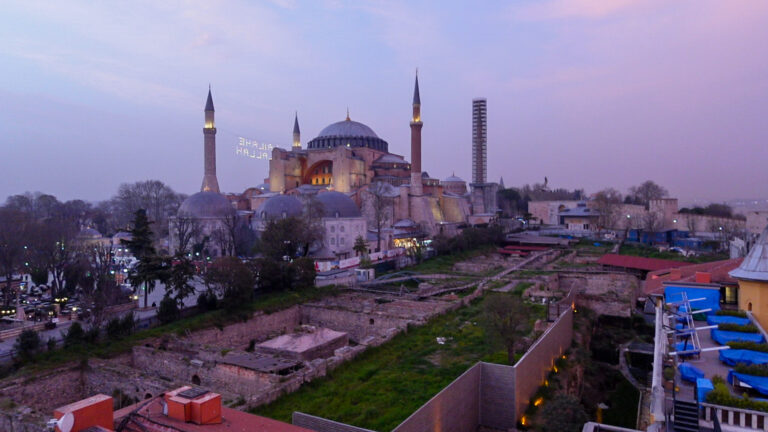
Daylight over the old town, shipping on the water beyond. Two hundred paces to Hagia Sophia, and this.
Bottom line
There is no other site like it in Istanbul, and the hotel knows not to compete with it. Book a courtyard-facing Deluxe for two nights, and be on the roof half an hour before sunset.
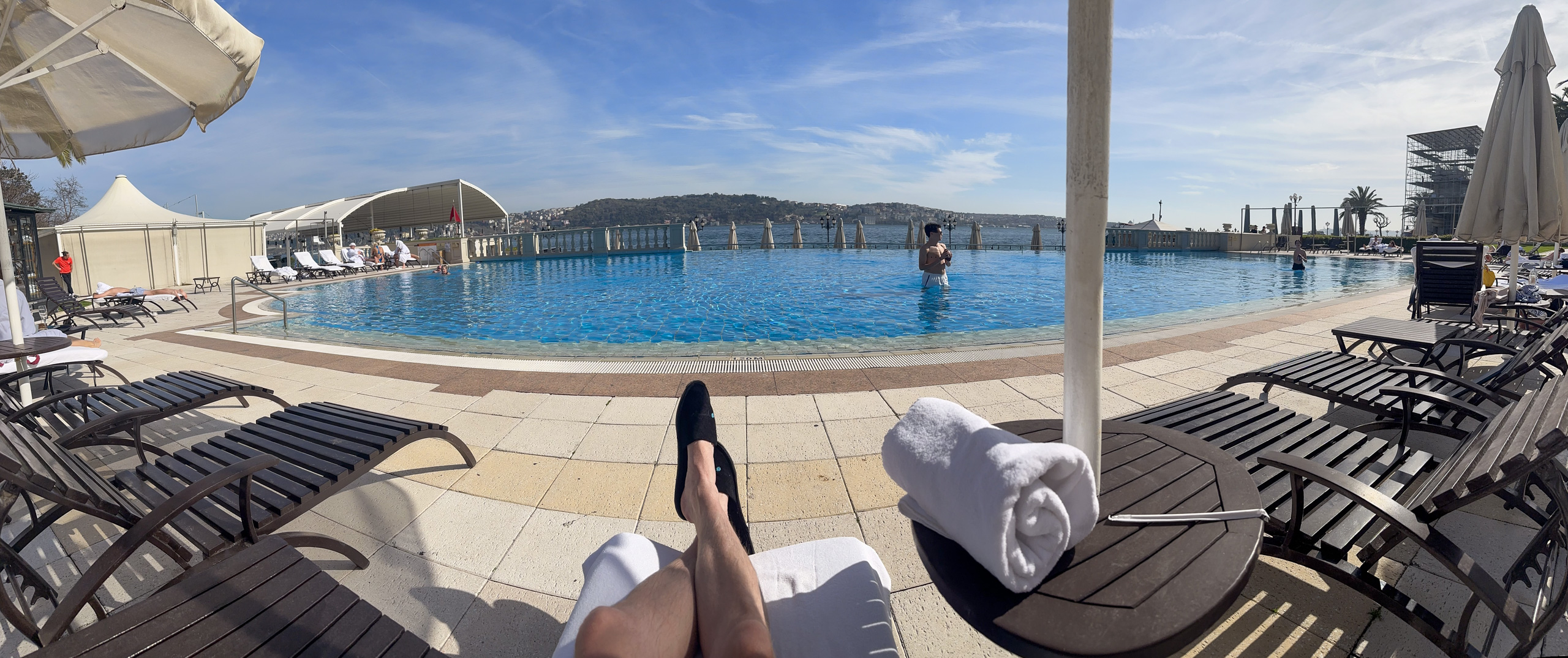
The pool is six or seven metres from the Bosphorus and about a metre above it, and the first thing that happens when you swim here is that a container ship goes past at what feels like arm’s length. It is the single most memorable amenity in Istanbul, it belongs to this hotel and no other, and it is the honest answer to why people book the Çırağan and keep booking it.
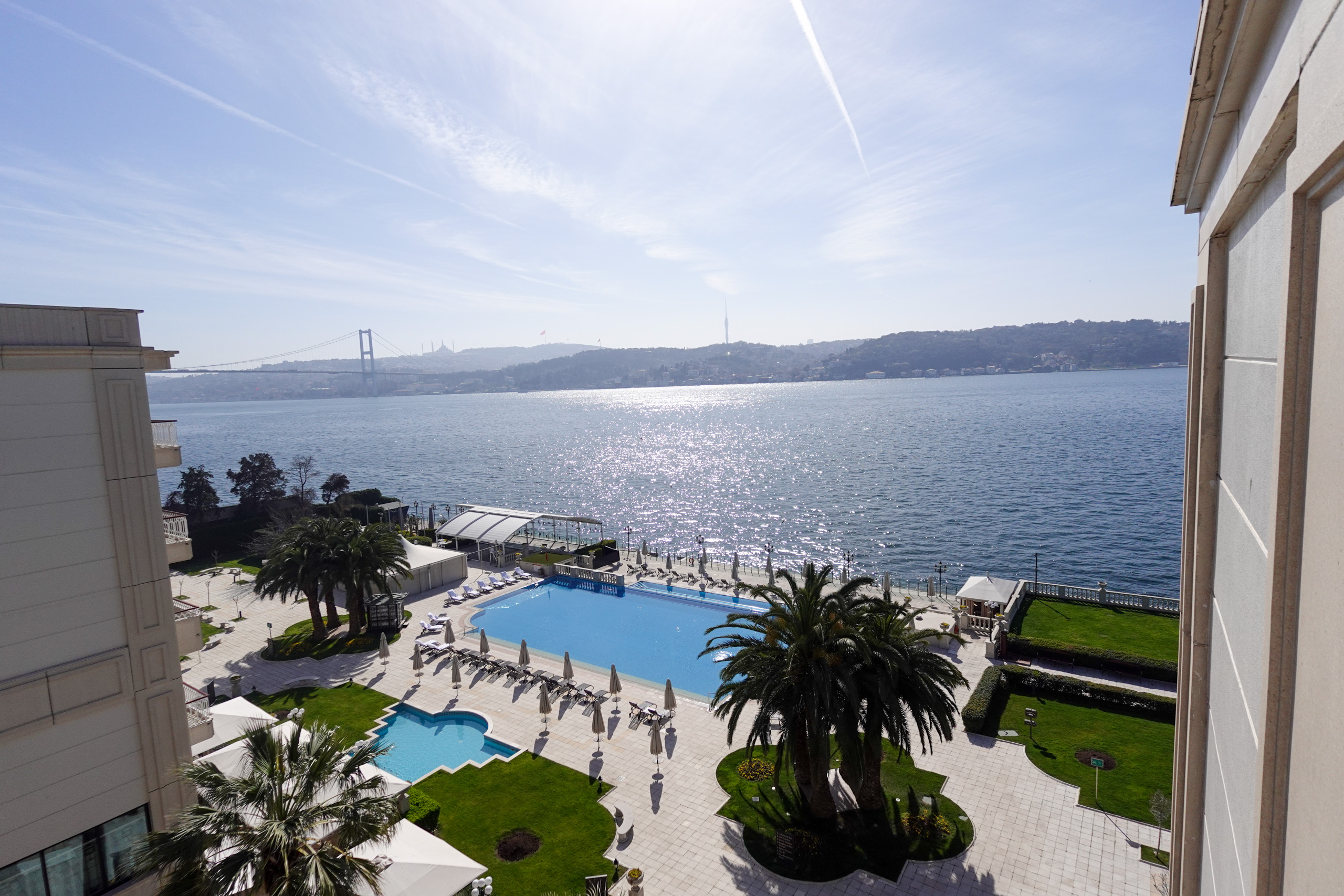
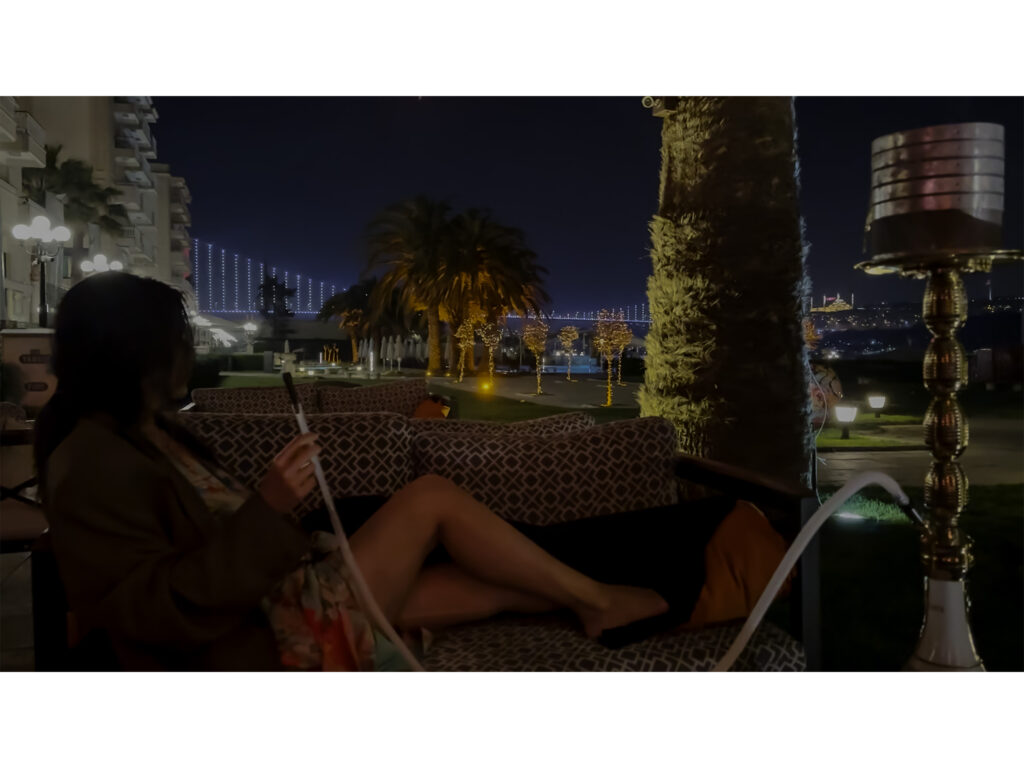
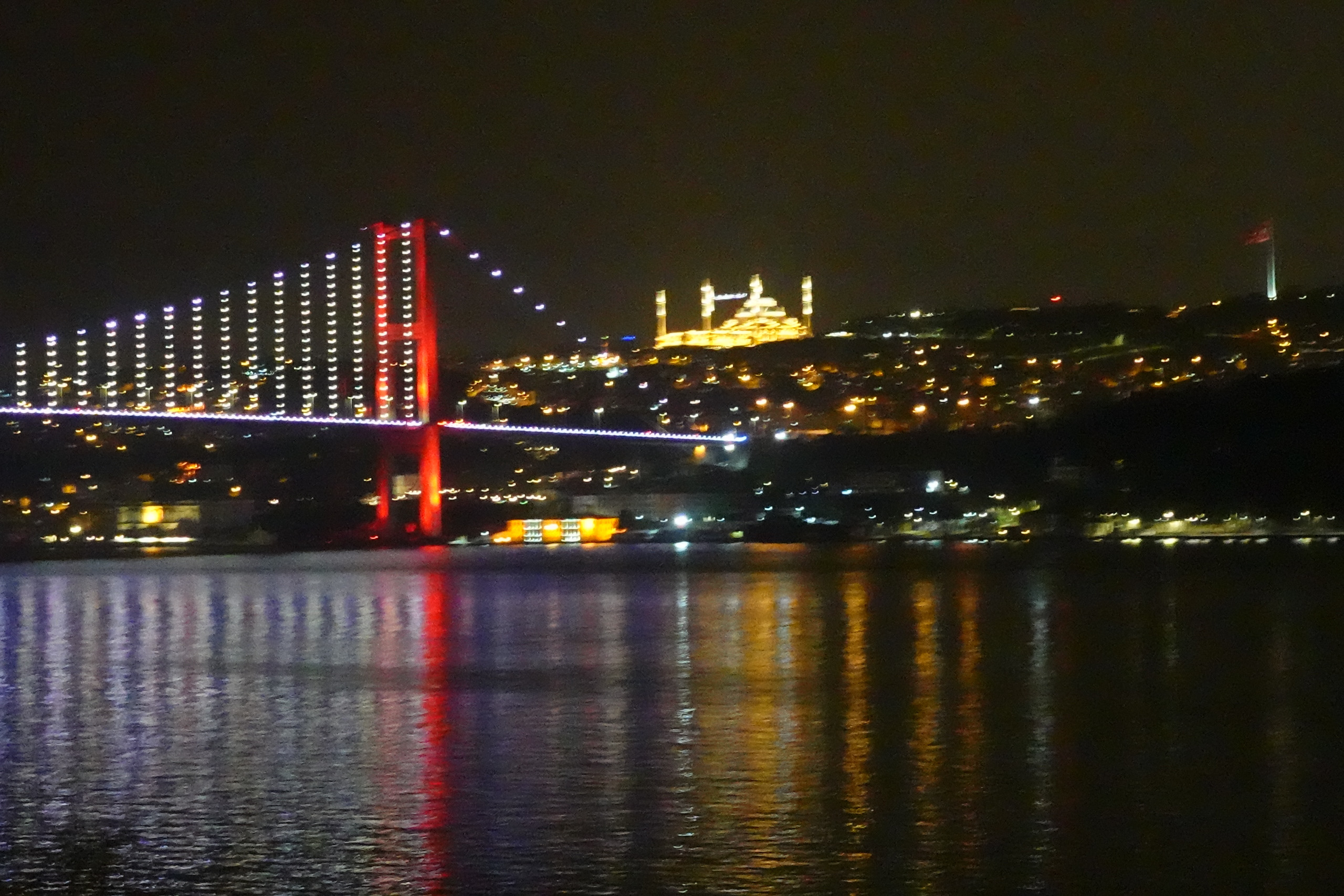
The address is on the European shore, on the last piece of open waterfront before the city closes up again. From the terrace you can see the bridge, the Ortaköy mosque, and a strait that has been the busiest thing in the neighbourhood for three thousand years — and at the heart of the property stands the last sultan’s palace itself, restored, open to its guests, and carrying a history wing the equal of any publicly accessible hotel anywhere. Smoke a hookah on the deck!
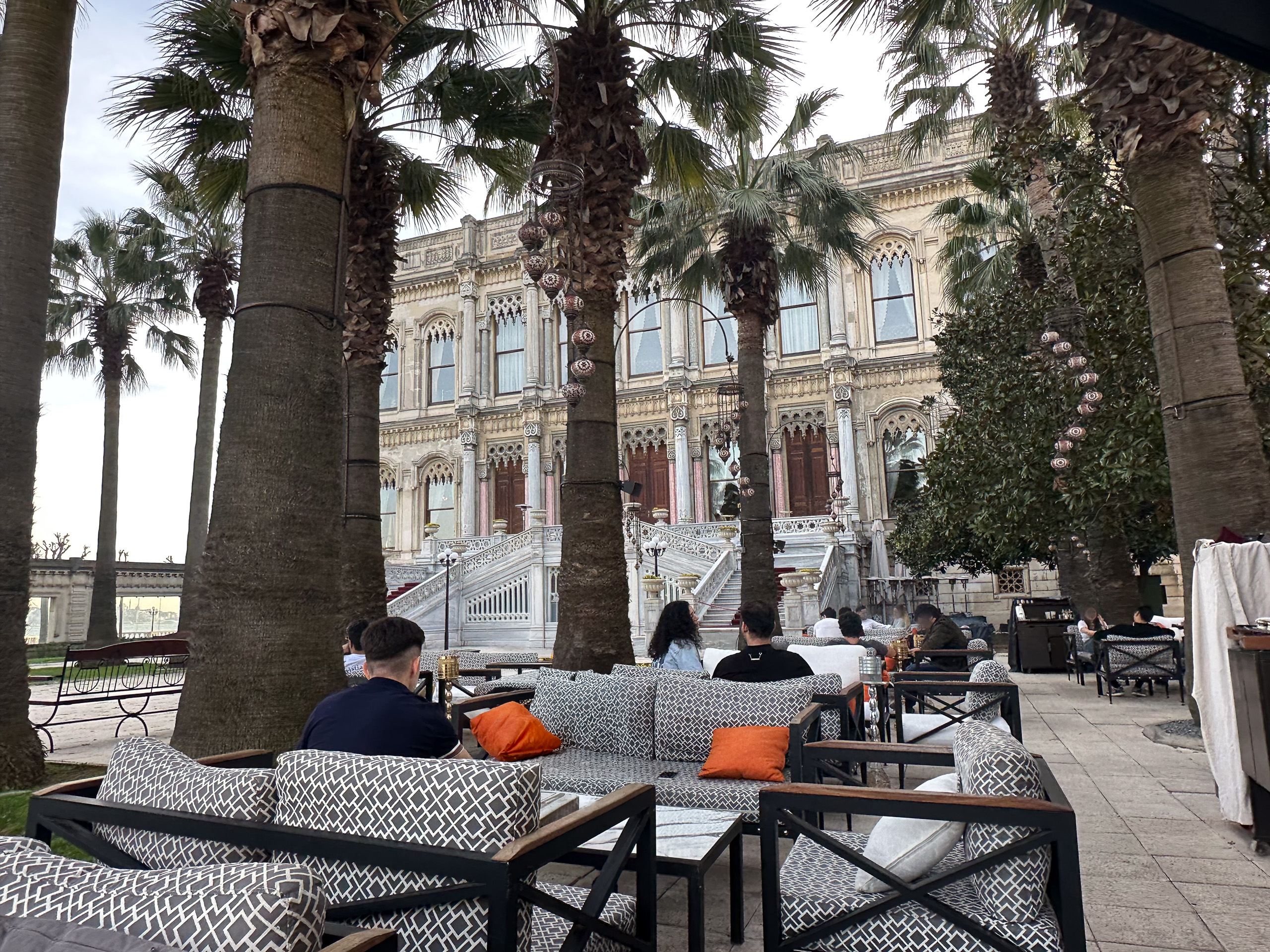
The palace through the palms, from the terrace café. Ask the front desk for the tour.
Ask the front desk for a tour of the palace side and they might take you into the sultan’s suites themselves. They took us into the one a very famous guest had left the week before — J.Lo, since you ask. The palace suites book like anything else on the property, and we are already plotting the return trip that puts us in one.
The front drive at peak arrival is the one soft spot: the road, the security check and the volume of cars combine into a bottleneck nobody on the property can really solve. Arrive at four and you will be the only car. Arrive at six and you will meet everyone else’s.
The room
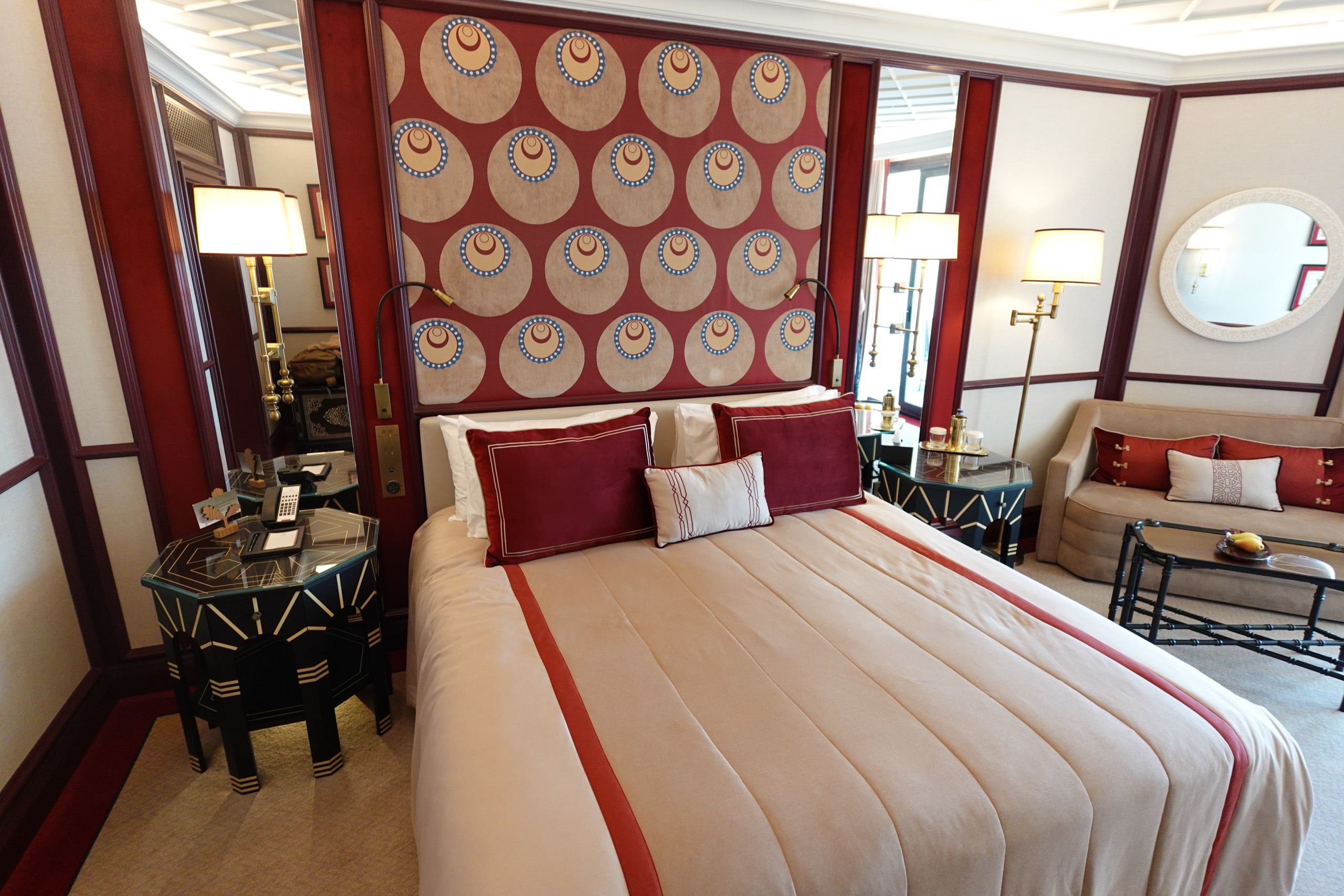
I had a Superior Bosphorus View room. The decoration is committed Ottoman revival: a tall headboard of gold medallions on deep red, red bolsters, an octagonal black and gold side table, red-framed panelling. It is not the pale, quiet beige the rest of the luxury industry has converged on, and by day three I preferred the commitment.
Ottoman revival, without apology.
The proportions are generous, the storage is generous, the bathroom is marble and large, and everything works. The corridors are wide and quiet. Book a Bosphorus-facing room in writing and confirm it again the week before: the water side is serene, the land side is a main road, and the rooms know the difference.
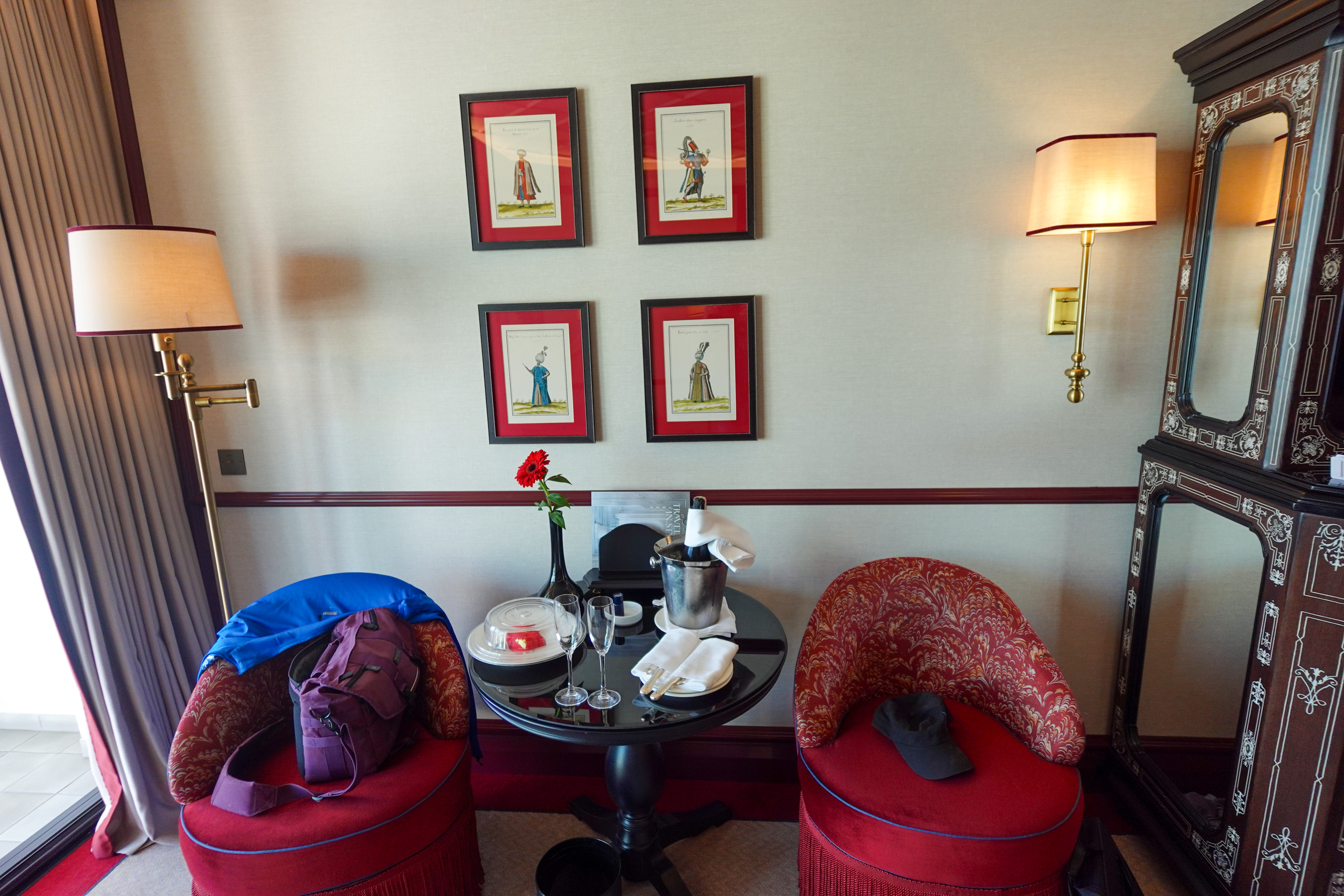
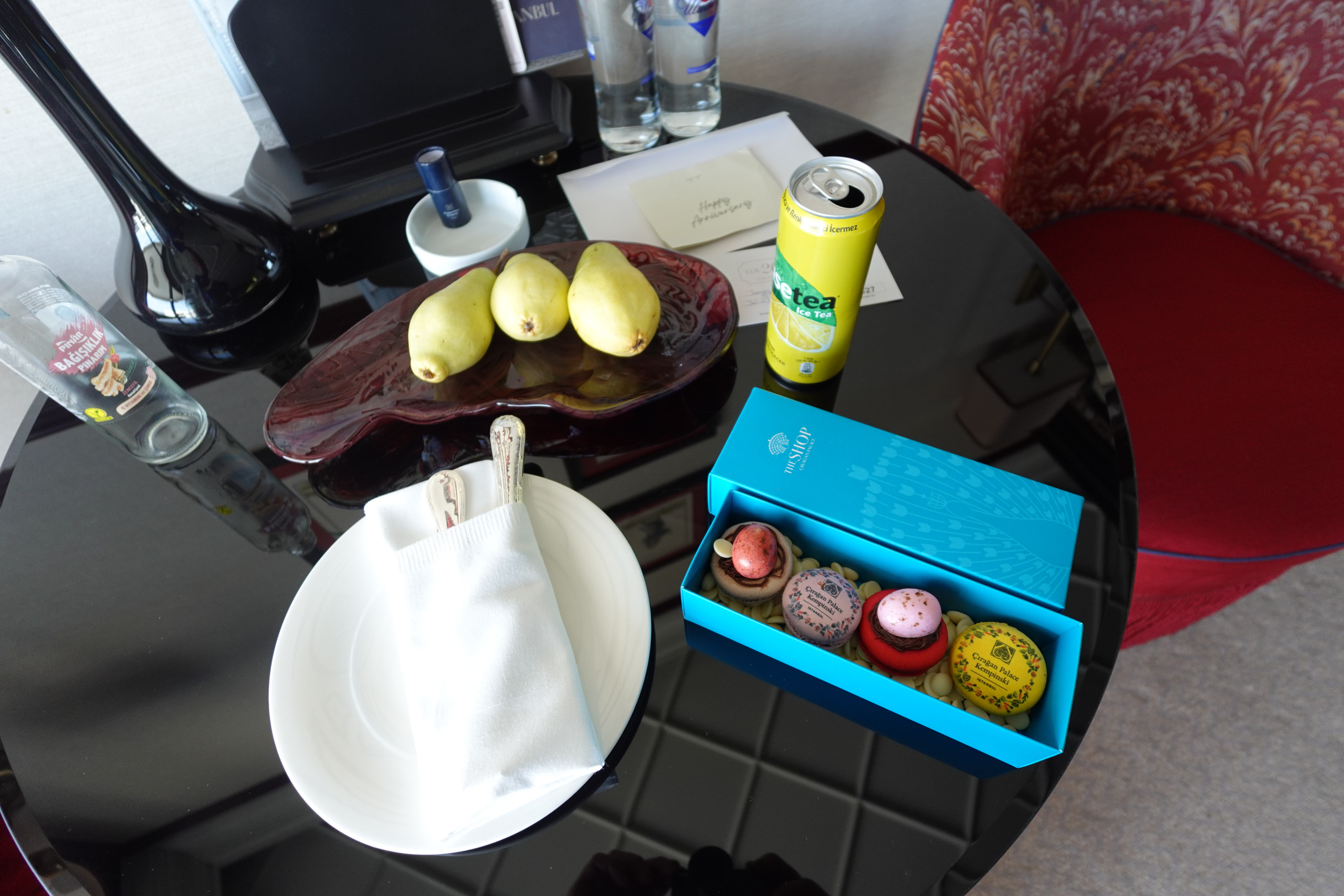
The two red tub chairs, the ice bucket, the prints.Macarons, lemons and a drink, waiting on the desk.The engraving over the bed, dated 1577.
Noted
Observed on the stay, not measured.
What
Checked on the stay
WiFi
Strong in Room, Spotty through property
Noise
Quiet in the room; Çırağan Caddesi is audible on the land side, call to prayer each night through the window. Blackout curtains weak.
Bed
King, medium-firm
Water pressure
Strong and hot
Walk to Ortaköy
About fifteen minutes along the shore
Eating
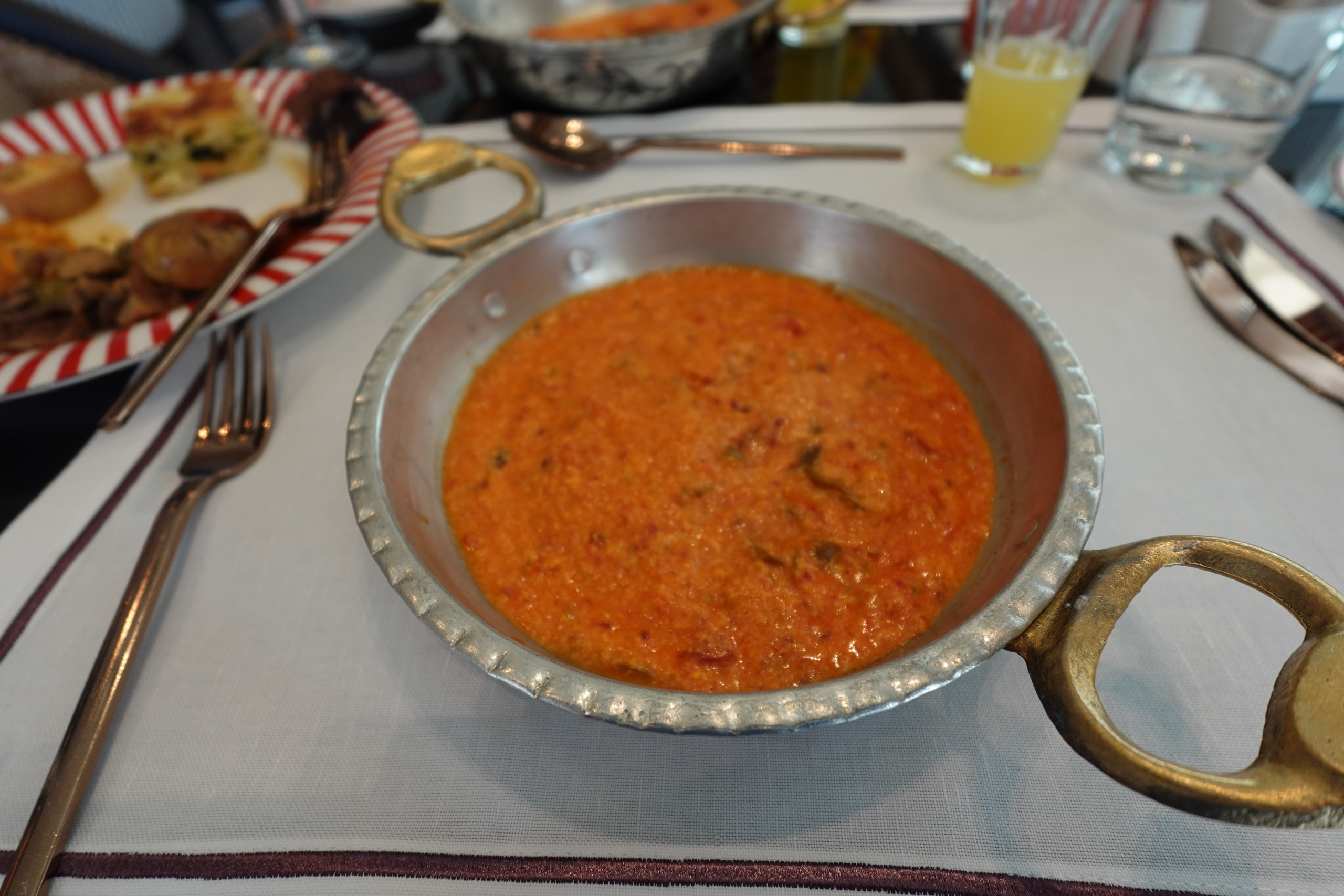
Breakfast is the meal that tells you where you are. A proper Turkish spread rather than a European buffet with olives added at the end, and the thing to order is menemen, brought to the table in its own copper pan and still moving. Ask for Turkish coffee rather than filter, and take the second one. Have breakfast included and eat it outside every morning the weather allows.
Breakfast on the terrace: the copper pan of tomato and egg, plates set around it.
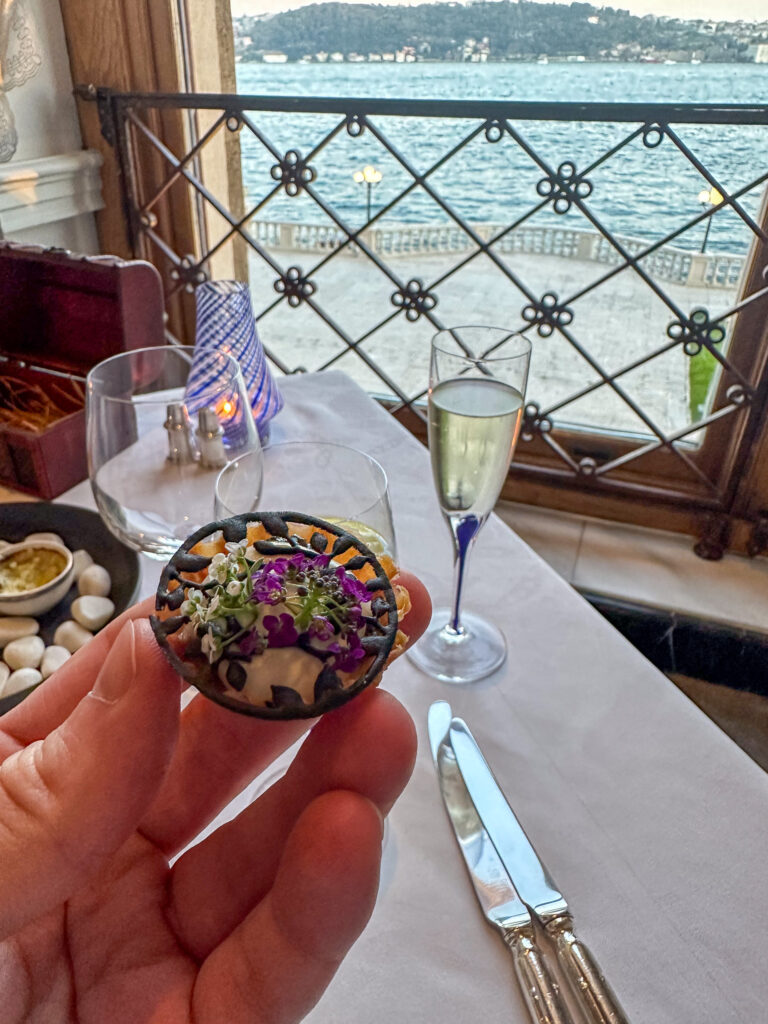
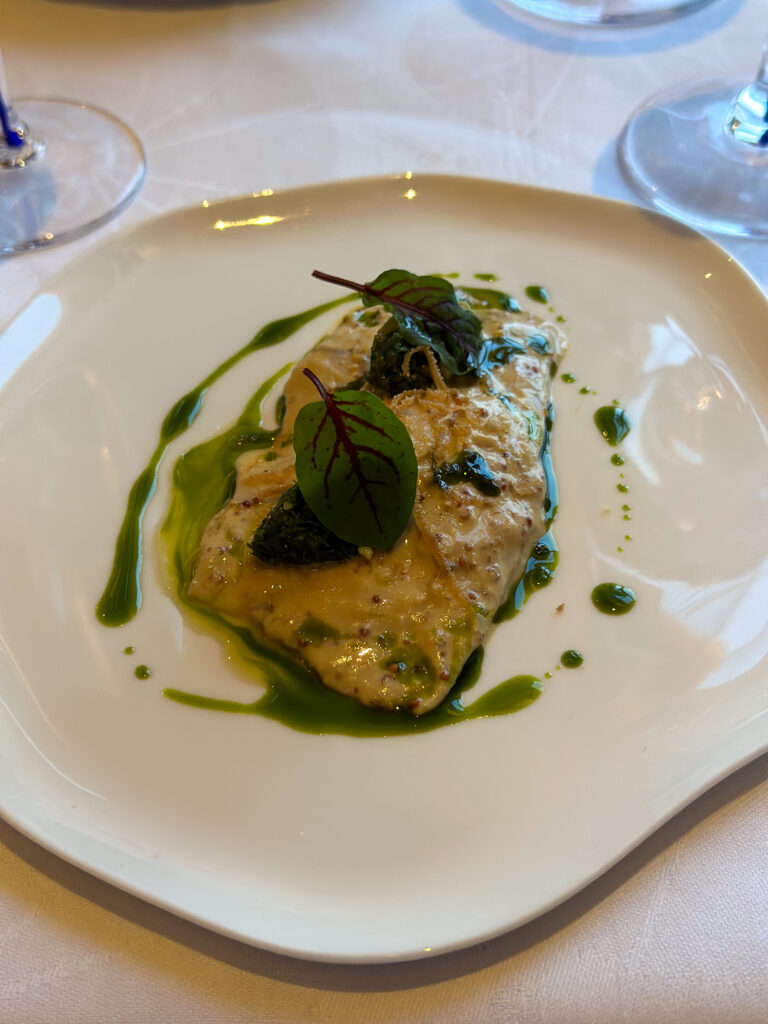
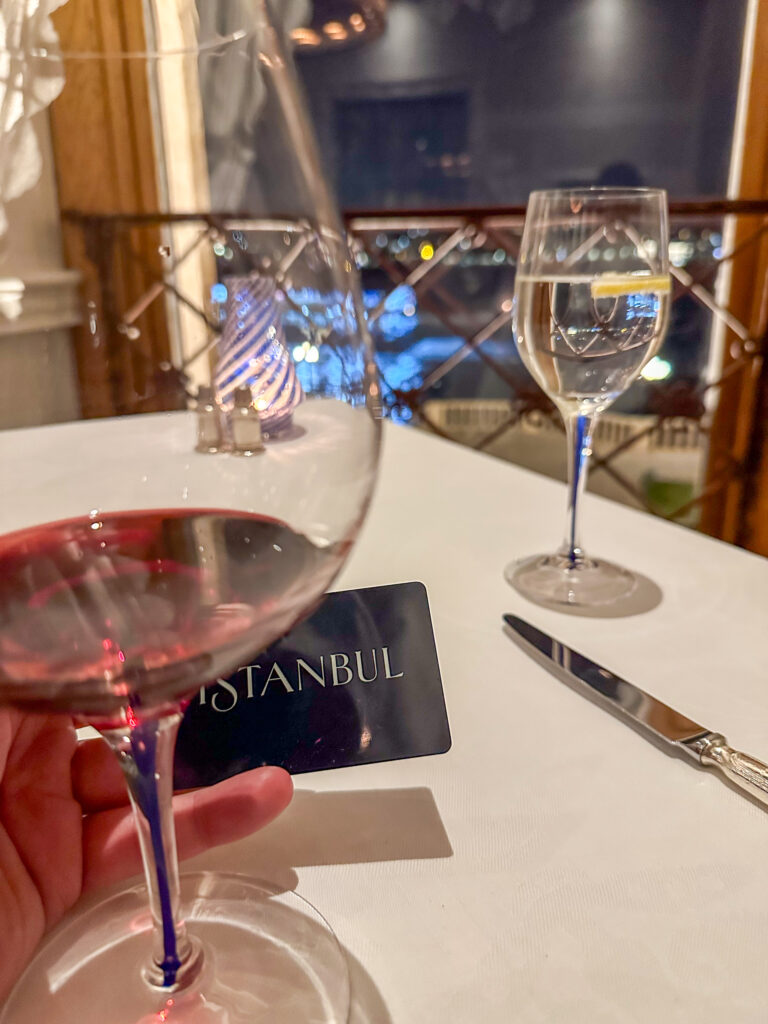
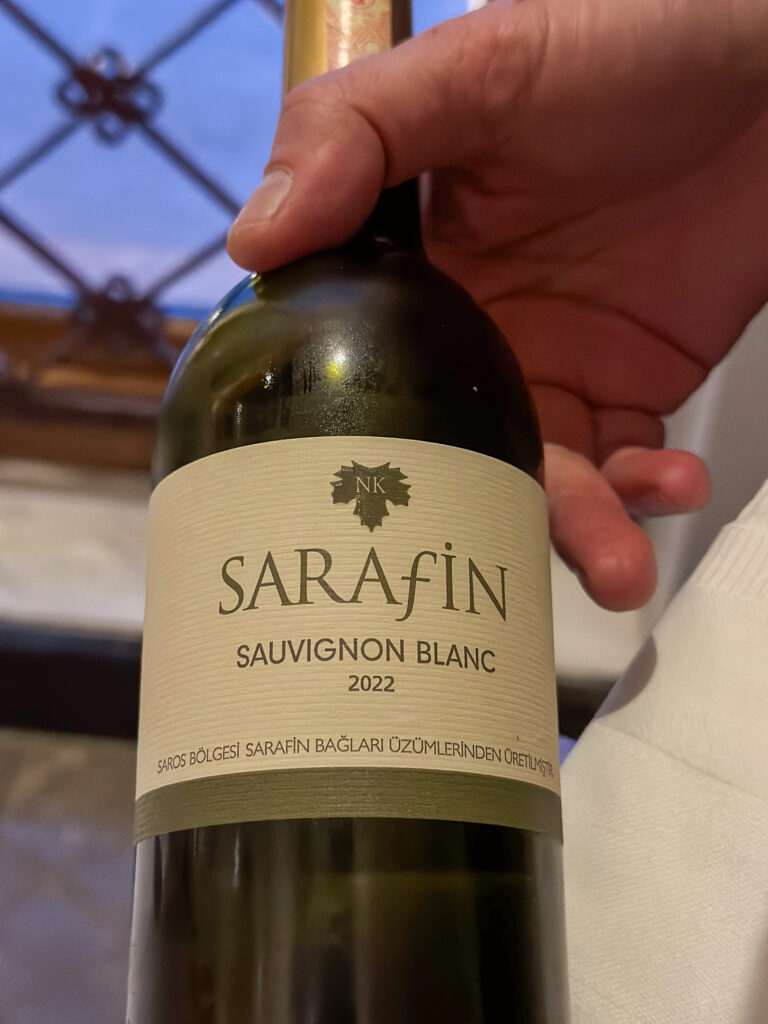
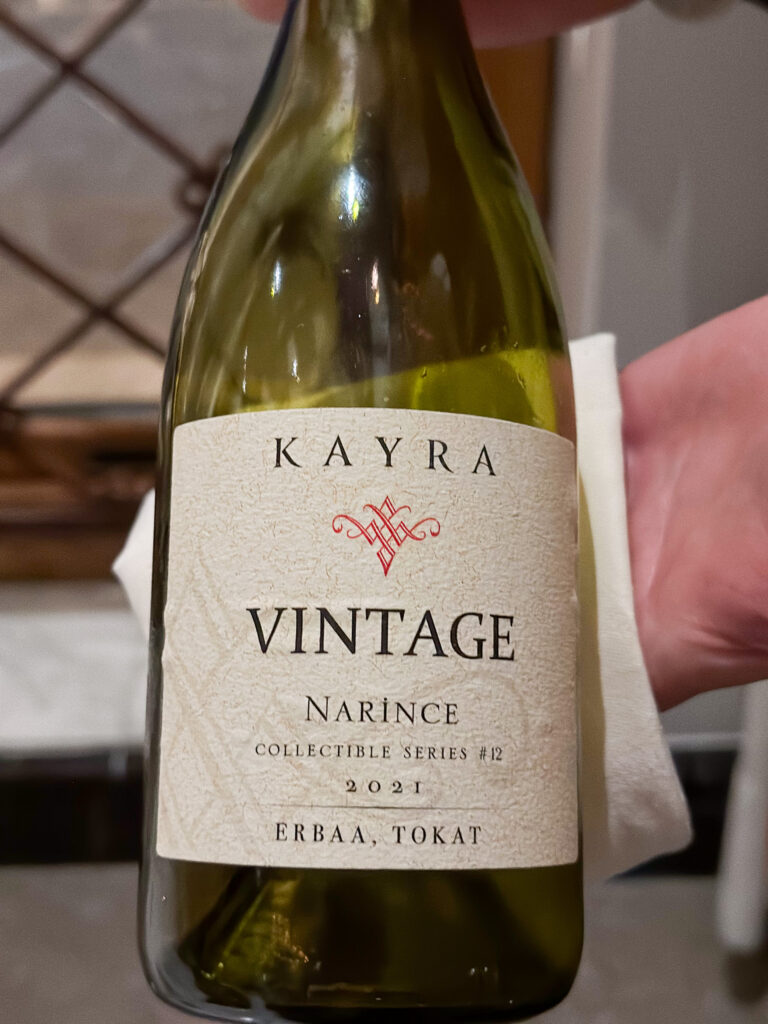
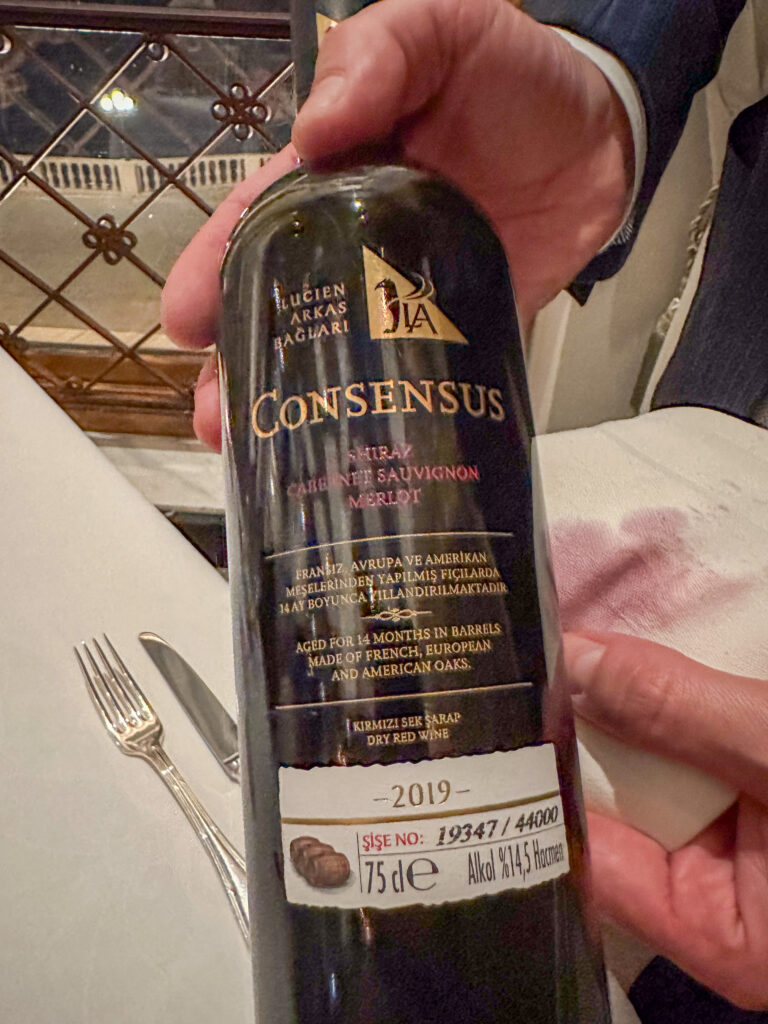
And then Tuğra, in the palace itself, which is the dinner to plan the trip around: EXCEPTIONAL, and a must-do before death. You eat under the palace ceilings at a table overlooking the Bosphorus, and the sommelier packages Anatolian wines from around the region in a way that is unreasonably good. Who knew Turkey had excellent wine? Everyone except Americans, it turns out. What you get is a truly world-class introduction to the finest varieties this country grows, paired with delightful Turkish cooking, in the last sultan’s palace. Book it before you fly.
The first bite, held up to the window.A course under green herb oil.The window table, the strait beyond.
A Sarafin white, shown first.Kayra’s Narince — the grape to learn.The reds arrive with the dark.
The pool, the palace and the art
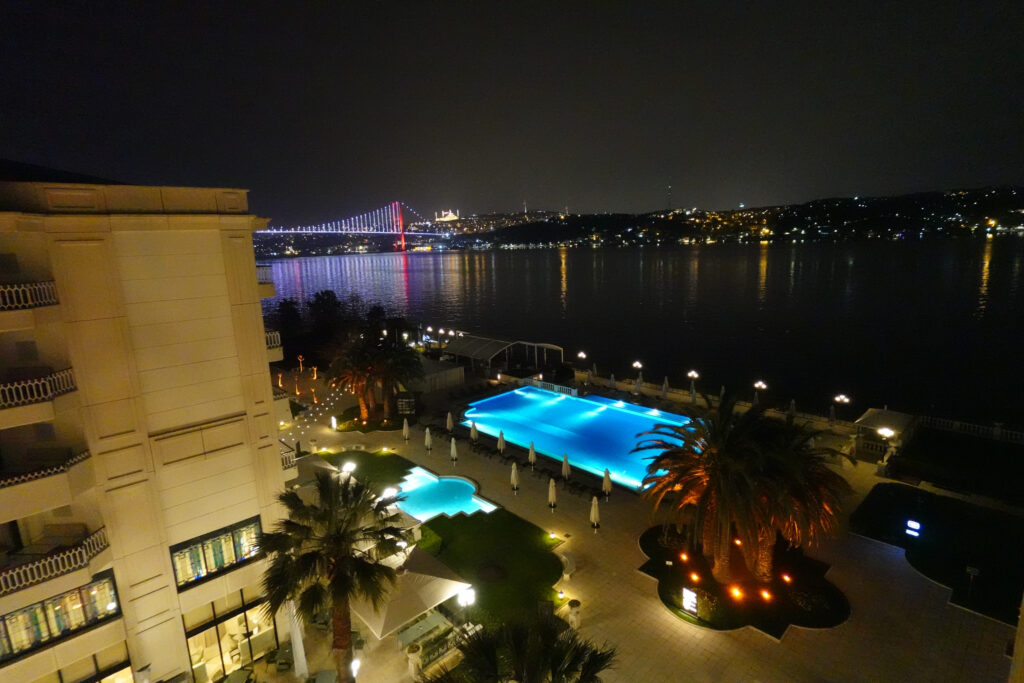
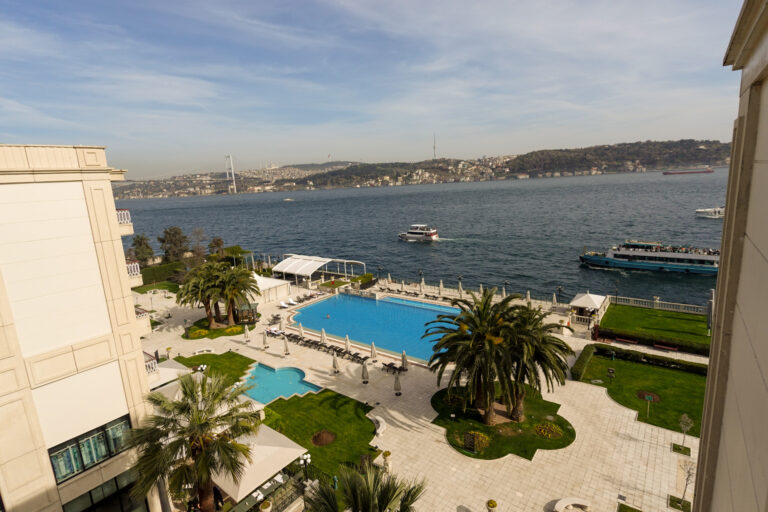
By day the pool sits in a lawn of palms with the strait immediately beyond it and the bridge in the distance, and the light comes off the water and back up at you all afternoon. By night it is lit turquoise against black water and the bridge changes colour on a cycle behind it. Go early and take a lounger on the water side; by eleven in April the good ones were gone, and in summer that will happen an hour earlier.
Mid-morning. The shipping lane is roughly where the far palm is.
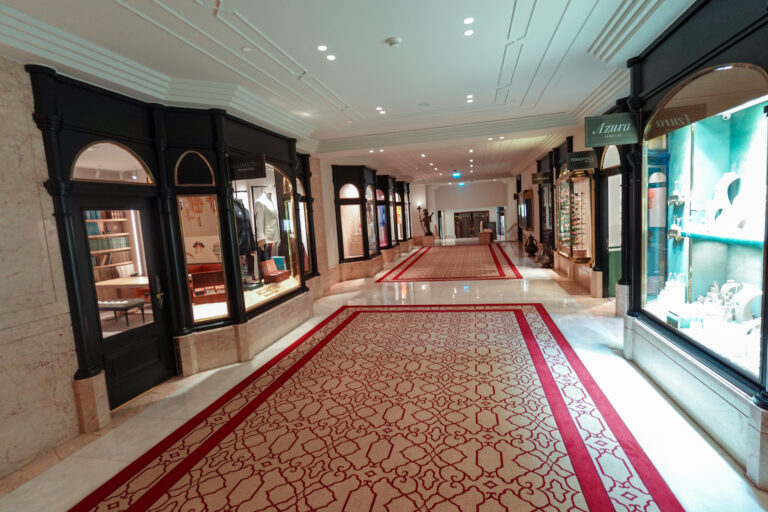
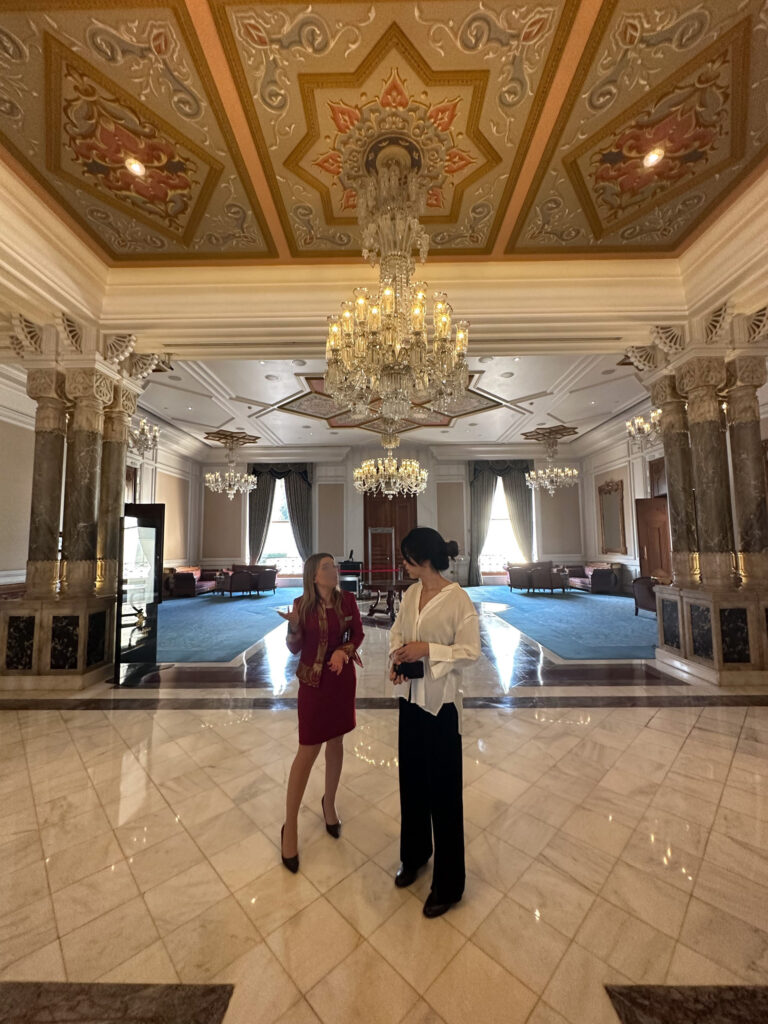
The artwork throughout the hotel is extremely well done — well chosen, well hung, and worth several unhurried hours of wandering. The gallery through the palace is black and white marble underfoot, palms in patterned urns, lantern chandeliers, and mirrored panels that make it read longer than it is. Slow down through all of it; the walls are half the collection.
The history wing: patterned red carpet to a lit window, and art worth hours on the walls either side.
There is a hammam and a spa, and a terrace above the water where the hotel will set up a nargile in the evening. It is the sort of thing that could easily be a costume, and here it is not: set up properly, at the rail, at dusk, the best hour of the day to be outside on this property. Take it after dinner rather than before.
The nargile at the rail after dark, the city lit across the water. This is the hour.The long pool from a lounger, towel rolled, the strait doing what the strait does.
Service moments
Warm, formal and slightly old-fashioned, in keeping with everything else. Requests are met without fuss and without the performance of being met. The copper pan arrived at the same table every morning after the first without my asking, and the coffee with it.
And the moment that tells you everything. A screw came loose from my eyeglasses and fell to the floor of the room — a part so small you would not find it if you knew it was there. Housekeeping found it cleaning, walked it to the front desk, and the manager brought it to me presented like it was the Sultan’s jewel. I cannot stress how small this item was. That is what clean means here, and what care means.
The marble lobby, a circular ottoman under a palm. Arriving at four and arriving at six are different hotels.
Who it is for, and who it is not
Come for a view-first stay, an occasion, the pool season, or simply the most outsized value at this level in the city. Walk to Ortaköy along the shore in the evening rather than taking a car; the traffic outside will take longer than your legs will. Boats along the Bosphorus leave from a short walk away and are one of the great cheap pleasures of the city, which is worth remembering on a property that will happily arrange a private one.
Look elsewhere only if you want a small hotel where the desk knows your name by the second day — the Four Seasons in Sultanahmet does that, and I have written it up. It has no pool, no palace, and no ships at arm’s length. Nothing in this city is simple.
The bridge at night, the mosque floodlit on the far shore. The Four Seasons does not have this. It also has no pool.
Bottom line
A beautiful hotel and a tremendous value, with the last sultan’s palace at its heart, art worth an afternoon, and a dinner at Tuğra you should not die without. Book the water side in writing, and ask for the tour.
How it was booked Direct with the hotel, public rate
What the channel bought Nothing beyond the public rate.
Value verdict Worth it for one or two nights; a week is too long here.
When to go Whenever — it will be mostly inside. Book this stay
Booked the way any other guest would book it.
Arrival
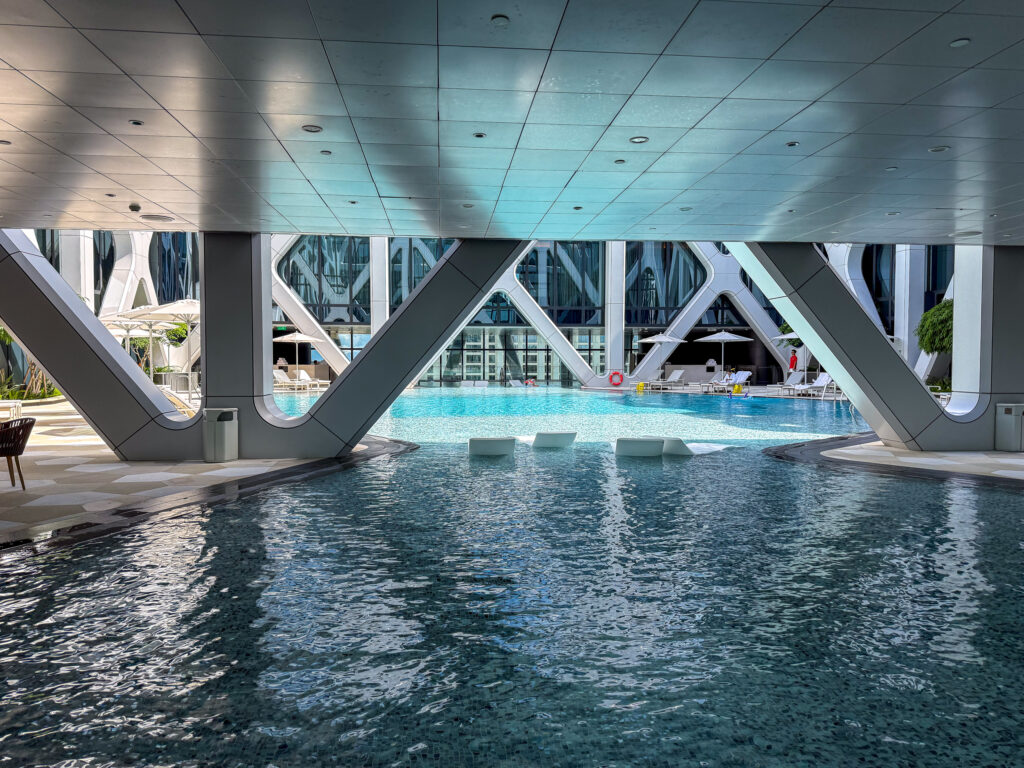
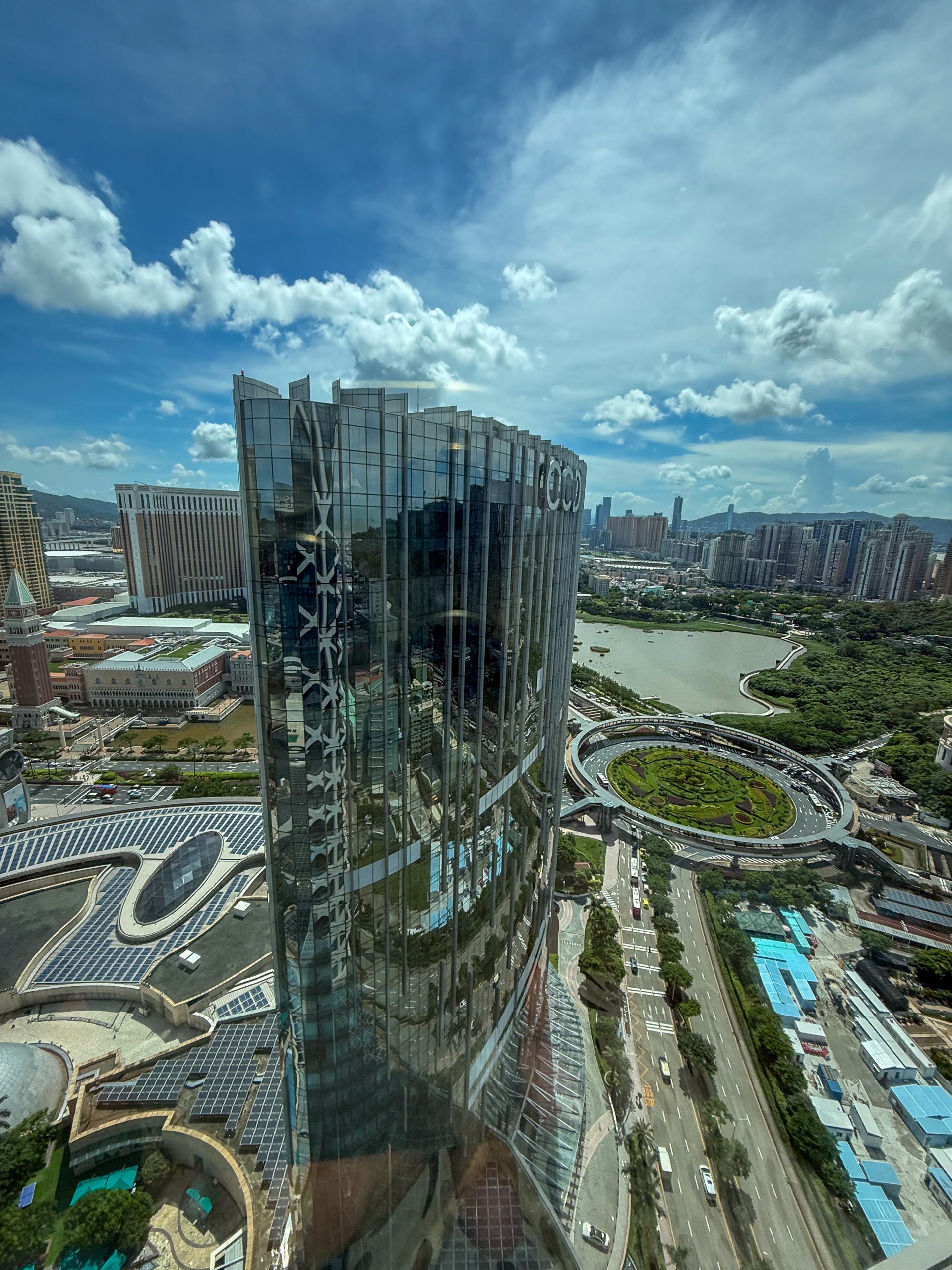
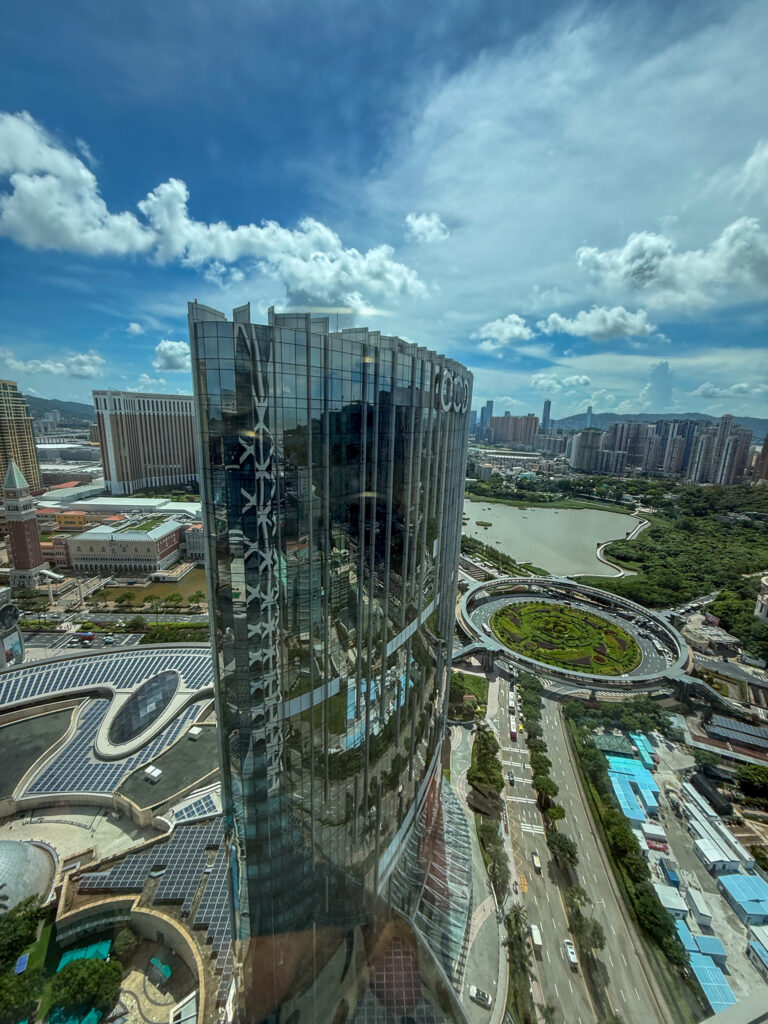
You notice the holes first. Morpheus is two towers joined at the top and bottom, with three voids punched clean through the middle, and from the ground you can see sky and the far side of Cotai straight through a building that is nothing but hotel. Nothing about it looks structurally possible, which is the point, and which is why people with no interest in Macau come to Cotai to stand underneath it.
The frame that holds it up is on the outside, wrapped around the glass in a lattice that thickens where the loads are and thins where they are not, so the shape of the structure is a diagram of what it is doing. Inside, that means no columns: an atrium the full height of the building with glass lifts crossing it diagonally, corridors without interruptions, and rooms with an unbroken wall of glass because nothing needs to stand in it.
The frame is the building. Everything inside it is hanging off that.
The exterior is a more interesting object than the interior is a place. The lobby is dramatic and slightly cold, and the corridors, column-free and curved and uniformly lit, are the least legible I have walked in any large hotel. For the first day I found my room by reading the numbers, like a person. By the second I had learned the carpet.
The room
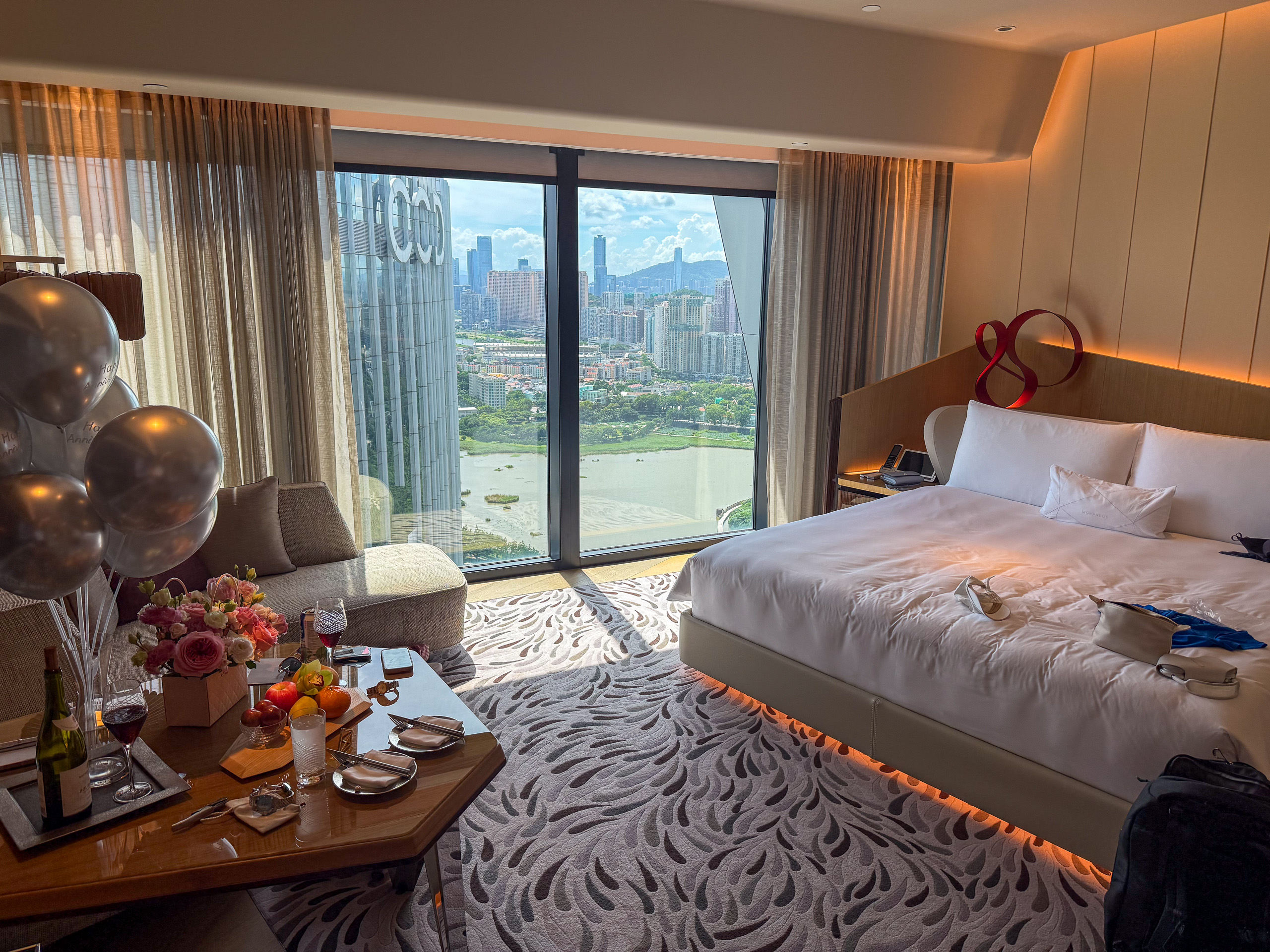
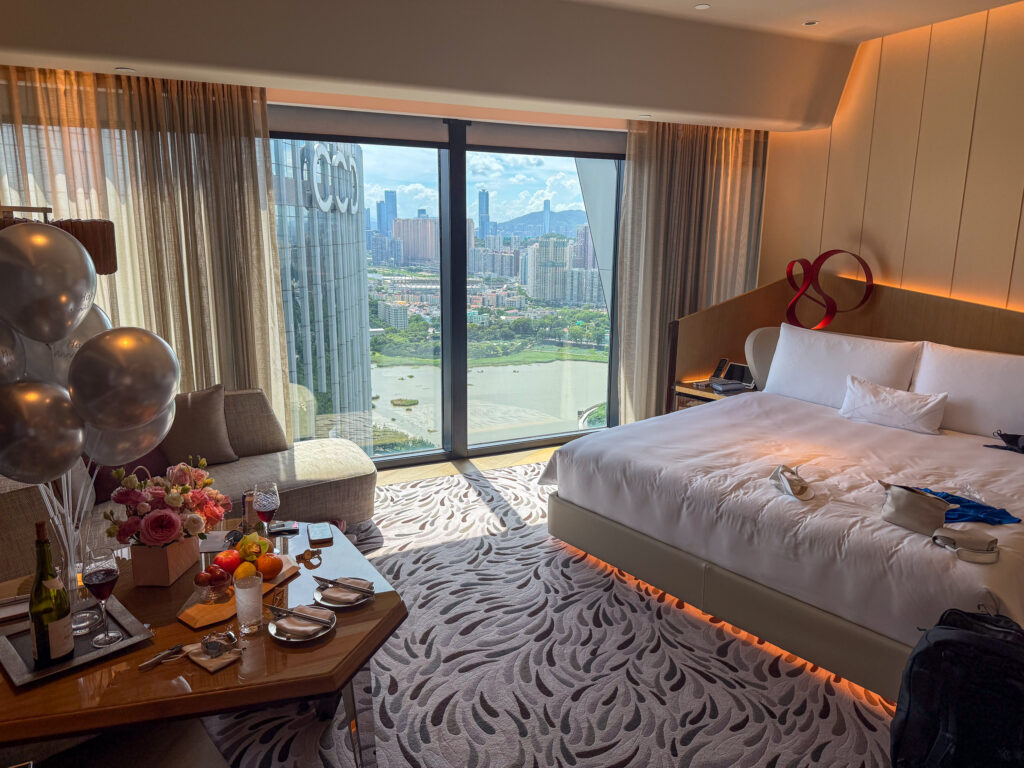
I had a Deluxe King on a high floor facing Cotai. It is a big, calm, pale room organised around the glass: bed placed to face out, a low timber headboard, one red sculptural piece on the wall doing the work a picture would normally do, and a carpet with a pattern that reads as the exoskeleton if you look for it and as nothing much if you do not.
The hotel set the table up before arrival. The view does not need the help.
The hotel had set the table before I arrived, with balloons, flowers and a board of fruit, which is either charming or slightly much depending on the day you have had. On this occasion it was charming. The view on a clear afternoon runs across the whole strip to the lakes and then to the mountains on the mainland, and it is the best thing in the room by a distance.
The bathroom is where the building shows off: twin basins, a deep tub placed to see the window, a shower with pressure that arrives immediately, and enough marble to make the room feel colder than it is. Storage is generous and thoughtfully placed, which sounds like faint praise and is not; this is a hotel where people arrive for four nights with luggage for ten.
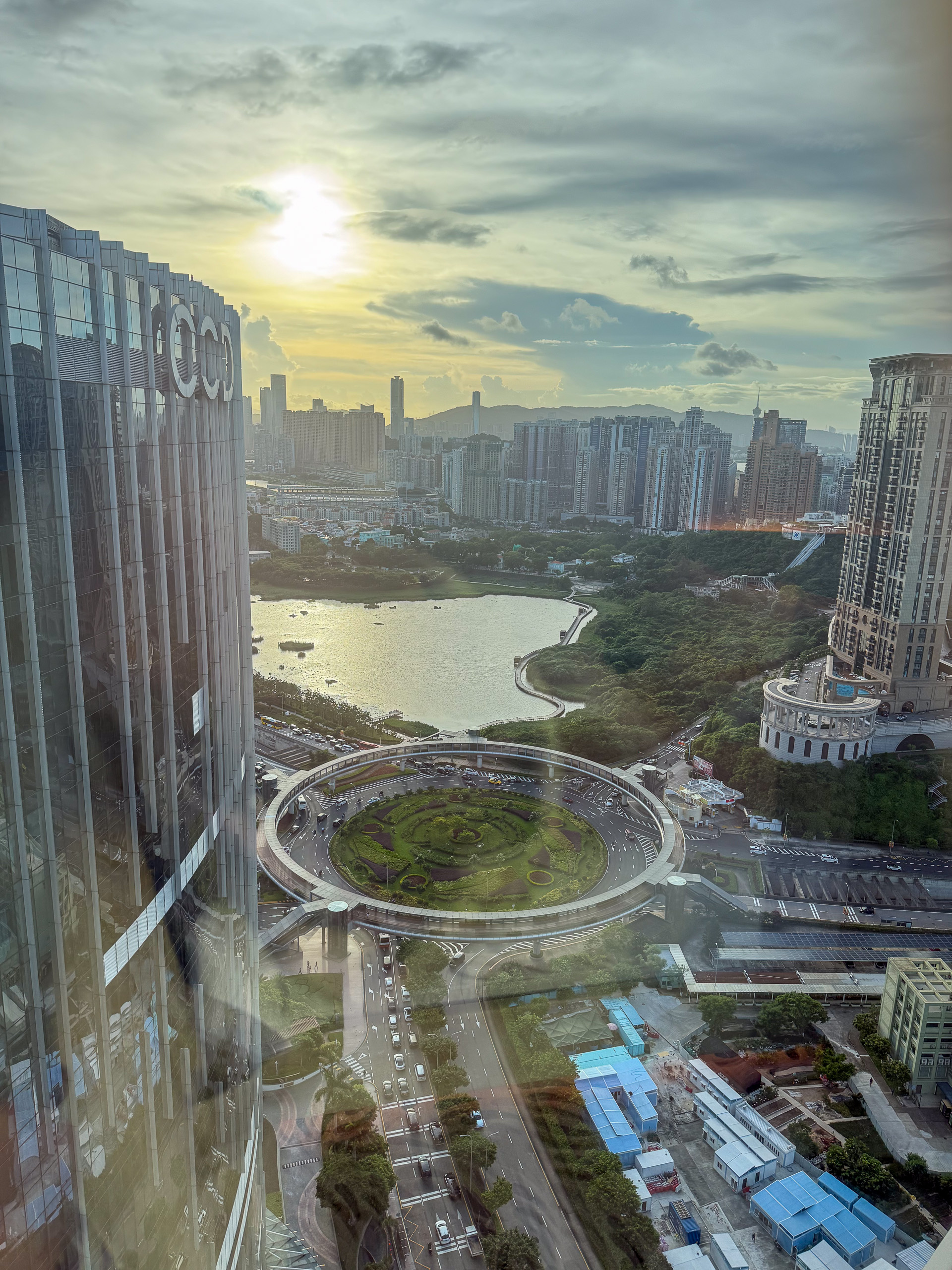
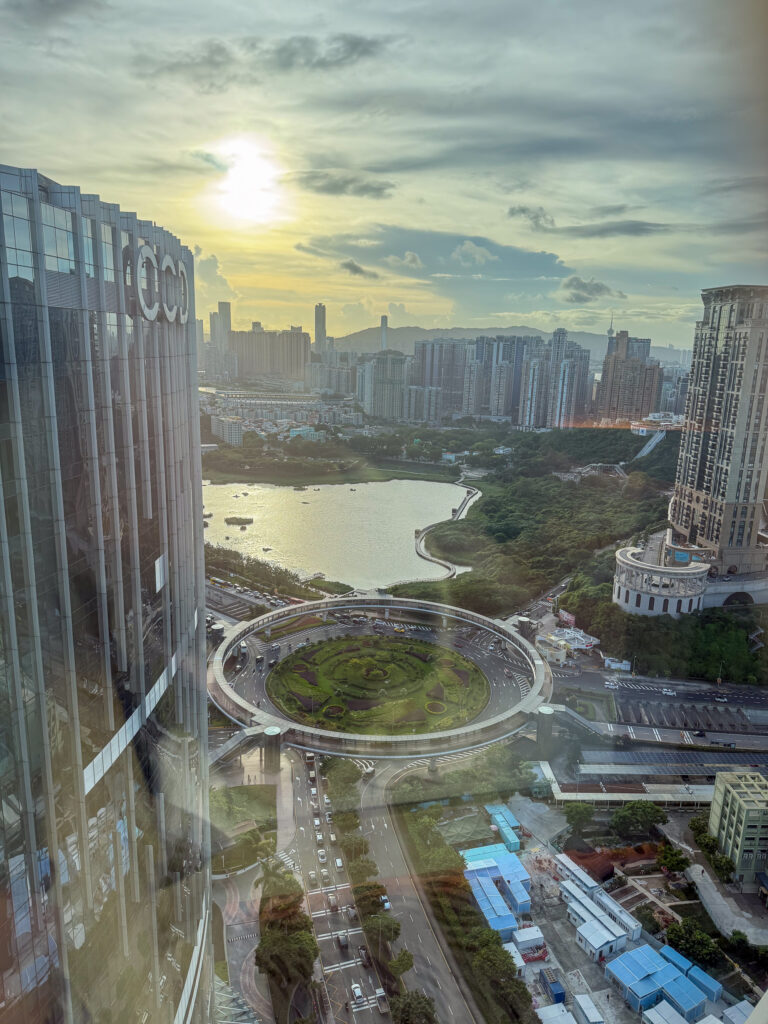
Cotai from the window: the lake, the ring, the shopping mall with a view.
Noted
Observed on the stay, not measured.
What
Checked on the stay
Pool
Runs from indoors out through the exoskeleton void
Noise
Silent on a high floor; the podium is not
Bed
Very comfortable, and the air conditioning is noiseless
Blackout
Perfect — automated curtains
Water pressure
High, and a beautiful shower
Wi-Fi
Fast, no drop-outs
Walk to the theatre
Under ten minutes, all of it indoors
Eating
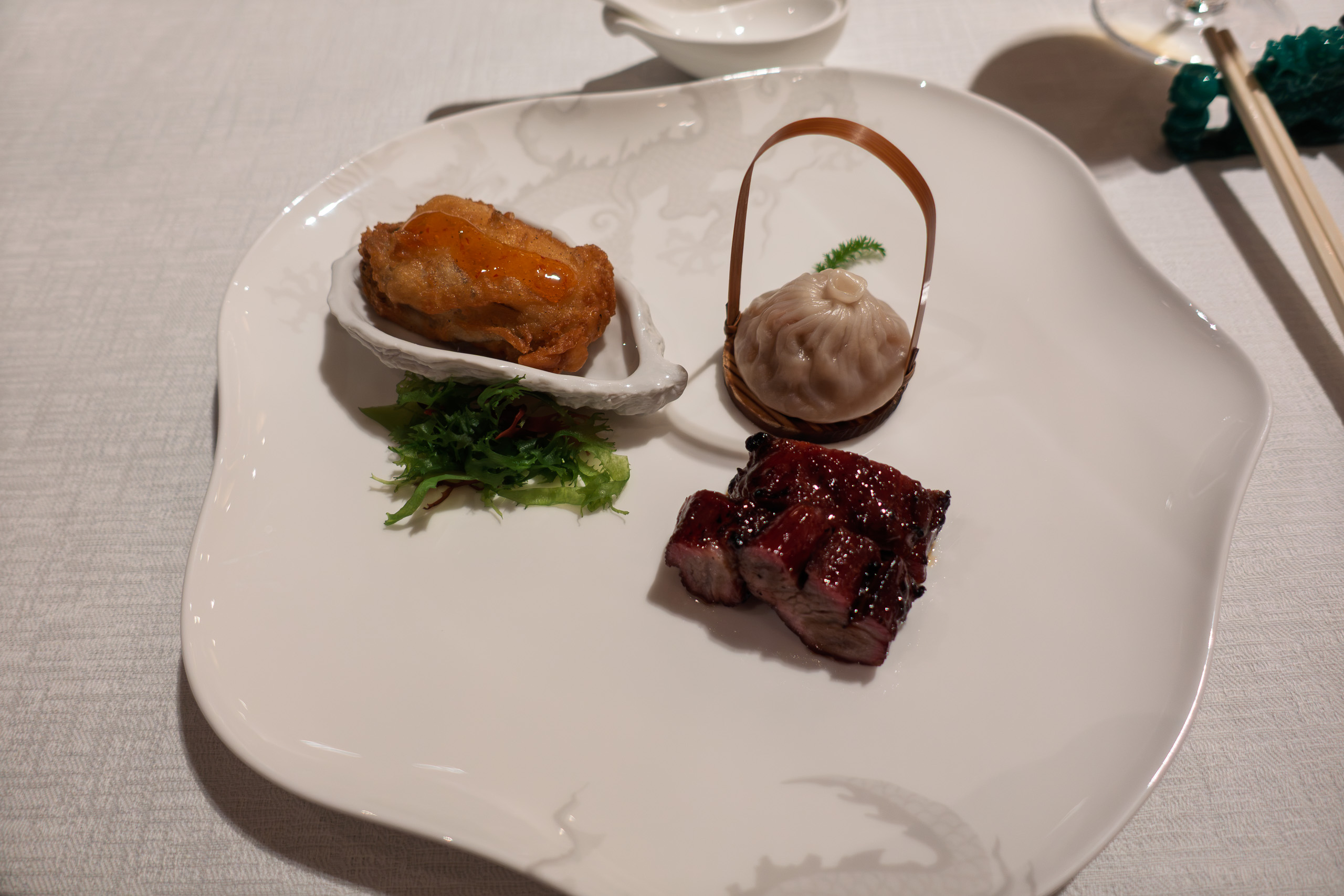
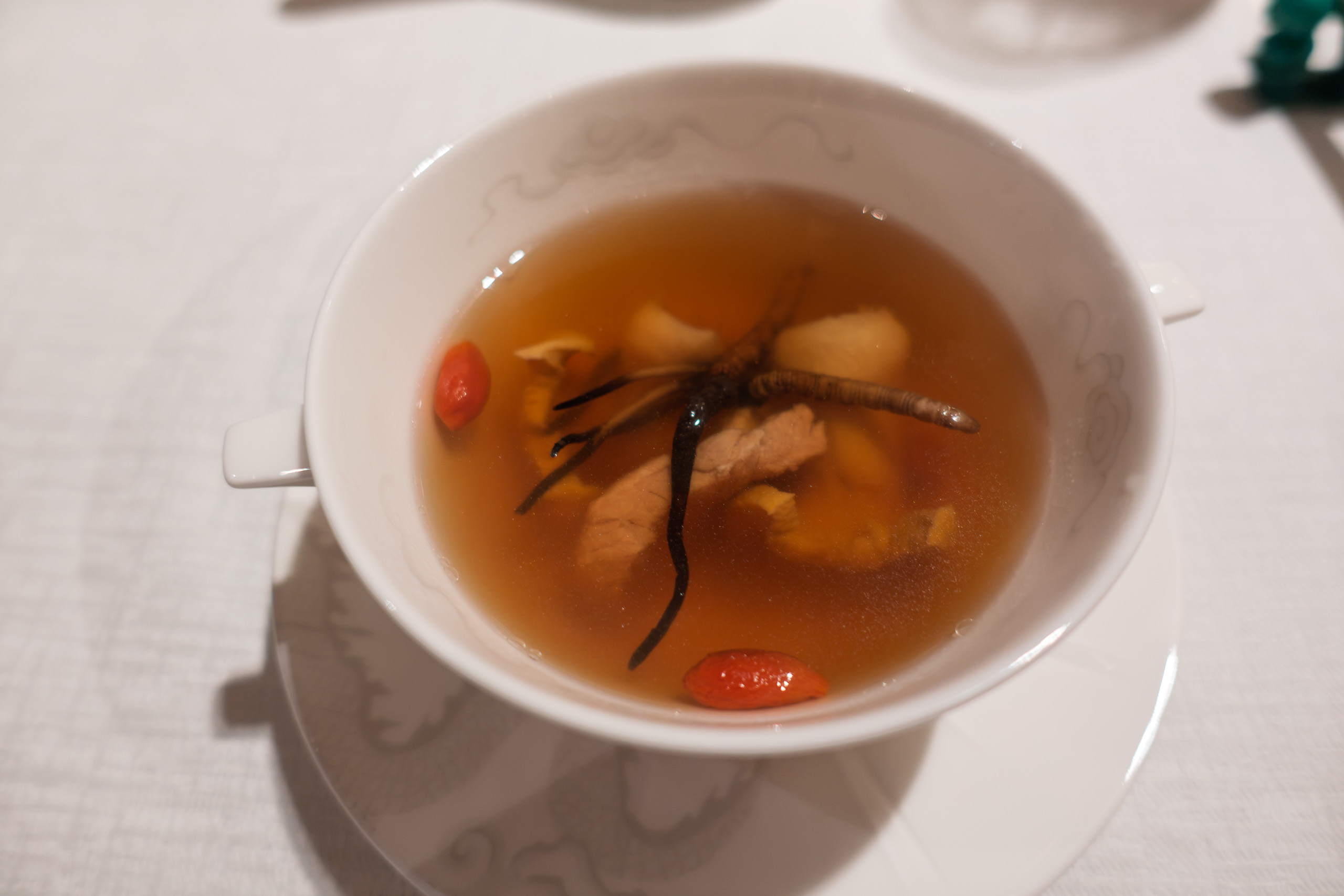
Alain Ducasse at Morpheus is upstairs and is the formal room; Voyages is the all-day one; Yí is the small, high, glassy one; and Pierre Hermé does the pastry in the atrium. The best meal on the estate, though, is not in Morpheus at all. Jade Dragon is downstairs, three stars on the door, and it is the reason to plan a night here properly rather than eating whatever is closest to the lift. There is a separate piece on it.
Jade Dragon downstairs: the opening trio.The double-boiled soup, in a white bowl.The bronze dragons at the door.
The pool goes through the building
The pool is on the deck above the podium and it does the single cleverest thing on the property: it starts indoors under a low ceiling, then runs out through the gap in the exoskeleton, so you swim from shade into daylight between two structural members the size of tree trunks. Two versions of the same pool, and a doorway made of the thing holding the hotel up. Quiet in the morning, busy from noon, and a good deal of shade on the indoor half, which in a Macau June is not a luxury.
The spa and the gym are on the podium levels, large, well equipped and essentially anonymous. Neither is a reason to book. The pool is.
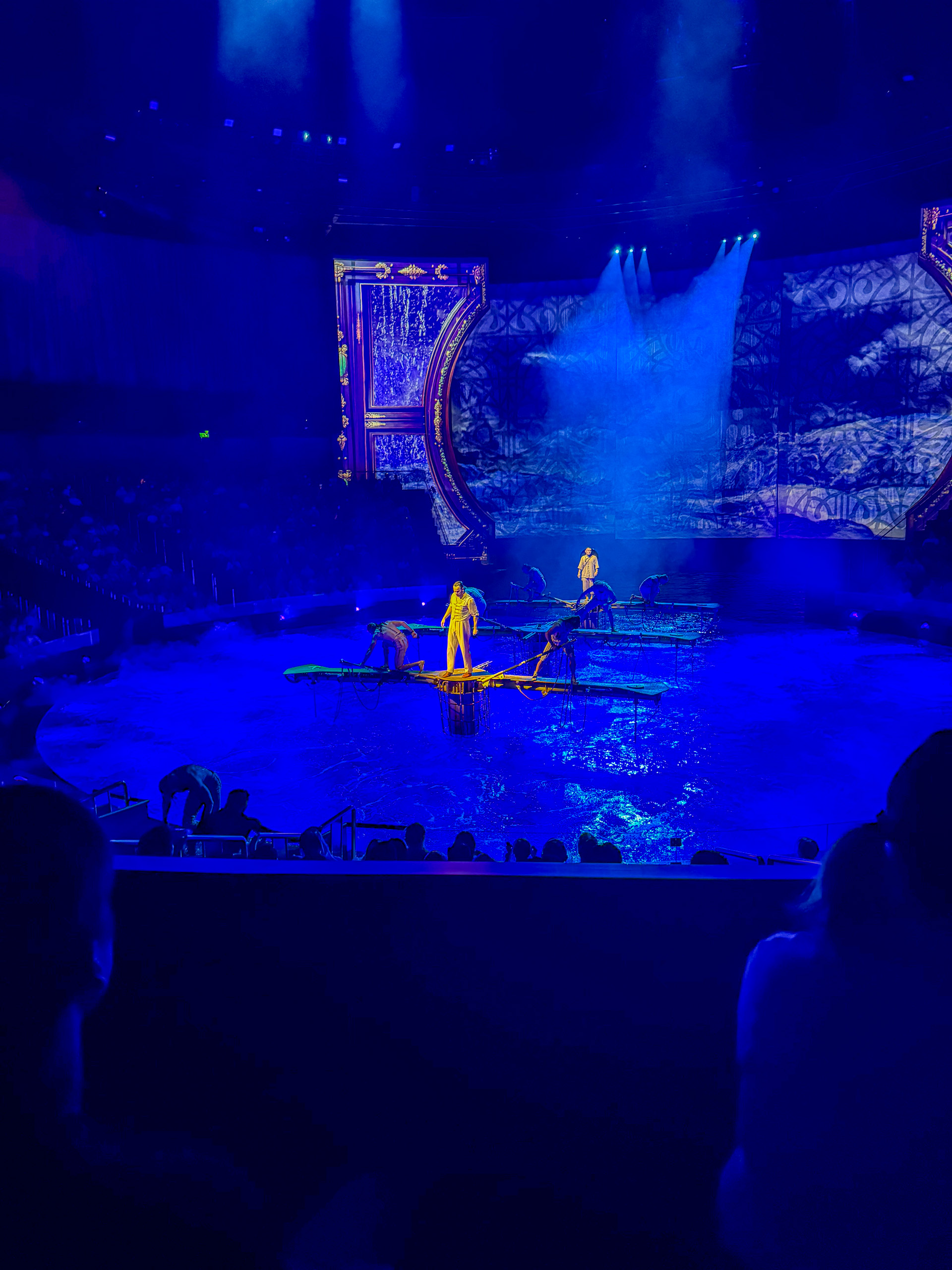
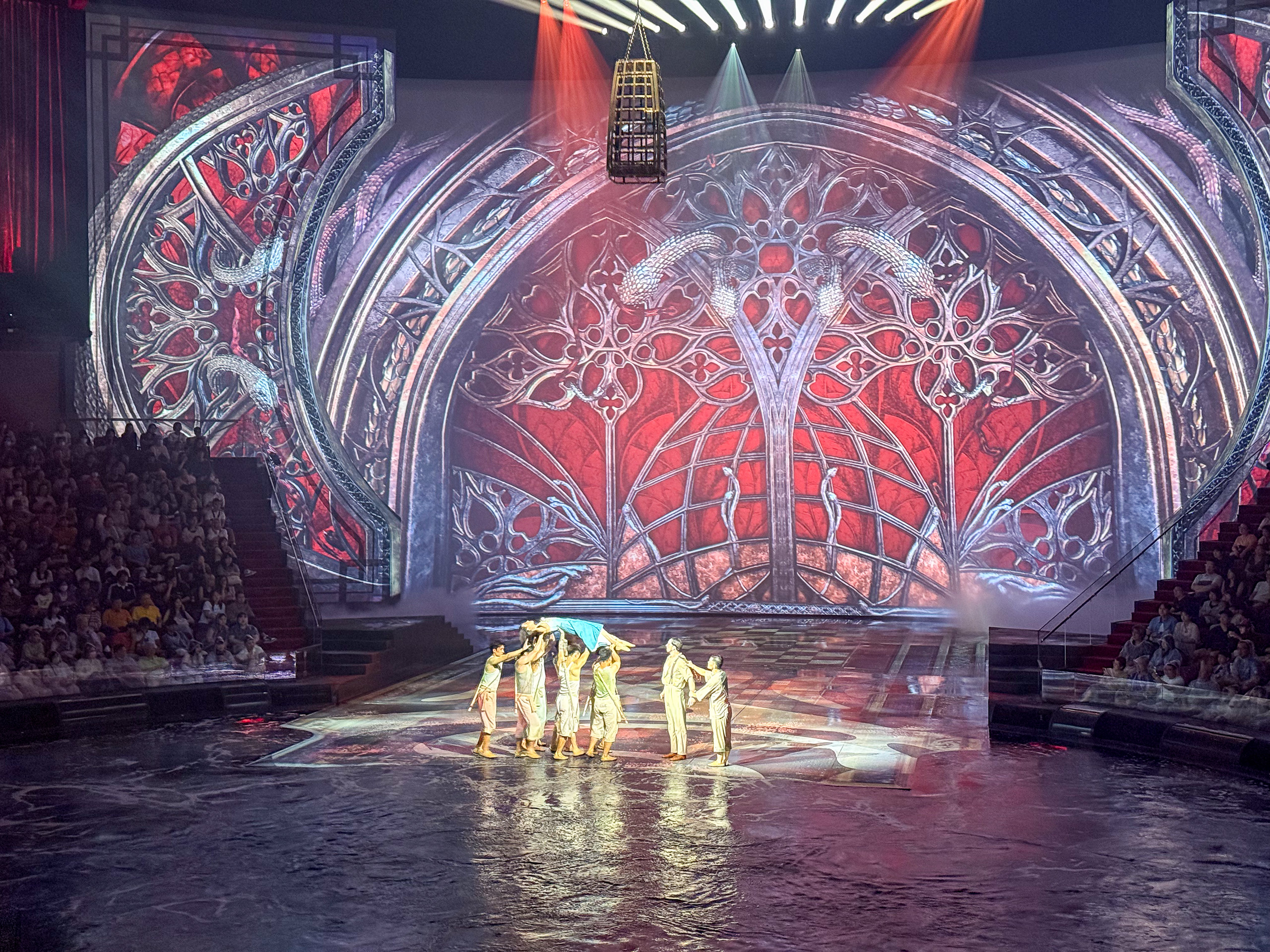
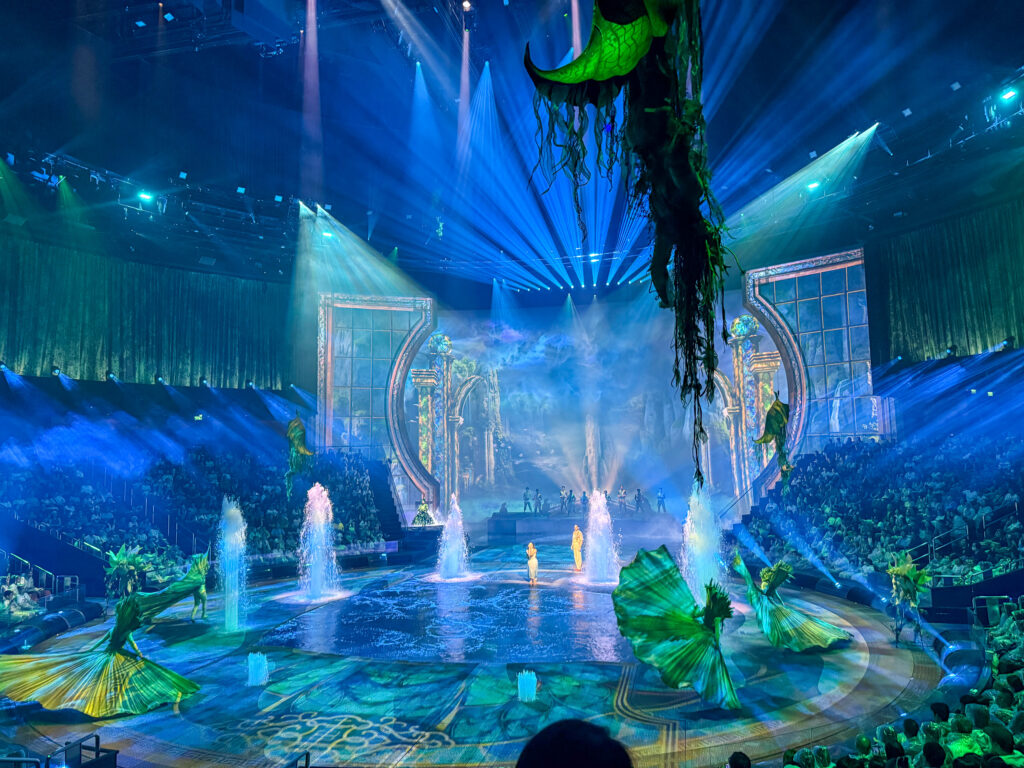
Blue light, one performer, the water stage.The red set piece filling the whole stage.The floor, drained, forty people on it.
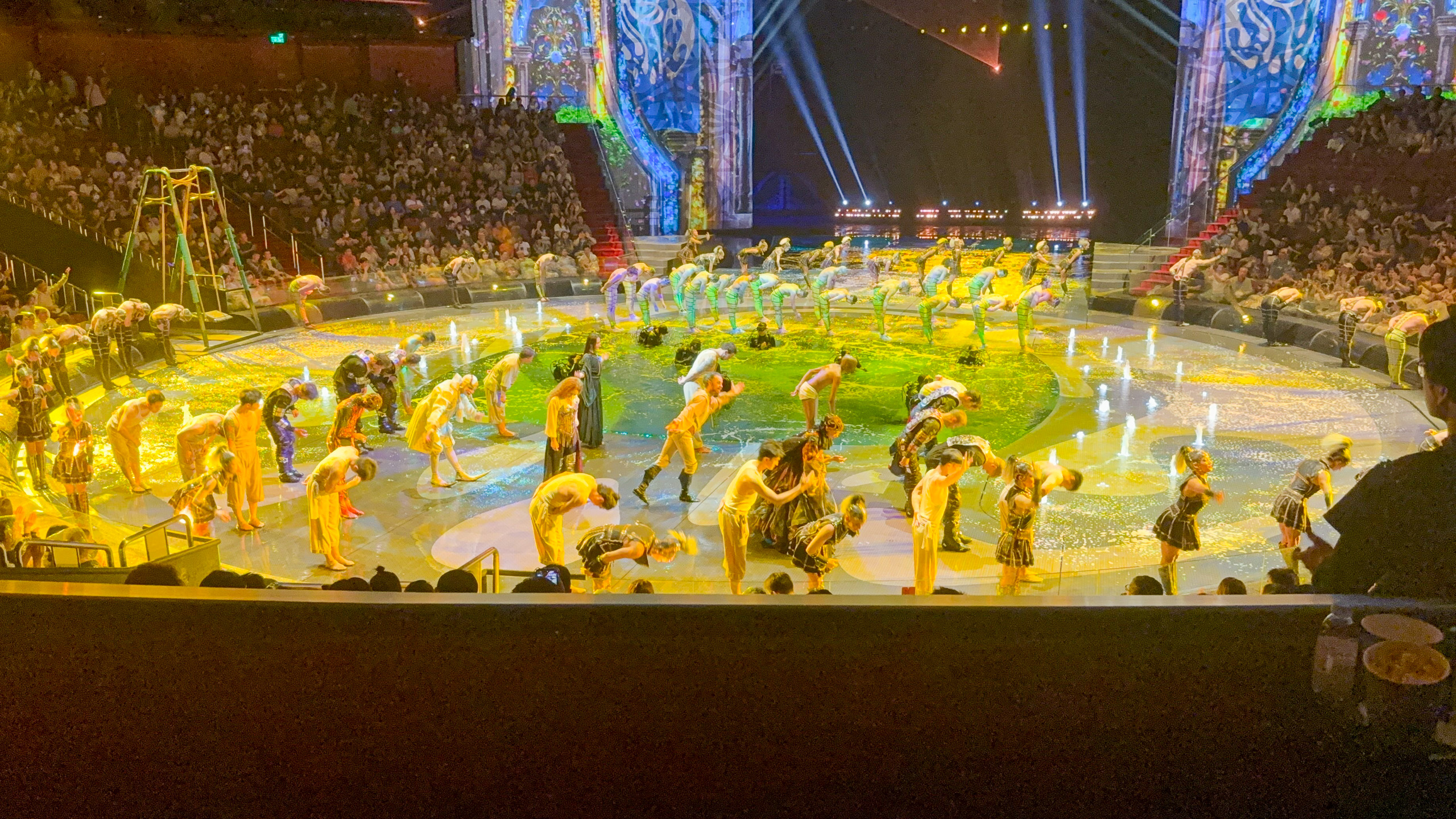
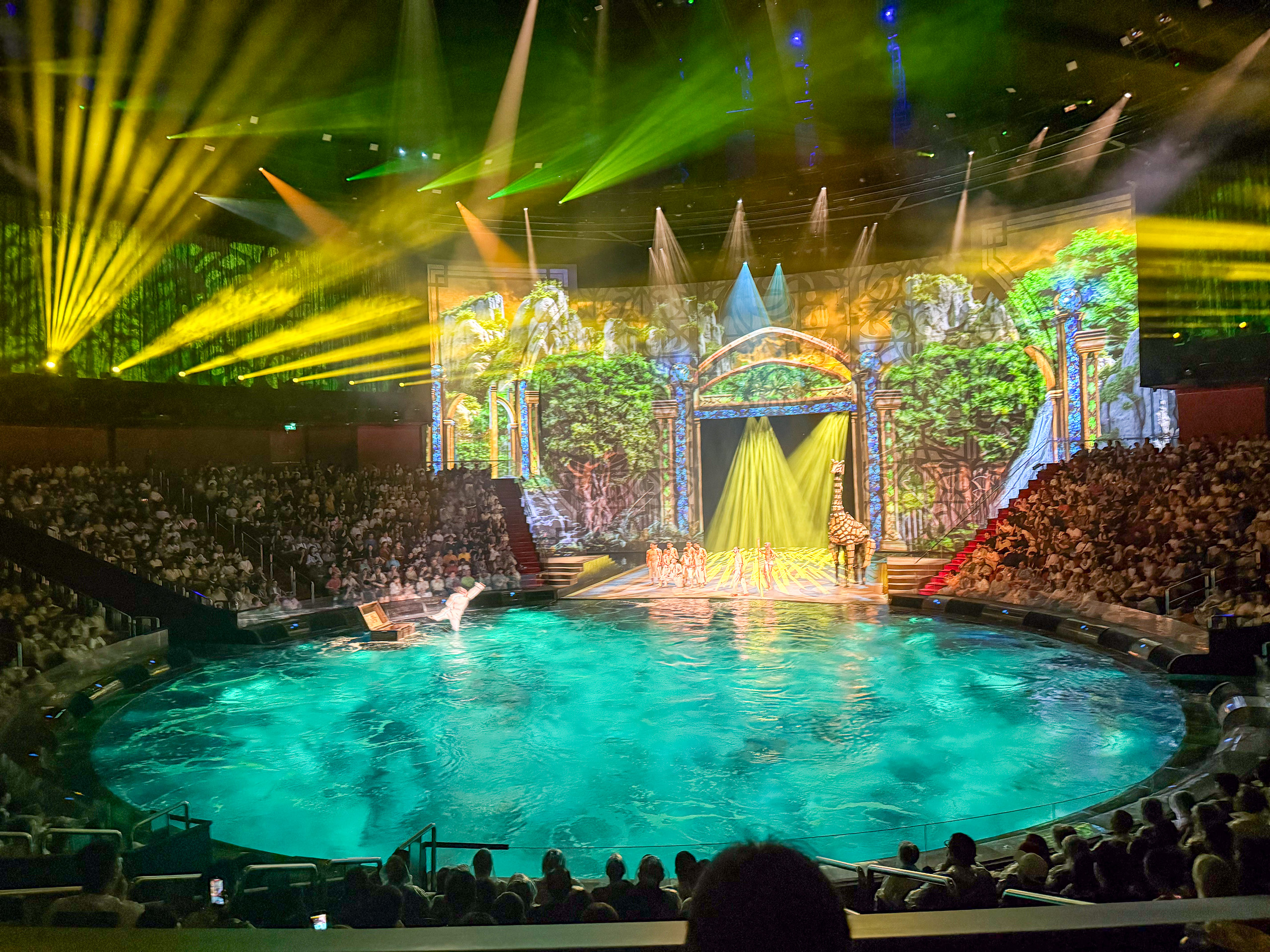
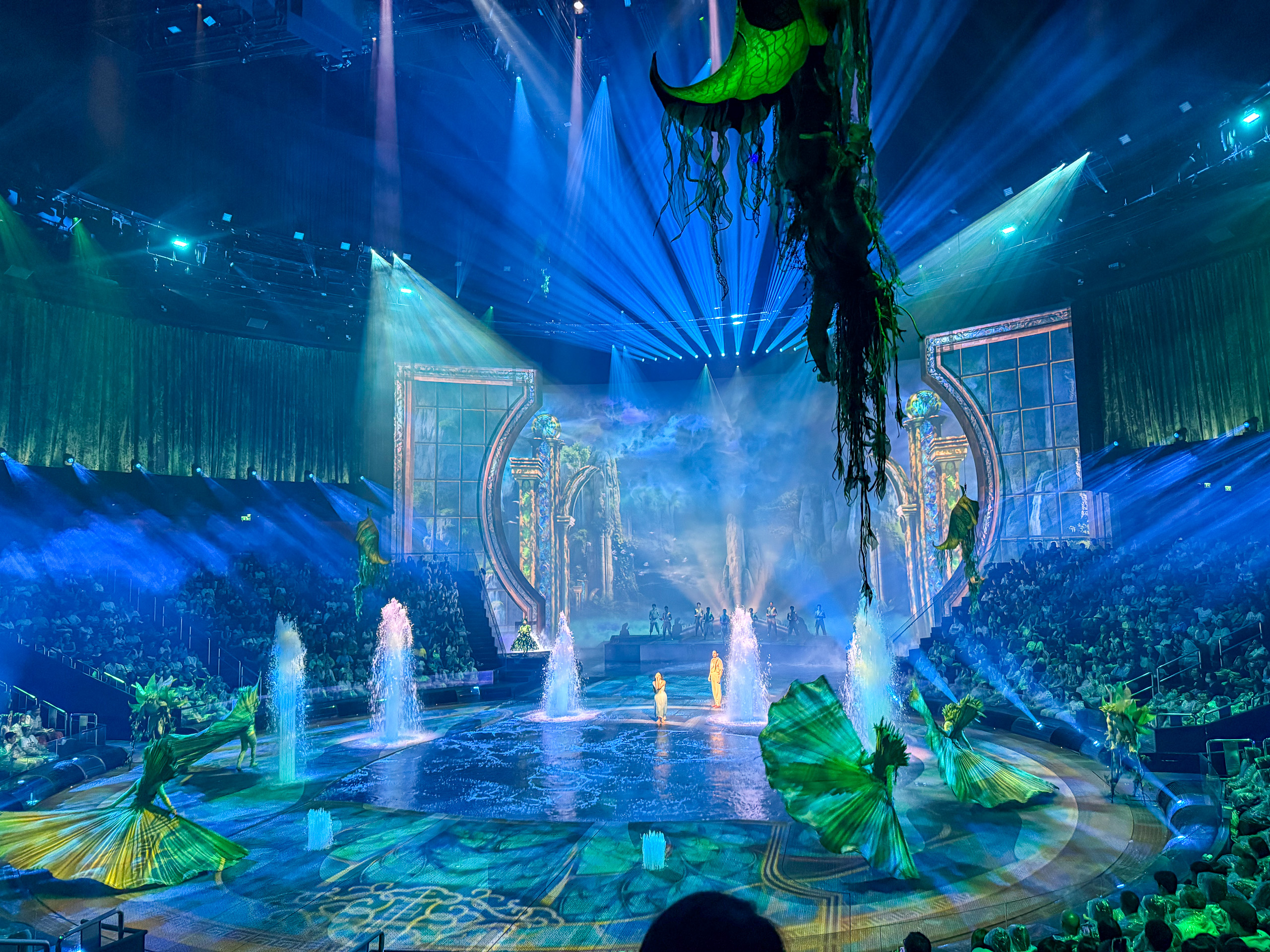
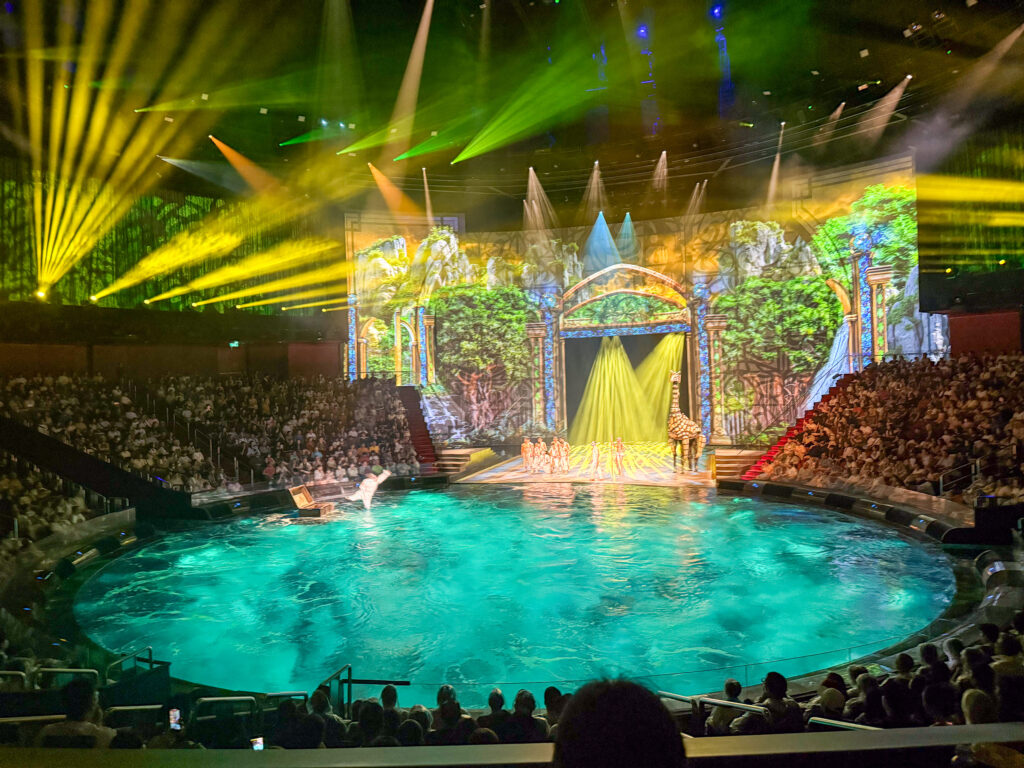
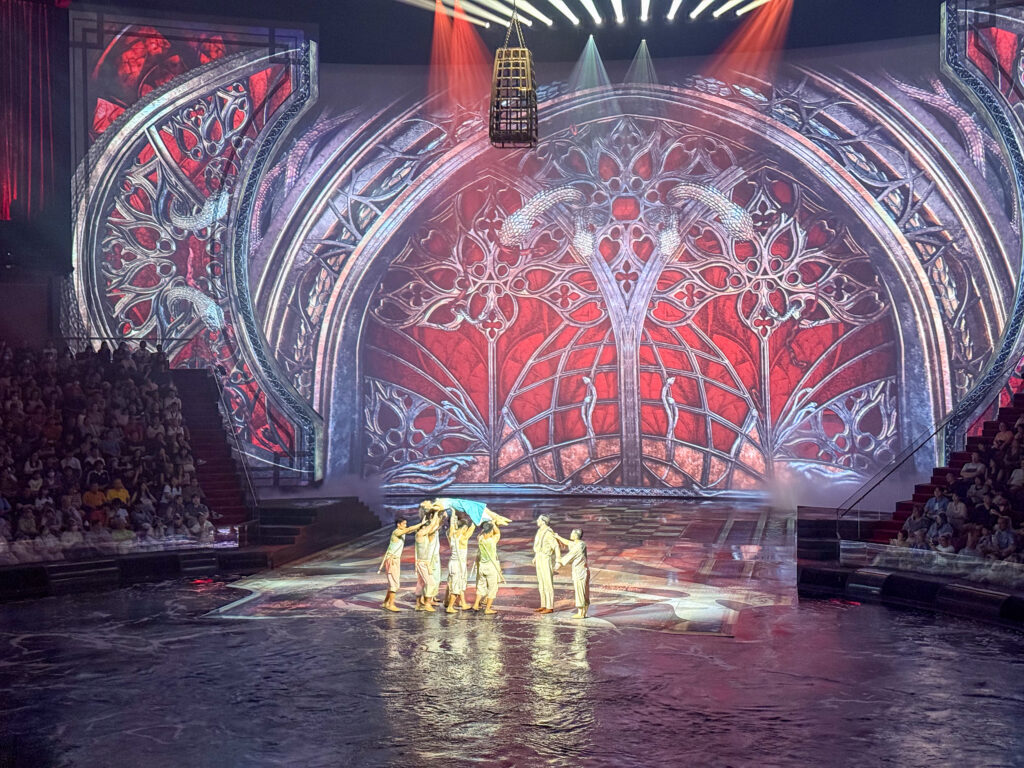
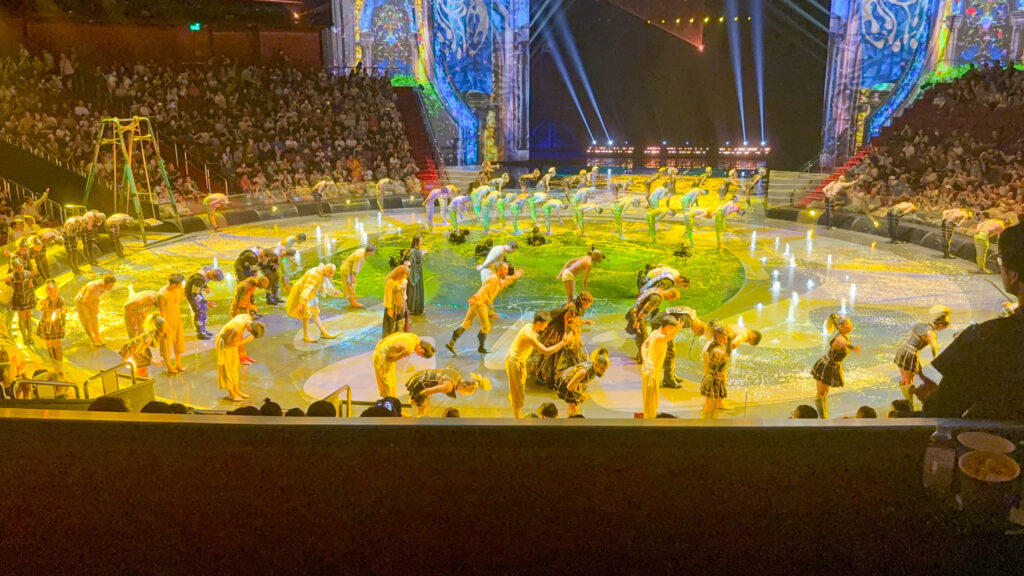
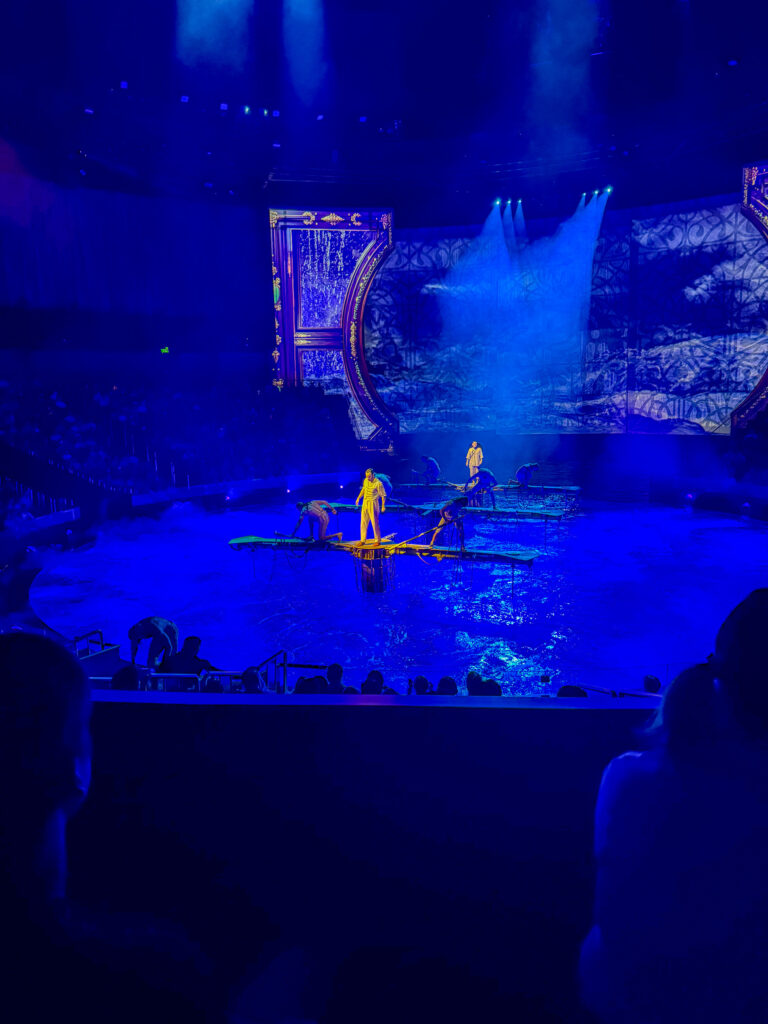
The show is at City of Dreams a separate space connected through the lobby with a stage that floods and drains inside a scene change. It is very loud, very wet and completely unembarrassed, and it is the best ninety minutes of entertainment in Macau. I have seen Cirque du Soleil and the like across the globe — this was my favorite to date. If you like circus — this is a MUST DO before you die. Book a middle VIP seat rather than the front, which is a splash zone that trades a soaking for a worse view of a stage designed to be read from a distance. Go on the first night rather than the last, because you will want to talk about it for the rest of the trip and nobody at home is going to believe you.
The stage floods and drains inside a scene change. You can watch it happen.
Service moments
Efficient and a little impersonal, which is the house style across Cotai rather than a fault of this hotel in particular. Requests are actioned quickly and correctly. Nobody learns your name. In a property this size attached to a casino floor, that is the honest trade, and it is worth knowing rather than being disappointed by. We needed no assistance and received none.
The lifts are part of the architecture and part of the problem. The glass cabins running diagonally across the atrium are thrilling the first three times. They are also slower than a conventional bank and there are fewer of them than a hotel this size would normally have, so at the two peaks of the day, checkout and pre-show, you wait. They fly up though when it is only you.
A building that is a better argument than a bedroom, and worth the trip anyway.
Who it is for, and who it is not
Come if you are the kind of person who travels to stand under a building, and use Cotai as a base camp: two nights, one afternoon in the old peninsula, one evening at the show, one dinner at Jade Dragon. Ask for a high floor facing Cotai and the lakes. Swim before ten. Book the show and Jade Dragon before you fly. And walk out to the base of the building at night to look up through the voids, which asks nothing of you and is the best thing here.
Look elsewhere if you mind that the casino is effectively the lobby: almost every route to almost anything crosses a gaming floor, and its noise and lighting are designed by people whose interests are not yours. Look elsewhere for anything more than two nights. Cotai is reclaimed land laid out for coaches, there is nothing to walk to, and old Macau, which is an extraordinary city, is a taxi away every time.
Nobody at home will believe you. Take this one anyway.
Bottom line
The best building you will sleep in this year, wrapped around a resort you will want to leave after two experiences. Book a high floor facing Cotai for two nights, and see the show.
You reach Key Biscayne over the Rickenbacker Causeway, which lifts out of downtown Miami, crosses open water with the whole skyline behind you in the mirror, and drops you onto a barrier island with a village on it and not much else. It takes about twenty minutes and it does something to your expectations that no amount of lobby design could. By the time the road narrows into palms you have already stopped thinking about the city.
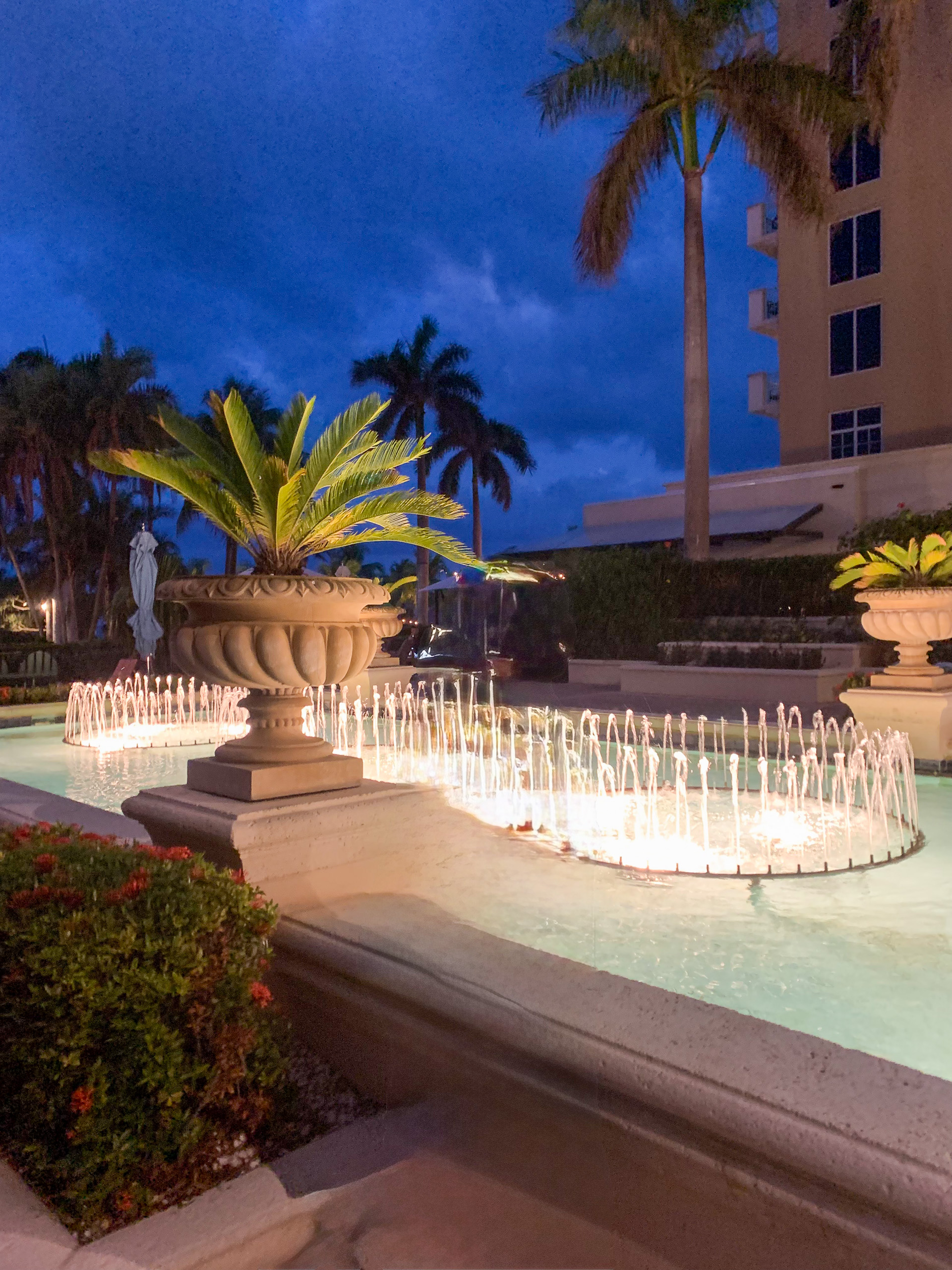
The fountain and the front of the building, lit against a deep blue sky.
That geography is the entire proposition. This is a resort close enough to Miami to use it and far enough from Miami to ignore it, which is a rarer combination than it sounds, and it is why the place has always sold to families who want the beach without the noise of South Beach twenty minutes north.
It closed for most of last year and reopened in December, rebuilt rather than refreshed: the rooms taken back to the shell, six places to eat and drink instead of the usual three and a coffee cart, and the heavy dark millwork that dated every Ritz-Carlton of that generation gone. The palette is pale and sandy now, the timber light. It reads current without chasing a trend, which is the hard thing to get right on a property whose guests come back every year and notice everything.
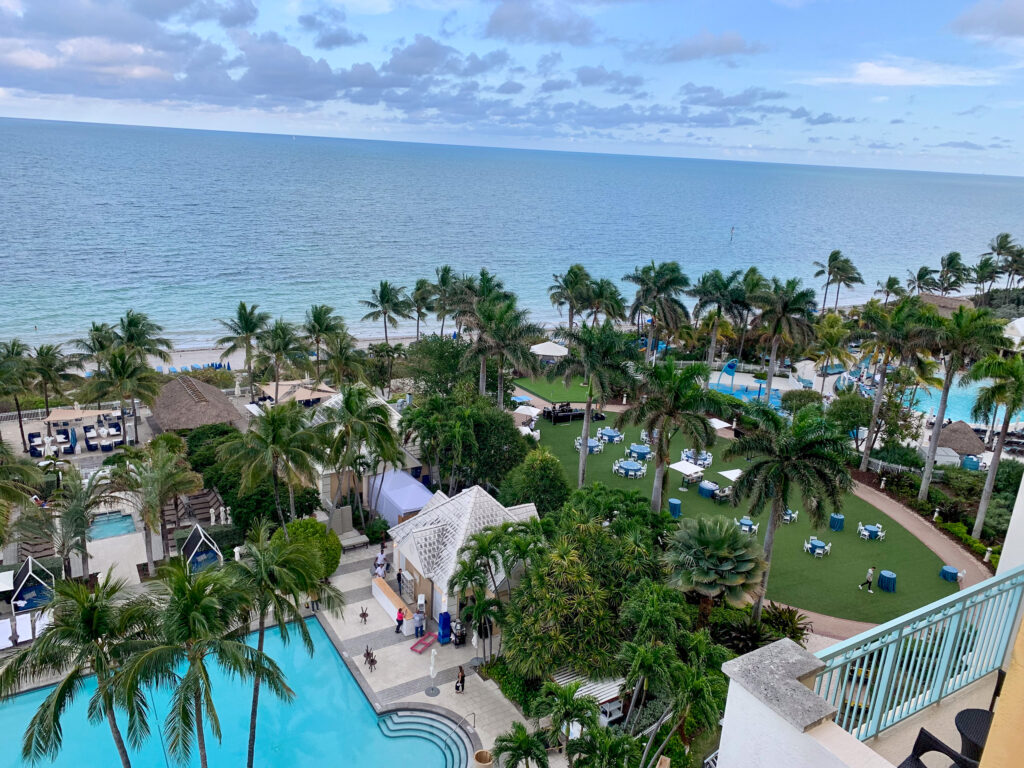
From the balcony. The lawn between the pools and the sand is the part nobody photographs and everybody uses.
The room, and whether the Club Level is worth it
I had a Club Level room on a high floor with an ocean view. Calm, pale, floor-to-ceiling glass, and a proper balcony rather than a French one, which is the difference between a room facing the sea and a room you actually sit in: two chairs, a small table, and a rail low enough to see over from a seat. ABSOLUTELY WORTH IT.
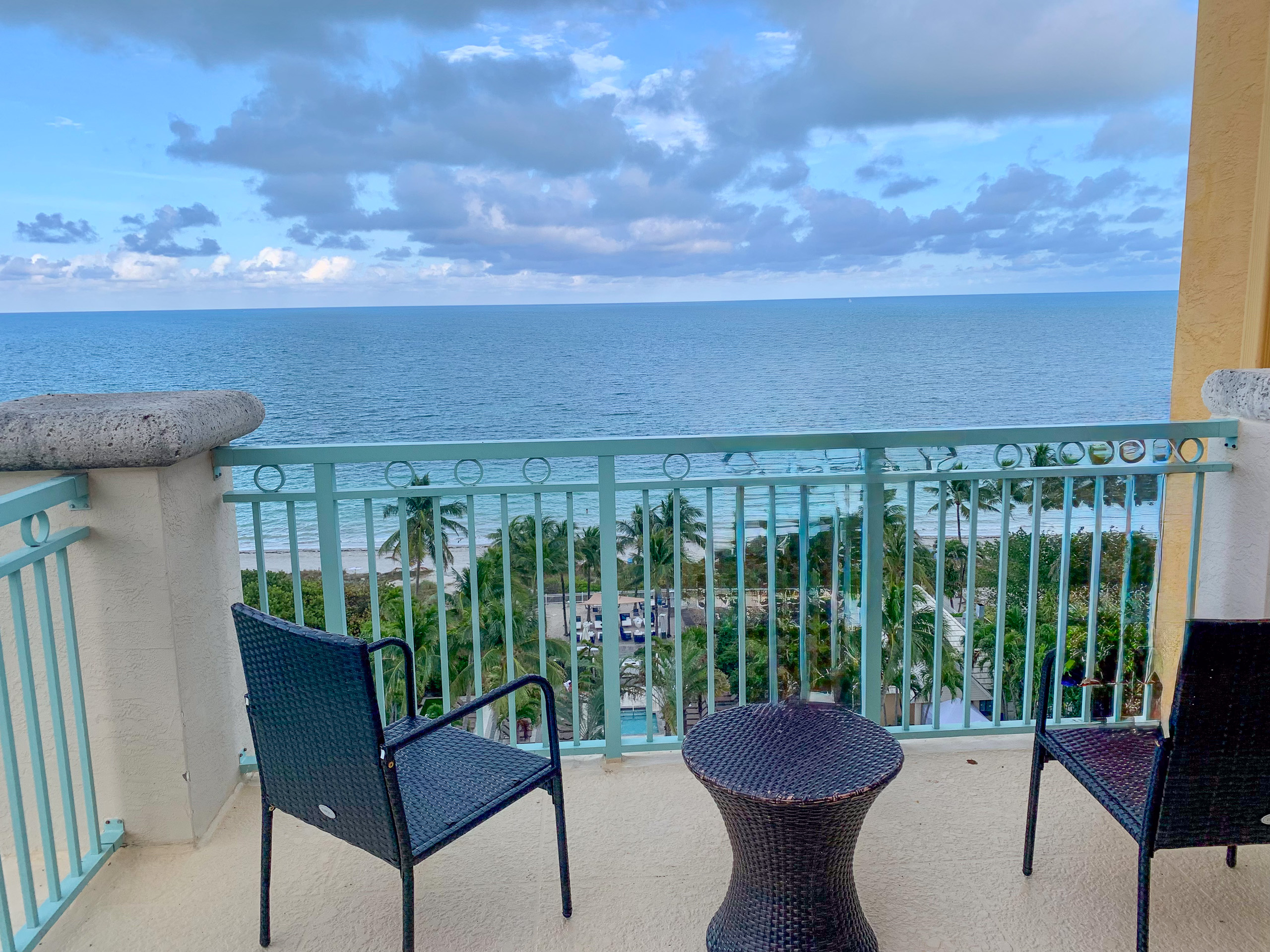
Two chairs and a small table on the balcony; the sea fills the gap in the rail.
The Club Lounge is the decision worth thinking about. It runs food through the day in five services, from a proper breakfast to canapés and desserts in the evening, in a bright room with rattan seating and its own terrace.
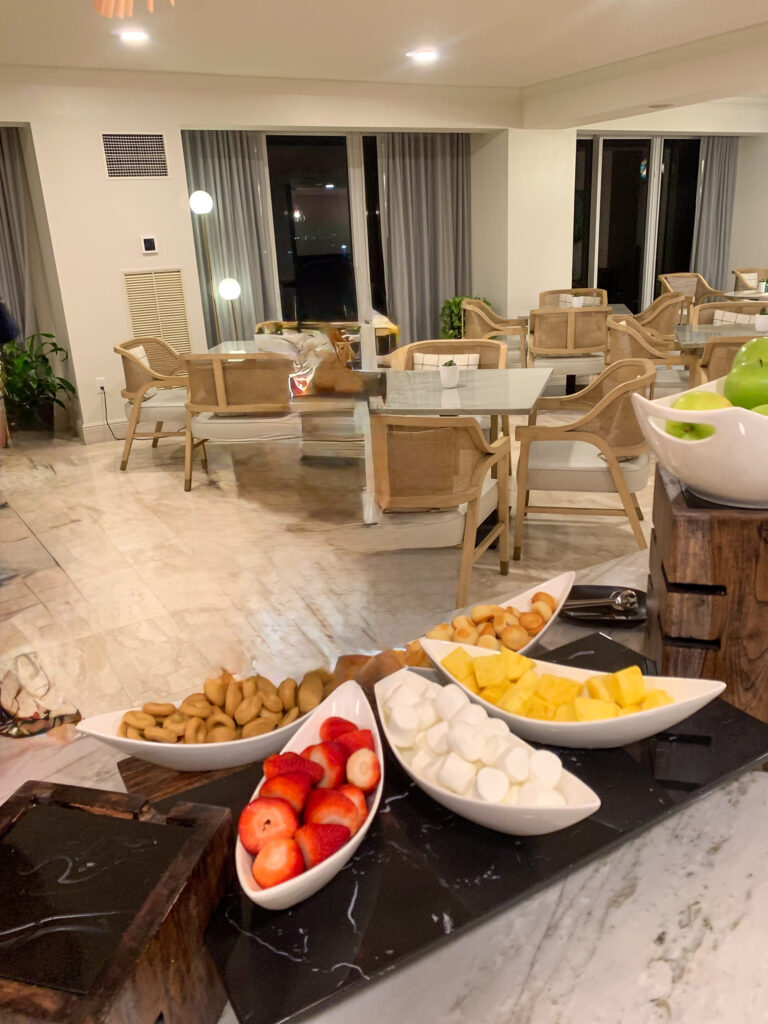
The middle service at the Club Lounge. This is the one that decides whether you buy the tier.
For two adults on a short stay it is a marginal call. For a family, or for anyone here four nights or more, it changes the shape of the day: breakfast without a restaurant, a place to feed children at six, and an evening spread substantial enough that dinner becomes optional rather than compulsory. That last point is where it pays for itself, and where I stopped pretending I was going out.
The chocolates, opened with one hand.Hot chocolate sauce going over ice cream, the cherry on.
Noted
Observed on the stay, not measured.
What
Checked on the stay
Beach
Long, with umbrellas and loungers in rows; the umbrellas come down around six
Pools
Main, adults-only, and a children’s splash pad
Drive to downtown Miami
About twenty minutes over the causeway
Balcony
Full depth, two chairs and a table, on the ocean side
Wi-Fi
Fast and always available
Bed
Medium-firm, very comfortable
Blackout
Acceptable, with some leakage
Eating
Six places. Luma is the Mediterranean room and the main dining option; Paralia is Greek and Turkish and the more interesting of the two. Stefano’s does pizza by the pool, Dune is the beach bar, there is a rum bar, and Scoop sells gelato to the people who have been in the pool since ten, which by four in the afternoon is everyone.
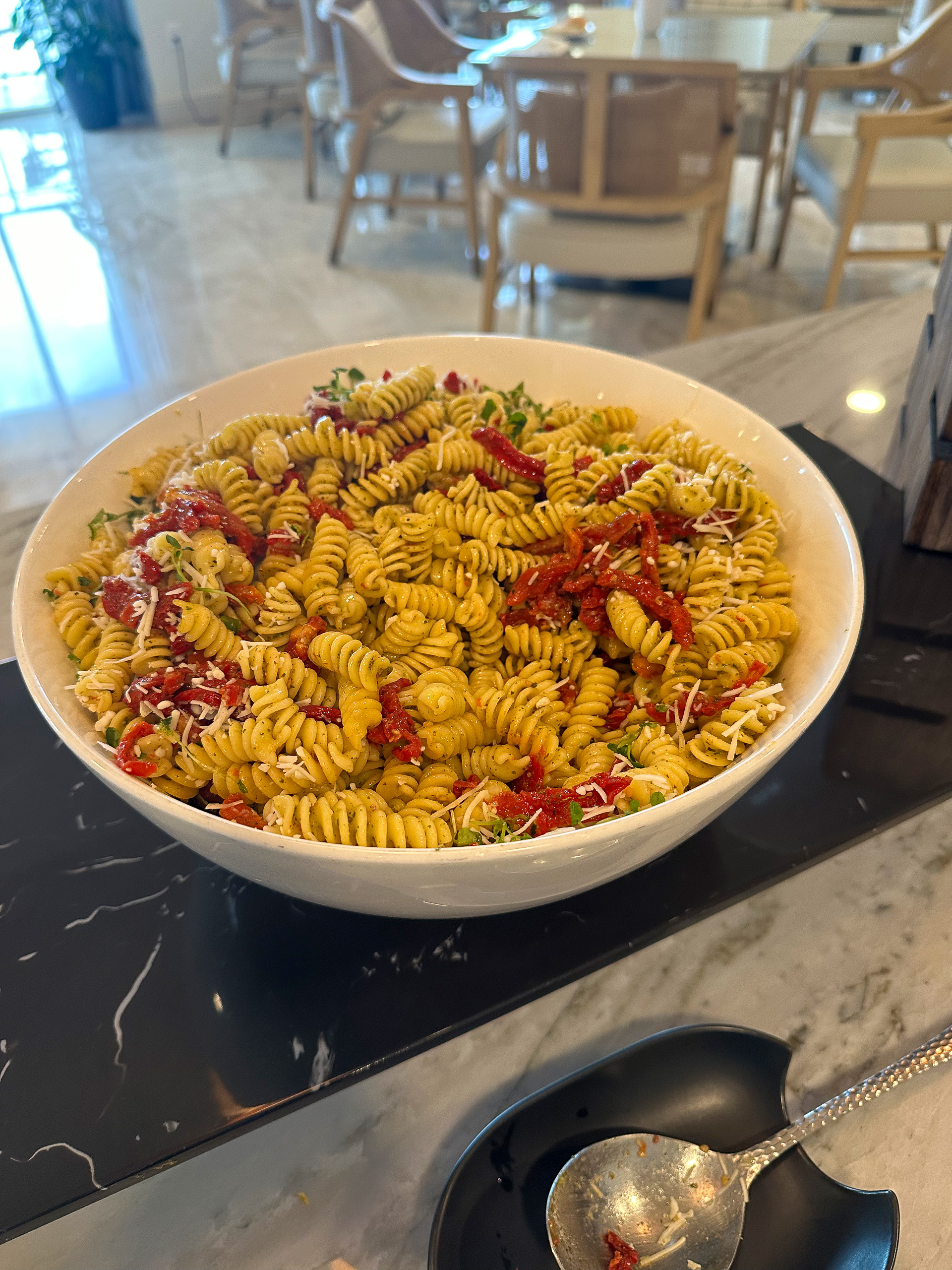
Fusilli in tomato sauce at the counter. Not the point of the trip, and correct.
That spread is well judged for the guest this resort actually has. A family staying five nights needs a good pizza more often than it needs a tasting menu, and the property has stopped pretending otherwise. If you want a serious restaurant evening, that is what the causeway is for.
Small burgers on a board.Burgers dressed with avocado and leaves.Banana and chocolate on a glass stand.
The pools, the beach, and the water
There are pools for different populations, which is the correct way to build a resort of this kind: a large free-form main pool ringed with white cabanas, an adults-only one, and a children’s splash pad with fountains and jets set back into the palms so that the noise stays where it belongs.
The beach is long, with blue umbrellas and loungers in rows and a lawn behind them. In the late afternoon the umbrellas come down and the loungers get stacked and the whole thing turns into a very good stretch of empty sand for an hour, which is the best time to walk it.
Six o’clock, after the loungers go away. Twenty minutes of the best beach on the property.
A word about the water, because it is the thing people get wrong before they arrive. This is the Atlantic over a shallow shelf with seagrass beds in it, so from a high floor you can see dark patches in the green, and at the shoreline the water is warm, calm and slightly cloudy rather than gin-clear. It is excellent swimming and it is not the Caribbean. Anyone booking on the strength of a drone photograph should look at the actual colour of the water in it first.
The spa is large, with co-ed relaxation areas and an outdoor garden to sit in afterwards, and the garden is the part that distinguishes it.
The fountains in the shallow pool.The rope hammock on the boardwalk.The shoreline at dusk, last light on the wet sand.
Service moments
A resort this size lives or dies on the desk that runs the day, and this one runs it: the activities desk, the beach crew who have the umbrellas down and the loungers stacked at six like a change of scene, the lounge staff who know by the second morning which table and which coffee. The manager who upgraded me to the room I got when my room was not ready on time — amazing.
Rebuilt for the family it already had, rather than for the one it wished it had.
Who it is for, and who it is not
Come with a family, for four nights or more, and book the ocean side on a high floor, saying so at booking. Do the arithmetic on the Club Level rather than deciding on instinct.
Look elsewhere if you are coming without children in the school holidays: the splash pad is busy from nine, the main pool has an age range rather than a demographic, and the lobby at four is a lot of people in swimwear carrying towels. The adults-only pool exists and helps; it does not change the register. Look elsewhere too if you want a restaurant town at your door. There is a village with a handful of places and then there is nothing, so almost every meal is on the property or a twenty-minute drive each way. The isolation you are paying for is real isolation.
Coconut palms against the sky at the end of the day. In school holidays the whole resort is a family.
Bottom line
The Ritz-Carlton Key Biscayne is a large, well-run American beach resort rebuilt for the family it already had, and it is close to the top of its category on this coast. Book the ocean side on a high floor, do the sums on the Club Level, and look at the colour of the water before you book, not after.
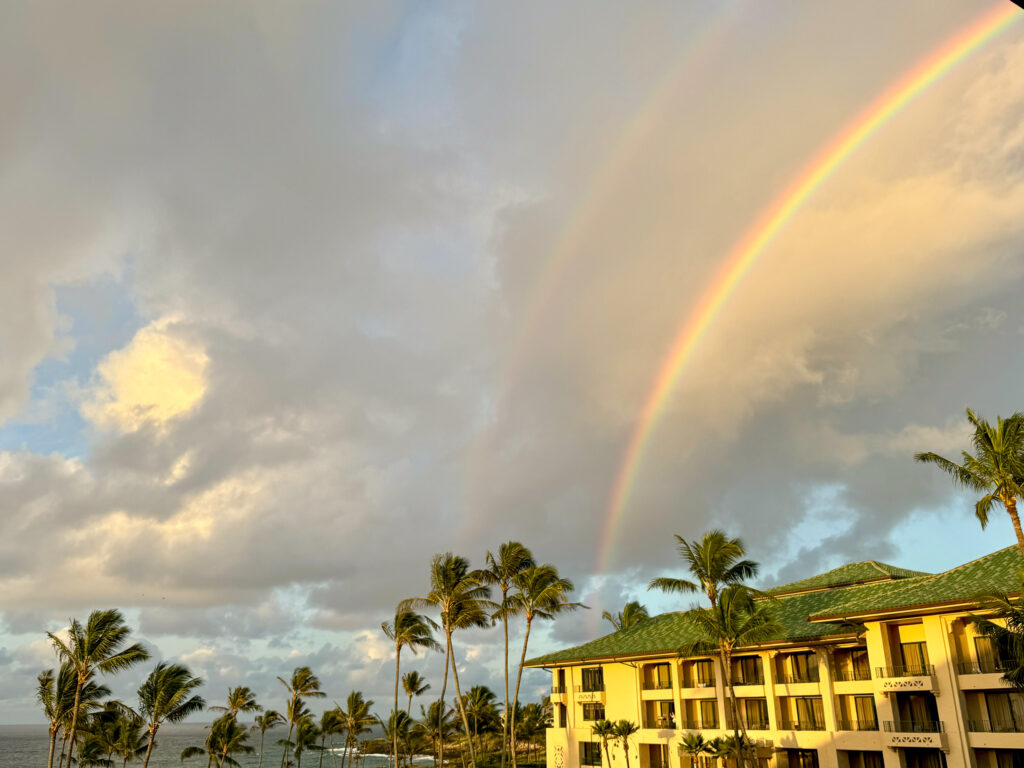
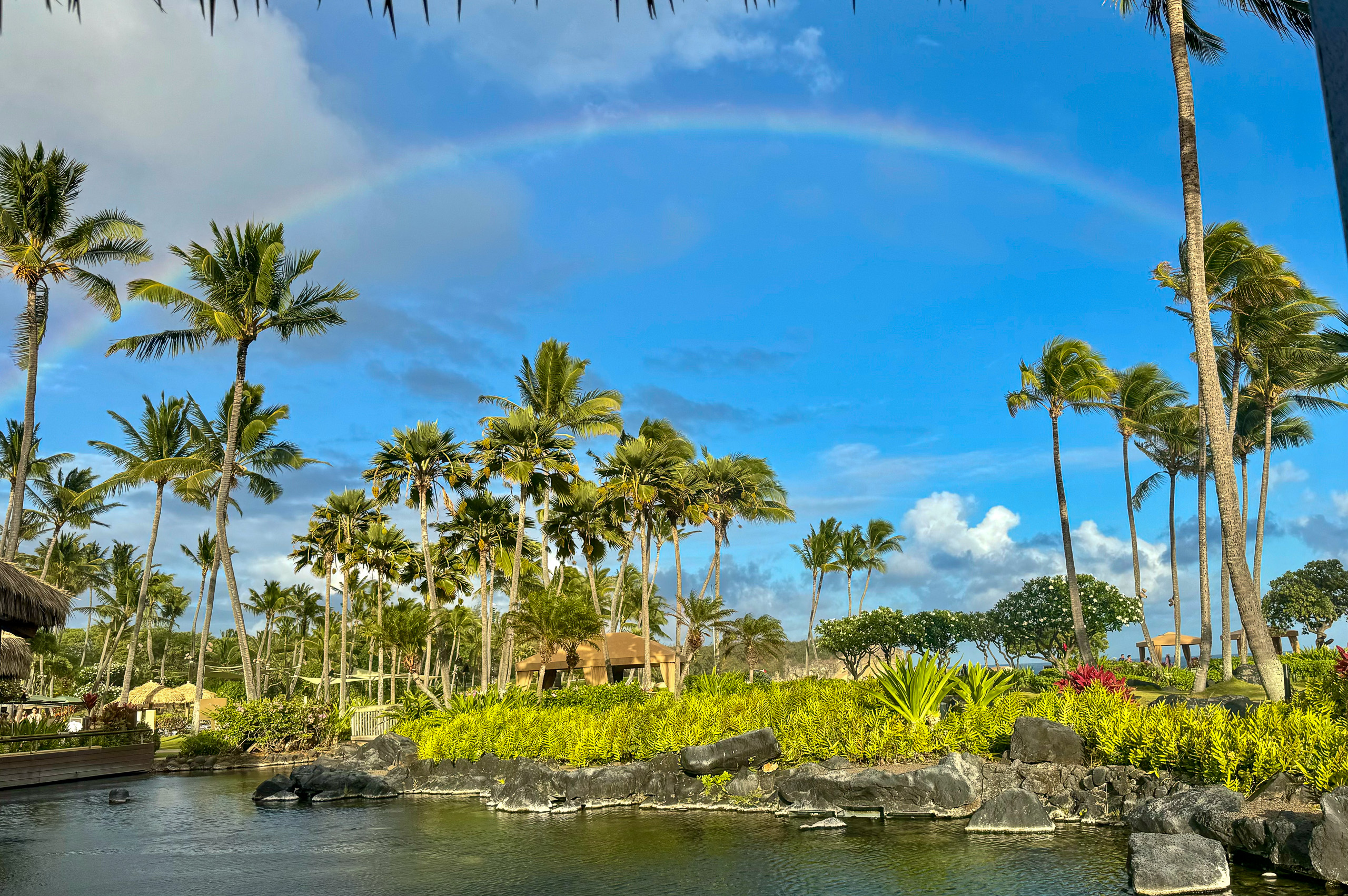
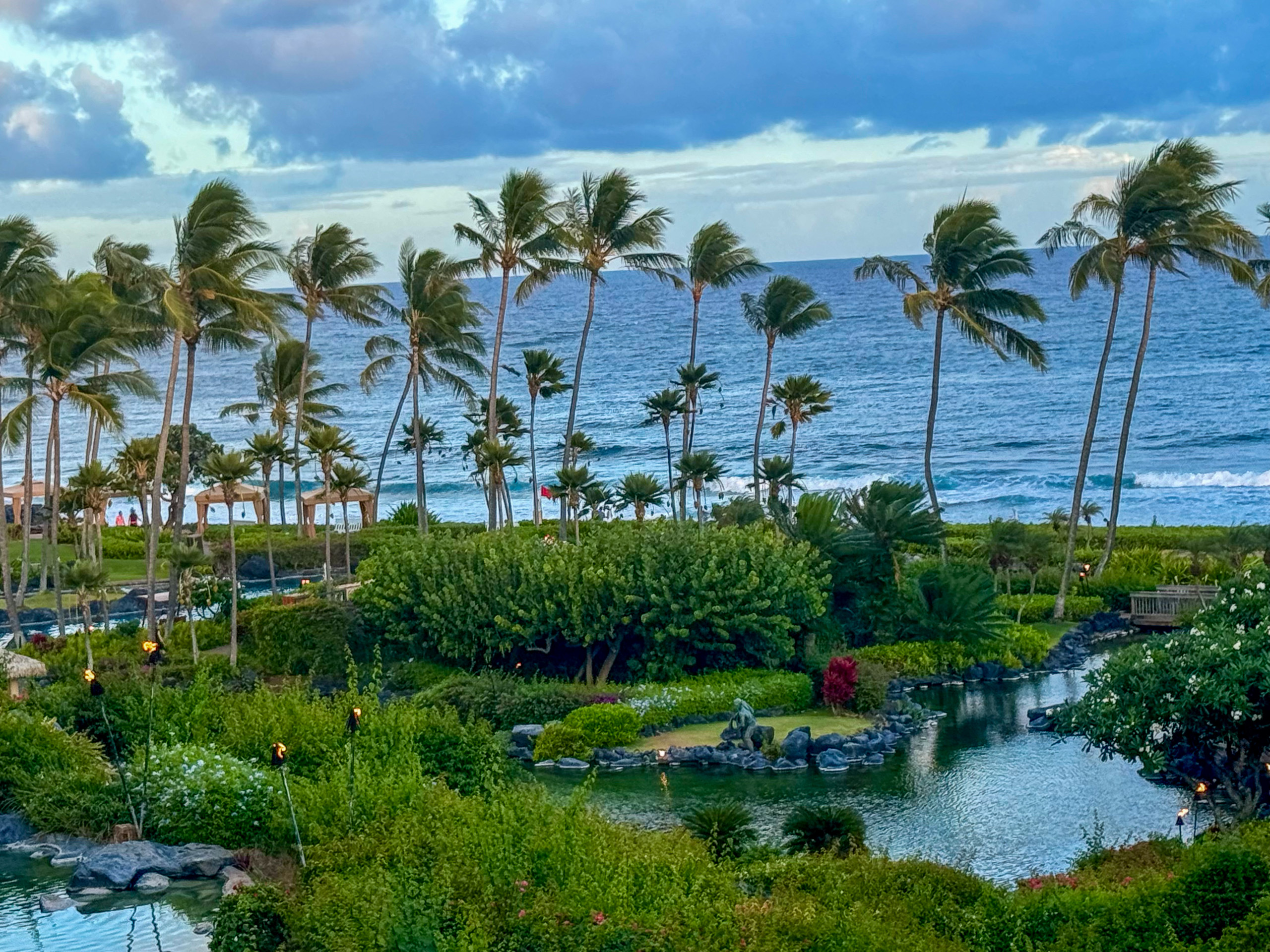
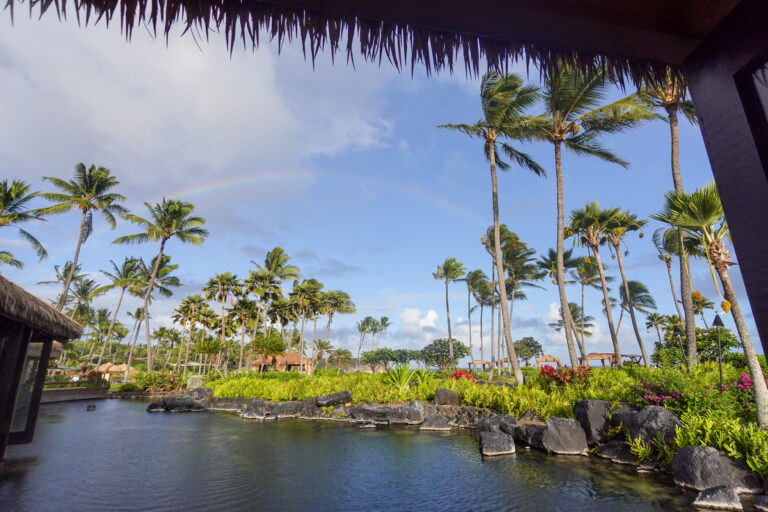
On the second evening a double rainbow came up over the resort and stayed for about four minutes, which on the south shore of Kauai is closer to a scheduled event than a piece of luck. The trade winds push showers across from the mountains most afternoons, the sun is low and behind you, and the geometry does the rest. Nobody around the pool looked up for long. That tells you how often it happens, and how good the pool is.
A full rainbow over the palms and the lagoon, most afternoons. It is not a metaphor; it is the weather.
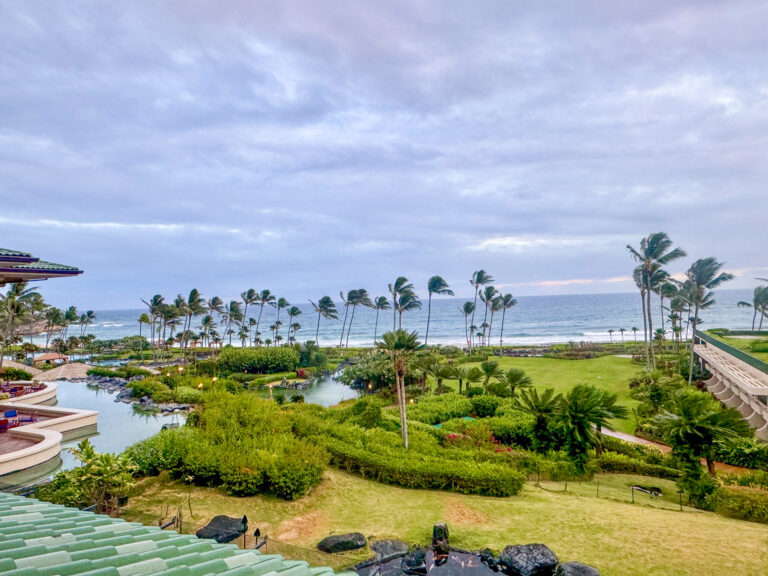
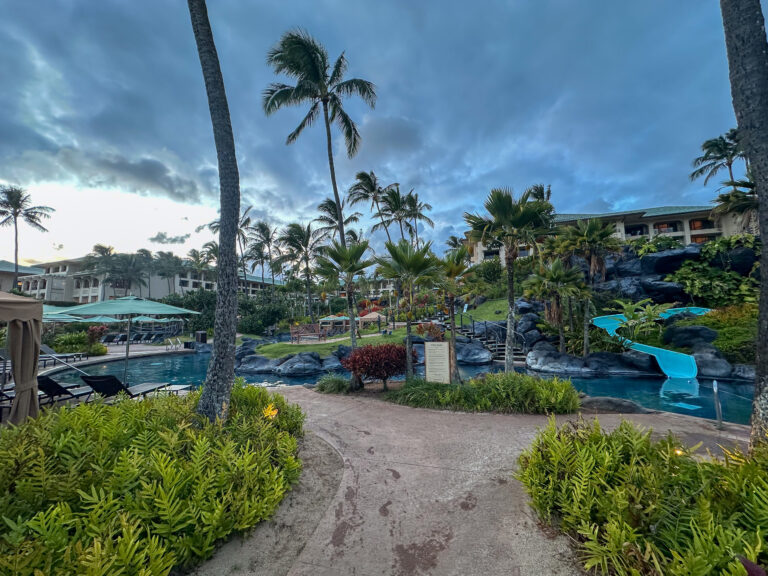
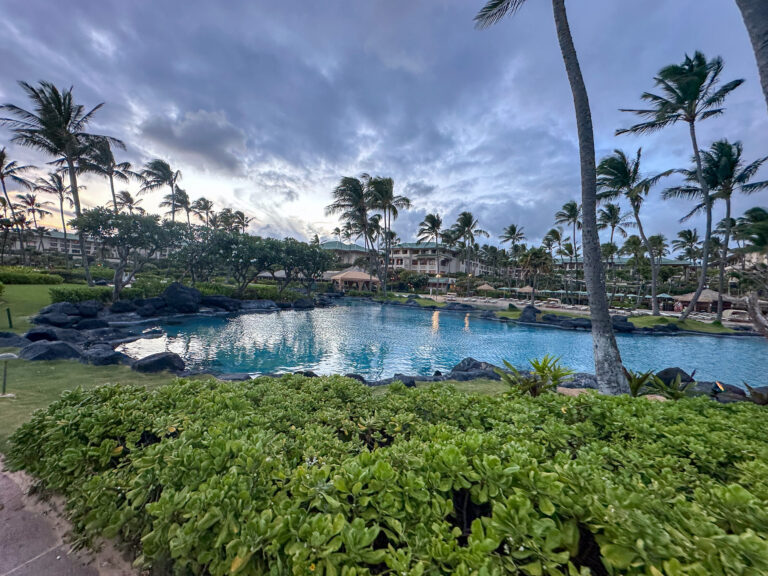
Kauai keeps its buildings no taller than a mature palm, and this resort is the most conspicuous consequence of that on the island. Instead of a tower there are long, low plantation-style wings with green tile roofs, spread wide across the site and joined by open-sided corridors that are outdoors in every sense that matters.
The effect is that a very large resort does not look or feel like one from the ground. You almost never see the whole property at once. The cost is walking: from the far rooms to the far restaurant is a genuine ten minutes, and you will do that walk in the rain at some point.
The room
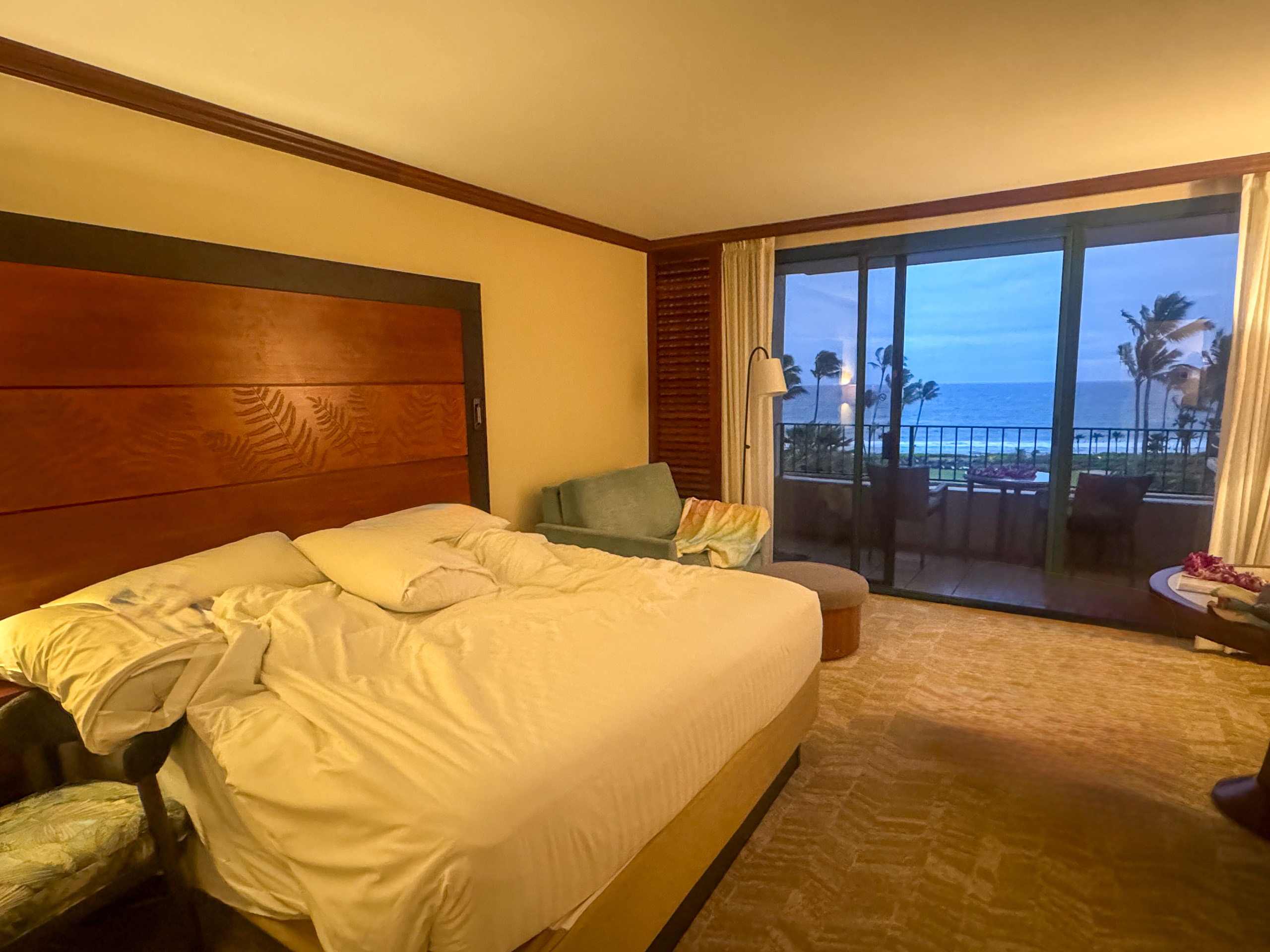
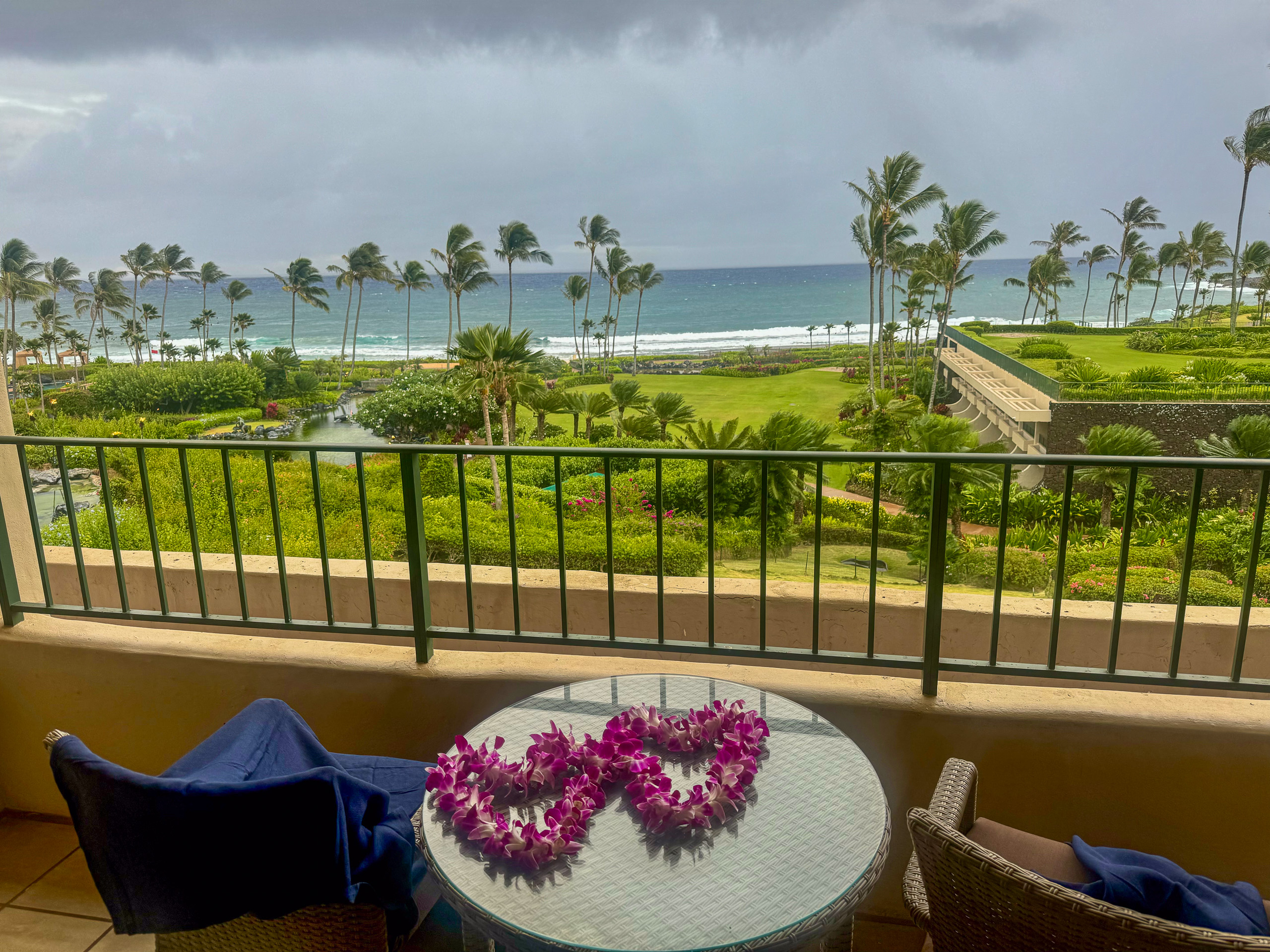
I had an Ocean View king on an upper floor. It is a warm, wide, slightly traditional room: a carved timber headboard, tiled floors, a sitting chair, and sliding doors the full width of the wall onto a lanai deep enough for two chairs and a table. The materials are timber and stone rather than the pale plaster that has taken over resort design in the last decade, and it has aged more gracefully than that description suggests.
A bed made up in white, the doors open to the lanai and the water beyond.
It is not a new room. Nothing is broken or tired, but the bones are older than most of the guests and the refreshes have been respectful rather than transformative. The difference shows in the bathroom more than anywhere else. If you have just come from a property that reopened last winter, you will notice. If you came for Kauai, you will be on the lanai. There is a huge problem with the rooms facing south, and ours had it, so we had to move: humidity. There is a strong mildew smell and a pervasive dampness that was oppressive. For a beach resort nothing dried — not suits, not spills of water in the room, not clothes hung outside or in.
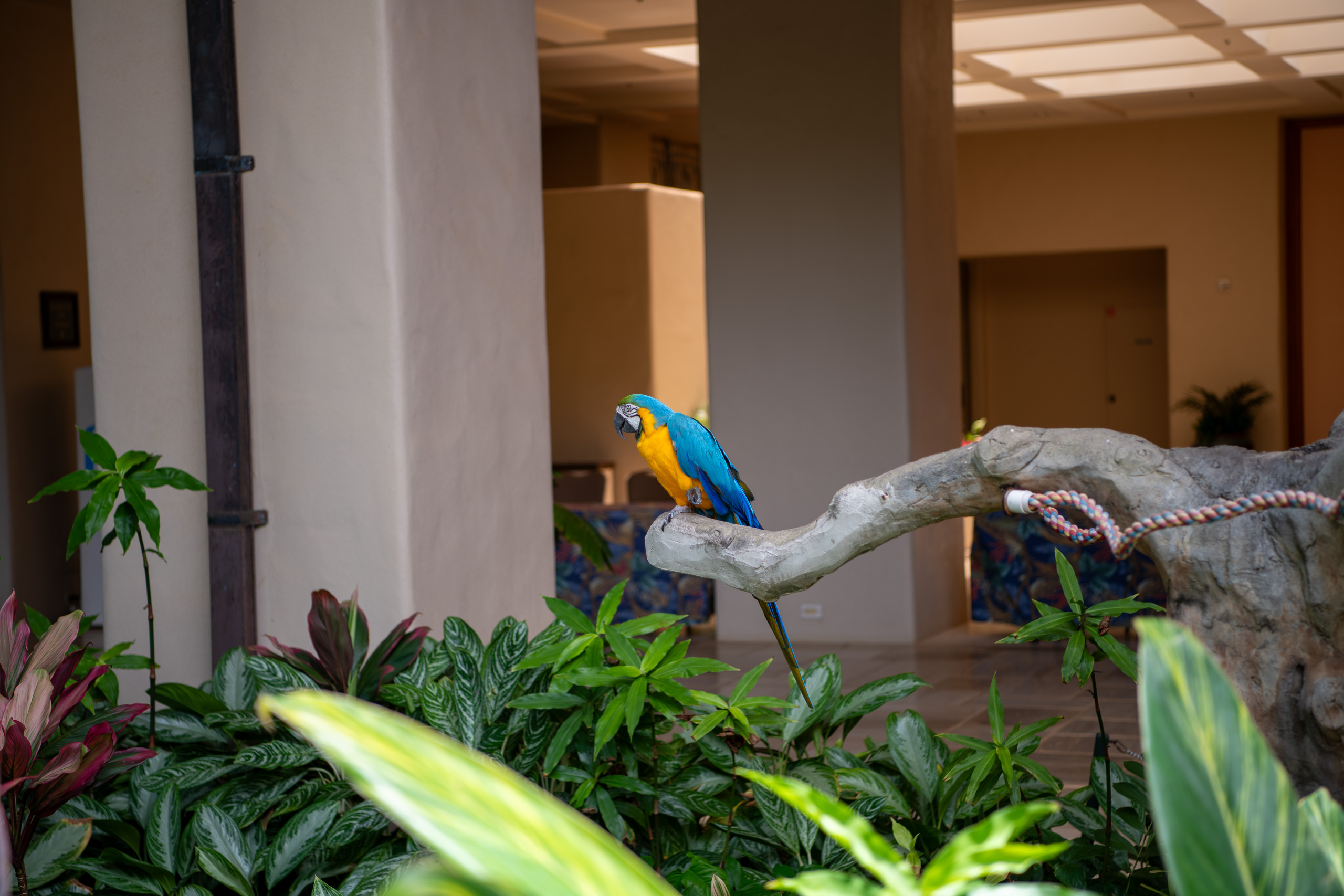
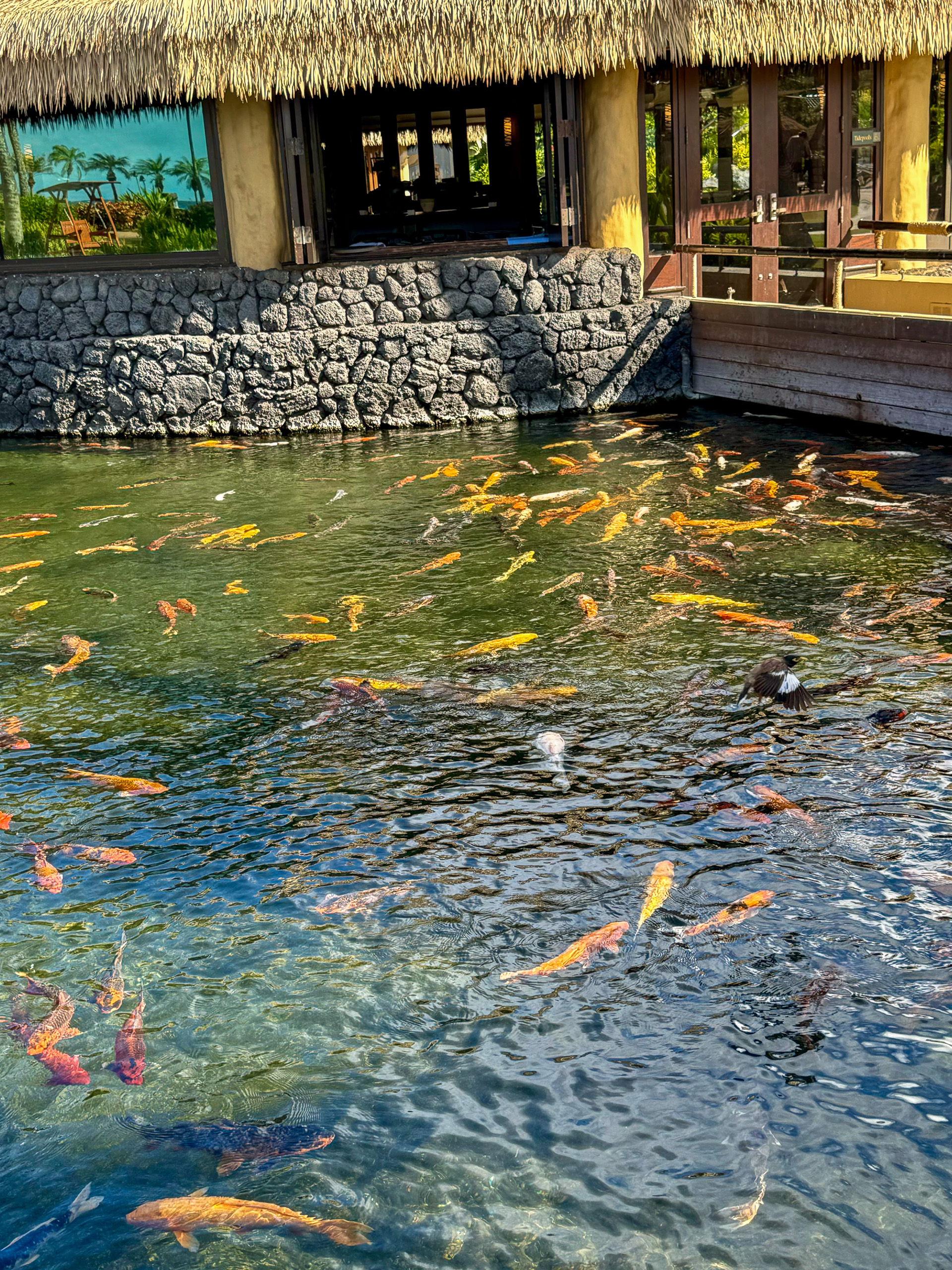
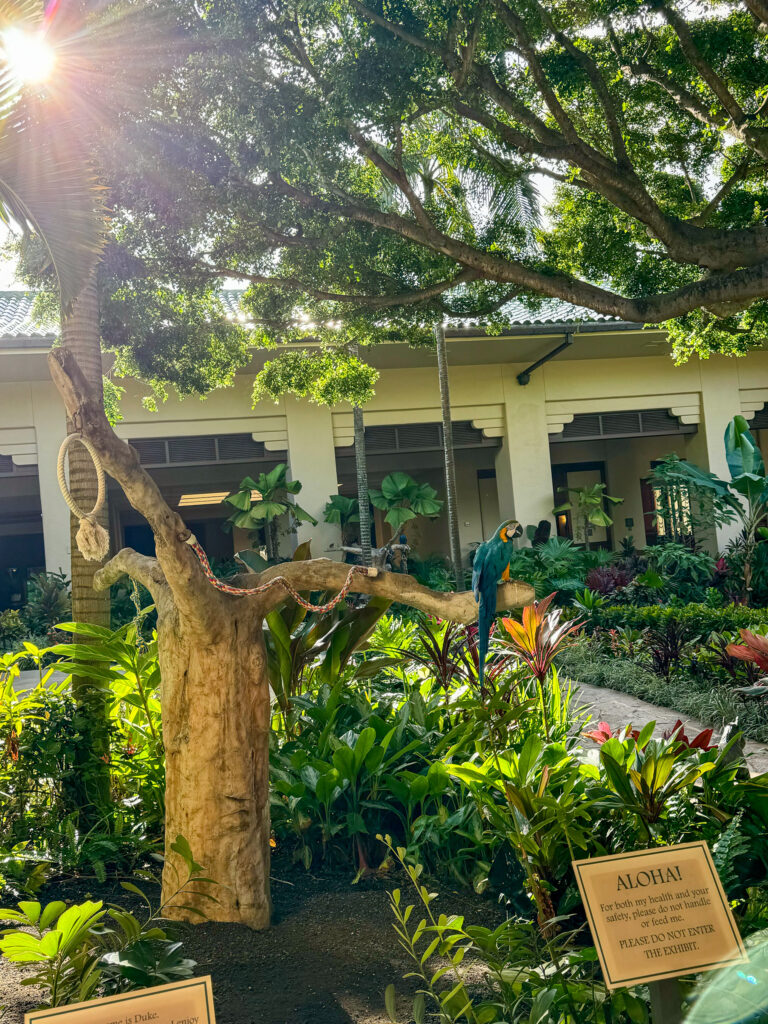
An orchid lei on the lanai table.The macaw in the lobby.Koi under the thatch, on the way to breakfast.
Noted
Observed on the stay, not measured.
What
Checked on the stay
Beach
Keoneloa Bay; heavy shorebreak, often not swimmable
Lagoon
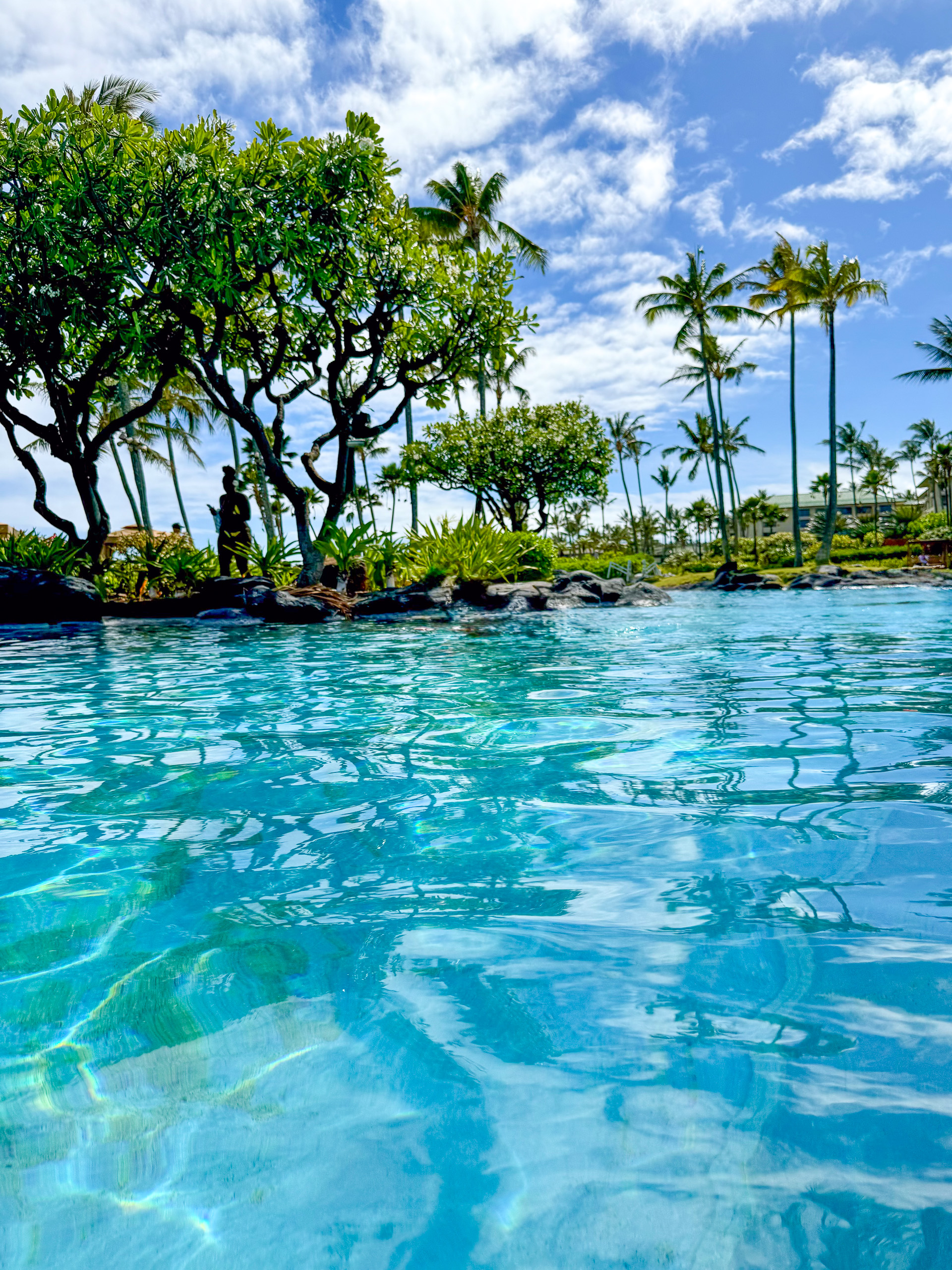
Saltwater, sandy-bottomed, swimmable every day of the stay
Wi-Fi
Strong and constant through the resort
Water pressure
High and hot
Bed
Mediocre, and it felt damp
Air conditioning
Could not pull the humidity out of the room
Longest walk
About ten minutes, room to far restaurant
Rainbows
Most afternoons, late, looking east
Eating
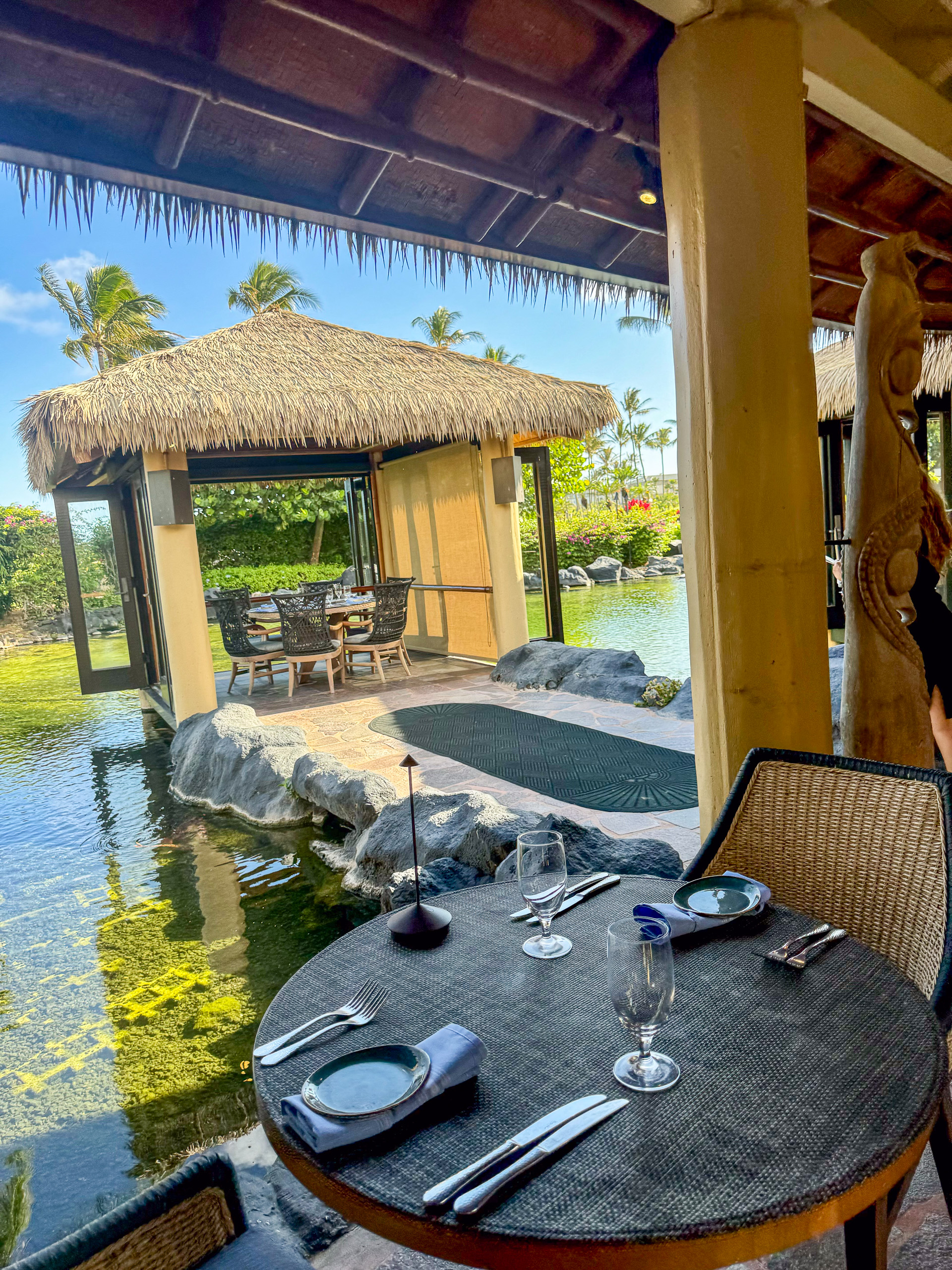
Tidepools is the reason to book a table before you fly. The dining room is a set of thatched hales standing over a koi lagoon, open on every side, lit low, with fish moving under the walkways and frogs starting up at dusk. It is the most atmospheric restaurant on the south shore and it books out days ahead.
Tidepools, under the thatched roof. Book it before you fly, not when you arrive.
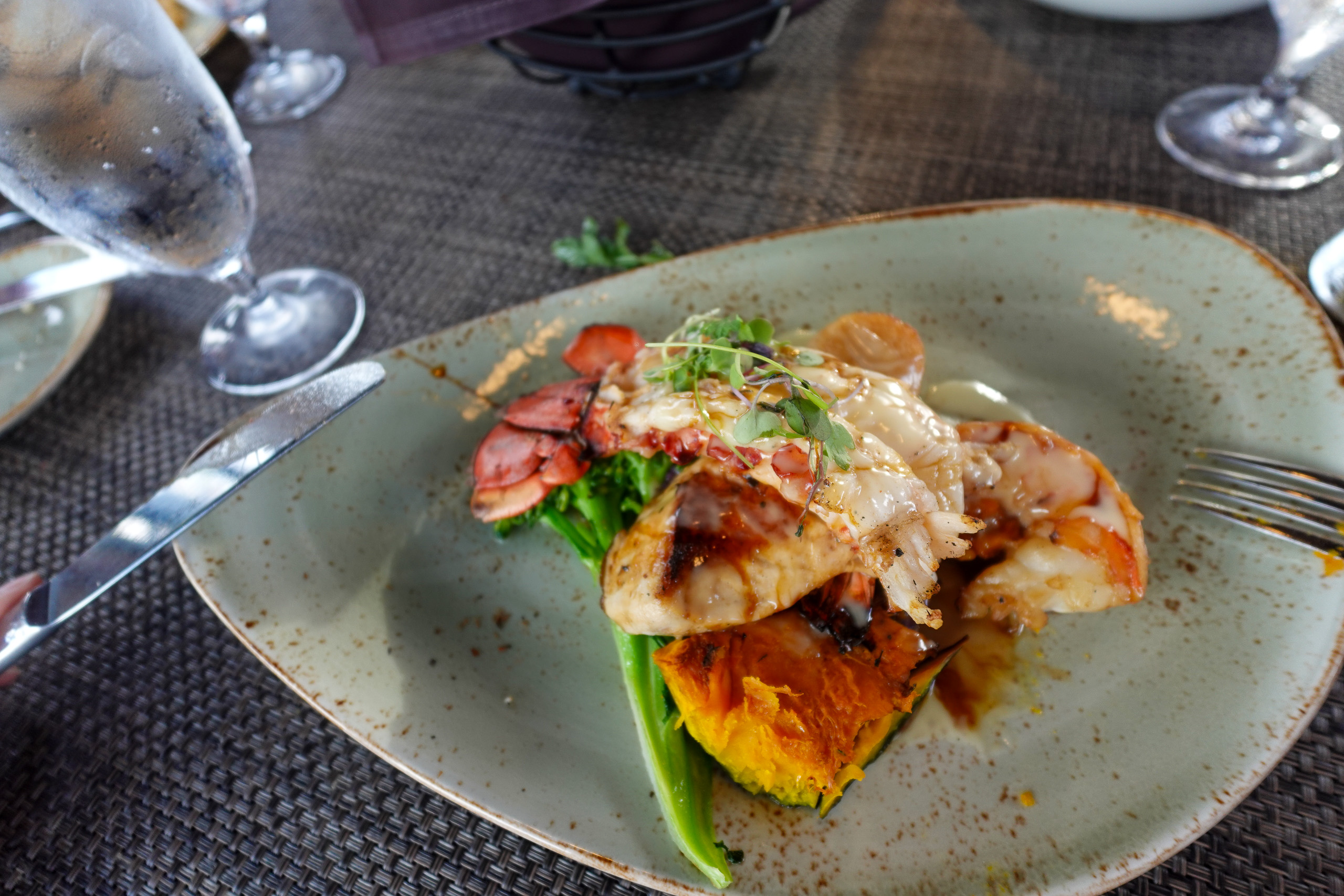
Dondero’s is the Italian room and the more formal one. Beyond those two the resort does what large resorts do: a poolside grill, a lobby bar facing west, coffee at six for the people the time difference woke up. The cooking is better than it needs to be, particularly the fish, which is landed locally and treated simply.
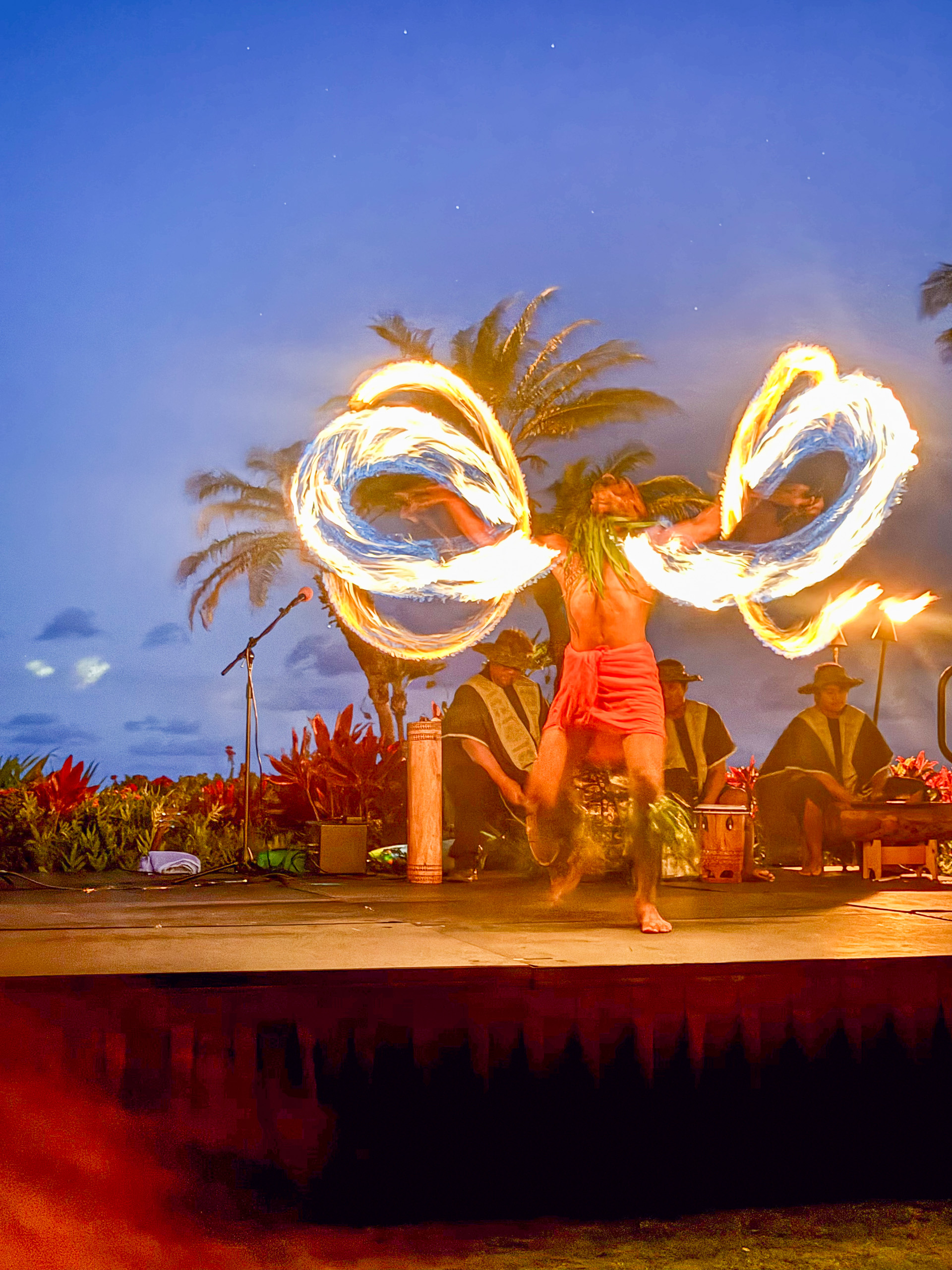
The luau on the lawn is worth going to once with clear eyes about what it is: a professional show for visitors, performed well, with an imu pit, kalua pork, hula and a fire dancer to close. It does not claim to be anything else. If you have children they will talk about the fire for the rest of the trip, and possibly at the wedding.
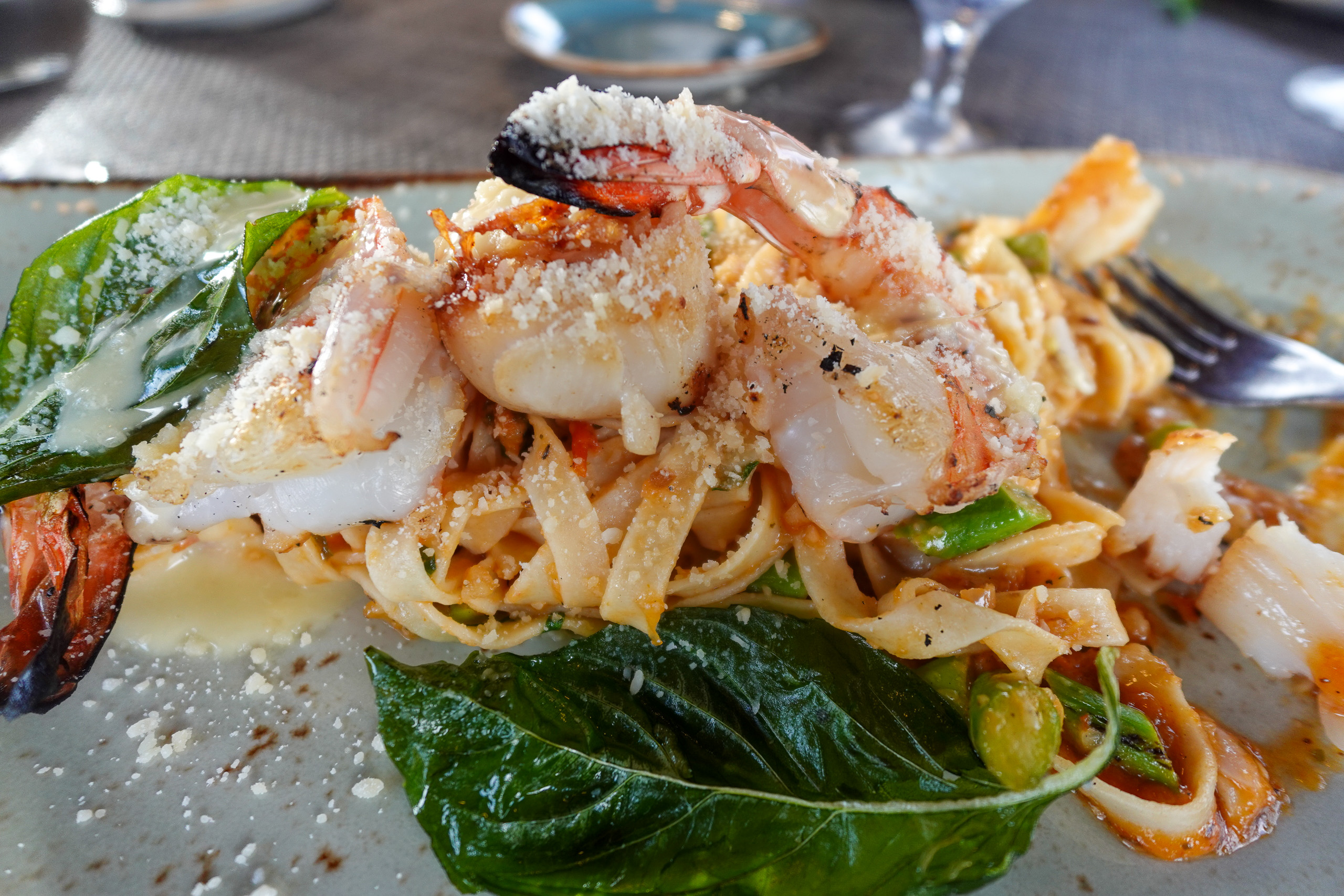
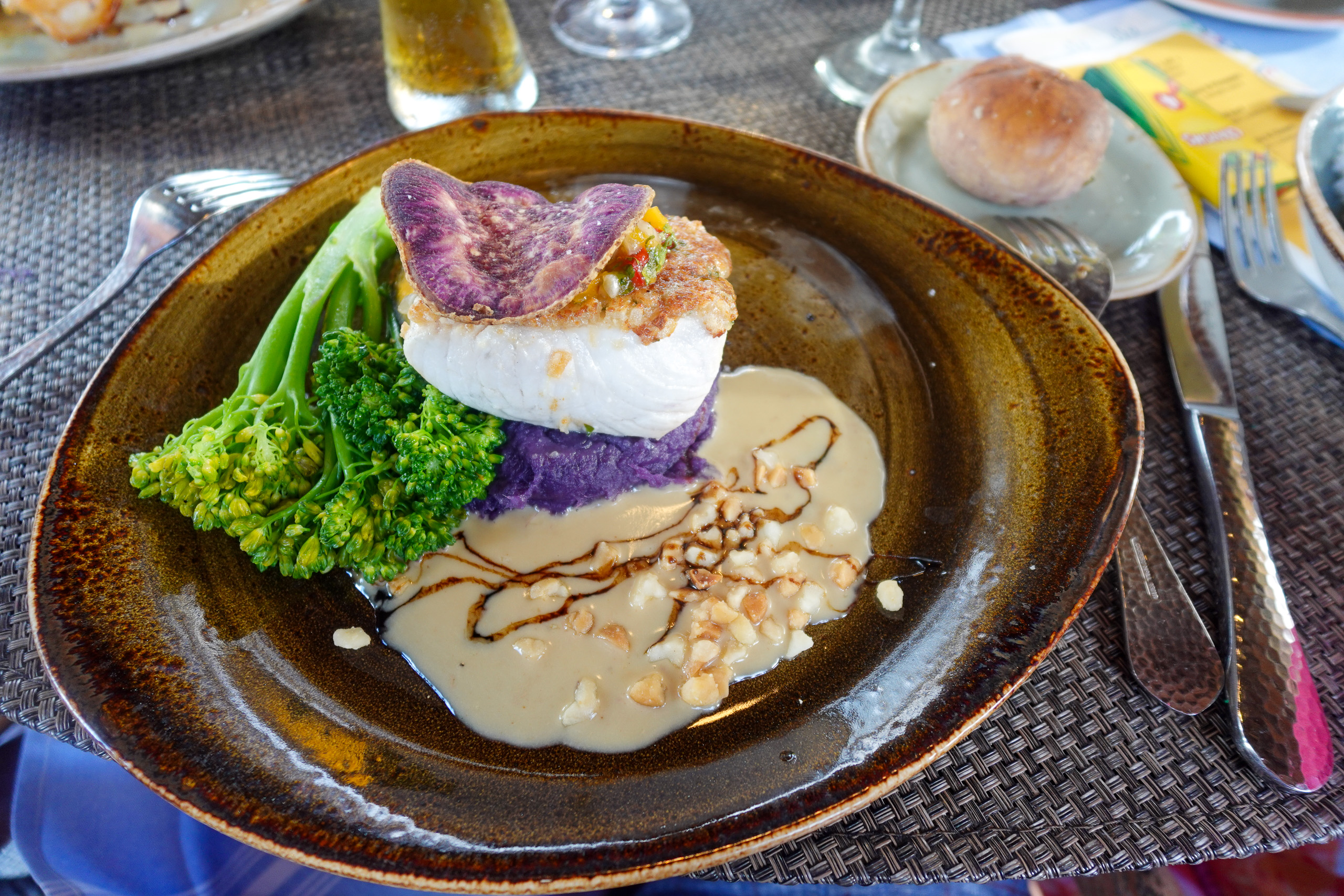
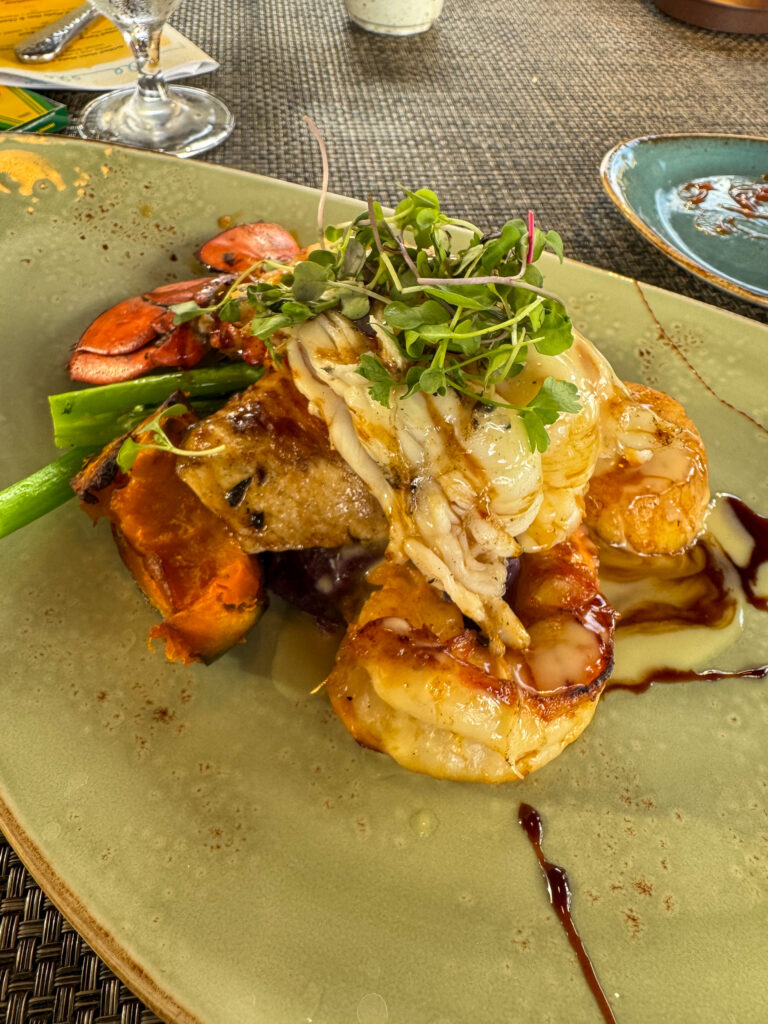
A fillet on grey with a spoon of sauce.Prawns and greens, the shells left on.Something in purple and white on dark stoneware.
The water you will actually use
Here is the thing to understand before booking. The beach in front of the resort is Keoneloa Bay, known locally as Shipwreck, and it has a heavy shorebreak. For much of the year it is not a swimming beach. It is a magnificent beach to walk, to look at, and to watch better surfers than you get it wrong on, and the lifeguards will tell you plainly when to stay out.
The lagoon does the work the beach cannot. Note the surf line beyond it.
So the resort built its own ocean. A meandering saltwater lagoon, a chain of river pools with waterfalls between them, and a slide through lava rock. The lagoon is the cleverest thing here: salt water, sandy-bottomed, calm, large enough to swim properly in, and lined up with the sea beyond so that it never feels like a substitute even though that is exactly what it is. There is an adults-only pool as well, which on a property with this many families is not a nicety but the entire difference between a restful stay and a loud one.
Anara Spa is the other reason people book here rather than elsewhere on the south shore. A number of the treatment rooms are open-air, in garden courtyards with lava-rock showers, so a massage happens with birds and wind and the smell of wet ground rather than under a ceiling with a whale recording. Ask for an outdoor room when you book; the indoor ones are ordinary.
The pool, very blue in the sun, ironwood and palms behind. The slide is out of frame and audible.
The grounds are the underrated part. Koi ponds, swans, gardens that have had decades to mature, and a resident macaw in the open lobby that has worked out exactly how much attention it can extract. Walking the site before the pools open is the best half hour of the day here.
Service moments
Standard for a resort of this class, nothing to write about.
A fire dancer at dusk, on the lawn, at somebody else’s wedding. Everyone watched.
A resort that built its own ocean because the real one was not co-operating, and got away with it.
Who it is for, and who it is not
Come with a family, or as anyone who wants to swim somewhere warm and calm and does not need the room to be the point. Ask for an upper floor on the ocean side and take the lanai seriously as a room you will use. Book Tidepools before you fly. Hire the car for the whole stay rather than the days you think you need it, because nothing on Kauai is close to anything else. And look east in the late afternoon.
Look elsewhere if your idea of Hawaii is walking into flat water from your towel; Poipu Beach Park, a few minutes west, does that and this beach does not. Look elsewhere if you want current rather than comfortable. And know that the scenery that makes Kauai extraordinary is on the north shore and in the west canyon, both long drives on a single road with no alternative, so staying here means days out that start early.
The night sky over the palms. The south shore is dry, and it shows after dark.
Bottom line
The grounds and the lagoon carry the Grand Hyatt, and the building knows to stay out of their way. Book an upper-floor Ocean View with a lanai but make sure it is not on the shaded side, and swim in the lagoon, not the bay. Next time I go back to Hawaii I am returning to the Fairmont Orchid, not here.